
In modern mechanical engineering education, we face the challenge of preparing students for complex real-world problems that require integrated knowledge across multiple disciplines. Traditional teaching methods often present topics in isolation, leaving students struggling to connect concepts from different courses. To address this, we have developed a comprehensive modular experimental teaching approach centered on the design, manufacturing, and testing of a gear shaft. This component is a fundamental element in machinery, combining the characteristics of both gears and shafts, making it an ideal subject for illustrating the interconnected nature of mechanical engineering principles.
The gear shaft serves as a perfect case study because it involves a wide range of engineering considerations, from material selection and structural design to precision manufacturing and quality control. By focusing on this single component, we can guide students through a holistic learning experience that mirrors the entire product development lifecycle. Our approach emphasizes a results-oriented methodology, where students actively engage in each phase, from initial concept to final validation, fostering a deeper understanding of how theoretical knowledge applies in practical scenarios.
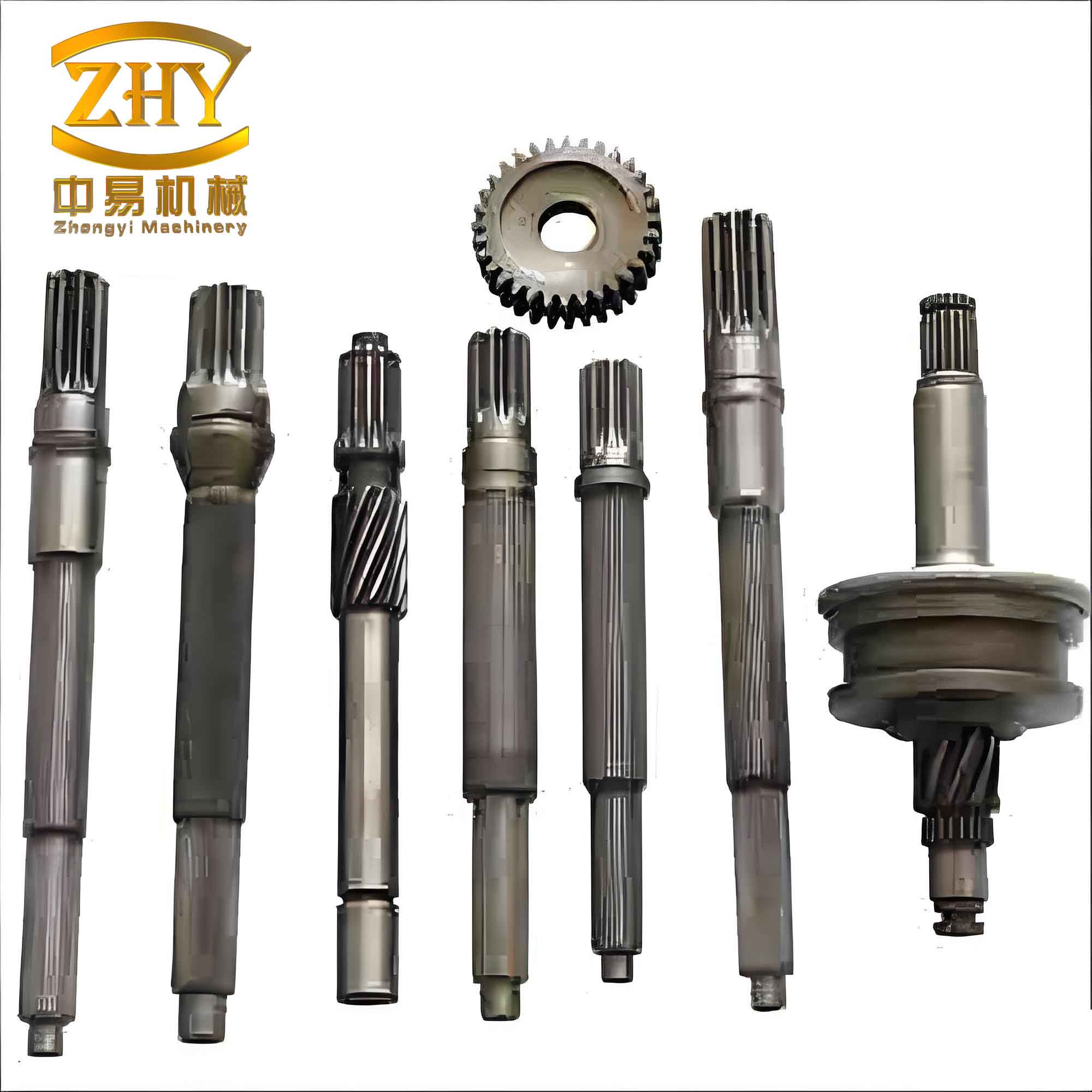
In the design phase of the gear shaft, students must consider various factors, including load conditions, material properties, and geometric constraints. The gear shaft design integrates both the shaft and gear elements, requiring calculations for strength, stiffness, and durability. For instance, the bending stress in the gear shaft can be evaluated using the formula for shaft deflection under load: $$ \delta = \frac{F L^3}{3 E I} $$ where \( \delta \) is the deflection, \( F \) is the applied force, \( L \) is the length, \( E \) is the modulus of elasticity, and \( I \) is the moment of inertia. Similarly, the gear teeth must withstand contact stresses, which can be analyzed using the Hertzian contact theory: $$ \sigma_c = \sqrt{\frac{F E}{\pi b R}} $$ where \( \sigma_c \) is the contact stress, \( b \) is the face width, and \( R \) is the equivalent radius. These formulas help students quantify the performance of the gear shaft and make informed design decisions.
To streamline the design process, we encourage students to use parametric tables that summarize key variables. For example, the selection of materials for the gear shaft involves comparing properties like yield strength and hardness, as shown in Table 1. This table helps students evaluate different materials based on criteria such as cost, availability, and suitability for the intended application, ensuring that the gear shaft meets both functional and economic requirements.
| Material | Yield Strength (MPa) | Hardness (HB) | Cost Index |
|---|---|---|---|
| Alloy Steel | 600 | 250 | High |
| Carbon Steel | 400 | 200 | Medium |
| Stainless Steel | 500 | 220 | High |
In addition to material selection, the gear shaft design includes detailed geometric parameterization. Students learn to define parameters such as the number of teeth, module, pressure angle, and shaft diameters. The gear ratio, for instance, is calculated as: $$ i = \frac{N_2}{N_1} $$ where \( N_1 \) and \( N_2 \) are the numbers of teeth on the driving and driven gears, respectively. This emphasizes the importance of kinematic relationships in the gear shaft assembly. Furthermore, tolerance design is critical; students apply principles of geometric dimensioning and tolerancing (GD&T) to specify limits on dimensions, such as the shaft diameter tolerance based on the hole-basis system: $$ \text{Tolerance} = \text{Upper Limit} – \text{Lower Limit} $$ This ensures that the gear shaft will fit and function correctly with other components in the system.
The manufacturing phase of the gear shaft involves transforming the design into a physical component through processes like CNC machining. Students begin by creating a 3D model of the gear shaft using software tools such as SolidWorks or CATIA, which allows them to visualize the geometry and generate 2D drawings with annotated dimensions and tolerances. The manufacturing process requires selecting appropriate cutting tools and determining optimal cutting parameters. For example, the cutting speed \( V_c \) in milling operations can be calculated as: $$ V_c = \pi D N $$ where \( D \) is the tool diameter and \( N \) is the spindle speed in RPM. This formula helps students optimize the machining process for the gear shaft to achieve desired surface finish and dimensional accuracy.
Table 2 outlines a typical machining sequence for the gear shaft, highlighting the operations, tools, and parameters involved. This table serves as a guide for students to plan the manufacturing steps systematically, ensuring that each feature of the gear shaft is produced efficiently and accurately.
| Operation | Tool Type | Cutting Speed (m/min) | Feed Rate (mm/rev) |
|---|---|---|---|
| Rough Turning | Carbide Insert | 150 | 0.2 |
| Gear Hobbing | Hob Cutter | 100 | 0.1 |
| Finish Grinding | Grinding Wheel | 30 | 0.05 |
CNC programming is another key aspect of gear shaft manufacturing. Students learn to write G-code or use CAM software to generate tool paths. For instance, a simple linear interpolation command for machining a shaft section might be: $$ G01 X… Y… Z… F… $$ where F specifies the feed rate. By practicing these programming skills, students gain hands-on experience in controlling machine tools to fabricate the gear shaft with high precision. The integration of CAD/CAM systems enables a seamless transition from design to production, reinforcing the connection between digital models and physical artifacts.
Quality control and testing form the final phase of the gear shaft experimental module. Students use various metrology instruments to verify that the manufactured gear shaft conforms to the design specifications. Measurements include dimensional checks, geometric tolerances, and surface roughness assessments. For example, the surface roughness \( R_a \) can be measured using a profilometer and compared to the design value: $$ R_a = \frac{1}{L} \int_0^L |y(x)| dx $$ where \( y(x) \) is the profile height over the assessment length \( L \). This quantitative analysis helps students evaluate the manufacturing quality of the gear shaft.
Table 3 summarizes common measurement techniques and instruments used for gear shaft inspection. This table aids students in selecting the appropriate tools for each type of measurement, ensuring comprehensive validation of the gear shaft’s critical features.
| Parameter | Instrument | Measurement Range | Accuracy |
|---|---|---|---|
| Diameter | Micrometer | 0-25 mm | ±0.001 mm |
| Tooth Profile | Gear Tester | Module 1-10 | ±0.005 mm |
| Surface Roughness | Profilometer | 0.1-100 μm | ±0.01 μm |
In the experimental setup, we implement an open-ended, modular approach where students work in teams to complete the entire gear shaft lifecycle. Each module—design, manufacturing, and testing—has defined objectives and deliverables. For instance, in the design module, students must submit a complete set of drawings and calculations for the gear shaft. In manufacturing, they produce the actual component using CNC machines, and in testing, they conduct measurements and analyze data to verify compliance. This structure encourages active learning and collaboration, as students must integrate their knowledge to solve problems encountered at each stage.
The gear shaft project effectively bridges multiple core courses in mechanical engineering, such as machine design, manufacturing processes, and metrology. For example, concepts from strength of materials are applied in the shaft design, while gear theory informs the tooth geometry. Manufacturing courses contribute to process planning, and measurement principles from metrology ensure quality assurance. By working on the gear shaft, students see how these disciplines interrelate, reinforcing a systems-thinking approach. This integration is crucial for developing the ability to tackle complex engineering challenges, where solutions often require cross-disciplinary insights.
Throughout the gear shaft experimental teaching, we emphasize the importance of iterative improvement. Students are encouraged to refine their designs based on testing results, fostering a mindset of continuous learning and adaptation. For instance, if the measured gear shaft dimensions deviate from the tolerances, students must analyze the causes—such as tool wear or machine calibration—and propose corrective actions. This iterative process mirrors real-world engineering practices, where feedback loops drive product enhancement.
In conclusion, the modular experimental teaching approach centered on the gear shaft has proven effective in enhancing students’ understanding of mechanical engineering principles. By engaging in the full spectrum of activities—from conceptual design and detailed calculation to hands-on manufacturing and precise measurement—students develop a comprehensive skill set that prepares them for professional practice. The gear shaft serves as a unifying element that demonstrates the interconnectedness of knowledge, helping students transition from isolated learning to integrated problem-solving. Future work will focus on expanding this methodology to include advanced topics like dynamic analysis and additive manufacturing, further enriching the educational experience for the next generation of engineers.