
In my extensive career focusing on rotating machinery and power transmission systems, I have repeatedly observed that gear shafts stand as pivotal elements in ensuring operational integrity. These components, particularly in applications like ball mills, are subjected to severe dynamic loads, misalignments, and environmental challenges. The failure of a gear shaft can lead to catastrophic downtime, significant economic losses, and safety hazards. Through firsthand investigation and remediation of numerous field failures, I have compiled a detailed account of the most prevalent failure modes, their root causes, and effective mitigation strategies. This article delves deeply into the mechanical behavior, design nuances, and maintenance protocols essential for prolonging the service life of gear shafts.
The performance and reliability of gear shafts are intrinsically linked to their design, manufacturing quality, and installation precision. My analysis begins with a common yet severe failure: shaft fracture, typically occurring at the shaft ends. This phenomenon is not merely a result of material deficiency; it often stems from a combination of geometric stress concentrators, improper assembly practices, and operational dynamics. For instance, the transition radius at bearing shoulders is a critical detail. When this radius is machined smaller than specified, it creates a localized stress concentration that drastically reduces fatigue strength. The stress concentration factor, \( K_t \), for a shaft with a circumferential groove or fillet can be approximated using empirical formulas. One such relation for a stepped shaft under bending is:
$$ K_t = 1 + \frac{2}{\sqrt{\frac{r}{d}}} \cdot \left( \frac{D}{d} – 1 \right) $$
where \( r \) is the fillet radius, \( d \) is the smaller diameter, and \( D \) is the larger diameter. A reduction in \( r \) exponentially increases \( K_t \), making the shaft susceptible to crack initiation under impact loads. In many cases I’ve examined, the specified radius was neglected during machining, leading to premature fractures. The following table summarizes key geometric factors influencing stress concentration in gear shafts:
| Geometric Feature | Typical Specification | Effect of Deviation | Recommended Action |
|---|---|---|---|
| Bearing Shoulder Fillet Radius | Match bearing inner ring radius (e.g., 1.5 mm to 3 mm) | Smaller radius increases stress concentration factor by up to 300% | Strict adherence to drawing; use profile gauges for inspection |
| Shaft Diameter Transitions | Gradual taper with ratio < 1:3 | Abrupt changes cause localized plastic deformation | Implement generous chamfers or undercuts |
| Keyway Corners | Radiused corners per ISO 773 | Sharp corners initiate fatigue cracks | Machine keyways with end radii; consider stress-relief features |
Assembly-induced failures are equally critical. The inner end covers, which seal the bearing housing, are often misaligned during installation. If the clearance between the cover and the gear shaft is not uniform circumferentially, intermittent rubbing occurs. This friction generates localized heat, which can anneal the shaft material, forming hardened protrusions or “welding beads” upon cooling. Repeated cycles lead to groove formation, effectively notching the shaft and reducing its cross-sectional area. The thermal stress generated can be modeled using Fourier’s heat equation simplified for a rotating cylinder:
$$ \frac{\partial T}{\partial t} = \alpha \left( \frac{\partial^2 T}{\partial r^2} + \frac{1}{r} \frac{\partial T}{\partial r} \right) + \frac{q}{\rho c_p} $$
where \( T \) is temperature, \( t \) is time, \( \alpha \) is thermal diffusivity, \( r \) is radial coordinate, \( q \) is heat generation rate per volume from friction, \( \rho \) is density, and \( c_p \) is specific heat. This localized heating can cause tempering or rehardening, altering material properties. Moreover, improper horizontal alignment between the gear shaft, the reducer output shaft, and the ball mill筒体 introduces bending moments that amplify stress. The misalignment angle \( \theta \) induces an additional bending stress \( \sigma_b \) given by:
$$ \sigma_b = \frac{32 M}{\pi d^3}, \quad M = F \cdot L \cdot \sin(\theta) $$
where \( M \) is bending moment, \( F \) is transmitted force, \( L \) is distance from bearing, and \( d \) is shaft diameter. Even minor misalignments of 0.1 degrees can elevate stress by over 15%, accelerating fatigue.
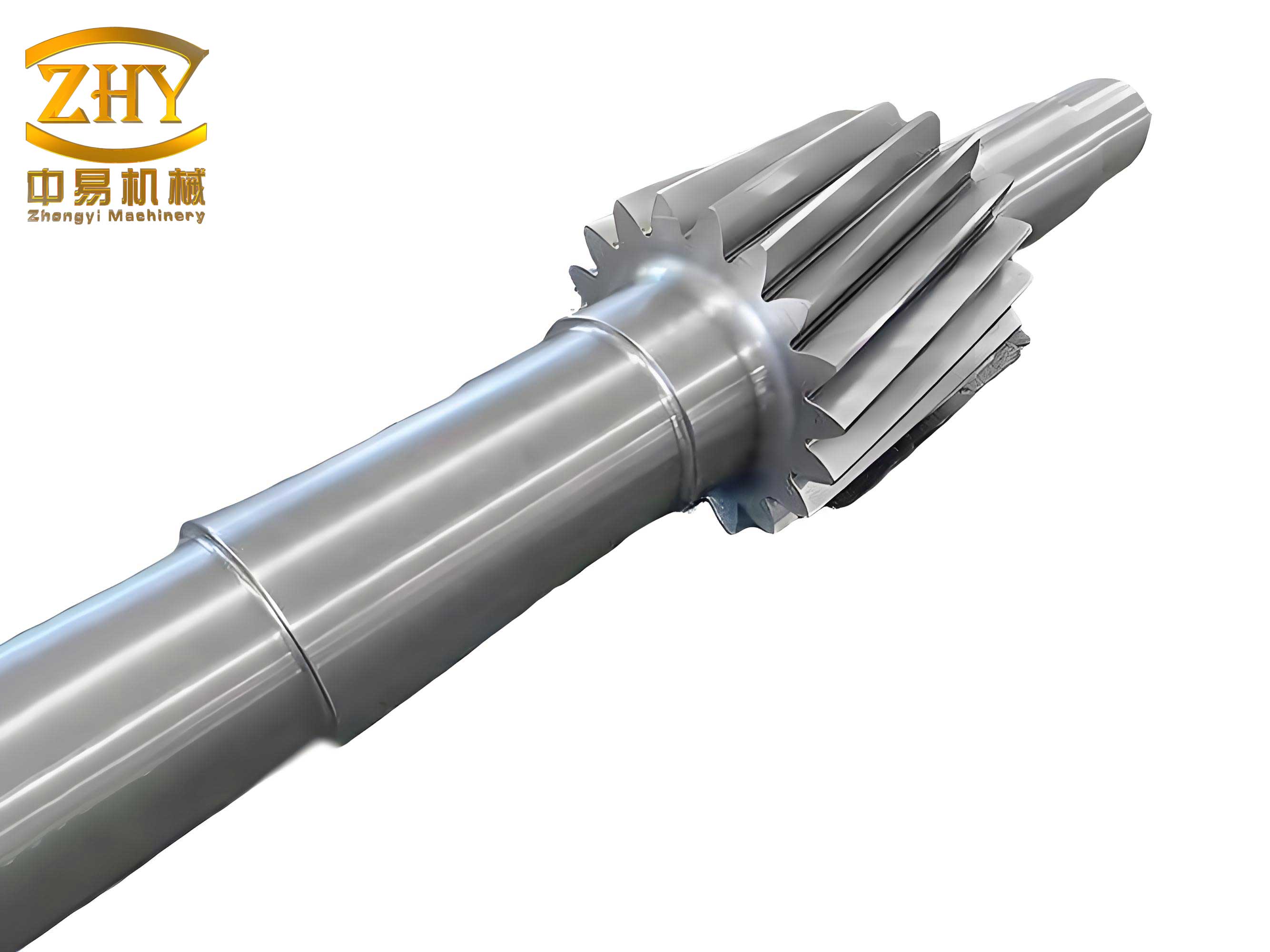
Another pervasive issue is bearing inner race rotation relative to the gear shaft, commonly termed “bearing creep” or “walking.” This occurs when the interference fit between the bearing bore and the shaft is insufficient to resist torsional and impact loads. The required interference, \( \delta \), depends on the transmitted torque and material properties. The contact pressure \( p \) at the interface can be derived from thick-walled cylinder theory:
$$ p = \frac{\delta}{d} \cdot \frac{E}{2 \left(1 – \nu^2\right)} \cdot \frac{1}{\left( \frac{1}{Q_o} + \frac{1}{Q_i} \right)} $$
with \( Q_o = \frac{d_o^2 + d^2}{d_o^2 – d^2} – \nu \) and \( Q_i = \frac{d^2 + d_i^2}{d^2 – d_i^2} + \nu \), where \( E \) is Young’s modulus, \( \nu \) is Poisson’s ratio, \( d \) is nominal shaft diameter, \( d_o \) is bearing outer diameter, and \( d_i \) is inner race bore diameter. For typical gear shafts, an interference fit of 0.002\( d \) to 0.003\( d \) is advisable. Inadequate interference leads to fretting wear, generating debris that contaminates lubricant and further degrades bearing performance. The wear volume \( V \) due to fretting can be estimated using Archard’s wear law:
$$ V = K \frac{F_n s}{H} $$
where \( K \) is wear coefficient, \( F_n \) is normal load, \( s \) is slip distance, and \( H \) is material hardness. This wear debris, if not removed through regular maintenance, causes abrasive damage to both gear shafts and bearing rollers.
When bearing inner race rotation damages the shaft surface, repair becomes necessary. Electroplating is a common method, but in my practice, I have found that for gear shafts subjected to high-impact loads, the plated layer often delaminates due to poor adhesion and cyclic stresses. Therefore, I prefer using a welded repair technique. The process involves preparing the worn area by grinding to a smooth contour, then applying low-carbon steel electrodes (such as E7018) with intermittent, circumferential welding passes to minimize heat input and distortion. The heat input per unit length \( Q \) must be controlled:
$$ Q = \frac{60 \cdot V \cdot I}{S} $$
where \( V \) is voltage, \( I \) is current, and \( S \) is travel speed in mm/min. Keeping \( Q \) below 1.5 kJ/mm prevents excessive grain growth and maintains the base metal’s mechanical properties. After welding, the gear shaft must be cooled slowly to ambient temperature before machining to the nominal diameter plus a grinding allowance of 0.5 mm to 1 mm. The table below contrasts repair methods for worn gear shafts:
| Repair Method | Process Overview | Advantages | Limitations | Suitability for Gear Shafts |
|---|---|---|---|---|
| Electroplating (Hard Chrome) | Electrochemical deposition of chromium layer (0.05–0.5 mm thick) | Precise thickness control; minimal heat affect zone | Poor fatigue strength; risk of hydrogen embrittlement; layer may spall under impact | Low to moderate dynamic loads only |
| Arc Welding (GTAW/SMAW) | Fusion welding with filler metal; post-weld heat treatment optional | Strong metallurgical bond; can restore large material loss; good impact resistance | High heat input may cause distortion; requires skilled operator; machining needed | High-impact, heavy-duty gear shafts |
| Thermal Spray (HVOF) | High-velocity oxy-fuel coating of carbides or alloys | Excellent wear resistance; low substrate temperature | Bond strength lower than welding; not ideal for high shear stresses | Auxiliary components; non-critical diameters |
Preventive maintenance is paramount. Regular inspection and cleaning of bearings are essential to remove abrasive particles. The lubricant viscosity \( \mu \) must be selected based on operating temperature \( T \) and pressure \( p \) using the Barus equation:
$$ \mu = \mu_0 e^{\alpha p – \beta (T – T_0)} $$
where \( \mu_0 \) is reference viscosity, \( \alpha \) is pressure-viscosity coefficient, \( \beta \) is temperature-viscosity coefficient, and \( T_0 \) is reference temperature. Contaminated or degraded lubricant leads to boundary lubrication, increasing friction and wear. Furthermore, proper bearing installation and removal techniques are crucial. Using force-fit methods like hydraulic pressure or induction heating ensures uniform expansion of the bearing inner race. The temperature rise \( \Delta T \) needed for clearance fit assembly is:
$$ \Delta T = \frac{\delta + c}{\alpha \cdot d} $$
where \( c \) is desired clearance, and \( \alpha \) is coefficient of thermal expansion. Typically, heating bearings to 80–100°C provides sufficient expansion for mounting on gear shafts without hammering, which can cause brinelling or micro-cracks.
From a design perspective, optimizing gear shafts involves material selection, surface treatments, and dynamic analysis. High-strength alloy steels such as AISI 4340 or DIN 34CrNiMo6 are common, with ultimate tensile strengths exceeding 1000 MPa. Fatigue life prediction using the modified Goodman diagram is essential:
$$ \frac{\sigma_a}{S_e} + \frac{\sigma_m}{S_u} = 1 $$
where \( \sigma_a \) is alternating stress amplitude, \( \sigma_m \) is mean stress, \( S_e \) is endurance limit modified for size, surface finish, and reliability, and \( S_u \) is ultimate tensile strength. Surface enhancements like shot peening induce compressive residual stresses \( \sigma_{res} \), improving fatigue resistance. The effective alternating stress becomes \( \sigma_{a,eff} = \sigma_a – \sigma_{res} \). For gear shafts operating in corrosive environments, material degradation accelerates fatigue crack growth, described by Paris’ law:
$$ \frac{da}{dN} = C (\Delta K)^m $$
where \( a \) is crack length, \( N \) is number of cycles, \( \Delta K \) is stress intensity factor range, and \( C \), \( m \) are material constants. Regular non-destructive testing (e.g., magnetic particle inspection) can detect incipient cracks before catastrophic failure.
In summary, the durability of gear shafts hinges on a holistic approach encompassing precise manufacturing, meticulous assembly, proactive maintenance, and robust design. Through my experience, I have established that most failures are preventable with adherence to specifications and continuous monitoring. The integration of predictive maintenance technologies, such as vibration analysis and thermography, further enhances reliability. For instance, vibration spectra can reveal misalignment or bearing defects early. The root mean square (RMS) velocity \( v_{rms} \) in mm/s is a common indicator:
$$ v_{rms} = \sqrt{\frac{1}{T} \int_0^T v(t)^2 dt} $$
where \( v(t) \) is instantaneous vibration velocity. An increase in \( v_{rms} \) beyond baseline levels signals developing faults in gear shafts or associated components.
To encapsulate the critical parameters for gear shaft integrity, the following comprehensive table provides a reference for engineers and maintenance personnel:
| Aspect | Key Variables | Optimal Range or Formula | Impact on Gear Shaft Life |
|---|---|---|---|
| Material Properties | Yield strength \( S_y \), Toughness \( K_{IC} \), Hardness HRC | \( S_y > 700 \) MPa, \( K_{IC} > 60 \) MPa√m, HRC 30–40 | Higher toughness resists impact; adequate hardness prevents wear |
| Geometric Design | Fillet radius \( r \), Diameter ratio \( D/d \), Surface finish \( R_a \) | \( r \geq 0.05d \), \( D/d \leq 1.2 \), \( R_a \leq 1.6 \) µm | Reduces stress concentration; improves fatigue limit by up to 25% |
| Fits and Tolerances | Interference \( \delta \), Clearance \( c \), Runout tolerance | \( \delta = (0.002 \text{ to } 0.003)d \), \( c \leq 0.001d \), runout < 0.05 mm | Prevents fretting and creep; ensures even load distribution |
| Lubrication | Viscosity \( \mu \), Additive package, Contamination level | ISO VG 68 to 150, anti-wear additives, particle count < ISO 17/14/12 | Minimizes friction and wear; dissipates heat; prevents corrosion |
| Operational Loads | Bending moment \( M \), Torque \( T \), Impact factor \( K_i \) | \( \sigma_{von Mises} = \sqrt{ \left( \frac{32M}{\pi d^3} \right)^2 + 3 \left( \frac{16T}{\pi d^3} \right)^2 } \leq 0.6 S_y \) | Dynamic overloads accelerate fatigue; proper sizing is critical |
In conclusion, gear shafts are indispensable yet vulnerable components whose failure modes are multifaceted. Through systematic analysis and application of engineering principles, their operational life can be substantially extended. My firsthand experiences underscore the importance of integrating theoretical knowledge with practical insights—from stress analysis formulas to on-site repair techniques—to ensure that these critical elements perform reliably under demanding conditions. Continuous improvement in materials, manufacturing technologies, and condition monitoring will further advance the resilience of gear shafts in industrial applications.