
In my extensive experience within the heavy-duty transmission manufacturing industry, the pursuit of optimal balance between cost-efficiency and precision has always been paramount. One of the most significant technological shifts I have been involved with is the strategic adoption and refinement of gear shaving processes. Traditionally, our passenger vehicle transmissions utilized gear grinding, while truck transmissions relied on gear shaving. However, market pressures and internal strategic goals for cost reduction and efficiency gains (“passenger and cargo parallel, cost reduction and efficiency increase”) necessitated a deep dive into the capabilities of the gear shaving process. This article, drawn from firsthand application and analysis, details the complete technical ecosystem of gear shaving, from process design to parameter optimization and tool management, aiming to demonstrate its viability as a high-precision, high-productivity finishing method.
The core of our initiative was to apply gear shaving to components like the secondary shaft first gear, where operational noise is less critically determined by tooth flank precision compared to constant-mesh gears. The process flow we implemented is as follows:
| Process Step | Description |
|---|---|
| Forging | Creation of the gear blank. |
| Isothermal Normalizing | Heat treatment for uniform microstructure and machinability. |
| Rough & Finish Turning | Machining of the gear’s bore and faces. |
| Gear Shaping | Initial generation of the tooth profile. |
| Gear Hobbing | Pre-finishing of the tooth flanks to a specific pre-shave geometry. |
| Gear Shaving | The critical finishing operation to achieve final dimensional and geometrical accuracy. |
| Carburizing & Quenching / Tempering / Stress Peening | Final heat treatment for surface hardness and core toughness. |
| Bore & Face Grinding | Post-heat treatment finishing of locating surfaces. |
| Noise Testing | Functional validation in a meshing test. |
| Cleaning & Final Inspection | Preparation for assembly. |
This sequence hinges on the performance of the gear shaving operation. Gear shaving is a free-cutting, gear-finishing process renowned for its high productivity, excellent surface quality, long tool life, and relatively simple machine setup. Its widespread use in the automotive sector is a testament to its effectiveness.
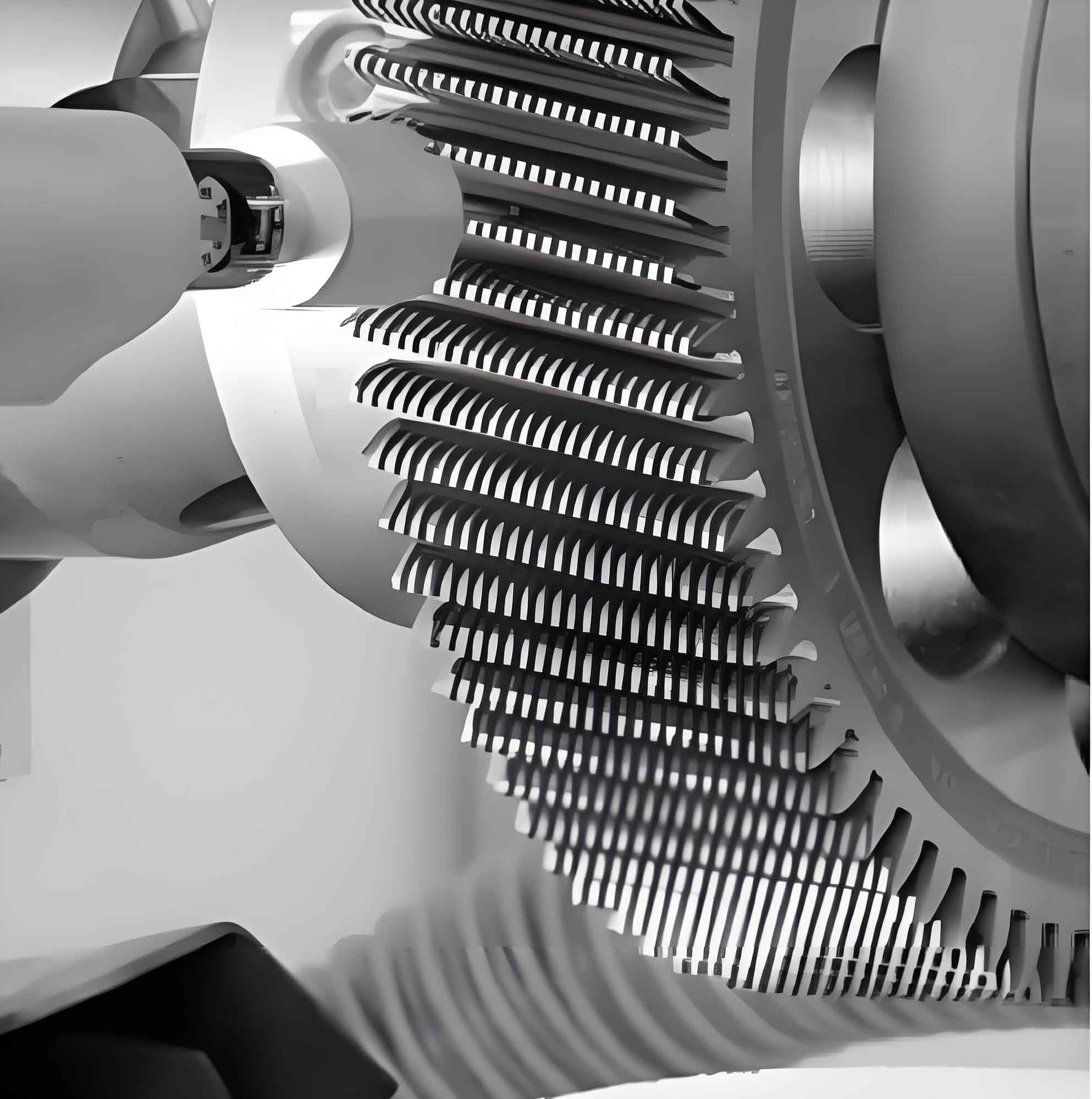
The fundamental mechanism of gear shaving involves a crossed-axes engagement between a cutter (the shaving cutter) and the workpiece gear. This crossing generates a sliding motion along the tooth flank, which is the primary cutting action. The cutter’s teeth are serrated, creating numerous small cutting edges that remove minute amounts of material, typically in the range of 0.02 to 0.1 mm. The kinematics of this process are crucial. The sliding velocity at the pitch point, often referred to as the cutting speed (V_c), is a key parameter. For a shaving cutter with a helix angle $\beta_c$ and a workpiece gear with a helix angle $\beta_g$, operating with a shaft crossing angle $\Sigma$, the relationship at the pitch point can be described. The transverse module must be considered for calculation consistency.
In practice, the cutting speed is derived from the cutter’s rotational speed (n_c) and its pitch diameter (d_c). A common formula is:
$$ V_c = \frac{\pi \cdot d_c \cdot n_c}{1000} \quad \text{(in m/min)} $$
However, due to the crossed-axes geometry, the effective sliding speed varies across the tooth profile, which influences cut distribution and final tooth form.
There are several primary methods of gear shaving, classified by the direction of feed relative to the workpiece axis:
| Shaving Method | Feed Direction | Characteristics |
|---|---|---|
| Axial (Traverse) Shaving | Parallel to the workpiece axis. | Most common, excellent for correcting lead errors, suitable for gears with face widths less than cutter width. |
| Diagonal Shaving | At an angle to the workpiece axis. | Reduces cycle time, allows use of a narrower cutter on wider gears, but correction capability is a mix of axial and tangential. |
| Tangential (Plunge) Shaving | Radial infeed only, no axial traverse. | Very fast, but limited ability to correct lead errors. Best for pre-shaped gears with good lead accuracy. |
| Radial (Underpass) Shaving | A specialized form of plunge shaving. | Used for gears with shoulder restrictions. |
For the secondary shaft first gear application, we employed the axial gear shaving method due to its superior lead correction capability and process stability. The success of any gear shaving operation is built on four pillars: the machine, the cutter, the fixture, and the parameters.
Machine and Tooling Setup: Our process utilized a ZSA320 gear shaving machine. Critical machine prerequisites include exceptional spindle and tailstock alignment. The cutter runout must be minimized: axial and radial runout ≤ 0.01 mm. The workpiece is mounted on a precision mandrel using a floating fixture to compensate for minor misalignment and reduce clamping-induced errors. The mandrel-to-bore fit is a slip fit with minimal clearance. Machine condition standards we enforce are:
$$ \text{Tailstock radial runout} \leq 0.005 \text{ mm} $$
$$ \text{Alignment of centers over 150mm} \leq 0.01 \text{ mm} $$
$$ \text{Spindle face and radial runout} \leq 0.005 \text{ mm} $$
$$ \text{Parallelism of spacing collars} \leq 0.005 \text{ mm} $$
The shaving cutter itself is a disc-type cutter made from W6Mo5Cr4V2 high-speed steel, precision ground to A-grade quality. Key parameters for our application were: diameter 244 mm, width 25 mm, number of teeth 46, helix angle 2.5°, and a shaft crossing angle ($\Sigma$) of 10° with the workpiece (helix angle 7.5°).
Shaving Parameter Control: The art of gear shaving lies in the meticulous selection of cutting parameters. These parameters directly influence gear accuracy, surface finish, tool life, and process economics. The target technical parameters for the shaved gear, considering pre-heat treatment correction, are summarized below:
| Parameter | Target Value (Pre-heat treat) |
|---|---|
| Number of Teeth | 50 |
| Normal Module (m_n) | 4.75 mm |
| Normal Pressure Angle ($\alpha_n$) | 24° |
| Helix Angle ($\beta$) | 7.5° |
| Span Measurement (W_k) | 110.74 – 110.71 mm |
| Radial Composite Deviation (F”_i) | ≤ 0.04 mm |
| Tooth-to-Tooth Radial Composite Deviation (f”_i) | ≤ 0.015 mm |
| Profile Form Deviation (f_f) | ≤ 0.02 mm (subject to thermal correction) |
| Lead Direction Deviation (F_\beta$) | ≤ 0.015 mm (subject to thermal correction) |
1. Cutting Speed (V_c): As mentioned, for HSS cutters on alloy steel workpieces, a cutting speed of 105 m/min is typical. The corresponding workpiece rotational speed (n_w) is calculated based on the kinematics of the crossed axes. A simplified relationship for the workpiece speed is:
$$ n_w = \frac{V_c \cdot 1000}{\pi \cdot d_w \cdot \cos \beta_w} \cdot \text{(Factor based on $\Sigma$)} $$
In our case, for the given geometry, we determined n_w to be 141 rpm.
2. Feed Rates: We control two feed components: axial feed per workpiece revolution (f in mm/rev) and the resulting table feed rate (v_f in mm/min). The relationship is:
$$ v_f = f \cdot n_w $$
For the secondary shaft gear, f was selected between 0.1 and 0.2 mm/rev. Through empirical testing, we established optimal table feeds:
$$ v_{f,\text{rough}} = 35 \text{ mm/min}, \quad v_{f,\text{finish}} = 20 \text{ mm/min} $$
The radial infeed per stroke (d_r) is critical for error correction and stock removal. The total shaving allowance was 0.10 mm. This was allocated over four cutting strokes:
$$ d_{r,1} = 0.02 \text{ mm}, \quad d_{r,2} = 0.03 \text{ mm}, \quad d_{r,3} = 0.03 \text{ mm}, \quad d_{r,4} = 0.02 \text{ mm} $$
3. Stroke Count: The number of strokes includes cutting strokes and non-infeed finishing strokes. We used four cutting strokes (as per the radial infeed schedule) followed by two finishing strokes (with no radial infeed) to improve surface finish. The total number of strokes (6) is an even number to ensure symmetrical cutting action.
4. Shaft Crossing Angle ($\Sigma$) and Cutting Fluid: The shaft crossing angle, set at 10° for this job, influences the cutting action, surface finish, and tool life. A smaller $\Sigma$ reduces sliding velocity but increases contact length. A water-soluble cutting fluid with excellent lubricity and cooling properties is essential and must be filtered to prevent recirculation of swarf.
Ensuring Shaving Accuracy: Gear shaving is a correcting process, but its corrective power is selective. It excels at improving tooth-to-tooth accuracy (pitch) and lead but has an inherent tendency to create a profile dip (mid-section concavity). Therefore, control must start with the pre-shave gear.
1. Pre-Shave Gear Requirements:
- Material homogeneity in hardness and structure is non-negotiable.
- The gear must be accurate in terms of cumulative pitch error (F_p) and runout (F_r) before shaving; these are not significantly improved by gear shaving.
- Pre-shave tooth geometry must include protuberance or root relief to prevent shaving cutter tip interference.
- Surface integrity from hobbing/shaping must be free of severe work hardening or tearing.
- Pre-shave accuracy should be: 1st tolerance group (F_p, F_r) equal to final requirement; other parameters can be one grade lower.
- Pre-correction for thermal distortion may be applied in the pre-shave cutting tool.
2. Shaving Process Discipline:
- The shaving cutter must be periodically re-sharpened to maintain sharp cutting edges. Dull cutters cause burnishing, poor form, and noise.
- The contact ratio during gear shaving should be kept below 1.5 to maintain corrective pressure.
- Cutting parameters must be stable; variations induce inconsistent residual stresses and unpredictable thermal distortion.
- A first-article inspection is mandatory after any machine setup or cutter change.
Process monitoring signs for cutter change include: loss of characteristic cross-hatch pattern on the tooth flank, appearance of a burnished or smeared surface, increased burrs at tooth ends, audible change in cutting sound, and degradation of measured profile form.
Shaving Cutter Profile Modification (Topping): This is the most critical aspect of advanced gear shaving process control. The goal is to grind a deliberate, non-involute form onto the shaving cutter to compensate for both kinematic errors in the shaving process and predictable heat treatment distortions.
1. Basis for Modification:
- Kinematic “Hollow” Correction: The variable sliding velocity across the tooth profile during gear shaving causes non-uniform material removal, typically resulting in a profile dip of 0.01–0.02 mm near the pitch line. The cutter profile must be ground with a corresponding “hump” (negative of the dip).
- Load Capacity Optimization: Even a theoretically perfect involute may not be optimal under load. Slight modifications (tip and root relief) are introduced to avoid edge contact and reduce meshing noise.
- Thermal Distortion Compensation: Empirical data on how specific gear geometries distort during carburizing and quenching is used to pre-distort the shaved form in the opposite direction.
2. Modification Methodology: The process is iterative and empirical.
- Shave a sample gear with a standard involute shaving cutter under optimal conditions.
- Measure the resulting gear profile on a precision gear measuring instrument. Quantify the dip magnitude $\rho_f$ at the specific roll length.
- Calculate the required angular correction for the cutter grinding machine’s template or CNC path. The modification $\Delta$ is typically applied as a function of roll angle or profile distance. For a simple linear modification, the relationship can be approximated. If the gear shows a dip of $\rho_f$ at a distance $h$ from the reference circle, the cutter’s corresponding point needs to be altered by $-\rho_f \cdot \cos \alpha$, considering pressure angle.
- Grind the new profile onto the shaving cutter.
- Shave a new sample gear and measure. Iterate steps 2-5, incorporating thermal distortion data from heat-treated samples, until the final heat-treated gear meets all profile, lead, and noise requirements.
In our case, initial trials with a standard cutter produced a gear with a slightly smaller pressure angle and a discernible dip. A first modification of -0.015 mm was applied to the cutter profile. Subsequent gear shaving runs produced gears whose post-heat-treatment form and noise performance met specifications, with over 90% passing the assembly noise test.
Statistical Analysis of Pre- and Post-Heat Treatment Data: To validate the stability of the gear shaving process, we conducted a capability study on a batch of 12 gears, measuring key parameters before and after heat treatment. The span measurement (over 8 teeth, W_8) was a primary control characteristic.
| Gear ID | Pre-HT W_8 (mm) | Post-HT W_8 (mm) | Change ΔW (mm) |
|---|---|---|---|
| 1 | 110.715 | 110.735 | +0.020 |
| 2 | 110.710 | 110.732 | +0.022 |
| 3 | 110.718 | 110.738 | +0.020 |
| 4 | 110.712 | 110.734 | +0.022 |
| 5 | 110.720 | 110.740 | +0.020 |
| 6 | 110.708 | 110.730 | +0.022 |
| 7 | 110.716 | 110.736 | +0.020 |
| 8 | 110.714 | 110.736 | +0.022 |
| 9 | 110.722 | 110.742 | +0.020 |
| 10 | 110.711 | 110.733 | +0.022 |
| 11 | 110.717 | 110.737 | +0.020 |
| 12 | 110.709 | 110.731 | +0.022 |
| Mean ΔW | +0.021 mm | ||
| Std Dev of ΔW | ~0.001 mm | ||
The data shows a consistent and predictable growth of approximately 0.02 mm in span measurement after heat treatment. The final values (Post-HT W_8 ranging from 110.730 to 110.742 mm) were well within the final product specification of 110.82 – 110.759 mm and the required tolerance for span variation (F_w ≤ 0.045 mm). This consistency underscores that controlling the pre-shave dimension is the key to managing final size. Furthermore, profile and lead trace comparisons before and after heat treatment for sample gears showed that the characteristic shape imparted by the modified gear shaving cutter remained largely stable through the thermal cycle, with only minor, predictable shifts. This stability is crucial for achieving consistent final gear quality through the gear shaving route.
The economic impact of replacing a “hob-shave-grind” process with a “hob-shave” process is substantial. Gear shaving cycle times are significantly shorter than form or generating grinding. Eliminating the grinding operation for suitable components reduces capital equipment costs, energy consumption, and direct labor time. The successful implementation for the secondary shaft first gear demonstrated that for many transmission gears, especially those not operating in the most critical noise paths, gear shaving is more than capable of meeting all functional and durability requirements at a lower cost. The process demands rigorous attention to detail—in pre-machining, cutter management, parameter optimization, and an empirical understanding of thermal effects—but the rewards in manufacturing efficiency and cost savings are compelling. In conclusion, gear shaving remains a cornerstone of high-productivity gear finishing, and its potential can be fully unlocked through a systematic, data-driven approach to process design and control.