
Abstract: The intricate relationship between gear shaving process parameters and tooth root residual stress, aiming to enhance gear bending fatigue performance, ultimately improving load-bearing capacity and service life. Through simulation and testing, the research reveals the formation mechanism of residual stress during gear shaving and optimizes process parameters for optimal performance.
1. Introduction
Gear shaving, as a critical manufacturing process, significantly influences the mechanical properties of gears. Residual stress, particularly at the tooth root, plays a pivotal role in determining gear bending fatigue performance. This paper focuses on analyzing the impact of gear shaving process parameters on tooth root residual stress and optimizing these parameters for improved performance.
2. Formation Mechanism of Residual Stress in Gear Shaving
2.1 Principle and Motion Relationship of Gear Shaving
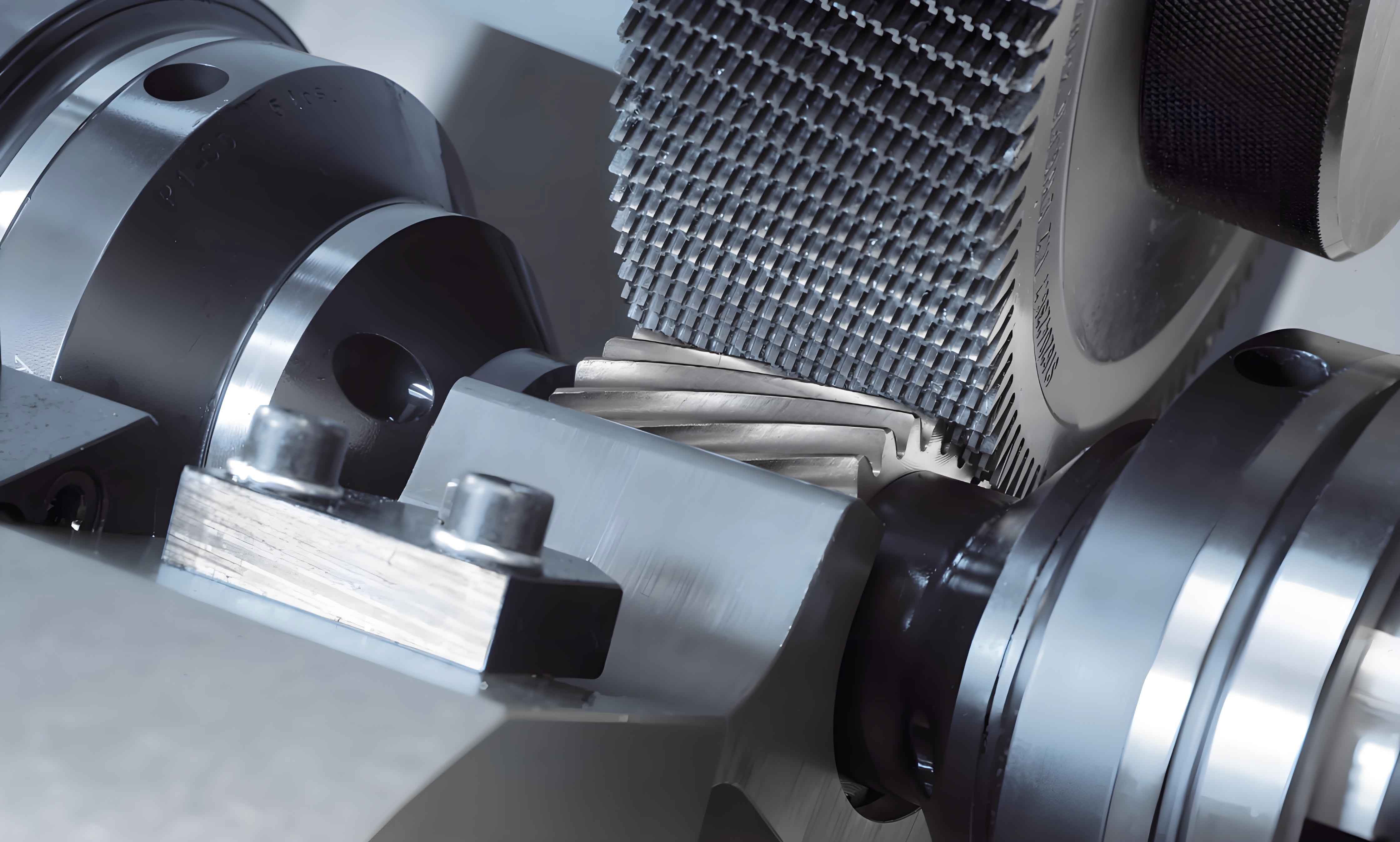
Gear shaving involves complex spatial multi-blade intermittent cutting. Understanding the principle and motion relationship is crucial for analyzing residual stress formation. The gear shaving process and its motion relationship.
2.2 Residual Stress Formation Mechanism
During gear shaving, high temperatures, high pressures, and high strain rates lead to plastic deformation, resulting in residual stress formation. The residual stress formation mechanism in gear shaving.
3. Impact of Process Parameters on Tooth Root Residual Stress
3.1 Preselection of Process Parameters
Based on the analysis of the residual stress formation mechanism, preselection of gear shaving process parameters was conducted. These parameters include hob speed, axial feed rate, and radial cutting depth.
Table 3.1: Preselected Gear Shaving Process Parameters
| Parameter | Symbol | Preselected Range |
|---|---|---|
| Hob speed | Vc | 100-500 m/min |
| Axial feed rate | fz | 0.1-0.5 mm/rev |
| Radial cutting depth | ap | 1-5 mm |
3.2 Single Factor and Orthogonal Tests
Single factor and orthogonal tests were conducted to investigate the primary and secondary relationships, interactions, and influence laws of process parameters on tooth root residual stress.
Table 3.2: Single Factor Test Results
| Parameter | Level | Tooth Root Residual Stress (MPa) |
|---|---|---|
| Vc | 100 | σ1 |
| 200 | σ2 | |
| … | … | |
| fz | 0.1 | σ3 |
| 0.3 | σ4 | |
| … | … | |
| ap | 1 | σ5 |
| 3 | σ6 | |
| … | … |
The orthogonal test results revealed significant interactions among process parameters.The interaction effects of hob speed, axial feed rate, and radial cutting depth.
3.3 Influence Coefficient Calculation
The Least Absolute Shrinkage and Selection Operator (LASSO) method was employed to calculate the influence coefficient of gear shaving process parameters on tooth root residual stress.
Table 3.3: Influence Coefficients of Process Parameters
| Parameter | Influence Coefficient |
|---|---|
| Vc | β1 |
| fz | β2 |
| ap | β3 |
4. Optimization of Gear Shaving Process Parameters
4.1 Regression Model Establishment
Response surface methodology (RSM) was used to establish regression models for tooth profile total deviation and tooth root residual stress.
Table 4.1: Regression Model Coefficients
| Model Term | Coefficient |
|---|---|
| Constant | α0 |
| Vc | α1 |
| fz | α2 |
| ap | α3 |
| Vc*fz | α4 |
| Vc*ap | α5 |
| fz*ap | α6 |
| Vc^2 | α7 |
| fz^2 | α8 |
| ap^2 | α9 |
4.2 Multi-Objective Optimization
The non-dominated sorting genetic algorithm-II (NSGA-II) was applied for multi-objective optimization, considering both tooth profile total deviation and tooth root residual stress.
Table 4.2: Optimized Process Parameters and Results
| Optimized Parameter | Value | Tooth Profile Total Deviation | Tooth Root Residual Stress (MPa) |
|---|---|---|---|
| Vc (m/min) | Vc_opt | δ_opt | σ_opt |
| fz (mm/rev) | fz_opt | ||
| ap (mm) | ap_opt |
5. Conclusion
The comprehensive analysis of the impact of gear shaving process parameters on tooth root residual stress and their optimization. By understanding the formation mechanism and conducting detailed experiments, significant insights into the process-property relationship were gained. The optimized process parameters not only reduced tooth profile total deviation but also improved tooth root residual stress, enhancing gear bending fatigue performance.