
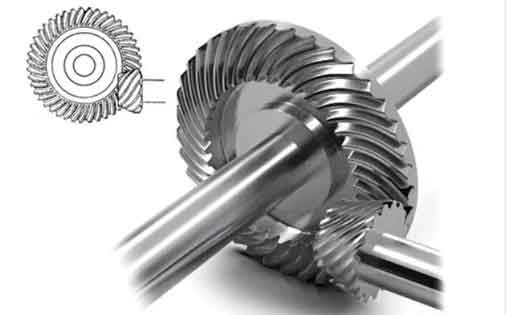
Spiral bevel gears are widely used in aerospace transmissions due to their high load capacity and smooth operation. However, under extreme conditions such as high-speed rotation and heavy loads, lubrication failure often leads to surface pitting and scuffing. This study focuses on the thermal elastohydrodynamic lubrication (TEHL) characteristics of spiral bevel gears at the pitch circle position under varying operating parameters. A numerical model incorporating Reynolds equation, energy equation, and elastic deformation theory is developed to analyze pressure, film thickness, and temperature distributions.
1. Fundamental Equations
The governing equations for spiral bevel gear TEHL analysis include:
1.1 Reynolds Equation
$$ \frac{\partial}{\partial x}\left(\frac{\rho h^3}{\eta}\frac{\partial p}{\partial x}\right) + \frac{\partial}{\partial y}\left(\frac{\rho h^3}{\eta}\frac{\partial p}{\partial y}\right) = 12u_s\frac{\partial(\rho h)}{\partial x} $$
where \( u_s = (u_1 + u_2)/2 \) represents entrainment velocity.
1.2 Film Thickness Equation
$$ h(x,y) = h_0 + \frac{x^2}{2R_x} + \frac{y^2}{2R_y} + \frac{2}{\pi E’}\iint_\Omega \frac{p(s,t)}{\sqrt{(x-s)^2 + (y-t)^2}} \, \mathrm{d}s \, \mathrm{d}t $$
1.3 Viscosity-Pressure-Temperature Relationship
$$ \eta = \eta_0 \exp\left\{(\ln\eta_0 + 9.67)\left[(1 + 5.1 \times 10^{-9}p)^z\left(\frac{T-138}{T_0-138}\right)^{-s} – 1\right]\right\} $$
1.4 Load Balance Equation
$$ w = \int_{y_0}^{y_1}\int_{x_0}^{x_1} p(x,y) \, \mathrm{d}x \, \mathrm{d}y $$
2. Numerical Implementation
The computational domain is discretized using non-dimensional coordinates:
$$ X = \frac{x}{a}, \quad Y = \frac{y}{b}, \quad P = \frac{p}{p_H} $$
where \( a \) and \( b \) represent Hertzian contact semi-axes. The multilevel multi-integration method is employed for elastic deformation calculation.
3. Lubrication Characteristics Analysis
Key findings for spiral bevel gears under different operating conditions:
3.1 Rotational Speed Effects
| Speed (rpm) | hmin (μm) | pmax (GPa) | Δtmax (°C) |
|---|---|---|---|
| 12,079 | 0.402 | 0.277 | 3.581 |
| 16,106 | 0.463 | 0.327 | 6.640 |
| 20,132 | 0.524 | 0.369 | 10.829 |
3.2 Load Effects
| Power (kW) | hmin (μm) | pmax (GPa) | Δtmax (°C) |
|---|---|---|---|
| 600 | 0.536 | 0.389 | 11.892 |
| 800 | 0.528 | 0.378 | 11.340 |
| 1,000 | 0.524 | 0.369 | 10.823 |
3.3 Lubricant Viscosity Effects
| Temperature (°C) | η (mPa·s) | hmin (μm) | pmax (GPa) |
|---|---|---|---|
| 80 | 7.108 | 1.104 | 0.790 |
| 120 | 3.191 | 0.649 | 0.463 |
| 160 | 1.789 | 0.441 | 0.308 |
4. Sensitivity Analysis
The sensitivity coefficients for spiral bevel gear lubrication parameters are calculated as:
$$ S(a_k) = \frac{(M_k – M^*)/M^*}{(a_k – a^*)/a^*} $$
| Parameter | hmin | pmax | Δtmax |
|---|---|---|---|
| Speed (n) | 0.58 | 0.60 | 1.80 |
| Power (P) | 0.04 | 0.09 | 0.24 |
| Viscosity (η) | 0.64 | 0.66 | 2.20 |
| Elastic Modulus (E) | 0.25 | 1.35 | 1.35 |
5. Critical Findings
Key conclusions for spiral bevel gear lubrication:
- The classical double pressure peaks merge under high-speed conditions (>20,000 rpm)
- Minimum film thickness shows strong dependence on viscosity (S=0.64) and speed (S=0.58)
- Temperature rise demonstrates highest sensitivity to viscosity (S=2.20) and elastic modulus (S=1.35)
- Lubrication regime transitions occur at critical speeds:
$$ \lambda = \frac{h_{\mathrm{min}}}{\sqrt{\sigma_1^2 + \sigma_2^2}} $$- λ < 1: Boundary lubrication
- 1 ≤ λ < 3: Mixed lubrication
- λ ≥ 3: Full-film lubrication
6. Optimization Strategies
Recommended measures for improving spiral bevel gear lubrication:
- Maintain oil supply temperature below 120°C to ensure η > 3.2 mPa·s
- Adopt surface coatings to reduce equivalent elastic modulus by 10-15%
- Implement micro-geometry modifications to enhance lubricant entrainment:
$$ \Delta h = 0.5(R_{a1} + R_{a2}) $$ - Utilize advanced lubricants with pressure-viscosity coefficient α > 20 GPa-1
This comprehensive analysis provides critical insights into the thermal EHL behavior of spiral bevel gears under extreme operating conditions, enabling better lubrication system design and failure prevention in aerospace applications.