
In the field of mechanical transmissions, the pursuit of compact, high-ratio, and efficient gear systems has led to the exploration of novel architectures. Among these, nutation drives utilizing internal meshing spiral bevel gears have emerged as a promising solution. My research focuses on overcoming a significant challenge in this area: the complex derivation process for the mathematical model of the tooth surface in internal meshing nutation spiral bevel gears. To facilitate the design and analysis of such gears with various tooth profiles, I have developed a generalized mathematical framework. This framework allows for the establishment of precise three-dimensional models and subsequent in-depth load contact analysis using finite element methods. The core of this work lies in creating a universal tooth surface model applicable to arbitrary profiles, thereby streamlining the process for future investigations into different tooth forms for nutation bevel gears.
The nutation reducer, a compact device offering large reduction ratios, operates on the principle of a wobbling or nutating motion. This motion is facilitated by pairs of internally meshing spiral bevel gears. The performance, longevity, and noise characteristics of this entire system are profoundly influenced by the geometry and contact mechanics of these critical bevel gears. Traditionally, developing a mathematical model for a specific tooth profile, such as the double circular-arc, required a dedicated and intricate derivation process. This process, tied to the specific parameters of that profile, lacked generality. My objective was to devise a more efficient and universal approach. I aimed to construct a general tooth surface model that could be easily adapted to any given normal basic tooth profile, be it involute, double circular-arc, or another curve. This model would then serve as the foundation for building accurate 3D digital twins of the gears and conducting comparative load contact analyses to evaluate their mechanical behavior under operational loads.
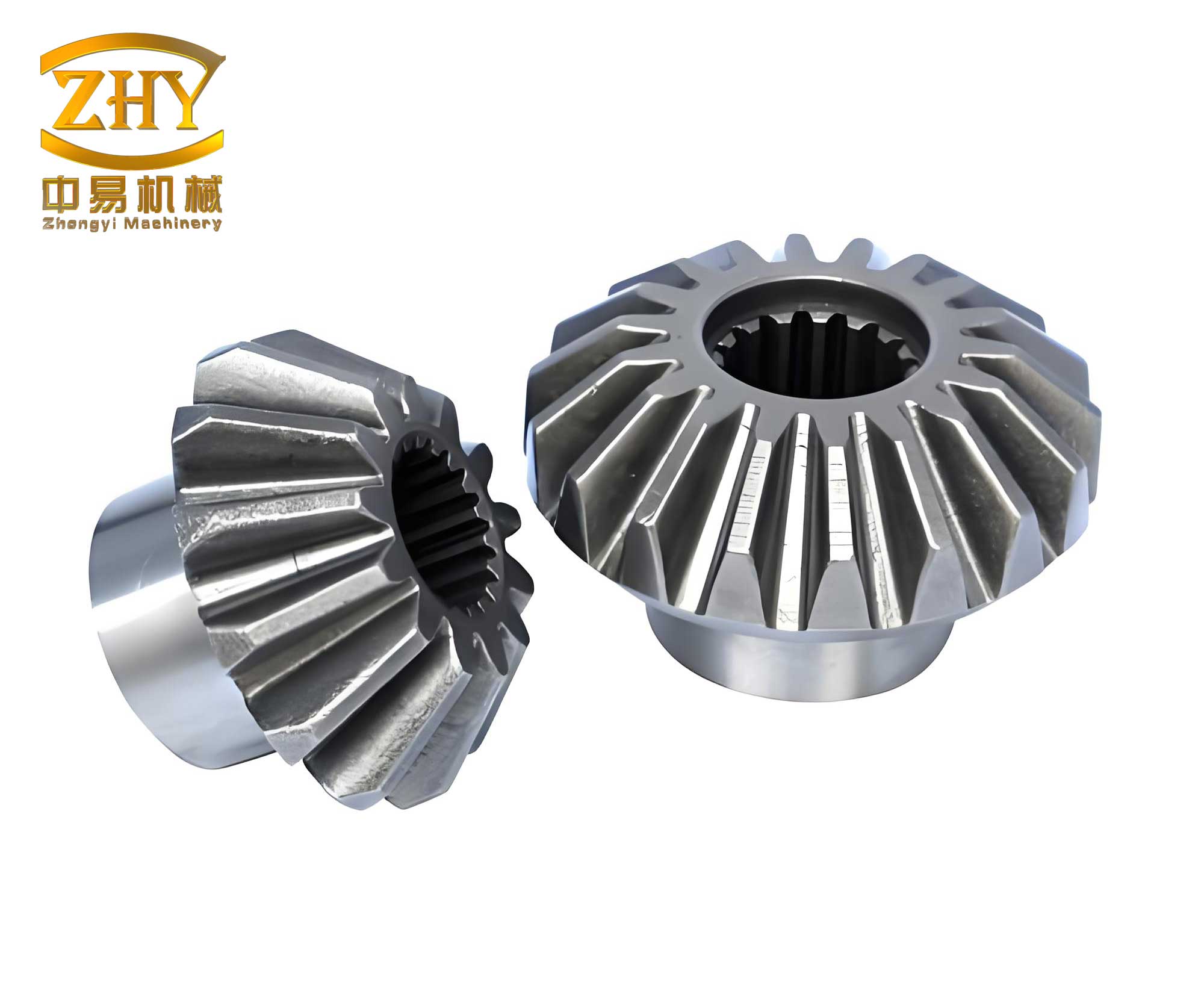
The foundation of my modeling methodology is the concept of a virtual crown gear, which serves as an intermediate generating tool. The tooth surface of the crown gear is generated by sweeping a normal basic tooth profile along a predefined path on its conceptual pitch surface. The first step was to define this normal basic tooth profile in a general form. In a coordinate system \( S_n (i_n, j_n, k_n) \), a general planar curve can be represented using parameters \( r_0 \) and \( \alpha_0 \). The equation for this general profile is:
$$ \mathbf{r}_n = [x_n, y_n, z_n]^T = [x_n(r_0, \alpha_0), \, y_n(r_0, \alpha_0), \, 0]^T $$
This equation, \( \mathbf{r}_n \), is the cornerstone of the universal model, where \( x_n \) and \( y_n \) are functions describing the specific tooth flank shape. To form the crown gear’s tooth surface, this profile is moved along a helical path on the crown gear’s pitch cone, which is essentially a plane for a crown gear. The helical path, defined by a spiral angle \( \beta \), is derived using the principle of equal strength. The actual helical path \( \rho’ \) is obtained by offsetting a base helix \( \rho \). Its equations within the crown gear coordinate system \( S_C \) are:
$$ x’_{\rho} = e^{\theta \cot \beta} \cos(\theta – \Delta\theta) \mp \frac{1}{2}s \sin \phi $$
$$ y’_{\rho} = e^{\theta \cot \beta} \sin(\theta – \Delta\theta) \pm \frac{1}{2}s \cos \phi $$
where \( \phi = \theta – \Delta\theta + \beta \), \( \theta \) is the angular parameter, \( \Delta\theta \) is a rotation angle related to the tooth symmetry, and \( s \) is the normal tooth thickness at the small end of the equivalent bevel gear’s pitch cone. By establishing the transformation matrix \( \mathbf{M}_{\{C\}\{n\}} \) from the profile coordinate system \( S_n \) to the crown gear system \( S_C \), the universal mathematical model for the crown gear tooth surface is obtained:
$$ [\mathbf{r}_C, 1]^T = \mathbf{M}_{\{C\}\{n\}} [\mathbf{r}_n, 1]^T = [x_C, y_C, z_C, 1]^T $$
which expands to:
$$ x_C = \left[y_n \mp \frac{s}{2}\right] \sin \phi + e^{\theta \cot \beta} \cos(\theta – \Delta\theta) $$
$$ y_C = -\left[y_n \mp \frac{s}{2}\right] \cos \phi + e^{\theta \cot \beta} \sin(\theta – \Delta\theta) $$
$$ z_C = x_n $$
This model, \( \mathbf{r}_C \), is universal; any specific normal tooth profile equation can be substituted for \( x_n(r_0, \alpha_0) \) and \( y_n(r_0, \alpha_0) \) to generate the corresponding crown gear surface for that profile.
The next critical phase involves transferring this crown gear geometry to the actual nutation bevel gears. The internal meshing pair consists of an external spiral bevel gear and an internal spiral bevel gear. Their generation is simulated via the meshing motion between the virtual crown gear and each gear. Separate coordinate systems are established: \( S_C \) fixed to the crown gear, \( S_1 \) fixed to the external bevel gear, and \( S_2 \) fixed to the internal bevel gear, along with fixed reference systems \( S_0 \) and \( S_m \). The kinematic relationship, defined by the nutation motion, involves rotations \( \phi_C, \phi_1, \phi_2 \) and cone angles \( \delta_1, \delta_2 \). The transformation matrices from the crown gear system to each bevel gear system, \( \mathbf{M}_{\{1\}\{C\}} \) and \( \mathbf{M}_{\{2\}\{C\}} \), are derived from these spatial relationships. Applying these transformations to the crown gear surface \( \mathbf{r}_C \) yields the General Tooth Surface Mathematical Model for Nutation Spiral Bevel Gears:
$$ \mathbf{r}_t^i = \mathbf{M}_{\{i\}\{C\}} \mathbf{r}_C = [x_i, y_i, z_i]^T, \quad i=1,2 \text{ (for external and internal)} $$
The expanded form of this universal model is:
$$ x_i = (-1)^i \left\{ \left[y_n \mp \frac{s}{2}\right] \sin \psi \cos \phi_i + \left[y_n \mp \frac{s}{2}\right] \cos \psi \sin \phi_i \sin \delta_i \right\} + e^{\theta \cot \beta} \left( -\cos \psi’ \cos \phi_i + \sin \psi’ \sin \phi_i \sin \delta_i \right) + x_n \sin \phi_i \cos \delta_i $$
$$ y_i = (-1)^i \left\{ -\left[y_n \mp \frac{s}{2}\right] \sin \psi \sin \phi_i + \left[y_n \mp \frac{s}{2}\right] \cos \psi \cos \phi_i \sin \delta_i \right\} + e^{\theta \cot \beta} \left( \cos \psi’ \sin \phi_i + \sin \psi’ \cos \phi_i \sin \delta_i \right) + x_n \cos \phi_i \cos \delta_i $$
$$ z_i = -\left[y_n \mp \frac{s}{2}\right] \cos \psi \cos \delta_i – (-1)^i e^{\theta \cot \beta} \sin \psi’ \cos \delta_i + (-1)^i x_n \sin \delta_i $$
where \( \psi = \phi – \phi_C \) and \( \psi’ = \theta – \Delta\theta – \phi_C \). This powerful equation is the key outcome. To model bevel gears with any specific tooth profile, one simply needs to insert the corresponding \( x_n \) and \( y_n \) functions from the normal basic profile into this general model. This eliminates the need for repetitive, profile-specific derivations for each new type of bevel gear in the nutation drive.
To demonstrate the application and validate the utility of this general model, I applied it to two distinct and important tooth profiles: the involute and the double circular-arc. These profiles are widely studied in gear theory for their differing characteristics. For the involute profile, the normal basic tooth profile equations in its local coordinate system are:
$$ \mathbf{r}_{Jn} = [x_{Jn}, y_{Jn}, 0]^T = [r_k \cos \varphi_k – r, \mp r_k \sin \varphi_k, 0]^T $$
Here, \( r_k \) is the radius to a point on the involute, \( r \) is the pitch radius, \( \varphi_k \) is the involute roll angle, and \( m_n \) is the normal module. Substituting \( x_{Jn} \) and \( y_{Jn} \) into the general model (Equation for \( \mathbf{r}_t^i \)) yields the specific tooth surface equations for nutation involute spiral bevel gears. The resulting set of equations fully describes the geometry of these involute bevel gears within the nutation drive context.
For the double circular-arc profile, conforming to standard definitions, the normal basic profile consists of four circular arcs (two convex, two concave). The equation for the \( n \)-th arc segment (\( n=1,2,3,4 \)) is:
$$ \mathbf{r}_{Sn} = [x_{Sn}, y_{Sn}, 0]^T = [r_n \sin \alpha_n + E_n, \, r_n \cos \alpha_n + F_n, \, 0]^T $$
where \( r_n \) and \( \alpha_n \) are the radius and polar angle for the arc, and \( (E_n, F_n) \) are the coordinates of the arc’s center. Similarly, substituting these expressions into the universal tooth surface model generates the explicit mathematical model for nutation double circular-arc spiral bevel gears. The parameters \( \Delta\theta_j \) (with \( j=1,2 \)) correspond to the different angular offsets for the convex and concave flanks of the double circular-arc bevel gears. The complete model is detailed but stems directly from the general framework.
The practical implementation of these mathematical models for computer-aided design and analysis requires the generation of discrete point coordinates on the tooth surface. Using computational software, I calculated dense point clouds based on the derived equations for both involute and double circular-arc bevel gears. These point clouds define the precise geometry of a single tooth flank. This data was then imported into a solid modeling environment. A gear blank model was created, and the tooth profile was formed by constructing a surface through the imported points or by using them to define cutting sweeps. Replicating this tooth around the gear axis yielded the full, three-dimensional, high-precision digital models of both the external and internal nutation spiral bevel gears for each profile. The accuracy of these models is paramount for meaningful subsequent engineering analysis, especially for complex geometries like internally meshing spiral bevel gears.
With the precise 3D models of the nutation bevel gear pairs (involute and double circular-arc) established, the next phase was to conduct a comparative load contact analysis. This analysis aims to evaluate and contrast the mechanical behavior of these two types of bevel gears under simulated operational conditions. The finite element method was employed for this purpose. The 3D models were imported into a finite element analysis software. The material properties were assigned as follows: Young’s modulus \( E = 2.1 \times 10^{11} \) Pa, Poisson’s ratio \( \nu = 0.3 \), and density \( \rho = 7850 \) kg/m³. The contact interaction between the meshing tooth flanks of the external and internal bevel gears was defined using a penalty friction formulation with a coefficient of \( \mu = 0.1 \) and a finite sliding formulation. Due to the complex curvatures of the spiral bevel gear teeth, an automatic tetrahedral meshing algorithm was used to discretize the models, ensuring adequate refinement in the contact regions. Boundary conditions simulated the nutation motion: the input shaft (connected to the nutating element carrying the gears) was assigned a constant rotational speed of 1500 rpm. To investigate the influence of load magnitude, two distinct power levels were applied: a higher power of 3 kW and a lower power of 1 kW. These translate to different torque loads on the gear system. A dynamic explicit analysis was performed for a total time of 1 second, with data extracted from the stabilized period between 0.5 and 1 second for consistent comparison.
The results from the finite element analysis provide critical insights into the contact characteristics of the different bevel gears. The metrics analyzed include instantaneous contact area, contact force components, and von Mises stress distribution. For brevity and clarity, the analysis focuses on the larger external bevel gear in each pair, as it is typically a critical component. The following table summarizes key comparative observations between the involute and double circular-arc bevel gears under the two load conditions:
| Performance Metric | Involute Spiral Bevel Gears | Double Circular-Arc Spiral Bevel Gears | Comparative Insight |
|---|---|---|---|
| Contact Area | Smaller area; fluctuates significantly with load. High load (3 kW) shows different pattern vs. low load (1 kW). | Larger contact area; more stable pattern with less sensitivity to load change. | Double circular-arc bevel gears distribute load over a larger area, reducing pressure. Their behavior is more consistent across load ranges. |
| Contact Force (X-component) | Higher magnitude forces in general; pattern varies considerably between high and low power. | Lower magnitude forces for most of the cycle; high and low load curves are closer, showing less load-dependence. | The convex-concave mating in double circular-arc bevel gears leads to lower contact forces and more stable transmission. |
| Maximum von Mises Stress | Significantly higher stress levels. Strong load dependence: much higher at 3 kW than at 1 kW. | Substantially lower stress levels. Load increase raises stress, but the relative change is smaller. | Double circular-arc bevel gears exhibit superior load-carrying capacity due to lower induced stresses. |
| Stress Distribution | Stress concentrated at the tooth root fillet and the heel (large end) of the tooth. Clear root bending stress focus. | Stress is more uniformly distributed across the active tooth flank. Some stress concentration may appear at the toe (small end) under high load. | The multi-point contact of double circular-arc profiles promotes uniform stress distribution, potentially improving fatigue life. |
The quantitative data for contact area over time can be represented by an approximate functional trend observed from the FEA results. While the actual data is discrete, the behavior for involute bevel gears shows higher volatility. A simplified representation of the contact area \( A_c \) as a function of time \( t \) and load torque \( T \) might show:
$$ A_{c,\text{inv}}(t, T) \approx A_0 + \Delta A(T) \sin(\omega t + \zeta(T)) $$
where \( \Delta A(T) \), the amplitude of fluctuation, is strongly dependent on \( T \). For double circular-arc bevel gears, the contact area is more stable:
$$ A_{c,\text{dca}}(t, T) \approx \bar{A}(T) + \epsilon \sin(\omega t) $$
with \( \bar{A}(T) \) being the mean area (larger than for involute) and \( \epsilon \) being a small fluctuation amplitude less sensitive to \( T \).
The contact force, particularly in the meshing direction, is crucial for dynamic analysis. The FEA results indicate that the peak contact force \( F_{max} \) scales with load but follows different relationships for the two profiles. For the analyzed range, the involute bevel gears exhibit a steeper increase:
$$ F_{max,\text{inv}} \propto T^{\kappa_{\text{inv}}}, \quad \text{with } \kappa_{\text{inv}} \text{ likely > 1 (non-linear sensitive response)} $$
For double circular-arc bevel gears, the relationship is closer to linear and less steep:
$$ F_{max,\text{dca}} \propto T^{\kappa_{\text{dca}}}, \quad \text{with } \kappa_{\text{dca}} \approx 1 \text{ (more linear, robust response)} $$
This underscores the better load-sharing characteristics of the double circular-arc profile in these internally meshing bevel gears.
The von Mises stress \( \sigma_{vM} \) is a key indicator of yielding and fatigue risk. The maximum stress values from the analysis clearly demonstrate the advantage of the double circular-arc geometry. The stress for involute bevel gears shows a strong power-law dependence on torque:
$$ \sigma_{vM, max,\text{inv}} \approx C_{\text{inv}} \cdot T^{m_{\text{inv}}} $$
where \( m_{\text{inv}} \) is significant. For double circular-arc bevel gears:
$$ \sigma_{vM, max,\text{dca}} \approx C_{\text{dca}} \cdot T^{m_{\text{dca}}} $$
with \( C_{\text{dca}} < C_{\text{inv}} \) and \( m_{\text{dca}} < m_{\text{inv}} \), confirming both a lower base stress and reduced sensitivity to load increases. This fundamental difference arises from the localized line contact in involute gears versus the distributed point contacts in correctly designed double circular-arc bevel gears, which have favorable convex-concave conjugacy reducing contact pressure.
The implications of these findings are substantial for the design of nutation drives. The double circular-arc spiral bevel gears consistently outperform their involute counterparts in this internal meshing application regarding key mechanical metrics. The larger and more stable contact area leads to lower contact pressures. The lower and less load-sensitive contact forces contribute to smoother torque transmission and potentially lower vibration and noise. Most importantly, the significantly lower von Mises stress indicates a higher inherent load-carrying capacity and potential for longer service life or more compact gear design for the same power. However, it is important to note that the manufacturability and precision requirements for double circular-arc bevel gears are generally higher than for involute bevel gears. The insights gained from this analysis, enabled by the general tooth surface model, provide clear guidance: for high-performance, high-load nutation drive applications where stability and strength are critical, double circular-arc profiles are advantageous. For applications where manufacturing ease or standardization is prioritized, and loads are moderate, involute bevel gears remain a viable option, though with careful consideration of their load-sensitive behavior.
In conclusion, this study has successfully addressed the challenge of complex modeling for internal meshing nutation spiral bevel gears. I have developed and presented a comprehensive general tooth surface mathematical model that is universally applicable to bevel gears with arbitrary normal basic tooth profiles. This model, derived via the virtual crown gear approach and coordinate transformations for the nutation kinematics, provides an efficient pathway for generating precise geometry for a wide variety of bevel gear designs. The practical utility of this framework was demonstrated by deriving specific models for both involute and double circular-arc spiral bevel gears and constructing their accurate 3D digital models. The subsequent finite element-based load contact analysis revealed significant performance differences. The results conclusively show that for the nutation drive configuration, double circular-arc spiral bevel gears offer superior characteristics, including larger load capacity, more stable transmission behavior under varying loads, and a more favorable stress distribution compared to traditional involute spiral bevel gears. This work establishes a foundational tool for the continued exploration and optimization of nutation drives and other advanced gear systems utilizing complex bevel gear geometry. Future work can leverage this general model to investigate other advanced profiles, incorporate manufacturing errors, perform dynamic response analyses, and explore topological optimization for further enhancing the performance of these critical mechanical components.