
In the field of gear transmission, spiral bevel gears hold a critical position due to their ability to transmit power between intersecting shafts with high efficiency and smooth operation. Among various types, the epicycloidal spiral bevel gear, characterized by its curved tooth traces, offers significant advantages in terms of load capacity, noise reduction, and suitability for hard-faced finishing processes like grinding or skiving. This article delves into the fundamental generation principle of these gears and derives the mathematical equations describing their generating gear tooth surfaces. The focus is on providing a comprehensive, first-person perspective analysis that incorporates detailed formulations, tabular summaries, and practical insights, aiming to serve as a reference for designers and engineers working with high-performance gear systems.
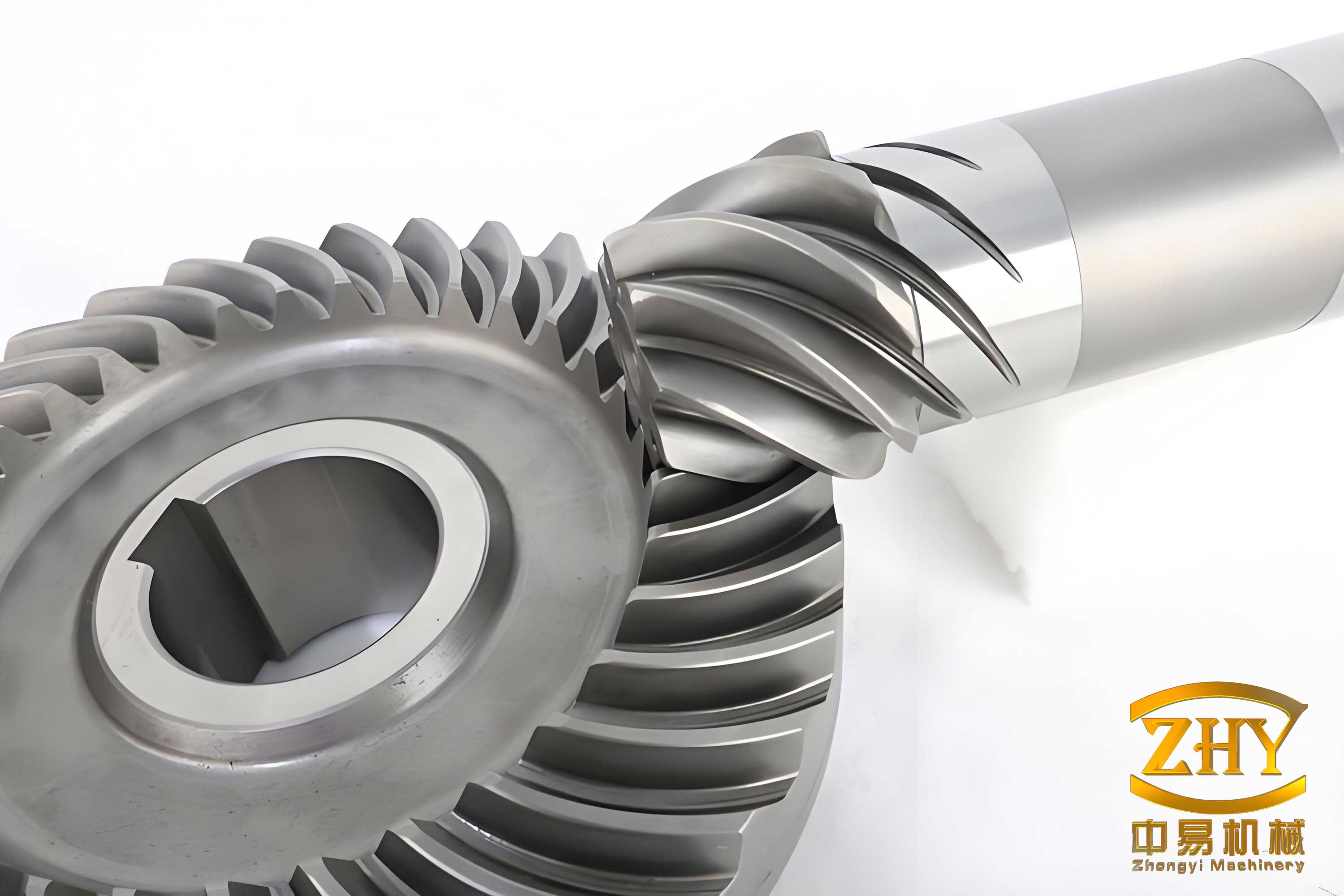
The manufacturing process of spiral bevel gears, particularly the epicycloidal variant, involves a complex kinematic relationship between the cutter head, the machine worktable, and the gear blank. Essentially, the cutting action simulates the meshing of a hypothetical generating gear—often called a crown gear or planning gear—with the workpiece. The cutter head, equipped with inner and outer cutting blades, rotates about its own axis while simultaneously revolving with the worktable. This composite motion causes the blade edges to sweep out surfaces that form the teeth of the generating gear. Consequently, the concave and convex tooth surfaces of the actual spiral bevel gear are generated as the envelope of the generating gear’s convex and concave surfaces, respectively. Notably, the hand of spiral on the generated gear is opposite to that of its generating gear; a left-hand spiral bevel gear is produced from a right-hand generating gear, and vice versa. This principle is foundational for understanding the tooth geometry and meshing behavior of spiral bevel gears.
To mathematically describe this process, we establish a Cartesian coordinate system \( S_p (O_p – X_p Y_p Z_p) \) that is fixed to and rotates with the machine worktable. The corresponding unit vectors are denoted as \( \mathbf{i}_p \), \( \mathbf{j}_p \), and \( \mathbf{k}_p \). The \( Z_p \)-axis coincides with the worktable axis, pointing toward the side of a left-hand gear for convention, and the \( X_p Y_p \)-plane represents the pitch plane of the generating gear. The initial position is defined when a reference point \( M \) on the cutter blade aligns with a specific location, typically on the pitch circle.
For a right-hand generating gear, the motion of the cutter head relative to the worktable can be visualized. Starting from the initial position, as the cutter head rotates through an angle \( \theta \) (positive or negative depending on the direction of angular velocity \( \boldsymbol{\omega}_p \) relative to \( \mathbf{k}_p \)), it also spins about its own axis by an angle \( i_{0p} \theta \), where \( i_{0p} \) is a fixed ratio related to the machine settings. The total angular displacement of the blade relative to the worktable is \( (1 + i_{0p}) \theta \). Let \( n = 1 + i_{0p} \). The position vectors for points on the outer blade (convex surface) and inner blade (concave surface) can be derived through sequential rotations.
Define the initial cutter location vector \( \mathbf{E}_x \) from the worktable center \( O_p \) to the cutter center \( O \), and the cutter radius vector \( \mathbf{r} \) from \( O \) to the reference point \( M \). In the initial position:
$$ \mathbf{E}_x = E_x (\sin \gamma \, \mathbf{i}_p + \cos \gamma \, \mathbf{j}_p) $$
$$ \mathbf{r} = r (-\sin \eta \, \mathbf{i}_p + \cos \eta \, \mathbf{j}_p) $$
Here, \( E_x \) is the cutter radial distance, \( r \) is the cutter radius, and \( \gamma \), \( \eta \) are angular parameters defining orientation. For an arbitrary point \( P_v \) on the outer blade, the vector \( \overrightarrow{MP_v} \) can be expressed in terms of a parameter \( u \) (signed distance along the blade profile), the tool profile angle \( \alpha_0 \), and the spiral angle \( \beta_m \):
$$ \overrightarrow{MP_v} = u (\sin \alpha_0 \cos \beta_m \, \mathbf{i}_p – \sin \alpha_0 \sin \beta_m \, \mathbf{j}_p + \cos \alpha_0 \, \mathbf{k}_p) $$
Similarly, for a point \( P_c \) on the inner blade:
$$ \overrightarrow{MP_c} = u (-\sin \alpha_0 \cos \beta_m \, \mathbf{i}_p – \sin \alpha_0 \sin \beta_m \, \mathbf{j}_p + \cos \alpha_0 \, \mathbf{k}_p) $$
After the worktable rotates by \( \theta \), the position vector \( \mathbf{r}_{pv} \) for point \( P_v \) on the generating gear’s convex surface (from outer blade) is obtained by applying rotation operators. Let \( \mathbf{a}(\mathbf{e}, \varepsilon)_R \) denote the vector \( \mathbf{a} \) rotated by angle \( \varepsilon \) about unit vector \( \mathbf{e} \). Then:
$$ \mathbf{r}_{pv} = \left[ \mathbf{E}_{xv} (\mathbf{k}_p, -\theta)_R + \left( \mathbf{r}_v + \overrightarrow{MP_v} \right) (\mathbf{k}_p, n\theta)_R \right] $$
Expanding these rotations yields the parametric equations for the convex surface \( \Sigma_v \) of a right-hand generating gear:
$$ x_v = E_{xv} \sin(\gamma_v + \theta) – r_v \sin(\eta_v + n\theta) + u \sin \alpha_0 \cos(\beta_m – n\theta) $$
$$ y_v = E_{xv} \cos(\gamma_v + \theta) + r_v \cos(\eta_v + n\theta) – u \sin \alpha_0 \sin(\beta_m – n\theta) $$
$$ z_v = u \cos \alpha_0 $$
Similarly, for the concave surface \( \Sigma_c \) from the inner blade:
$$ x_c = E_{xc} \sin(\gamma_c + \theta) – r_c \sin(\eta_c + n\theta) – u \sin \alpha_0 \cos(\beta_m – n\theta) $$
$$ y_c = E_{xc} \cos(\gamma_c + \theta) + r_c \cos(\eta_c + n\theta) + u \sin \alpha_0 \sin(\beta_m – n\theta) $$
$$ z_c = u \cos \alpha_0 $$
These equations describe the generating gear tooth surfaces under standard conditions. However, in practice, modification or correction is often applied to improve meshing performance, compensate for deflection, or achieve desired contact patterns. Two common types of modification are profile shift (height modification) and tangential shift. Profile shift involves moving the cutter radially along the generating gear axis by a distance \( x_1 m_n \), where \( x_1 \) is the profile shift coefficient for gear 1 and \( m_n \) is the normal module. Tangential shift involves shifting the cutter blade along the normal to the tooth trace by a distance related to the tangential modification coefficient \( x_{t1} \). For spiral bevel gears, these modifications are crucial for optimizing load distribution and reducing stress concentrations.
Incorporating both height and tangential modifications, the equations for the modified right-hand generating gear surfaces become:
For convex surface \( \Sigma_v \):
$$ x_v = E_{xv} \sin(\gamma_v + \theta) – r_v \sin(\eta_v + n\theta) + (u \sin \alpha_0 + x_{t1} m_n) \cos(\beta_m – n\theta) $$
$$ y_v = E_{xv} \cos(\gamma_v + \theta) + r_v \cos(\eta_v + n\theta) – (u \sin \alpha_0 + x_{t1} m_n) \sin(\beta_m – n\theta) $$
$$ z_v = u \cos \alpha_0 – x_1 m_n $$
For concave surface \( \Sigma_c \):
$$ x_c = E_{xc} \sin(\gamma_c + \theta) – r_c \sin(\eta_c + n\theta) – (u \sin \alpha_0 + x_{t1} m_n) \cos(\beta_m – n\theta) $$
$$ y_c = E_{xc} \cos(\gamma_c + \theta) + r_c \cos(\eta_c + n\theta) + (u \sin \alpha_0 + x_{t1} m_n) \sin(\beta_m – n\theta) $$
$$ z_c = u \cos \alpha_0 – x_1 m_n $$
For a left-hand generating gear, the kinematic relationship is mirrored. The cutter head rotation direction relative to the worktable is reversed, leading to a different parameter \( n’ = 1 + i’_{0p} \). The parametric equations for the convex and concave surfaces of a left-hand generating gear, considering modifications with coefficients \( x_2 \) and \( x_{t2} \) for gear 2, are derived as:
For convex surface \( \Sigma_{v’} \):
$$ x_{v’} = E_{xv’} \sin(\gamma_{v’} + \theta) – r_{v’} \sin(\eta_{v’} + n’\theta) – (u’ \sin \alpha_0 + x_{t2} m_n) \cos(\beta_{m’} – n’\theta) $$
$$ y_{v’} = E_{xv’} \cos(\gamma_{v’} + \theta) + r_{v’} \cos(\eta_{v’} + n’\theta) + (u’ \sin \alpha_0 + x_{t2} m_n) \sin(\beta_{m’} – n’\theta) $$
$$ z_{v’} = u’ \cos \alpha_0 + x_2 m_n $$
For concave surface \( \Sigma_{c’} \):
$$ x_{c’} = E_{xc’} \sin(\gamma_{c’} + \theta) – r_{c’} \sin(\eta_{c’} + n’\theta) + (u’ \sin \alpha_0 + x_{t2} m_n) \cos(\beta_{m’} – n’\theta) $$
$$ y_{c’} = E_{xc’} \cos(\gamma_{c’} + \theta) + r_{c’} \cos(\eta_{c’} + n’\theta) – (u’ \sin \alpha_0 + x_{t2} m_n) \sin(\beta_{m’} – n’\theta) $$
$$ z_{c’} = u’ \cos \alpha_0 + x_2 m_n $$
In many applications, especially for interchangeable gear sets, balanced profile shift is employed where \( x_1 = -x_2 > 0 \), meaning pinion undergoes positive shift and gear negative shift, with equal magnitude. This approach helps maintain center distance while improving pinion strength and contact conditions.
To summarize the key parameters and their meanings in the generating surface equations, the following table provides a clear reference:
| Symbol | Description | Typical Units |
|---|---|---|
| \( E_x \) | Cutter radial distance (machine setting) | mm |
| \( r \) | Cutter radius | mm |
| \( \gamma \) | Angular position of cutter center | rad |
| \( \eta \) | Angular position of reference point on cutter | rad |
| \( \theta \) | Worktable rotation angle (motion parameter) | rad |
| \( u \) | Parameter along blade profile (tooth depth direction) | mm |
| \( \alpha_0 \) | Tool profile angle (pressure angle) | rad or ° |
| \( \beta_m \) | Spiral angle at reference point | rad or ° |
| \( n, n’ \) | Kinematic coefficients (\( 1 + i_{0p} \)) | dimensionless |
| \( x_1, x_2 \) | Profile shift coefficients | dimensionless |
| \( x_{t1}, x_{t2} \) | Tangential modification coefficients | dimensionless |
| \( m_n \) | Normal module | mm |
The derived generating surface equations are not merely theoretical constructs; they serve as the foundation for analyzing the meshing characteristics of spiral bevel gears. According to gear meshing theory, the condition for contact between two surfaces is that the common normal vector at the point of contact is perpendicular to the relative velocity vector. Mathematically, for surfaces in mesh, the equation of meshing must be satisfied: \( \mathbf{n} \cdot \mathbf{v}_{12} = 0 \), where \( \mathbf{n} \) is the normal to the surface and \( \mathbf{v}_{12} \) is the relative velocity.
Given that the concave tooth surface of gear 1 is generated by the convex surface \( \Sigma_v \) of the generating gear, and the convex tooth surface of gear 2 is generated by the concave surface \( \Sigma_c \) of the generating gear, the actual meshing between gear 1 and gear 2 can be envisioned as mediated by these generating surfaces. At any instant, the contact point between the mating spiral bevel gears corresponds to the intersection of the contact lines on \( \Sigma_v \) and \( \Sigma_c \) with respect to their respective generated gears. By applying coordinate transformations from the generating gear coordinates to the gear coordinates, one can derive the equations of the meshing line (locus of contact points on the generating surface) and ultimately the equations of the mating tooth surfaces themselves.
Specifically, let \( S_1 \) and \( S_2 \) be coordinate systems attached to gear 1 and gear 2, respectively. The transformation from \( S_p \) to \( S_1 \) involves rotations and translations based on the gear geometry and machine setup. The tooth surface of gear 1, say the concave side, is the envelope of the generating convex surface \( \Sigma_v \) as it moves according to the generation motion. The position vector \( \mathbf{r}_1 \) of a point on gear 1’s tooth surface can be expressed as:
$$ \mathbf{r}_1 = \mathbf{M}_{1p} \cdot \mathbf{r}_{pv} $$
where \( \mathbf{M}_{1p} \) is the homogeneous transformation matrix from \( S_p \) to \( S_1 \). Simultaneously, the equation of meshing must hold:
$$ f(u, \theta) = \mathbf{n}_{pv} \cdot \mathbf{v}_{p1} = 0 $$
Here, \( \mathbf{n}_{pv} \) is the normal vector to \( \Sigma_v \) at the point, and \( \mathbf{v}_{p1} \) is the relative velocity of the generating surface relative to gear 1. The normal vector can be computed as the cross product of partial derivatives of \( \mathbf{r}_{pv} \) with respect to \( u \) and \( \theta \):
$$ \mathbf{n}_{pv} = \frac{\partial \mathbf{r}_{pv}}{\partial u} \times \frac{\partial \mathbf{r}_{pv}}{\partial \theta} $$
Solving the equation of meshing yields a relationship between \( u \) and \( \theta \), which defines the contact line on \( \Sigma_v \) for that instant. By varying the motion parameter (like rotation angle of gear 1), a family of contact lines sweeps out the generated tooth surface of gear 1. Similar process applies for gear 2 using \( \Sigma_c \). The actual meshing line between gear 1 and gear 2 is then found by imposing the condition that a point lies on both generated surfaces simultaneously, considering their relative position according to the assembly.
To illustrate the application of these equations in a computational framework, consider the following steps for tooth contact analysis (TCA) of spiral bevel gears:
- Surface Representation: Use the parametric equations of the generating surfaces with modifications as given above.
- Coordinate Transformations: Define transformation matrices based on gear design parameters: shaft angle \( \Sigma \), offset if any, pitch angles \( \delta_1 \) and \( \delta_2 \), and rotational positions \( \phi_1 \) and \( \phi_2 \).
- Equation of Meshing: Derive and solve for each gear pair with its generating surface.
- Contact Point Solution: Solve the system of equations that enforce a common point and common normal direction between gear 1 and gear 2 tooth surfaces.
- Transmission Error and Contact Path: Evaluate the kinematic error and plot the contact ellipse on the tooth surface under load.
The complexity of spiral bevel gear geometry necessitates the use of numerical methods and computer simulations. The equations provided enable such simulations, facilitating the design of gears with optimized performance. For instance, by adjusting modification coefficients \( x_1 \), \( x_{t1} \), etc., one can control the tooth thickness, root fillet, and contact pattern location to enhance durability and reduce noise.
Another critical aspect is the manufacturing of hard-faced spiral bevel gears. Traditional soft-faced gears have limitations in load capacity and lifespan. Modern industries demand gears with surface hardness up to HRC 58-62, which can be achieved through carburizing and grinding or skiving. The epicycloidal spiral bevel gear is particularly amenable to hard finishing because its generation principle allows for corrective machining after heat treatment to eliminate distortions. The equations derived are essential for programming computer numerical control (CNC) machines used in such finishing operations. By inputting the correct machine settings (like \( E_x \), \( r \), \( \gamma \), etc.) and modification coefficients, the CNC can guide the cutter along the precise path to generate the desired tooth form.
To further elaborate on the influence of modifications, let’s examine the effects through a quantitative example. Suppose we have a pair of spiral bevel gears with the following basic data:
| Parameter | Pinion (Gear 1) | Gear (Gear 2) |
|---|---|---|
| Number of teeth | \( z_1 = 16 \) | \( z_2 = 41 \) |
| Normal module \( m_n \) (mm) | 5.0 | 5.0 |
| Shaft angle \( \Sigma \) (°) | 90 | |
| Spiral angle \( \beta_m \) (°) | 35 | |
| Profile shift coefficient \( x \) | \( x_1 = +0.25 \) | \( x_2 = -0.25 \) |
| Tangential coefficient \( x_t \) | \( x_{t1} = +0.05 \) | \( x_{t2} = -0.05 \) |
Using the equations, we can compute the tooth surface coordinates for both members. The following table shows sample points on the pinion concave surface (generated by right-hand generating gear convex surface) for fixed \( u = 0 \) (at the reference point) and varying \( \theta \):
| \( \theta \) (rad) | \( x_v \) (mm) | \( y_v \) (mm) | \( z_v \) (mm) |
|---|---|---|---|
| 0.0 | 15.20 | 85.30 | -1.25 |
| 0.1 | 14.88 | 85.45 | -1.25 |
| 0.2 | 14.55 | 85.60 | -1.25 |
| 0.3 | 14.22 | 85.74 | -1.25 |
These coordinates are in the generating gear coordinate system \( S_p \). After transformation to the pinion coordinate system, they define the actual tooth surface. The negative \( z_v \) due to \( x_1 m_n = 1.25 \) mm shift indicates the axial adjustment of the cutter.
The mathematical framework also allows for the analysis of undercutting and pointing limits, which are crucial for designing gears with small tooth numbers. The condition for undercutting is related to the singularity of the generated surface, which occurs when the equation of meshing and its derivative have certain relationships. By studying these conditions, designers can select appropriate profile shift to avoid undercutting while maintaining strength.
In the context of advanced manufacturing, the derivation of generating surface equations is the first step toward digital twin technology for spiral bevel gears. A digital twin is a virtual replica of the physical gear that simulates its behavior under various operating conditions. Using the equations, one can create a high-fidelity geometric model in CAD software, perform finite element analysis (FEA) for stress and deformation, and even predict wear patterns. This integration of design, manufacturing, and analysis is key to developing next-generation transmission systems.
Moreover, the principles discussed are not limited to epicycloidal spiral bevel gears but extend to other types of bevel gears with curved teeth, such as those generated by the Gleason or Klingelnberg methods. The fundamental idea of a generating gear and envelope formation remains consistent, though the specific machine kinematics and cutter geometry may differ. Therefore, mastering these equations provides a versatile toolset for gear engineers.
Looking forward, the trend in spiral bevel gear technology is toward higher precision, higher load capacity, and increased integration with smart systems. For example, gears with sensor embeddings for real-time health monitoring are being developed. The accurate tooth surface geometry derived from these equations ensures proper meshing even when such features are incorporated. Additionally, the push for sustainability drives research into noise reduction and efficiency improvement, where tooth surface modifications play a pivotal role.
In conclusion, the generation principle and surface equations for spiral bevel gears form the cornerstone of their design and manufacturing. This article has presented a detailed derivation of the generating gear tooth surface equations, incorporating both standard and modified cases, and highlighted their applications in meshing analysis and manufacturing simulation. The use of mathematical formulations and tabular data aims to provide a clear and comprehensive reference. As industries continue to adopt hard-faced spiral bevel gears for heavy-duty applications, the insights offered here will aid in harnessing their full potential, leading to more reliable, efficient, and durable mechanical transmissions.