
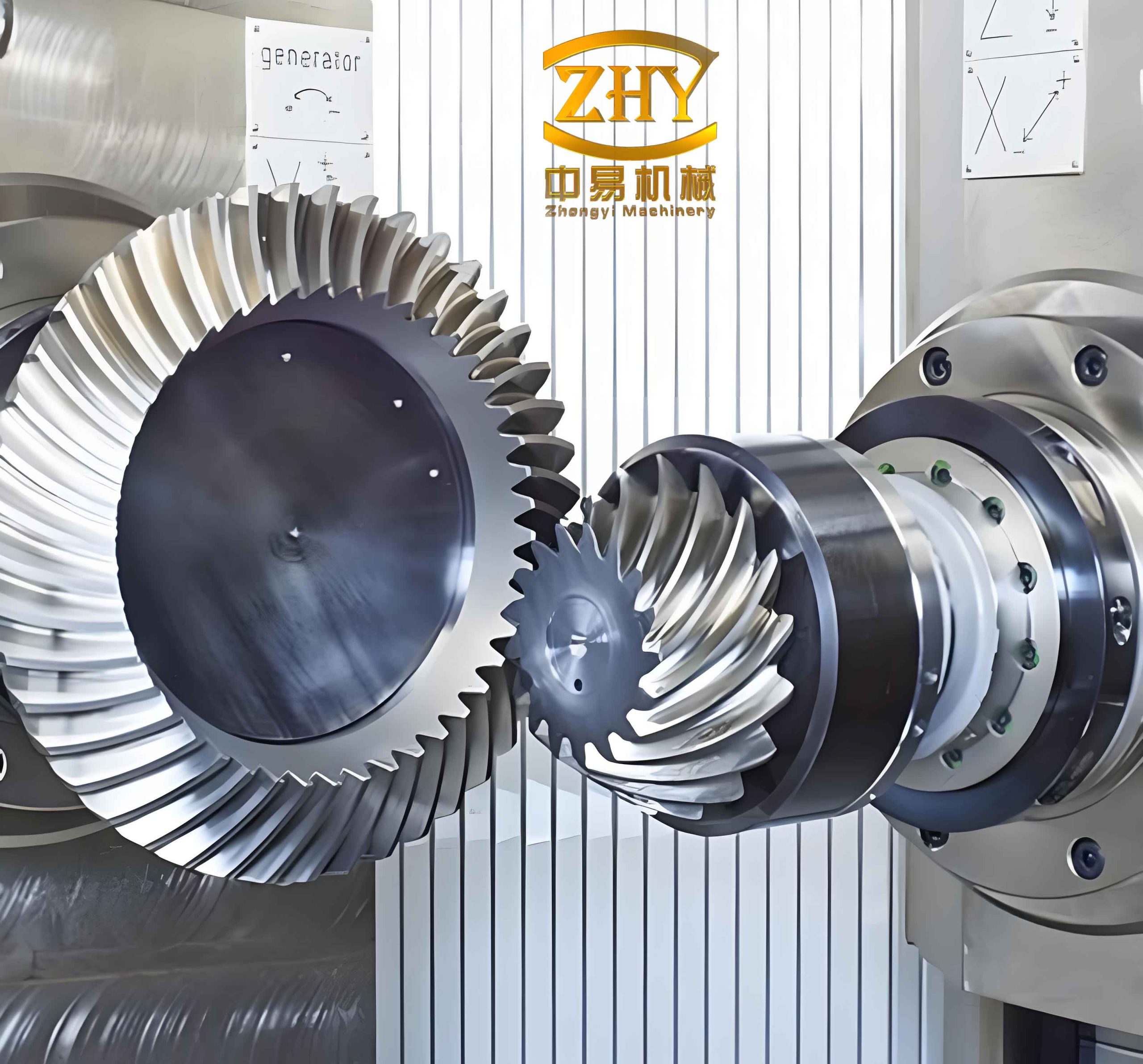
The evolution of power transmission systems, particularly in demanding sectors like aerospace, continually drives the need for more compact, efficient, and adaptable gearing solutions. Among these, the hyperboloid gear, more commonly known as the hypoid gear, stands out for its unique capabilities. Its defining characteristic is the axial offset between the pinion and gear axes, which allows for non-intersecting shafts. This offset, combined with the ability to have different spiral angles on the mating members, grants exceptional design flexibility. Hypoid gears enable more compact assemblies, improved load distribution, and the ability to navigate tight spatial constraints often found in advanced machinery. A prime example is in helicopter main transmissions, where drivelines frequently require power transfer between shafts arranged at non-standard, often obtuse, angles. The conventional orthogonal hypoid gear, with a standard shaft angle of 90 degrees, cannot fulfill these specific configurations. This has led to the exploration and development of non-orthogonal hypoid gears, specifically those designed for obtuse shaft angles exceeding 90 degrees. However, designing such gears presents significant challenges. Extreme geometric conditions can lead to non-converging solutions for fundamental design parameters and machine tool settings, making the precise control of the tooth surface geometry and its subsequent contact behavior exceptionally difficult. This article details a comprehensive methodology for the geometric design, contact behavior pre-setting, and defect avoidance for face-milled hypoid gears operating under obtuse shaft angle conditions.
Hypoid gears can be systematically classified based on the shaft angle, Σ, formed by their non-intersecting axes. The traditional and most common type is the orthogonal hypoid gear, where Σ = 90°. When the shaft angle deviates from 90°, the gear pair is termed a non-orthogonal hypoid gear. This category is further divided into two subsets: hypoid gears with small shaft angles (0° < Σ < 90°) and the focal point of this work, hypoid gears with obtuse shaft angles (Σ > 90°). The geometry of the pitch cone, particularly that of the gear, undergoes a critical transformation as the shaft angle increases beyond 90 degrees. In standard designs, the pitch cone is an external cone. However, for an obtuse shaft angle configuration, as the gear’s pitch cone angle, γ_{m2}, increases, it can exceed 90°. When γ_{m2} > 90°, the pitch cone conceptually inverts, becoming an internal cone. Therefore, obtuse shaft angle hypoid gears are additionally categorized by their pitch cone morphology: the external cone form (γ_{m2} < 90°) and the internal cone form (γ_{m2} > 90°). This distinction is fundamental, as the internal cone form presents unique challenges in manufacturing and parameter selection.
The cornerstone of designing any hypoid gear pair lies in establishing the geometry of its pitch cones—the imaginary cones that roll together without sliding at the mean point of contact. For an obtuse shaft angle configuration, the spatial relationship between the pinion and gear pitch cones is governed by three fundamental geometric conditions derived from their tangency at a designated reference point M. The first condition relates the shaft angle Σ, the pinion pitch cone angle γ_{m1}, the gear pitch cone angle γ_{m2}, and the difference in spiral angles at M, denoted β_{12} = β_1 – β_2. This relationship is expressed as:
$$ \cos \beta_{12} = \frac{\cos \Sigma}{\cos \gamma_{m1} \cos \gamma_{m2}} + \tan \gamma_{m1} \tan \gamma_{m2} $$
The second condition establishes the relationship between the velocity ratio i_{12} (gear ratio) and the geometry at point M:
$$ i_{12} = \frac{r_{m2} \cos \beta_1}{r_{m1} \cos \beta_2} $$
Here, r_{m1} and r_{m2} are the mean pitch radii of the pinion and gear, respectively. The third condition involves auxiliary parameters to solve for the cone distances and offsets. For the internal cone form (γ_{m2} > 90°), the derivation follows a similar logic but accounts for the inverted cone geometry. A key design step is determining the initial pitch cone angle for the gear, which serves as a guideline for choosing between the external and internal cone forms. This initial value is estimated as:
$$ \gamma_{m2}^{0} = \arctan \left( \frac{\sin \Sigma}{i_{12} + 1.2 \cos \Sigma} \right) $$
If γ_{m2}^{0} > 90°, the design strongly favors the internal cone form; otherwise, the external cone form is applicable. To prevent manufacturing issues associated with internal cones in high-volume production (specifically tool interference in conventional gear generators), a maximum allowable gear ratio for the external cone form can be defined:
$$ i_{12}^{max} = \frac{1}{1 – \cos \Sigma} $$
This equation helps delineate the feasible design space. The selection boundaries based on shaft angle and gear ratio can be visualized in a closed diagram, which is an essential tool for the initial design phase of an obtuse shaft angle hyperboloid gear.
Following the pitch cone design, the gear blank dimensions must be calculated. Parameters such as outer diameter, face width, pitch apex beyond crossing point, and root angles are determined based on standard calculation procedures. For hypoid gears produced via the face-milling process, three primary tooth taper systems are applicable: Standard Taper, Duplex Taper, and Modified Duplex Taper (also known as root tilt). The choice among these affects the sum of the pinion and gear root angles (Σθ_f). Their formulas are:
Standard Taper:
$$ \Sigma \theta_{fs} = \arctan \left( \frac{h_{fm1}}{R_{m2}} \right) + \arctan \left( \frac{h_{fm2}}{R_{m2}} \right) $$
Modified Duplex Taper:
$$ \Sigma \theta_{fc} = \arctan \left( \frac{90 \sin \beta_m}{R_{e2} \cos \alpha_n \cos \beta_m} \cdot \frac{m_{et}}{r_{co}} \right) $$
Duplex Taper:
$$ \Sigma \theta_{fd} = \min ( \Sigma \theta_{fc}, 1.3 \cdot \Sigma \theta_{fs} ) $$
Where h_{fm} is the mean dedendum, R_{m2} is the mean cone distance of the gear, R_{e2} is the outer cone distance, m_{et} is the outer transverse module, α_n is the normal pressure angle, and r_{co} is the cutter radius. The geometric design process for an obtuse shaft angle hyperboloid gear is generally not highly sensitive to the choice among these taper systems, and a suitable one can be selected based on other design priorities.
| Blank Parameter | Symbol | Description |
|---|---|---|
| Pitch Apex beyond Crossing | Z_m | Distance from pitch cone apex to crossing point of axes. |
| Face Apex beyond Crossing | Z_a | Distance from face cone apex to crossing point. |
| Root Apex beyond Crossing | Z_f | Distance from root cone apex to crossing point. |
| Outer Cone Distance | R_e | Distance from crossing point to outer end of tooth. |
| Face Angle | γ_a | Angle of the face cone. |
| Root Angle | γ_f | Angle of the root cone. |
The precise control of the meshing behavior—the contact pattern and transmission error—is critical for the performance, noise, and durability of a hyperboloid gear pair. This is achieved through a methodology known as Local Synthesis, which calculates the machine-tool settings required to generate pinion tooth surfaces with predetermined local geometric properties at the reference contact point. For the gear member, which is form-cut (using the Formate or HFT method), the machine settings (radial setting S_R, angular setting q_R, machine root angle M_R, sliding base setting B_M, and work offset A_M) are calculated directly from the blank data and cutter geometry. The pinion, however, is generated via a multi-axis process. The Local Synthesis method starts by prescribing three key conditions at the reference point on the gear tooth surface: the semi-major axis length L_ce of the contact ellipse, the angle θ_cr between the contact path and the root line, and the first derivative of the transmission error function, m’. From these prescribed conditions and the known principal curvatures and directions of the gear surface at the reference point, the corresponding principal curvatures and directions required on the pinion surface are computed. These are then used to solve for the complete set of machine-tool settings for the pinion’s convex and concave flanks separately, including parameters like cutter radial setting S_r, tilt angle i, swivel angle j, and machine root angle M_r.
| Preset Parameter | Symbol | Design Objective |
|---|---|---|
| Contact Ellipse Semi-Major Axis | L_ce | Controls the size and intensity of the contact patch. |
| Contact Path Direction | θ_cr | Orients the contact pattern diagonally across the tooth face for stability. |
| Transmission Error Slope | m’ | Pre-defines the linear function of transmission error, influencing noise characteristics. |
Designing an obtuse shaft angle hyperboloid gear requires vigilant avoidance of several potential tooth surface defects that become more probable under extreme geometric conditions. Three critical issues must be addressed:
1. Tool Interference in Internal Cone Form: When the gear pitch cone is internal (γ_{m2} > 90°), a conventional generating machine tool may physically interfere with the gear blank, making cutting impossible in a standard setup. This necessitates either the use of a 5-axis CNC mill (sacrificing efficiency) or, preferably, designing within the external cone form boundary defined by i_{12}^{max}.
2. Undercut (Root Fillet Interference): The pinion of an obtuse shaft angle hypoid gear is particularly susceptible to undercut, where the generating tool cuts into the active profile of the tooth. This is predicted by identifying singular points on the generated surface. By adjusting design parameters, such as reducing the gear addendum coefficient, these singular points can be moved outside the boundaries of the active tooth profile, thus avoiding undercut.
3. Non-Smooth Root Fillet Transition: Since the pinion’s convex and concave flanks are cut with separate machine settings, a sharp ridge or mismatched geometry can occur along the root line where the two flanks meet. To ensure a smooth transition, an iterative optimization is performed on the machine root angle settings (M_{r,convex} and M_{r,concave}). The objective is to minimize a “crossover angle” metric (σ_Σ) that quantifies the deviation of the root lines from the ideal root cone, while ensuring the crossover point lies within the tooth space.
Once the geometric and machine-tool parameters are determined, a digital twin of the gear pair is constructed. The tooth surfaces are modeled mathematically through a series of coordinate transformations governed by the machine kinematics and the cutter geometry. This results in a point cloud that accurately defines the pinion and gear flanks. A highly efficient Tooth Contact Analysis (TCA) algorithm is then employed to simulate the meshing of these precise surfaces. For an obtuse shaft angle hyperboloid gear, a robust TCA method is essential. The algorithm searches for points of contact by solving the condition of position vector coincidence and surface normal collinearity between the pinion and gear surfaces under a prescribed motion. To accurately trace the boundary of the contact ellipse, a fixed-interval search technique is used, where points on the gear surface are found that are at a fixed normal distance (e.g., 0.00635 mm, simulating the thickness of marking compound) from the pinion surface at a given instant of mesh. This method quickly yields the contact pattern path and the transmission error function across the roll angle.
$$ \mathbf{r}_g^{(2)}(u_w, \beta_w, \phi_2′) – \mathbf{r}_g^{(1)}(u_p, \beta_p, \phi_p, \phi_1′) = 0 $$
$$ \mathbf{n}_g^{(2)}(u_w, \beta_w, \phi_2′) + \mathbf{n}_g^{(1)}(u_p, \beta_p, \phi_p, \phi_1′) = 0 $$
Where $\mathbf{r}_g$ and $\mathbf{n}_g$ are the position and unit normal vectors in the global coordinate system, $u$ and $\beta$ are surface parameters, and $\phi’$ are rotation angles. To complement the unloaded TCA, a Loaded Tooth Contact Analysis (LTCA) is performed using Finite Element Analysis (FEA). A sector of the gear with several teeth is meshed with refined elements in the contact zone. A torque is applied to the gear, and the resulting contact pressure distribution and load-induced transmission error are computed. The results from the prescribed Local Synthesis, the unloaded TCA, and the loaded LTCA should be consistent, providing a multi-faceted validation of the designed meshing behavior before physical manufacturing.
The validity of the entire design and analysis methodology must be confirmed through physical testing. A pair of obtuse shaft angle hyperboloid gears is manufactured based on the calculated parameters. A dedicated four-axis rolling test rig is constructed for this purpose. The key feature of this rig is its modularity, allowing for precise adjustment of both the shaft angle Σ and the offset distance E to match the design specifications exactly. When the shaft angle is adjusted, the change in the center distance between the input and output shafts is automatically compensated for by programmable linear stages in the X and Y directions, according to the formulas:
$$ \Delta X = d \left( \sin \frac{\Sigma + \Delta \Sigma}{2} – \sin \frac{\Sigma}{2} \right) $$
$$ \Delta Y = d \left( \cos \frac{\Sigma}{2} – \cos \frac{\Sigma + \Delta \Sigma}{2} \right) $$
where d is a fixed machine constant. Under slow-speed, light-load conditions, the gears are run with marking compound applied to the teeth. The resulting contact pattern on the gear teeth is then inspected. A successful design is demonstrated when the physical contact imprint closely matches the location, size, and orientation predicted by the TCA simulation. Furthermore, the smoothness of operation and the absence of edge contact or harshness qualitatively validate the controlled transmission error and the effectiveness of the defect-avoidance strategies. This alignment between the prescriptive design, digital simulation, and empirical test result forms a conclusive verification loop for the proposed methodology.
In conclusion, this work presents a systematic and validated approach for tackling the complex problem of designing hypoid gears for obtuse shaft angle applications. The methodology encompasses a rigorous geometric foundation for both external and internal pitch cone forms, complete with clear selection boundaries. It integrates an advanced Local Synthesis technique for proactively setting desirable meshing characteristics and incorporates specific strategies to avoid critical manufacturing and performance defects like tool interference, undercut, and poor root fillet transition. The development of a robust digital modeling and contact analysis framework, coupled with a flexible physical testing platform, ensures that the design can be thoroughly verified before commitment to production. This comprehensive approach enables the reliable application of hyperboloid gear technology in advanced mechanical systems where space constraints and specific shaft arrangements demand the unique capabilities of non-orthogonal, obtuse-angle power transmission.