
In the realm of mechanical transmission systems, spiral gears, particularly those with involute tooth profiles, play a crucial role in transmitting motion and power between non-intersecting and non-parallel shafts. While spiral gears are less commonly used for heavy-duty power transmission due to challenges in grinding, their geometric principles are extensively applied in gear manufacturing processes such as hobbing, shaving, turning, and grinding with worm-shaped tools. This article delves into the geometric fundamentals of spiral gear meshing, employing concepts from differential geometry and analytic geometry to simplify complex interactions. By introducing the notion of a “projection rack,” the meshing problem between two spiral gears is transformed into a more manageable gear-and-rack engagement scenario. This approach not only clarifies the underlying geometry but also facilitates the analysis of key parameters like overlap ratio, tight meshing conditions, interference avoidance, and the meshing zone. The insights presented here are directly applicable to various gear machining techniques, including gear hobbing, shaving, turning, and worm grinding, which all rely on the principles of spiral gear meshing.
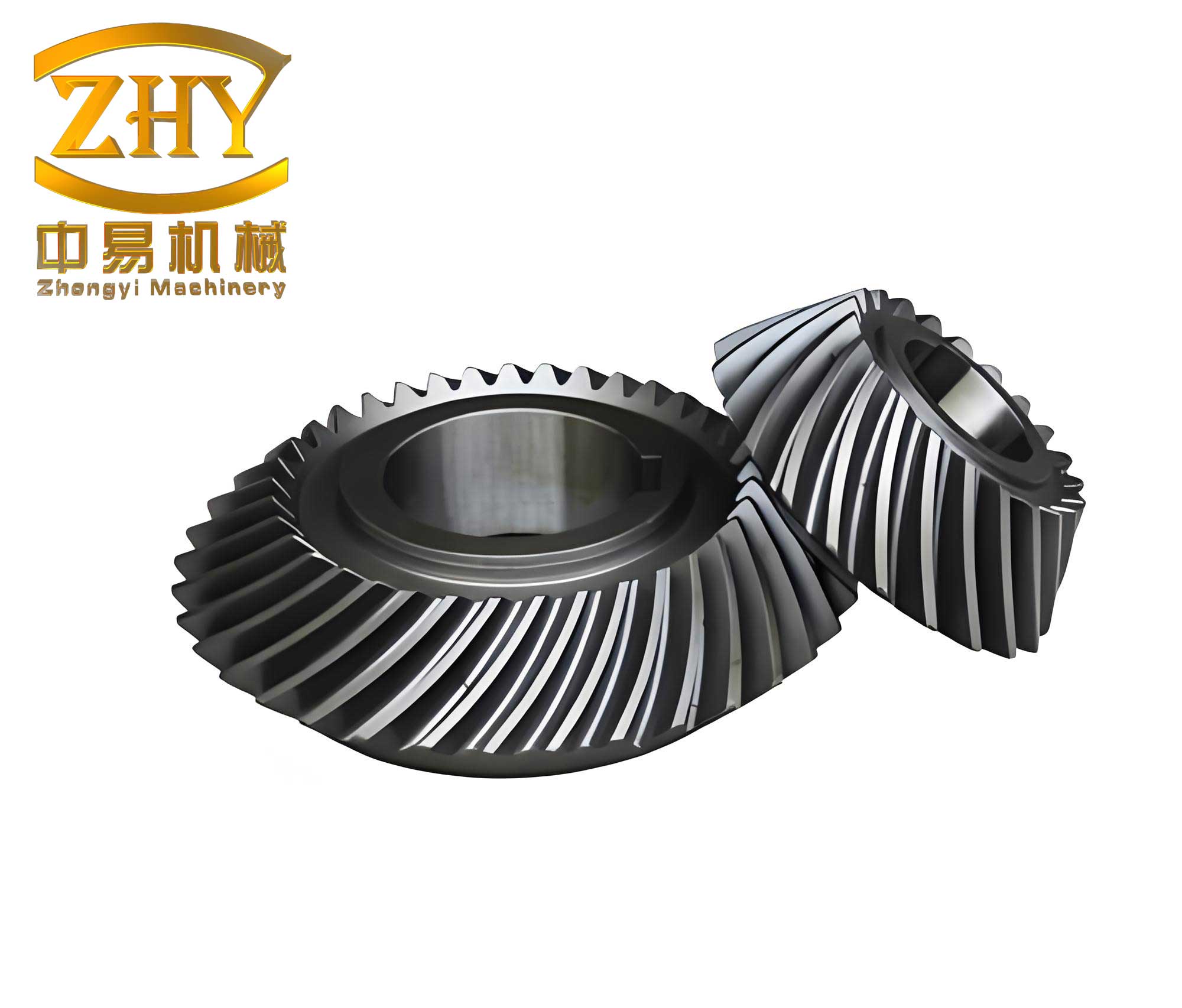
The core idea revolves around representing the spiral gear surface mathematically and projecting it onto a plane to form a virtual rack. This projection rack serves as a common intermediary between two spiral gears, allowing their meshing geometry to be analyzed through standard gear-and-rack theory. In this context, I will explore the parametric equations of involute spiral surfaces, derive meshing conditions, and establish relationships between axial distance, shaft angle, and gear parameters. Throughout this discussion, the term “spiral gear” will be emphasized to underscore the focus on helical or spiral tooth forms. The analysis will incorporate numerous formulas and tables to summarize key relationships, ensuring a comprehensive understanding of spiral gear behavior.
Fundamental Definitions and Symbols
To maintain clarity, let’s define the primary symbols used in the analysis of spiral gear meshing. These symbols correspond to geometric parameters of spiral gears and their projection racks.
| Symbol | Definition |
|---|---|
| \( r \) | Pitch circle radius (radius of the rolling circle in meshing with a rack). |
| \( r_0 \) | Standard pitch circle radius (radius when meshing with a standard rack). |
| \( r_b \) | Base circle radius. |
| \( r_a \) | Tip circle radius. |
| \( \beta \) | Helix angle on the pitch cylinder (angle between gear axis and rack tooth direction). |
| \( \beta_0 \) | Helix angle on the standard pitch circle. |
| \( \beta_b \) | Helix angle on the base circle. |
| \( \beta_a \) | Helix angle on the tip circle. |
| \( p_n \) | Normal tooth pitch on the pitch circle. |
| \( p_{n0} \) | Normal tooth pitch on the standard pitch circle. |
| \( p_{nb} \) | Normal tooth pitch on the base circle. |
| \( p_t \) | Transverse tooth pitch on the pitch circle. |
| \( p_{t0} \) | Transverse tooth pitch on the standard pitch circle. |
| \( p_{tb} \) | Transverse tooth pitch on the base circle. |
| \( p_x \) | Axial tooth pitch. |
| \( m_n \) | Normal module. |
| \( m_t \) | Transverse module. |
| \( m \) | Module of a spur gear. |
| \( \alpha_n \) | Normal pressure angle of the rack. |
| \( \alpha_t \) | Transverse pressure angle of the rack (pressure angle on the pitch circle). |
| \( \alpha_{n0} \) | Normal pressure angle of the standard rack (tool angle). |
| \( \alpha_{t0} \) | Transverse pressure angle of the standard rack. |
| \( \alpha \) | Pressure angle of a spur gear (meshing angle). |
| \( \alpha_0 \) | Tool angle of a spur gear. |
| \( L \) | Lead of the spiral surface. |
| \( z \) | Number of teeth. |
| \( A \) | Center distance (length of the common perpendicular between shafts). |
| \( \Sigma \) | Shaft angle (angle between the two axes). |
These parameters are interlinked through geometric relationships that govern spiral gear design. For instance, the helix angles at different circles relate to the base circle radius and lead. The normal base pitch \( p_{nb} \) remains constant regardless of the helix angle \( \beta \), ensuring that spiral gears cut with the same tool can mesh correctly. This invariance is key to the universality of spiral gear applications.
Projection of the Involute Spiral Surface
The involute spiral surface is a developable ruled surface generated by a straight line (generator) that is tangent to a helix on the base cylinder. Let’s establish a coordinate system where the z-axis aligns with the gear axis. The surface can be parameterized using coordinates \( \phi \) and \( \psi \), where \( \phi \) represents the angular position and \( \psi \) governs the generator’s position. The vector equation of the surface is:
$$ \mathbf{r} = \mathbf{r}_b + \psi \mathbf{t}, $$
where \( \mathbf{r}_b \) is the position vector on the base helix, and \( \mathbf{t} \) is the unit tangent vector along the generator. In cylindrical coordinates, this becomes:
$$ x = r_b \cos \phi – \psi \sin \beta_b \sin \phi, $$
$$ y = r_b \sin \phi + \psi \sin \beta_b \cos \phi, $$
$$ z = \psi \cos \beta_b + \frac{L}{2\pi} \phi. $$
Here, \( L \) is the lead of the spiral, and \( \beta_b \) is the helix angle on the base circle. The normal vector to the surface is derived from the cross product of partial derivatives, yielding conditions for projecting the surface onto a plane. When projecting along lines that form an angle \( \beta \) with the gear axis, the projected curves correspond to straight lines on the rack. This leads to the concept of the “projection rack,” where the gear’s spiral surface maps to a rack with straight-sided teeth in the projection plane. The rack’s tooth profile is essentially the gear’s tooth profile in normal section.
The effective height of the rack is determined by the intersection of the projected generator with the tip cylinder. It varies with the projection angle \( \beta \), influencing the length of the involute and transition curves on the gear tooth. The maximum effective height occurs when \( \beta \) equals the helix angle on the tip cylinder, and it equals the base circle radius. The normal pressure angle \( \alpha_n \) of the projection rack relates to the transverse pressure angle \( \alpha_t \) via the helix angle:
$$ \tan \alpha_n = \tan \alpha_t \cos \beta. $$
This relationship is fundamental in spiral gear design, as it connects the tool geometry to the resulting gear tooth. Moreover, the normal base pitch \( p_{nb} \) is constant, given by:
$$ p_{nb} = p_{n0} \cos \alpha_{n0} = \pi m_n \cos \alpha_{n0}. $$
This constancy ensures that spiral gears manufactured with the same tool will have compatible meshing properties, regardless of the helix angle adjustment during cutting.
Meshing Conditions and Transmission Ratio for Spiral Gears
For two spiral gears to mesh properly, they must both engage correctly with a common projection rack. This implies that their normal base pitches must be equal. Since the normal base pitch is a function of the normal module and normal pressure angle, the meshing condition can be stated as:
$$ m_{n1} \cos \alpha_{n01} = m_{n2} \cos \alpha_{n02}. $$
In practice, for standard gears, this simplifies to requiring equal normal modules and normal pressure angles. The transmission ratio \( i \) between two spiral gears is derived from the ratio of their base circle radii and helix angles. For gears 1 and 2:
$$ i = \frac{\omega_1}{\omega_2} = \frac{r_{b2} \cos \beta_{b2}}{r_{b1} \cos \beta_{b1}}. $$
Using the relationship between base radius and pitch radius, this can be expressed in terms of tooth numbers and helix angles:
$$ i = \frac{z_2}{z_1} = \frac{r_{b2} \cos \beta_{b2}}{r_{b1} \cos \beta_{b1}}. $$
This shows that the transmission ratio depends solely on the base geometry and is independent of the center distance and shaft angle, as long as meshing is maintained. This characteristic is pivotal in applications like gear hobbing, where the tool and workpiece maintain a fixed relative motion to generate the correct tooth form.
Relationship Between Shaft Angle and Helix Angles
When two spiral gears mesh, their shaft angle \( \Sigma \) is related to the helix angles on their pitch cylinders. For gears with the same hand of helix, the shaft angle is the sum of the helix angles; for opposite hands, it is the difference. Mathematically:
$$ \Sigma = \beta_1 + \beta_2 \quad \text{(same hand)}, $$
$$ \Sigma = |\beta_1 – \beta_2| \quad \text{(opposite hand)}. $$
Using the projection rack concept, we can derive explicit formulas linking \( \Sigma \), the pitch radii, and the normal pressure angles. For instance, the pitch radius \( r \) relates to the base radius and helix angle:
$$ r = \frac{r_b}{\cos \beta_b}. $$
Combining this with the meshing condition yields expressions for \( \beta_1 \) and \( \beta_2 \) in terms of \( \Sigma \). A key result is that for a given shaft angle, the pitch radii are determined, and thus the projection rack is uniquely defined. This allows the spiral gear meshing problem to be fully parameterized by \( \Sigma \) and the center distance \( A \). The following table summarizes some key relationships:
| Parameter | Expression in Terms of \( \Sigma \) |
|---|---|
| \( \beta_1 \) | \( \beta_1 = \arctan\left( \frac{\sin \Sigma}{\cos \Sigma + \frac{r_{b2}}{r_{b1}} } \right) \) |
| \( \beta_2 \) | \( \beta_2 = \Sigma – \beta_1 \) |
| Pitch radius \( r_1 \) | \( r_1 = \frac{r_{b1}}{\cos \beta_1} \) |
| Normal pressure angle \( \alpha_{n1} \) | \( \alpha_{n1} = \arctan( \tan \alpha_{t1} \cos \beta_1 ) \) |
These formulas enable the design of spiral gear pairs with specified shaft angles, ensuring proper meshing without interference.
Meshing Line and Meshing Zone Analysis
The meshing line is the locus of contact points between two spiral gears during engagement. Through the projection rack model, it can be shown that the meshing line is a straight line that is tangent to both base cylinders and perpendicular to the rack tooth surface. In coordinate form, the meshing line equation is derived from the intersection of two planes, each representing the meshing plane of a gear with the common rack. The vector equation of the meshing line is:
$$ \mathbf{R} = \mathbf{R}_0 + \lambda \mathbf{d}, $$
where \( \mathbf{d} \) is the direction vector parallel to the rack tooth normal, and \( \lambda \) is a parameter. The distance from the meshing line to the common perpendicular between the shafts is given by:
$$ y = \frac{A \sin(\alpha_{n1} – \alpha_{n2})}{\sin \alpha_{n1} \cos \alpha_{n2} + \cos \alpha_{n1} \sin \alpha_{n2}}. $$
When \( y = 0 \), the meshing line intersects the common perpendicular, leading to “normal meshing.” In this case, the center distance equals the sum of the pitch radii:
$$ A = r_1 + r_2. $$
Normal meshing is a special condition often assumed in textbooks, but general spiral gear meshing allows for non-intersecting meshing lines, which affects the overlap ratio and contact patterns. The meshing zone is the region in the parameter space of \( A \) and \( \Sigma \) where meshing is feasible without interference or insufficient contact. It is bounded by curves for the overlap ratio, tight meshing, and non-undercutting conditions.
Overlap Ratio and Its Maximization
The overlap ratio \( \epsilon \) measures the continuity of contact in spiral gear meshing. It is defined as the ratio of the meshing length to the base pitch. From geometry, the meshing length \( L_m \) is the distance between the intersections of the meshing line with the tip circles of both gears. For a spiral gear pair, \( L_m \) can be expressed as:
$$ L_m = \sqrt{r_{a1}^2 – r_{b1}^2} + \sqrt{r_{a2}^2 – r_{b2}^2} – A \sin \alpha_t, $$
where \( \alpha_t \) is the transverse pressure angle. The overlap ratio is then:
$$ \epsilon = \frac{L_m}{p_{nb}}. $$
Substituting the expressions for base pitch and meshing length yields a formula in terms of gear parameters and shaft angle. For practical design, \( \epsilon \) must exceed 1 to ensure smooth transmission. The overlap ratio can be maximized with respect to the center distance and shaft angle. Interestingly, for a fixed center distance, the maximum overlap ratio occurs under normal meshing conditions (\( y = 0 \)). This implies that normal meshing not only simplifies geometry but also optimizes contact continuity. The following table shows how \( \epsilon \) varies with \( \Sigma \) for a sample spiral gear pair:
| Shaft Angle \( \Sigma \) (degrees) | Overlap Ratio \( \epsilon \) |
|---|---|
| 20 | 1.2 |
| 30 | 1.5 |
| 40 | 1.8 |
| 50 | 1.7 |
This trend highlights the importance of selecting appropriate shaft angles to achieve desired meshing performance in spiral gear systems.
Tight Meshing and Its Equations
Tight meshing refers to the condition where both sides of the gear teeth are in contact, as in gear generation processes. The tight meshing equation relates the center distance \( A \) and shaft angle \( \Sigma \) such that the gear teeth fit perfectly without backlash. Using the projection rack model, the rack’s mean line (where tooth thickness equals space width) is determined, and its distance to each gear axis sums to \( A \). The derivation yields:
$$ A = r_1 + r_2 + \Delta A, $$
where \( \Delta A \) is a correction term depending on the tooth thickness modifications. For standard gears, \( \Delta A = 0 \). In general, the tight meshing equation is:
$$ A = \frac{r_{b1}}{\cos \beta_1} + \frac{r_{b2}}{\cos \beta_2} + \frac{m_n}{2} \left( \frac{\pi}{2} + 2 \tan \alpha_{n0} \Delta x \right), $$
where \( \Delta x \) is the profile shift coefficient. This equation allows for the design of modified spiral gears by adjusting either \( A \) or \( \Sigma \). When \( \Delta A = 0 \), we have standard tight meshing. The minimum center distance for tight meshing occurs under normal meshing conditions, demonstrating that normal meshing is also the most compact arrangement. This minimizes the overall size of spiral gear drives while maintaining full tooth contact.
Minimum Width and Axial Movement Range
To fully utilize the meshing length, spiral gears must have sufficient face width. The minimum width \( B_{\min} \) is the axial projection of the meshing length. For gear 1:
$$ B_{\min1} = \frac{L_m \sin \beta_1}{\cos \alpha_n}. $$
Similarly, for gear 2. If the width is insufficient, the meshing line may extend beyond the gear edges, reducing the effective overlap ratio and causing edge contact. Additionally, the axial position of the gears relative to the common perpendicular must be controlled to keep the meshing line within the face width. The allowable axial movement range \( \Delta z \) is derived from the intersection of the meshing line with the tip cylinders. For gear 1:
$$ \Delta z_1 = \frac{\sqrt{r_{a1}^2 – r_{b1}^2} \tan \beta_1}{\cos \alpha_n}. $$
This ensures that the entire meshing path is covered during operation. In reversible drives, the width must be doubled to accommodate both directions of rotation. These considerations are critical in spiral gear layout to prevent premature wear and noise.
Non-Undercutting Conditions and Minimum Tooth Number
Undercutting (or root cutting) occurs when the tool removes too much material from the gear root, weakening the tooth. For spiral gears, the non-undercutting condition requires that the tip of the projection rack does not extend beyond the tangent point of the meshing line with the base cylinder. Mathematically, for gear 2 meshing with gear 1 acting as a rack:
$$ \sqrt{r_{a1}^2 – r_{b1}^2} \leq r_{b2} \tan \alpha_{t2}. $$
This inequality defines a region in the \( A-\Sigma \) plane where undercutting is avoided. The boundary curve is the “non-undercutting curve.” For standard spiral gears, the minimum tooth number to avoid undercutting is given by:
$$ z_{\min} = \frac{2 h_a^*}{\sin^2 \alpha_t}, $$
where \( h_a^* \) is the addendum coefficient. This is similar to spur gears but adjusted for the transverse pressure angle. In spiral gears, due to helix angle effects, the effective tooth number is higher, so undercutting is less likely. However, for small spiral gears or large profile shifts, verification is necessary. The minimum tooth number can be reduced by increasing the helix angle, offering design flexibility.
Synthesis of the Meshing Zone
The meshing zone is the feasible domain for spiral gear parameters, bounded by constraints on overlap ratio, tight meshing, and non-undercutting. Graphically, in the \( A-\Sigma \) plane, the meshing zone is enclosed by curves for \( \epsilon = 1 \), tight meshing equation, and non-undercutting condition. The normal meshing curve lies within this zone, often at the optimum for overlap ratio. Designers must select \( A \) and \( \Sigma \) within this zone to ensure reliable spiral gear performance. For example, if the tight meshing curve falls below the non-undercutting curve, undercutting may occur even in tight meshing, necessitating careful parameter selection. The following table summarizes key boundaries:
| Boundary | Equation | Significance |
|---|---|---|
| Overlap Ratio \( \epsilon = 1 \) | \( L_m = p_{nb} \) | Minimum for continuous meshing |
| Tight Meshing | \( A = r_1 + r_2 + \Delta A \) | Zero-backlash condition |
| Non-Undercutting | \( \sqrt{r_{a1}^2 – r_{b1}^2} = r_{b2} \tan \alpha_{t2} \) | Avoidance of root interference |
By analyzing these boundaries, engineers can optimize spiral gear pairs for specific applications, balancing size, strength, and smoothness of operation. The projection rack method simplifies this analysis by reducing complex 3D gear interactions to 2D rack geometry.
Conclusion
In summary, the geometric principles of spiral gear meshing are profoundly elucidated through the projection rack concept, which transforms intricate gear-to-gear engagement into a more tractable gear-and-rack problem. This approach leverages differential and analytic geometry to derive fundamental relationships for meshing conditions, transmission ratios, shaft angles, overlap ratios, tight meshing, and non-undercutting. The key takeaway is that spiral gear behavior is governed by invariant parameters like the normal base pitch, while adjustable factors such as helix angle and center distance offer design flexibility. The meshing zone concept integrates all constraints, providing a comprehensive framework for spiral gear design and analysis. These principles are directly applicable to gear manufacturing processes, ensuring accuracy and efficiency in production. As spiral gears continue to be vital in precision machinery, a deep understanding of their geometry will drive innovations in transmission technology. The repeated emphasis on spiral gear throughout this discussion underscores its centrality in modern mechanical systems, where optimized meshing translates to enhanced performance and longevity.
Throughout this exploration, formulas and tables have been employed to encapsulate critical relationships, aiming for clarity and practicality. The mathematical rigor, combined with engineering insights, forms a solid foundation for advancing spiral gear applications. Future work may extend these principles to non-involute tooth profiles or dynamic loading conditions, but the core geometry presented here will remain essential. Ultimately, mastering the geometry of spiral gear meshing empowers designers to create more efficient, compact, and reliable gear drives, contributing to the evolution of mechanical engineering as a whole.