
Hyperboloidal gears, also known as hypoid gears, represent one of the most complex yet crucial components in modern power transmission systems, particularly in automotive drivetrains. Their unique geometry, characterized by offset and non-intersecting axes, allows for smoother operation, higher torque capacity, and more flexible design configurations compared to conventional bevel gears. The core of mastering hyperboloidal gear design lies in a thorough understanding of their three-dimensional geometrical relationships. This exposition delves into the methodology for determining the critical structural parameters of hyperboloidal gear pairs, focusing on a design principle where, disregarding backlash for initial derivation, the pinion tip cone is tangent to the wheel root cone and the pinion root cone is tangent to the wheel tip cone. By applying the established geometrical relationships of the pitch cones, we can systematically derive formulas for the pinion’s tip angle, root angle, and the axial locations of its tip and root cone apexes.
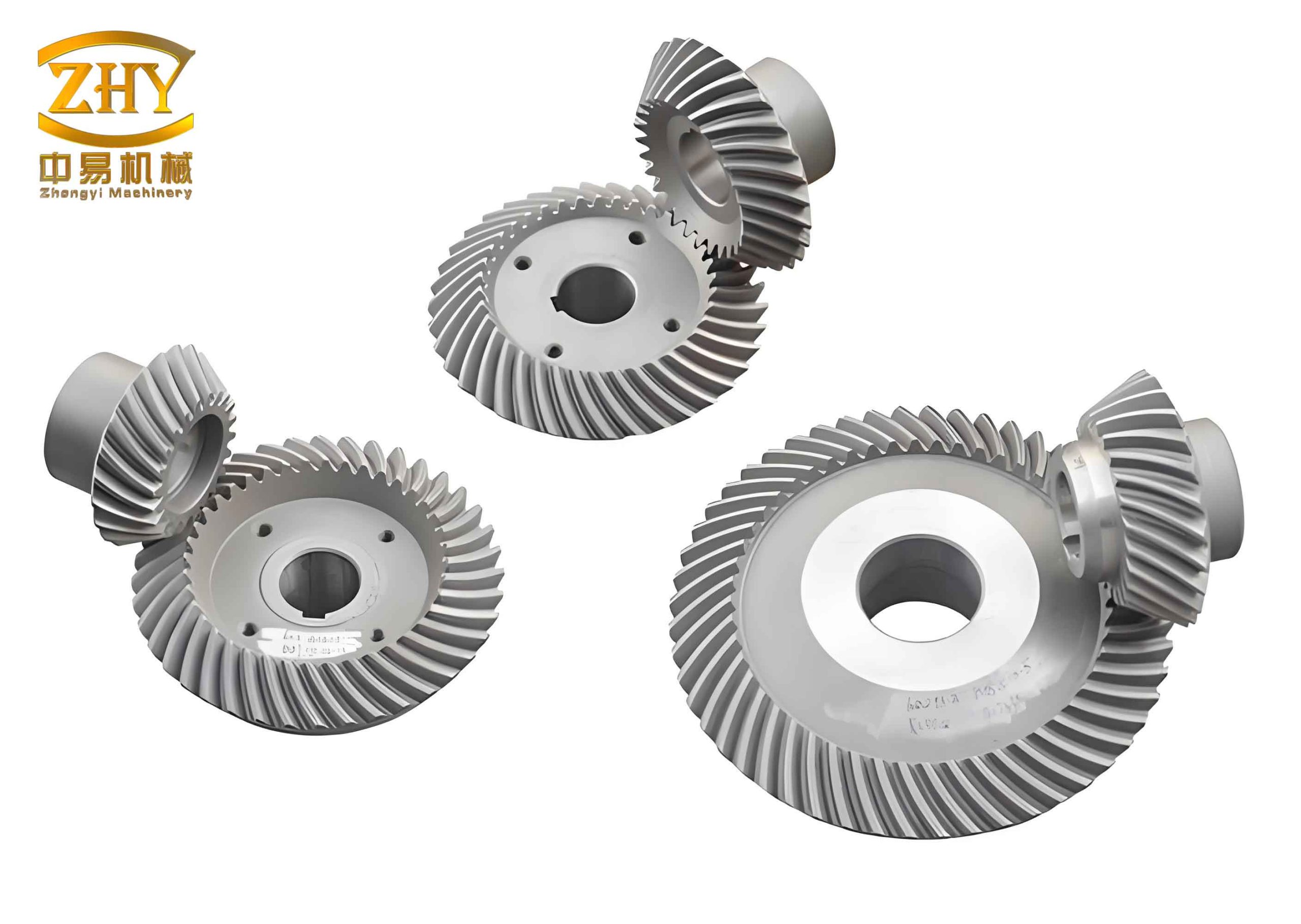
1. Fundamental Pitch Cone Geometry of Hyperboloidal Gears
The pitch cones of a hyperboloidal gear pair are conceptual cones that are in tangency along a line through the pitch point P. These cones form the basis for defining the gear blanks and are central to all subsequent geometrical calculations. The spatial arrangement is defined by several key parameters.
Let \( r_1 \) and \( r_2 \) be the pitch radii of the pinion and wheel, respectively, at the designated mid-point of the face width. The shaft angle is denoted by \( \Sigma \), which is most commonly \( 90^\circ \). The offset distance, the shortest distance between the two non-intersecting axes, is \( E \). The pinion and wheel pitch angles are \( \delta_1 \) and \( \delta_2 \). The offset angle \( \varepsilon \) is the angle between the line connecting the pitch point to the wheel axis (in the plane containing both axes) and the wheel axis itself. The spiral angles at the mid-point for the pinion and wheel are \( \beta_1 \) and \( \beta_2 \).
The three-dimensional relationship between these pitch cone parameters can be captured through a set of direction vectors and angles. Defining a coordinate system at the pitch point P with unit vectors \( \mathbf{e_1} \) along the wheel pitch cone element \( O_2P \), \( \mathbf{e_2} \) perpendicular to \( \mathbf{e_1} \) in the pitch plane (the common tangent plane to both pitch cones at P), and \( \mathbf{e_3} = \mathbf{e_1} \times \mathbf{e_2} \) normal to the pitch plane, we can express the unit direction vectors of the gear axes.
The unit vector along the pinion axis \( \mathbf{a_1} \) (directed from \( O_1 \) to \( K_1 \)) is:
$$ \mathbf{a_1} = \cos\delta_1 \cos\varepsilon \, \mathbf{e_1} + \cos\delta_1 \sin\varepsilon \, \mathbf{e_2} + \sin\delta_1 \, \mathbf{e_3} $$
The unit vector along the wheel axis \( \mathbf{a_2} \) (directed from \( O_2 \) to \( K_2 \)) is:
$$ \mathbf{a_2} = \cos\delta_2 \, \mathbf{e_1} – \sin\delta_2 \, \mathbf{e_3} $$
Further, the angles \( \zeta \) and \( \eta \) are defined as the angles between the plane containing the shortest center distance line \( C_1C_2 \) and the respective gear axis, and the planes perpendicular to \( C_1C_2 \) containing each axis. Their sines are given by:
$$ \sin\zeta = \frac{\cos\delta_1 \sin\varepsilon}{\sin\Sigma} $$
$$ \sin\eta = \frac{\cos\delta_2 \sin\varepsilon}{\sin\Sigma} $$
The cosine of the angle \( \theta \) between the gear axes in the projection perpendicular to the shortest distance line is:
$$ \cos\theta = \cos\delta_1 \cos\delta_2 \cos\varepsilon – \sin\delta_1 \sin\delta_2 $$
2. Determining Pitch Cone Apex Locations
A critical step in the structural design of hyperboloidal gears is locating the apex of each pitch cone relative to the crossing point of the gear axes. The distance from the wheel pitch cone apex \( O_2 \) to the crossing point \( C_2 \) on its axis is denoted \( G_2 \), and from the pinion pitch cone apex \( O_1 \) to \( C_1 \) is \( G_1 \).
For the wheel, referring to the geometrical layout, the distance \( Q_2 = C_2K_2 \) is found from the offset triangle:
$$ Q_2 = \frac{E}{\tan\eta \sin\zeta} $$
Consequently, the distance \( G_2 \) is:
$$ G_2 = O_2K_2 – Q_2 = \frac{r_2}{\sin\delta_2 \cos\delta_2} – \frac{E}{\tan\eta \sin\zeta} $$
This formula provides the location of the wheel pitch cone apex along its axis from the crossing point \( C_2 \).
Similarly, for the pinion, the distance \( Q_1 = C_1K_1 \) is:
$$ Q_1 = \frac{E}{\tan\eta \sin\zeta} $$
Thus, the distance \( G_1 \) is:
$$ G_1 = O_1K_1 – Q_1 = \frac{r_1}{\sin\delta_1 \cos\delta_1} – \frac{E}{\tan\eta \sin\zeta} $$
An alternative and often more useful expression for \( G_1 \) can be derived from the vector closure of the system around the shortest distance line \( \mathbf{C_1C_2} = E \mathbf{e_E} \), where \( \mathbf{e_E} = (\mathbf{a_1} \times \mathbf{a_2}) / \sin\Sigma \). Taking the scalar product with \( \mathbf{e_3} \) leads to a fundamental relationship:
$$ E \frac{\cos\delta_1 \cos\delta_2 \sin\varepsilon}{\sin\Sigma} = G_1 \sin\delta_1 + G_2 \sin\delta_2 $$
This equation is pivotal as it links the apex locations of both gears with the basic pitch cone parameters and the offset. Once \( G_2 \) is computed, \( G_1 \) can be found directly:
$$ G_1 = \frac{1}{\sin\delta_1} \left( E \frac{\cos\delta_1 \cos\delta_2 \sin\varepsilon}{\sin\Sigma} – G_2 \sin\delta_2 \right) $$
3. Structural Parameters of the Wheel
The wheel’s structural parameters are relatively straightforward to determine once its addendum and dedendum angles are known from tooth design considerations. Let \( \alpha_{a2} \) be the addendum angle and \( \alpha_{f2} \) be the dedendum angle of the wheel at the mean cone distance.
The tip (face) cone angle \( \delta_{a2} \) and the root cone angle \( \delta_{f2} \) are simply:
$$ \delta_{a2} = \delta_2 + \alpha_{a2} $$
$$ \delta_{f2} = \delta_2 – \alpha_{f2} $$
The mean cone distance of the wheel is \( R_2 = r_2 / \sin\delta_2 \).
The axial distances from the crossing point \( C_2 \) to the apexes of these cones, \( G_{a2} \) and \( G_{f2} \), are crucial for defining the wheel blank. Through geometrical analysis of the cone truncation, we find:
$$ G_{a2} = G_2 – \frac{R_2 \sin\alpha_{a2} – h_{a2} \cos\alpha_{a2}}{\sin\alpha_{a2}} $$
$$ G_{f2} = G_2 + \frac{R_2 \sin\alpha_{f2} – h_{f2} \cos\alpha_{f2}}{\sin\alpha_{f2}} $$
Here, \( h_{a2} \) and \( h_{f2} \) are the addendum and dedendum of the wheel at the mean cone distance. These formulas define the axial boundaries of the wheel’s active tooth zone.
4. Structural Parameters of the Pinion: The Tangency Principle
The determination of the pinion’s structural parameters is more intricate and employs a powerful conceptual model. The design principle states that, in the absence of backlash clearance, the pinion tip cone should be tangent to the wheel root cone, and the pinion root cone should be tangent to the wheel tip cone. This ensures full depth mesh without interference. We can treat these pairs of tangent cones as if they were pitch cones of two imaginary hyperboloidal gear pairs. This allows us to apply the fundamental pitch cone geometry equations derived earlier to solve for the unknown pinion angles and apex locations.
4.1 Pinion Tip Cone Parameters
Consider the imaginary gear pair formed by the pinion tip cone (as its “pitch” cone) and the wheel root cone (as its “pitch” cone). We assume the wheel’s pitch point remains at the same radius \( r_2 \), but its “pitch” angle is now the root angle \( \delta_{f2} \). For this imaginary pair, we can define an equivalent offset distance \( E \), shaft angle \( \Sigma \), and calculate new auxiliary angles \( \eta_f \) and \( \varepsilon_f \).
First, find the distance \( Q_{f2} \) from \( C_2 \) to the point where a perpendicular from \( C_2 \) meets the line along the wheel root cone element through P:
$$ Q_{f2} = \frac{\cos\delta_{f2}}{\cos\alpha_{f2}} R_2 – G_2 $$
Then, the equivalent angle \( \eta_f \) is:
$$ \tan\eta_f = \frac{E}{Q_{f2} \sin\zeta} $$
And the equivalent offset angle \( \varepsilon_f \) for this imaginary pair is:
$$ \sin\varepsilon_f = \frac{\sin\eta_f \sin\Sigma}{\cos\delta_{f2}} $$
Now, applying the fundamental pitch cone angle relationship (Eq. (3) analog) to this imaginary pair, where the wheel “pitch” angle is \( \delta_{f2} \) and the pinion “pitch” angle is the sought tip angle \( \delta_{a1} \), we have:
$$ \cos\theta = \cos\delta_{a1} \cos\delta_{f2} \cos\varepsilon_f – \sin\delta_{a1} \sin\delta_{f2} $$
Since \( \theta \) and \( \Sigma \) are known constants for the real gear pair, this equation can be solved numerically or algebraically for the pinion tip cone angle \( \delta_{a1} \).
With \( \delta_{a1} \) known, we use the apex location relationship (Eq. (10) analog) for the imaginary pair. The distance from the wheel root cone apex to \( C_2 \) is \( G_{f2} \). Therefore, the distance \( G’_{a1} \) from the pinion tip cone apex to \( C_1 \) for the imaginary pair (without clearance) is:
$$ E \frac{\cos\delta_{a1} \cos\delta_{f2} \sin\varepsilon_f}{\sin\Sigma} = G’_{a1} \sin\delta_{a1} + G_{f2} \sin\delta_{f2} $$
$$ G’_{a1} = \frac{1}{\sin\delta_{a1}} \left( E \frac{\cos\delta_{a1} \cos\delta_{f2} \sin\varepsilon_f}{\sin\Sigma} – G_{f2} \sin\delta_{f2} \right) $$
Finally, accounting for the required backlash clearance \( c \), the actual distance \( G_{a1} \) is reduced:
$$ G_{a1} = G’_{a1} – \frac{c}{\sin\delta_{a1}} $$
4.2 Pinion Root Cone Parameters
The procedure is perfectly analogous, considering the imaginary pair formed by the pinion root cone and the wheel tip cone. The wheel’s “pitch” angle is now its tip angle \( \delta_{a2} \).
First, calculate:
$$ Q_{a2} = \frac{\cos\delta_{a2}}{\cos\alpha_{a2}} R_2 – G_2 $$
$$ \tan\eta_a = \frac{E}{Q_{a2} \sin\zeta} $$
$$ \sin\varepsilon_a = \frac{\sin\eta_a \sin\Sigma}{\cos\delta_{a2}} $$
Apply the pitch cone angle relationship to solve for the pinion root cone angle \( \delta_{f1} \):
$$ \cos\theta = \cos\delta_{f1} \cos\delta_{a2} \cos\varepsilon_a – \sin\delta_{f1} \sin\delta_{a2} $$
Then, compute the uncorrected apex distance \( G’_{f1} \) using the wheel tip cone apex location \( G_{a2} \):
$$ G’_{f1} = \frac{1}{\sin\delta_{f1}} \left( E \frac{\cos\delta_{f1} \cos\delta_{a2} \sin\varepsilon_a}{\sin\Sigma} – G_{a2} \sin\delta_{a2} \right) $$
Applying the clearance correction gives the final pinion root cone apex location:
$$ G_{f1} = G’_{f1} – \frac{c}{\sin\delta_{f1}} $$
5. Summary of Design Formulas for Hyperboloidal Gears
The following table consolidates the key geometrical structure parameter design formulas for hyperboloidal gears derived from the pitch cone tangency principle.
| Parameter | Symbol | Formula | Note |
|---|---|---|---|
| Wheel Pitch Apex Distance | \( G_2 \) | $$ G_2 = \frac{r_2}{\sin\delta_2 \cos\delta_2} – \frac{E}{\tan\eta \sin\zeta} $$ | From basic layout. |
| Pinion Pitch Apex Distance | \( G_1 \) | $$ G_1 = \frac{1}{\sin\delta_1} \left( E \frac{\cos\delta_1 \cos\delta_2 \sin\varepsilon}{\sin\Sigma} – G_2 \sin\delta_2 \right) $$ | From vector closure. |
| Wheel Tip Cone Angle | \( \delta_{a2} \) | $$ \delta_{a2} = \delta_2 + \alpha_{a2} $$ | Direct sum. |
| Wheel Tip Apex Distance | \( G_{a2} \) | $$ G_{a2} = G_2 – \frac{R_2 \sin\alpha_{a2} – h_{a2} \cos\alpha_{a2}}{\sin\alpha_{a2}} $$ | Cone truncation geometry. |
| Wheel Root Cone Angle | \( \delta_{f2} \) | $$ \delta_{f2} = \delta_2 – \alpha_{f2} $$ | Direct difference. |
| Wheel Root Apex Distance | \( G_{f2} \) | $$ G_{f2} = G_2 + \frac{R_2 \sin\alpha_{f2} – h_{f2} \cos\alpha_{f2}}{\sin\alpha_{f2}} $$ | Cone truncation geometry. |
| Auxiliary Distance for Pinion Tip | \( Q_{f2} \) | $$ Q_{f2} = \frac{\cos\delta_{f2}}{\cos\alpha_{f2}} R_2 – G_2 $$ | For imaginary pair with wheel root cone. |
| Pinion Tip Cone Angle | \( \delta_{a1} \) | Solve: $$ \cos\theta = \cos\delta_{a1} \cos\delta_{f2} \cos\varepsilon_f – \sin\delta_{a1} \sin\delta_{f2} $$ where $$ \sin\varepsilon_f = \frac{\sin\eta_f \sin\Sigma}{\cos\delta_{f2}}, \, \tan\eta_f = \frac{E}{Q_{f2} \sin\zeta} $$ | From tangency condition with wheel root cone. |
| Pinion Tip Apex Distance | \( G_{a1} \) | $$ G_{a1} = \frac{1}{\sin\delta_{a1}} \left( E \frac{\cos\delta_{a1} \cos\delta_{f2} \sin\varepsilon_f}{\sin\Sigma} – G_{f2} \sin\delta_{f2} \right) – \frac{c}{\sin\delta_{a1}} $$ | From apex relation of imaginary pair, with clearance. |
| Auxiliary Distance for Pinion Root | \( Q_{a2} \) | $$ Q_{a2} = \frac{\cos\delta_{a2}}{\cos\alpha_{a2}} R_2 – G_2 $$ | For imaginary pair with wheel tip cone. |
| Pinion Root Cone Angle | \( \delta_{f1} \) | Solve: $$ \cos\theta = \cos\delta_{f1} \cos\delta_{a2} \cos\varepsilon_a – \sin\delta_{f1} \sin\delta_{a2} $$ where $$ \sin\varepsilon_a = \frac{\sin\eta_a \sin\Sigma}{\cos\delta_{a2}}, \, \tan\eta_a = \frac{E}{Q_{a2} \sin\zeta} $$ | From tangency condition with wheel tip cone. |
| Pinion Root Apex Distance | \( G_{f1} \) | $$ G_{f1} = \frac{1}{\sin\delta_{f1}} \left( E \frac{\cos\delta_{f1} \cos\delta_{a2} \sin\varepsilon_a}{\sin\Sigma} – G_{a2} \sin\delta_{a2} \right) – \frac{c}{\sin\delta_{f1}} $$ | From apex relation of imaginary pair, with clearance. |
6. Numerical Design Example
To demonstrate the application of the methodology, consider a hyperboloidal gear set with the following basic design input:
- Pinion teeth: \( z_1 = 7 \)
- Wheel teeth: \( z_2 = 38 \)
- Shaft angle: \( \Sigma = 90^\circ \)
- Offset: \( E = 35.0 \, \text{mm} \)
- Mid-point pinion pitch radius: \( r_1 = 33.9231 \, \text{mm} \)
- Mid-point wheel pitch radius: \( r_2 = 165.5893 \, \text{mm} \)
- Pinion pitch angle: \( \delta_1 = 12.3758333^\circ \)
- Wheel pitch angle: \( \delta_2 = 77.3591667^\circ \)
- Mid pinion spiral angle: \( \beta_1 = 45.0^\circ \)
- Mid wheel spiral angle: \( \beta_2 = 33.0593469^\circ \)
- Offset angle: \( \varepsilon = 11.9406531^\circ \)
- Backlash clearance: \( c = 2.021 \, \text{mm} \)
- Wheel addendum angle: \( \alpha_{a2} = 0.6636146^\circ \)
- Wheel dedendum angle: \( \alpha_{f2} = 4.4413744^\circ \)
- Wheel mid addendum: \( h_{a2} = 1.708531 \, \text{mm} \)
- Wheel mid dedendum: \( h_{f2} = 13.455399 \, \text{mm} \)
Following the sequence of calculations outlined in the formulas, we obtain the following key structural parameters for the hyperboloidal gears:
| Calculated Parameter | Value |
|---|---|
| Angle \( \zeta \) | \( 2.5950900^\circ \) |
| Wheel Pitch Apex Dist. \( G_2 \) | \( 3.2492528 \, \text{mm} \) |
| Angle \( \eta \) | \( 11.6592423^\circ \) |
| Pinion Pitch Apex Dist. \( G_1 \) | \( -7.5706545 \, \text{mm} \) (negative indicates apex is beyond \( C_1 \) from \( O_1 \)) |
| Wheel Tip Cone Angle \( \delta_{a2} \) | \( 78.0227813^\circ \) |
| Wheel Mean Cone Dist. \( R_2 \) | \( 169.7027159 \, \text{mm} \) |
| Wheel Tip Apex Dist. \( G_{a2} \) | \( 2.9864511 \, \text{mm} \) |
| Wheel Root Cone Angle \( \delta_{f2} \) | \( 72.9177923^\circ \) |
| Wheel Root Apex Dist. \( G_{f2} \) | \( 2.9632504 \, \text{mm} \) |
| Aux. Dist. \( Q_{f2} \) | \( 572.7400426 \, \text{mm} \) |
| Equiv. Angle \( \eta_f \) | \( 3.4969820^\circ \) |
| Equiv. Offset Angle \( \varepsilon_f \) | \( 11.9846965^\circ \) |
| Pinion Tip Cone Angle \( \delta_{a1} \) | \( \mathbf{16.7308875^\circ} \) |
| Pinion Tip Apex Dist. \( G_{a1} \) | \( \mathbf{-9.7577835 \, \text{mm}} \) |
| Aux. Dist. \( Q_{a2} \) | \( 814.4506366 \, \text{mm} \) |
| Equiv. Angle \( \eta_a \) | \( 2.4607006^\circ \) |
| Equiv. Offset Angle \( \varepsilon_a \) | \( 11.9400880^\circ \) |
| Pinion Root Cone Angle \( \delta_{f1} \) | \( \mathbf{11.7253356^\circ} \) |
| Pinion Root Apex Dist. \( G_{f1} \) | \( \mathbf{-17.0804749 \, \text{mm}} \) |
The successful computation of these parameters, particularly the pinion tip and root angles (\( \delta_{a1} \) and \( \delta_{f1} \)) and their corresponding apex locations (\( G_{a1} \) and \( G_{f1} \)), validates the described methodology. This systematic approach transforms the complex three-dimensional tangency conditions into a sequence of calculable steps, providing a clear and derivable path for the geometrical structure design of hyperboloidal gears. Mastering these relationships is fundamental to advancing the design and manufacturing precision of these essential transmission components.