
In the field of mechanical engineering, the pursuit of higher load-bearing capacity and durability in gear systems has long been a central focus. My experience and research have consistently shown that increasing the surface hardness of gears, such as through carburizing or quenching, significantly elevates the allowable contact stress. This is particularly true for miter gears, which are widely used in various machinery for transmitting motion between intersecting shafts. However, a persistent challenge arises: heat treatment processes, essential for hardening, invariably introduce distortions that degrade geometric accuracy. For straight-tooth miter gears, which are often not produced in massive batches, the use of quenching presses is rare, leading to a pronounced decline in post-treatment precision. Even with presses, consistency is hard to achieve. The consequence is severe—a loss in contact precision that can so drastically reduce load capacity that a hardened miter gear might underperform compared to its soft-faced counterpart. This undermines the very superiority hard-faced miter gears are meant to offer. Thus, the critical question emerges: can we find an economically viable method to re-machine these hardened gears post-heat treatment to restore and enhance their accuracy? The answer lies in the process known as “scraping.”
Scraping, in this context, refers to a finishing operation performed on hardened gear teeth using specialized tools tipped with hard alloy inserts. The tool employs a significant negative rake angle and a large cutting edge inclination angle, removing an extremely thin layer of metal in a manner reminiscent of a scraping action. Internationally, techniques like hard gear skiving with hobbling tools for cylindrical gears were pioneered, but my work has focused on adapting this for straight-tooth miter gears using a planing machine. Through systematic simulation, cutting tests, and process optimization, we have successfully developed a scraping process for planing miter gears. This method allows for the effective machining of miter gears with modules around 10 mm, face widths of 100 mm, made from materials like 20CrMnTi, and hardened to approximately HRC 58-62. Post-scraping, surface finish stabilizes above $\nabla 8$, contact pattern length reaches over 80% and height over 60%, motion accuracy improves, and meshing noise is substantially reduced. This technique has been formally integrated into our production line for coal mining machine miter gears, receiving positive feedback from users. The application of scraping to straight-tooth miter gears represents a significant breakthrough, reforming the traditional “planing, heat treatment, running-in” sequence and promising markedly enhanced load capacity and service life for hard-faced miter gears.
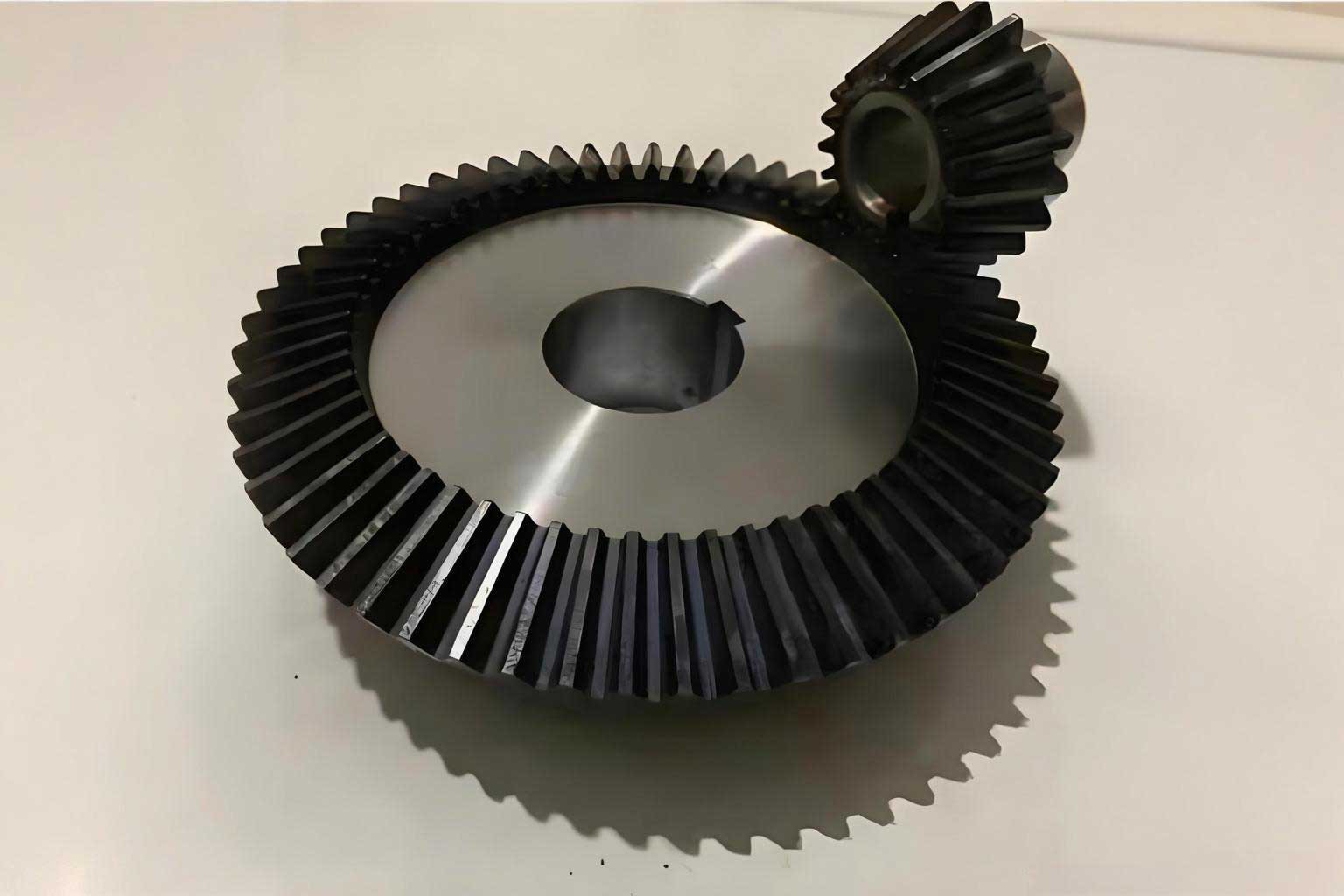
The core of this scraping technology for miter gears lies in the design and manufacture of the cutting tool. This encompasses the selection of tool tip material, determination of geometric angles, and the processes of brazing and sharpening. For tool tip material, we initially chose the “YN05” type hard alloy, a product of joint research. YN05 is an ultra-fine grain alloy with a room-temperature hardness of HRA 92.5 and a bending strength of $\sigma_{bb} \geq 1500 \text{ MPa}$. Its good weldability is crucial for brazed planer tools. Practice proved YN05 suitable for machining hardened steels in scraping applications for miter gears.
Determining the geometric angles is paramount. Given the high hardness of the workpiece, the angles used for standard gear planing tools are inadequate. To prevent edge chipping, a negative rake angle is essential. Simultaneously, the cutting edge inclination angle $\lambda_s$ plays a decisive role in enhancing edge strength and improving cutting performance. Therefore, selecting an appropriate combination of $\lambda_s$ and the negative rake angle $\gamma_o$ is the primary task in designing the planer tool for miter gears. Tests demonstrated that during scraping, surface finish improves with an increase in $\lambda_s$, and tool life shows a more pronounced increase with rises in both $\lambda_s$ and $\gamma_o$. We selected $\lambda_s = 10^\circ$. The change in $\lambda_s$ directly affects the working pressure angle of the gear tooth profile. For a standard planer tool, the relationship between the side cutting edge angle $\kappa_r’$ and the nominal normal pressure angle $\alpha_{on}$ is given by $\tan \kappa_r’ = \tan \alpha_{on} \cdot \cos \lambda_s$. For the scraping tool, it becomes $\tan \kappa_r = \tan \alpha_{on} / \cos \lambda_s$. With $\lambda_s = 10^\circ$, this introduces a slight change, which is acceptable in tool design for miter gears as they are typically cut in pairs. The working clearance angle $\alpha_{oe}$ is derived from $\alpha_{oe} = \alpha_o – \lambda_s$, where $\alpha_o$ is the standard clearance angle. After setting $\lambda_s = 10^\circ$, we optimized the rake angle $\gamma_o$. Tests indicated that for machining miter gears with hardness HRC 58-62, a rake angle $\gamma_o \approx -10^\circ$ yields good tool life. The tool structure incorporates these angles into a brazed tip design.
The brazing and sharpening processes are critical for tool integrity. During brazing, gradual preheating of the tip and tool body is necessary, using a low-melting-point solder with good wettability. Post-brazing, the tool should be placed in asbestos ash or an electric furnace for slow cooling. Sharpening is performed on a dedicated fixture using a resin-bonded diamond wheel with grit size no larger than 120# for roughing and 320# for finishing, with an infeed not exceeding 0.01 mm/pass. The surface finish of the flank and face should be no less than $\nabla 9$.
The scraping process parameters must be carefully controlled. Scraping is suitable for miter gears hardened by quenching or carburizing, but not for those treated with nitriding or multi-element diffusion. To extend tool life and prevent the tool nose from engaging in cutting, the pre-scraping planer tool is designed with a protuberance at the tip. The tooth profile before scraping and the distribution of scraping allowance are designed accordingly. The scraping allowance on the tooth flank, denoted $\Delta h$, depends on post-heat-treatment distortion and machining conditions, generally following $\Delta h \approx 0.15 \text{ mm}$. For shaft-mounted miter gears with less distortion, a smaller value can be used; for disk-type gears with greater distortion, a larger value is appropriate. To mitigate impact during scraping, the tooth ends should be chamfered by about 1 mm before heat treatment to avoid carbide concentration.
Regarding cutting forces and speeds, measurements of machine tool cutting power indicated that under identical cutting speeds and depths of cut, the cutting force for scraping hard-faced miter gears is nearly double that for planing non-hardened surfaces. However, due to the minimal scraping depth, the resultant force is not excessive and does not adversely affect the machine. A notable phenomenon is cold working hardening during scraping, which generates a hardened layer about 0.05 mm thick on the tooth surface. During a subsequent scraping pass, this layer must be removed. Therefore, each scraping depth should be between 0.05 mm and 0.10 mm. If the depth is too small, the force per unit length on the cutting edge increases proportionally, reducing tool life. The cutting speed, given the reciprocating motion and inherent impact in planing, should not be excessively high; a typical range is $v = 15-20 \text{ m/min}$. Adequate cooling lubrication with oil is beneficial for both tool life and surface finish when machining miter gears.
The mechanism of hard-faced scraping for miter gears involves unique chip formation and surface generation. Despite the tool’s negative rake angle, the high strength of the carburized and quenched surface layer means the metal in the shear zone undergoes plastic deformation without easy fracture along slip planes. The shear angle $\phi$ does not decrease significantly. Consequently, the chip produced is continuous, with minimal length contraction; measured length contraction coefficients are around 1.1-1.2. For low-alloy steel hardened miter gears, chips appear tubular or spirally curved. Dry scraping produces dark yellow or light blue chips, while oil application yields silvery-white chips. The large cutting edge inclination angle $\lambda_s$ is highly advantageous. It introduces a transverse “twisting” force component alongside the primary “shearing” force, making it easier to dislodge metal grains from the workpiece matrix. Furthermore, due to the high surface hardness, grain deformation is limited, and the freshly generated surface has fewer crystal lattice defects. The tool’s negative rake angle and flank face also exert a compressive “ironing” effect on the machined surface, contributing to high finish. Tool wear occurs nearly equally on the flank and face, with minor actual displacement of the tool nose, ensuring stability in scraping accuracy. However, this compression also induces a cold-worked hardened layer. Given the thin cut and high material strength, this layer is shallow, with only a moderate increase in hardness.
The influence of scraping on the performance characteristics of miter gears is multifaceted and significant, as summarized in the table below.
| Aspect | Effect of Scraping on Miter Gears | Key Parameters/Notes |
|---|---|---|
| Geometric Accuracy | Restores accuracy distorted by heat treatment; enables precise control over contact pattern location and size. | Contact pattern length >80%, height >60%; motion accuracy improved. |
| Surface Finish | Dramatically improves, stabilizing above $\nabla 8$ (comparable to Ra 0.8 µm). | Reduces friction coefficient, contact stress, and heat generation; benefits pitting resistance, scuffing resistance, and noise reduction. |
| Surface Layer Microstructure | Removes pre-existing defects (tool marks, oxidation, micro-cracks); reveals fresh, denser metal surface. | Creates a work-hardened layer ~0.05 mm thick; surface hardness increases by approx. HRC 1-2. |
| Residual Stress State | Introduces tensile residual stresses in the surface layer. | A potential drawback; can initiate micro-cracks under cyclic loading, affecting fatigue strength (pitting, spalling). |
| Overall Load Capacity | Net effect is generally positive if process is controlled; accuracy gains outweigh stress-induced strength reduction. | Dependent on optimal tool geometry, sufficient cut depth, and proper heat treatment of miter gears. |
The improvement in geometric accuracy for miter gears is perhaps the most direct benefit. Scraping corrects heat treatment distortions, restoring the tooth profile and alignment. Through careful machine adjustment and process control, the contact pattern on miter gears becomes controllable, directly enhancing load distribution and capacity. The increase in surface finish is equally vital. A smoother surface on miter gears lowers the friction coefficient, reducing operating temperatures and wear. This enhances resistance to failure modes like pitting and scuffing, common in heavily loaded miter gear applications. The microstructural alteration is twofold: the removal of a defective surface layer and the creation of a work-hardened, denser layer. The hardness gradient from surface to core becomes smoother compared to an unscraped surface, which may have a decarburized layer. However, the induced tensile residual stress is a critical concern. Measurements indicate that scraped miter gear surfaces exhibit tensile stress, which can promote crack propagation under cyclic loads, potentially offsetting some durability gains. Therefore, process optimization must ensure that the benefits of accuracy and finish outweigh this drawback.
To mitigate the detrimental tensile stresses, several strategies are essential when processing miter gears. First, select tool materials with the highest possible hardness to maximize the hardness difference between tool and workpiece, which minimizes the intensity of cold-working-induced tensile stress. Second, ensure that the depth of cut in successive passes is sufficient to remove the cold-worked layer from the previous pass. Third, heat treatment of the miter gears must be properly controlled—excessive carbon concentration or inadequate tempering can lead to susceptibility to grinding cracks, analogous to issues in scraped surfaces. Fourth, the geometric angles of the tool should be optimized not only for tool life but also for minimizing induced tensile stress. This requires extensive experimental study specific to miter gears. The relationship between tool angles and surface integrity can be explored through models. For instance, the effective stress state might be approximated by considering the shear and normal forces. The normal force $F_n$ and tangential force $F_t$ during scraping can be related to tool angles and cutting depth $a_p$:
$$ F_t = k_t \cdot a_p \cdot f(\gamma_o, \lambda_s) $$
$$ F_n = k_n \cdot a_p \cdot g(\gamma_o, \lambda_s) $$
where $k_t$ and $k_n$ are material-dependent coefficients. The specific form of $f$ and $g$ requires empirical determination for miter gear materials. The induced surface stress $\sigma_{surf}$ may be proportional to the normal pressure and inversely related to the cutting edge radius $\rho$:
$$ \sigma_{surf} \propto \frac{F_n}{\rho \cdot b} $$
where $b$ is the width of cut. Minimizing $F_n$ through tool geometry (e.g., optimal $\gamma_o$ and $\lambda_s$) and maintaining a sharp edge (small $\rho$) can help reduce $\sigma_{surf}$.
Beyond straight-tooth miter gears, the scraping principle has been successfully trialed on other gear types using different machines. For instance, on a gear shaping machine, cylindrical gears made of 18Cr2Ni4WA with hardness HRC 58-60 were scraped. Similarly, on a spiral bevel gear planer, spiral bevel gears with a module of 10 mm and hardness HRC 58-62 were processed, yielding satisfactory results. This demonstrates the potential versatility of the scraping technique for various hardened gear forms, though the focus here remains on miter gears.
The development and implementation of this scraping process for miter gears underscore its value as a post-heat-treatment finishing method. It offers a relatively simple and cost-effective solution for small-to-medium batch production, where investment in specialized grinding equipment for hardened miter gears might not be justified. The tooling is straightforward to manufacture, and no dedicated machines are required beyond standard planers or shapers with appropriate tooling modifications. However, it is not a panacea. The process demands careful attention to tool design, heat treatment quality of the miter gears, and parameter control to balance the trade-offs between accuracy improvement and surface integrity. Key parameters for scraping miter gears are summarized below.
| Parameter Category | Recommended Range for Miter Gears | Remarks |
|---|---|---|
| Tool Material | YN05 or equivalent ultra-fine hard alloy (HRA ≥92.5, $\sigma_{bb}$ ≥1500 MPa) | Good weldability and wear resistance are crucial. |
| Tool Angles | $\lambda_s = 8^\circ-12^\circ$, $\gamma_o = -8^\circ$ to $-12^\circ$, $\alpha_{oe} = 6^\circ-8^\circ$ | $\lambda_s$ improves edge strength; $\gamma_o$ prevents chipping. |
| Scraping Allowance ($\Delta h$) | 0.10 – 0.20 mm (total on flank) | Dependent on expected distortion of miter gears. |
| Depth of Cut per Pass ($a_p$) | 0.05 – 0.10 mm | Must exceed cold-hardened layer from previous pass. |
| Cutting Speed ($v$) | 15 – 25 m/min for planing | Lower due to reciprocating motion; adjust based on machine rigidity. |
| Feed Rate | Machine-dependent, typically moderate | Ensure smooth chip evacuation. |
| Coolant/Lubricant | Mineral oil or cutting oil, applied abundantly | Reduces heat, improves finish and tool life for miter gears. |
| Pre-scraping Tooth Prep | Chamfer ends (≈1 mm), provide protuberance in pre-gash tool | Reduces impact at tooth tips of miter gears. |
In conclusion, the scraping of hard-faced miter gears is a viable and effective post-heat-treatment machining process. It addresses the critical issue of accuracy loss in hardened miter gears, enabling the realization of their full load-bearing potential. The technology is accessible, requiring no extraordinary investment, and can be integrated into existing production lines for miter gears. Our work has demonstrated its success in practical applications, such as in coal mining machinery, where the performance of scraped miter gears has been well-received. Nonetheless, the process is not without its challenges, primarily the management of induced tensile residual stresses. Future research should focus on optimizing tool geometries and cutting parameters specifically for different grades of miter gears, developing predictive models for surface integrity, and exploring hybrid processes that combine scraping with other finishing methods. The ultimate goal is to establish a robust, controlled scraping methodology that consistently produces high-precision, high-durability miter gears, fully leveraging the advantages of hardened surfaces while mitigating any detrimental effects. The journey of refining this technique for miter gears continues, promising further advancements in gear manufacturing technology.
From a broader perspective, the scraping process exemplifies the innovative adaptation of traditional machining principles to solve modern material challenges. As materials for miter gears evolve towards higher strengths and hardenability, finishing techniques must keep pace. Scraping offers a complementary approach to grinding, especially for complex geometries like those found in miter gears, where grinding wheel access can be limited. The physical principles underlying the chip formation and surface generation during scraping of miter gears can be further elucidated through metallurgical analysis and finite element modeling. For instance, the strain rate and temperature in the shear zone could be modeled to predict white layer formation or phase transformations. The relationship between tool edge preparation (honing) and the resulting surface roughness on miter gears also warrants detailed study. As we continue to push the boundaries of gear performance, processes like scraping will play an integral role in manufacturing the next generation of high-performance miter gears for demanding applications in aerospace, automotive, and heavy industry.