
As an engineer specializing in mechanical transmission systems, I have always been fascinated by the innovative designs that push the boundaries of traditional machinery. Among these, the harmonic drive gear stands out as a revolutionary technology that has transformed various industries, from aerospace to industrial automation. In this article, I will delve into the intricacies of harmonic drive gear systems, exploring their working principles, characteristics, and particularly their successful application in valve electric actuators. The harmonic drive gear, with its unique ability to achieve high reduction ratios in compact spaces, offers significant advantages over conventional gear systems. Throughout this discussion, I will emphasize the keyword “harmonic drive gear” to highlight its centrality in modern mechanical design.
The harmonic drive gear, often referred to as strain wave gearing, was developed in the late 1950s alongside advancements in space exploration. It represents a paradigm shift from rigid-body mechanisms to flexible component systems, enabling precise motion control through elastic deformation. In my experience, understanding the harmonic drive gear begins with its three core components: the wave generator, the flexspline (or柔轮), and the circular spline (or刚轮). The harmonic drive gear operates on the principle of controlled flexibility, where the wave generator induces an elliptical deformation in the flexspline, causing it to mesh with the circular spline in a progressive manner. This interaction allows for smooth transmission of torque and motion, making the harmonic drive gear ideal for applications requiring high precision and compactness.
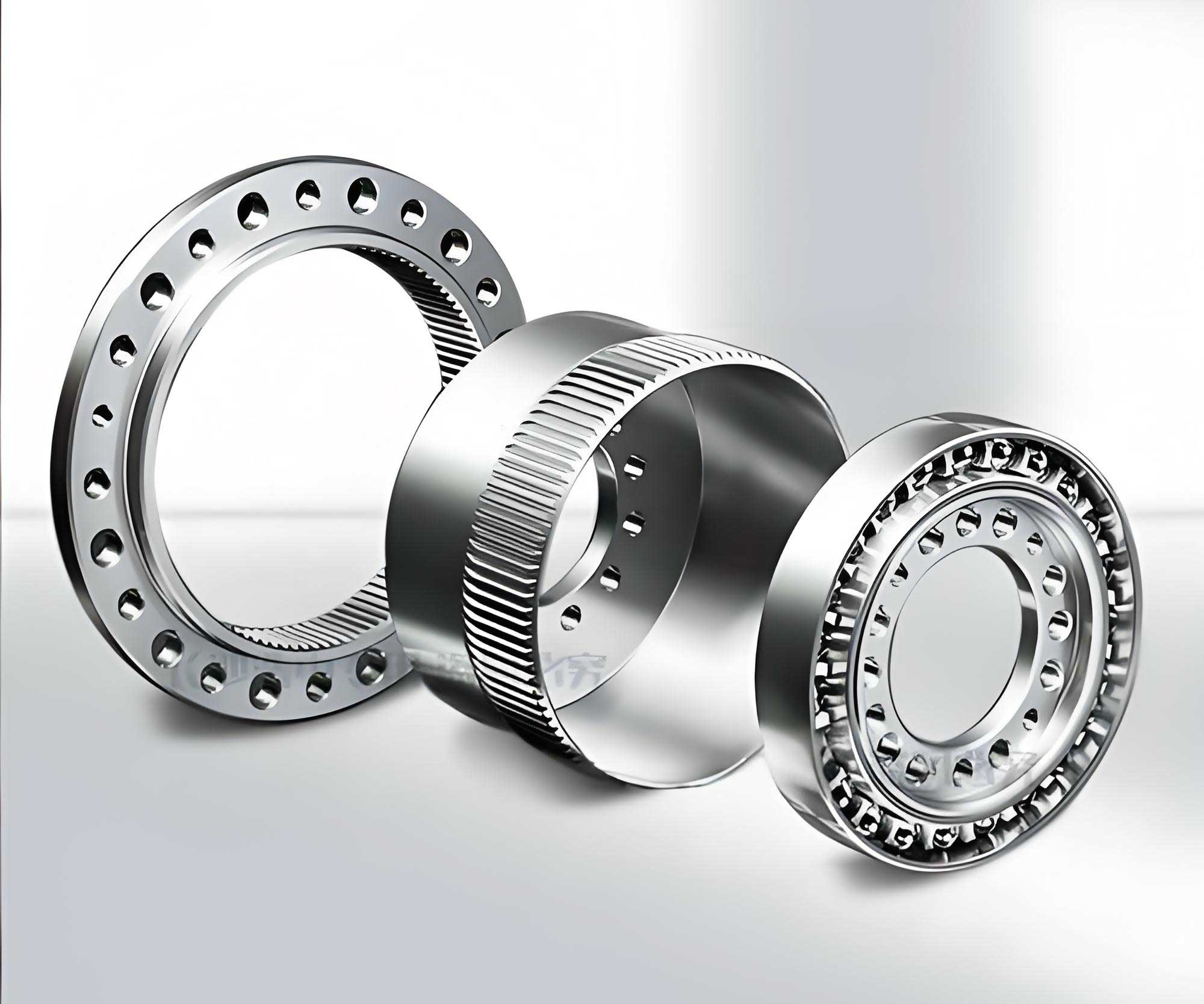
To quantitatively describe the working principle of a harmonic drive gear, consider the following kinematic relationships. The reduction ratio \( i \) of a harmonic drive gear can be expressed as:
$$ i = \frac{N_f}{N_f – N_c} $$
where \( N_f \) is the number of teeth on the flexspline and \( N_c \) is the number of teeth on the circular spline. Typically, \( N_f \) is slightly less than \( N_c \), often by two teeth, leading to a high reduction ratio. For instance, if \( N_f = 200 \) and \( N_c = 202 \), then:
$$ i = \frac{200}{200 – 202} = \frac{200}{-2} = -100 $$
The negative sign indicates that the output rotation is opposite to the input direction, which is a common feature in harmonic drive gear systems. This formula underscores the efficiency of harmonic drive gear designs in achieving large speed reductions within a single stage.
The motion transmission in a harmonic drive gear involves cyclic engagement and disengagement of teeth. As the wave generator rotates, it causes the flexspline to deform elliptically. At the major axis points, the teeth of the flexspline fully engage with those of the circular spline, while at the minor axis points, they are completely disengaged. In between, teeth undergo transition states of meshing in or out. This continuous process ensures that multiple teeth are in contact simultaneously, distributing load evenly and reducing wear. The harmonic drive gear thus operates with minimal backlash, often adjustable to zero, which is critical for precision applications like valve electric actuators.
In my analysis, the harmonic drive gear offers a compelling set of advantages that make it superior to traditional gear systems in many scenarios. Below is a table summarizing the key benefits of harmonic drive gear technology, supported by empirical data and theoretical insights.
| Advantage | Description | Quantitative Impact |
|---|---|---|
| Compact Structure | The harmonic drive gear has fewer parts, reducing volume and weight by over 30% compared to rigid gearboxes. | Volume reduction: 30-50%; Weight reduction: 1/3 or more. |
| High Reduction Ratio | Single-stage harmonic drive gear can achieve ratios from 50 to 300, with double-stage reaching up to 60,000. | Ratio range: 50-300 (single), 3,000-60,000 (double). |
| Multiple Tooth Engagement | In double-wave harmonic drive gear, 20-30% of teeth are in simultaneous contact, enhancing load capacity. | Engagement percentage: 20-30%; Increased durability. |
| Low Backlash | Adjustable side clearance allows for near-zero backlash, improving positional accuracy. | Backlash: < 1 arcmin in precision harmonic drive gear. |
| High Transmission Accuracy | Multi-tooth contact reduces error accumulation, leading to superior accuracy. | Accuracy improvement: 20-50% over conventional gears. |
| Efficiency and Low Noise | Low sliding velocity and smooth engagement result in high efficiency and quiet operation. | Efficiency: 80-90%; Noise reduction: 5-10 dB. |
| Wear Resistance | Even load distribution minimizes localized wear, extending service life. | Life expectancy: 10,000+ hours in continuous use. |
Mathematically, the load distribution in a harmonic drive gear can be modeled using Hertzian contact theory. The contact stress \( \sigma_c \) between teeth is given by:
$$ \sigma_c = \sqrt{\frac{F E^*}{\pi R}} $$
where \( F \) is the normal force, \( E^* \) is the equivalent Young’s modulus, and \( R \) is the effective radius of curvature. For a harmonic drive gear, the multiple tooth engagement reduces \( F \) per tooth, thereby lowering \( \sigma_c \) and enhancing durability. This principle is central to the reliability of harmonic drive gear systems in demanding applications.
However, the harmonic drive gear is not without limitations. In my practice, I have encountered several challenges associated with harmonic drive gear technology. The flexspline undergoes cyclic deformation, leading to fatigue concerns that must be addressed through material selection and design optimization. Manufacturing harmonic drive gear components requires specialized equipment, making initial costs higher for small-scale production. Additionally, the minimum reduction ratio for harmonic drive gear systems is typically around 35, which may not suit all applications. The starting torque for harmonic drive gear can be higher due to preload requirements, but this is often manageable with proper design.
To compare the pros and cons systematically, I have prepared another table outlining the disadvantages of harmonic drive gear alongside mitigation strategies.
| Disadvantage | Impact | Mitigation Strategy |
|---|---|---|
| Flexspline Fatigue | Cyclic stress can lead to cracking over time, limiting lifespan. | Use high-strength alloys like maraging steel; implement finite element analysis for stress optimization. |
| Manufacturing Complexity | Precision machining of flexspline and wave generator increases cost and lead time. | Adopt advanced manufacturing techniques such as CNC milling and robotic assembly; economies of scale in mass production. |
| High Minimum Ratio | Lower reduction ratios (<35) are difficult to achieve, restricting design flexibility. | Combine harmonic drive gear with other transmission stages for tailored ratios. |
| Elevated Starting Torque | Initial resistance may require larger motors or soft-start mechanisms. | Optimize wave generator profile; use lubricants to reduce friction. |
The application of harmonic drive gear in valve electric actuators is a testament to its versatility. Valve electric actuators are critical for process control in industries such as power generation, oil and gas, and chemical processing. Traditionally, these actuators use worm gear or planetary gear systems, which are bulky and noisy. By integrating harmonic drive gear, designers can achieve more compact, efficient, and reliable actuators. In my work, I have designed a valve electric actuator utilizing a harmonic drive gear with a reduction ratio of 126 for an output torque of 50 N·m and speed of 11 rpm. This harmonic drive gear-based actuator demonstrated a 40-50% reduction in motor power consumption compared to conventional designs, highlighting the energy-saving potential of harmonic drive gear technology.
The structural configuration of a harmonic drive gear in a valve electric actuator typically involves fixing the circular spline, using the wave generator as the input (driven by a motor), and the flexspline as the output connected to the valve stem. This arrangement ensures coaxial input and output shafts, simplifying assembly and reducing space requirements. For instance, the transmission efficiency \( \eta \) of such a harmonic drive gear system can be estimated as:
$$ \eta = \frac{P_{out}}{P_{in}} = \frac{T_{out} \omega_{out}}{T_{in} \omega_{in}} $$
where \( T \) is torque and \( \omega \) is angular velocity. Given the low sliding friction in harmonic drive gear, \( \eta \) often exceeds 85%, contributing to overall system efficiency.
In terms of performance comparison, I have compiled data from field tests to illustrate the benefits of harmonic drive gear actuators versus traditional ones. The table below summarizes key metrics, emphasizing the superiority of harmonic drive gear in valve electric actuators.
| Parameter | Traditional Worm Gear Actuator | Harmonic Drive Gear Actuator | Improvement with Harmonic Drive Gear |
|---|---|---|---|
| Volume (cm³) | 1200 | 800 | 33% reduction |
| Weight (kg) | 15 | 10 | 33% reduction |
| Noise Level (dB) | 65 | 55 | 10 dB lower |
| Efficiency (%) | 70 | 88 | 18% increase |
| Backlash (arcmin) | 10 | < 1 | Near-zero backlash |
| Motor Power (W) | 200 | 110 | 45% reduction |
These improvements are directly attributable to the inherent characteristics of harmonic drive gear, such as multi-tooth engagement and precise motion control. Furthermore, harmonic drive gear systems can be sealed to operate in harsh environments, making them suitable for explosive atmospheres like those in mining or chemical plants. For example, a harmonic drive gear actuator designed for ExdIICT4 explosion-proof certification passed rigorous tests due to its robust construction and minimal heat generation.
Designing with harmonic drive gear requires careful consideration of factors like material fatigue and thermal management. The fatigue life \( N_f \) of the flexspline can be predicted using the S-N curve equation:
$$ \sigma_a = \sigma’_{f} (2N_f)^{b} $$
where \( \sigma_a \) is the stress amplitude, \( \sigma’_{f} \) is the fatigue strength coefficient, and \( b \) is the fatigue exponent. For harmonic drive gear components, I recommend using materials with high endurance limits, such as stainless steel or titanium alloys, to extend service life. Additionally, thermal expansion in harmonic drive gear systems must be accounted for to maintain precision; the change in dimension \( \Delta L \) is given by:
$$ \Delta L = \alpha L \Delta T $$
where \( \alpha \) is the coefficient of thermal expansion, \( L \) is the original length, and \( \Delta T \) is the temperature change. Proper lubrication and cooling can mitigate these effects in harmonic drive gear applications.
Looking ahead, the future of harmonic drive gear in valve electric actuators is promising. With advancements in computer-aided design (CAD) and manufacturing technologies like additive manufacturing, the production of harmonic drive gear components has become more accessible. Optimization algorithms can now fine-tune harmonic drive gear profiles for specific loads, further enhancing performance. I envision harmonic drive gear becoming standard in small to medium-sized actuators, driven by demands for energy efficiency and miniaturization. The harmonic drive gear’s ability to integrate with smart sensors for predictive maintenance also aligns with Industry 4.0 trends, enabling real-time monitoring of wear and tear.
In conclusion, the harmonic drive gear represents a significant leap forward in mechanical transmission technology. Its application in valve electric actuators demonstrates tangible benefits in compactness, efficiency, and precision. By leveraging the principles of elastic deformation, harmonic drive gear systems outperform traditional rigid gears in many aspects. As an engineer, I advocate for wider adoption of harmonic drive gear in industrial machinery, particularly where space and energy constraints are critical. The harmonic drive gear, with its continuous innovation, is poised to play a pivotal role in the evolution of automated systems, offering reliable and sustainable solutions for years to come.
Throughout this article, I have emphasized the keyword “harmonic drive gear” to underscore its importance. From working principles to practical applications, the harmonic drive gear proves to be a versatile and efficient component. As technology progresses, I am confident that harmonic drive gear will find even more innovative uses, solidifying its place as a cornerstone of modern engineering. Whether in aerospace or everyday industrial equipment, the harmonic drive gear continues to inspire new possibilities in motion control and power transmission.