
As an engineer deeply involved in precision mechanical systems, I have always been fascinated by the elegant design and superior performance of the harmonic drive gear. This unique transmission mechanism, often referred to as a strain wave gear, offers exceptional advantages in compactness, high reduction ratios, and zero-backlash operation. In this comprehensive exploration, I will delve into the fundamental principles of harmonic drive gear operation, its mathematical modeling, and its innovative applications in speed reducers, particularly in configurations where space optimization is paramount. Throughout this discussion, I will emphasize the core concepts and practical implementations of the harmonic drive gear, supporting key points with detailed formulas, comparative tables, and analytical insights.
The harmonic drive gear is a specialized gearing system that relies on controlled elastic deformation to transmit motion. Its operation is fundamentally different from conventional rigid gear trains, enabling remarkable capabilities. The system comprises three primary components: the wave generator, the circular spline (or rigid gear), and the flexspline (or flexible gear). The interaction of these elements creates a unique kinematic relationship that results in high reduction ratios within a remarkably compact package. The harmonic drive gear is renowned for its precision, high torque capacity, and coaxial input-output alignment, making it indispensable in robotics, aerospace, and high-precision industrial machinery.
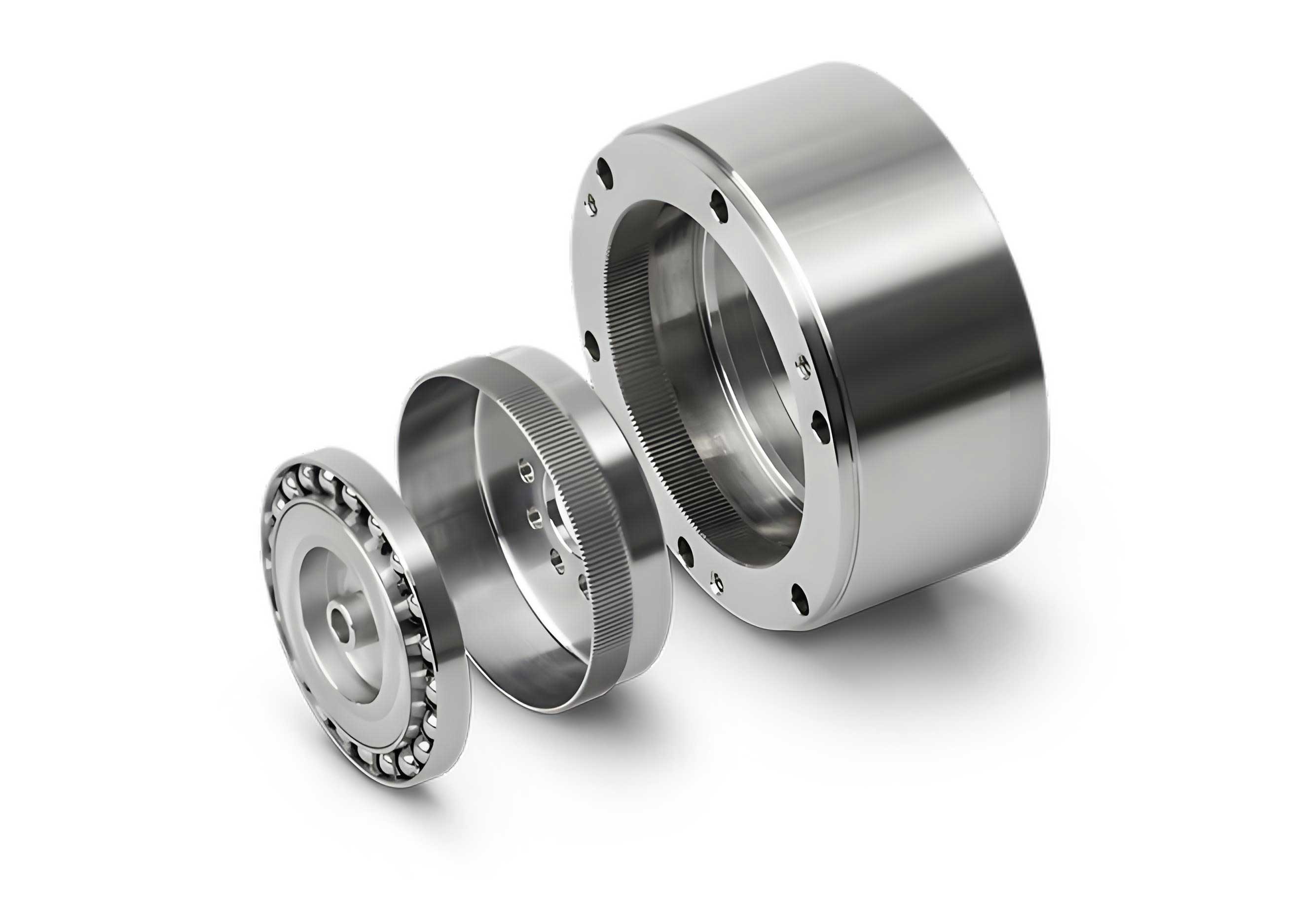
Let me begin by detailing the working principle. The harmonic drive gear functions through a process known as “wave generation” or “elliptical deformation.” The wave generator, typically an elliptical cam surrounded by a thin-walled ball bearing, serves as the input. When inserted into the flexspline—a thin-walled, flexible external gear—it deforms the flexspline into an elliptical shape. The circular spline is a rigid internal gear that meshes with the flexspline. The key to operation is the difference in tooth count between the flexspline and the circular spline, usually by two teeth for a standard double-wave configuration. As the wave generator rotates, it propagates an elastic wave through the flexspline, causing its teeth to engage and disengage with those of the circular spline in a sequential manner. This phenomenon, termed “tooth differential” or “error motion,” is the heart of the harmonic drive gear’s reduction capability.
The kinematic relationship can be derived mathematically. Consider a harmonic drive gear with a wave generator (WG), flexspline (FS), and circular spline (CS). Let \( N_{CS} \) be the number of teeth on the circular spline and \( N_{FS} \) be the number of teeth on the flexspline, with \( N_{CS} – N_{FS} = 2 \) for a double-wave generator. The basic speed reduction ratio \( i \) depends on which component is fixed. If the circular spline is fixed, the wave generator is the input, and the flexspline is the output, the reduction ratio is given by:
$$ i = \frac{\omega_{WG}}{\omega_{FS}} = -\frac{N_{FS}}{N_{CS} – N_{FS}} $$
Here, \( \omega_{WG} \) and \( \omega_{FS} \) are the angular velocities of the wave generator and flexspline, respectively. The negative sign indicates opposite rotation directions. Since \( N_{CS} – N_{FS} = 2 \), this simplifies to:
$$ i = -\frac{N_{FS}}{2} $$
For instance, if the flexspline has 200 teeth, the reduction ratio is -100:1, meaning the output rotates 1/100th the speed of the input in the opposite direction. Conversely, if the flexspline is fixed, and the wave generator is input, with the circular spline as output, the ratio becomes:
$$ i = \frac{\omega_{WG}}{\omega_{CS}} = \frac{N_{CS}}{N_{CS} – N_{FS}} = \frac{N_{CS}}{2} $$
These formulas highlight the high reduction ratios achievable with a single-stage harmonic drive gear, a significant advantage over traditional gearboxes that require multiple stages for similar ratios.
To further elucidate the tooth engagement process, I can describe the four distinct phases during one wave generator rotation: engagement, full mesh, disengagement, and complete disengagement. At the major axis of the ellipse, the flexspline teeth are fully engaged with the circular spline teeth. At the minor axis, they are completely disengaged. In between, teeth are either meshing in or out. This continuous cycle results in a relative rotation between the flexspline and circular spline. The angular displacement per wave generator revolution is precisely \( 2\pi / (N_{CS} – N_{FS}) \) radians in terms of relative motion, which corresponds to the output shaft’s movement. The harmonic motion generated is sinusoidal in nature, giving the harmonic drive gear its name.
Now, let’s explore the application of harmonic drive gear in speed reducers. Traditional reducers often have output shafts at the end of the assembly, which can lead to bulky designs when the driven component is centrally located. The harmonic drive gear enables a compact, coaxial design where the output can be positioned between the motor and the reducer body. This is particularly valuable in applications like robotic joints, automated guided vehicles, and precision positioning stages, where space constraints and weight minimization are critical.
Consider a design requirement for a reducer with input and output on the same axis, and the output gear located midway along the assembly. Using a harmonic drive gear, this can be achieved elegantly. The motor connects directly to the wave generator. The flexspline is fixed to the housing, and the circular spline serves as the output, carrying the output gear. This configuration leverages the inherent coaxiality of the harmonic drive gear. The transmission ratio is given by the formula above for the fixed flexspline case. This design not only saves space but also allows for integration of additional components, such as brakes or encoders, within the hollow shaft of the flexspline, enhancing functionality without increasing envelope dimensions.
To quantify the advantages, I can compare the harmonic drive gear with conventional planetary and cycloidal reducers. Below is a table summarizing key performance metrics:
| Parameter | Harmonic Drive Gear | Planetary Gear Reducer | Cycloidal Reducer |
|---|---|---|---|
| Reduction Ratio (Single Stage) | 50:1 to 320:1 | 3:1 to 12:1 | 10:1 to 100:1 |
| Backlash | Typically < 1 arcmin | 3-10 arcmin | 1-3 arcmin |
| Torque Density | High | Moderate | High |
| Coaxial Input/Output | Yes | Yes | Often, but not always |
| Efficiency | 80-90% | 95-98% | 85-92% |
| Compactness | Excellent | Good | Very Good |
The harmonic drive gear excels in applications requiring high precision and compactness, despite slightly lower efficiency due to elastic hysteresis. The near-zero backlash is a standout feature, crucial for robotic systems where positional accuracy is paramount. Moreover, the harmonic drive gear can handle high peak torques and offers excellent repeatability.
Delving deeper into the design mathematics, the stress and strain in the flexspline are critical considerations. The flexspline undergoes cyclic elastic deformation, which must remain within the endurance limit of the material to prevent fatigue failure. The maximum strain \( \epsilon_{max} \) at the major axis can be approximated by:
$$ \epsilon_{max} = \frac{\delta}{R} $$
where \( \delta \) is the radial deformation (half the difference between major and minor axes) and \( R \) is the nominal radius of the flexspline. For a double-wave generator, \( \delta \) is related to the tooth module \( m \) and the wave generator profile. The allowable deformation is constrained by material properties, such as the yield strength \( \sigma_y \) and Young’s modulus \( E \), ensuring \( \epsilon_{max} < \sigma_y / E \) for safety. Advanced materials like maraging steel or special alloys are often used for the flexspline to enhance durability.
The torque capacity of a harmonic drive gear is another vital aspect. It depends on the tooth geometry, material strength, and the number of teeth in simultaneous engagement. Typically, about 20-30% of the teeth are engaged at any time. The transmitted torque \( T \) can be expressed as:
$$ T = n_e \cdot F_t \cdot r $$
where \( n_e \) is the number of teeth in engagement, \( F_t \) is the tangential force per tooth, and \( r \) is the pitch radius. \( F_t \) is limited by the tooth bending strength and surface durability. For precise design, factors like stress concentration at the tooth root and sliding friction must be accounted for. The harmonic drive gear’s torque rating is often specified by manufacturers based on extensive testing.
In practical applications, the harmonic drive gear is frequently used in robotic arms. For example, in a six-axis industrial robot, each joint may employ a harmonic drive gear reducer to achieve precise angular control. The compact design allows for slim joint profiles, enhancing the robot’s workspace and dexterity. Additionally, in aerospace, harmonic drive gears are used in satellite antenna pointing mechanisms due to their reliability and minimal backlash.
Another innovative application is in medical devices, such as surgical robots, where the harmonic drive gear provides smooth, precise motion in a sterilizable package. The ability to integrate the harmonic drive gear directly into the joint without additional couplings reduces complexity and improves reliability.
From a manufacturing perspective, producing harmonic drive gears requires high precision. The flexspline’s teeth are often cut using gear hobbing or shaping processes, followed by heat treatment to achieve the desired hardness and toughness. The wave generator’s bearing must have low friction and high rigidity to maintain the elliptical shape under load. Quality control involves rigorous testing for backlash, torque transmission, and lifetime under cyclic loading.
To further illustrate the kinematic relationships, consider the differential nature of the harmonic drive gear. It can also function as a differential device when all three components are free to rotate. The angular velocities satisfy the following equation:
$$ \omega_{FS} \cdot N_{FS} + \omega_{CS} \cdot N_{CS} = \omega_{WG} \cdot (N_{CS} + N_{FS}) $$
This equation derives from the condition that the meshing teeth maintain continuous contact without slip. By fixing one component, we obtain the reduction ratios mentioned earlier. This differential capability allows for torque splitting or motion synthesis in advanced mechanisms, though it’s less common in standard reducer applications.
The efficiency of a harmonic drive gear is influenced by several factors, including friction losses at the tooth interfaces, hysteresis losses in the flexspline, and bearing losses in the wave generator. An approximate efficiency model can be given by:
$$ \eta = 1 – \frac{P_{loss}}{P_{in}} $$
where \( P_{loss} \) includes Coulomb friction losses proportional to load and speed, and hysteresis losses proportional to deformation frequency. Typically, efficiency decreases with higher reduction ratios due to increased sliding action between teeth. However, for most applications, the efficiency of a harmonic drive gear is acceptable given its other benefits.
Looking at future trends, advancements in materials science, such as composite materials or additive manufacturing, could lead to lighter and more durable harmonic drive gears. Additionally, integration with direct-drive motors and smart sensors for condition monitoring is becoming more prevalent, enhancing the functionality of harmonic drive gear systems.
In summary, the harmonic drive gear is a remarkable innovation in mechanical transmission technology. Its principle of operation, based on elastic deformation and wave generation, enables unique advantages in compactness, precision, and high reduction ratios. The harmonic drive gear finds extensive use in reducers where coaxial input-output and space-saving designs are required. Through mathematical analysis and comparative evaluation, I have highlighted the key aspects that make the harmonic drive gear a preferred choice in demanding applications. As technology progresses, the harmonic drive gear will continue to evolve, offering even greater performance and integration capabilities for next-generation mechanical systems.
To reinforce the concepts, here is a table listing typical design parameters for a standard harmonic drive gear unit:
| Design Parameter | Symbol | Typical Range | Units |
|---|---|---|---|
| Number of Circular Spline Teeth | \( N_{CS} \) | 100 to 500 | Teeth |
| Number of Flexspline Teeth | \( N_{FS} \) | 98 to 498 | Teeth |
| Tooth Module | \( m \) | 0.2 to 1.0 | mm |
| Reduction Ratio (Fixed CS) | \( i \) | 50:1 to 250:1 | Dimensionless |
| Rated Torque | \( T_{rated} \) | 10 to 5000 | Nm |
| Maximum Input Speed | \( \omega_{WG,max} \) | 3000 to 6000 | rpm |
| Backlash | \( \beta \) | < 1 to 3 | arcmin |
| Efficiency | \( \eta \) | 80% to 90% | Percentage |
The harmonic drive gear’s versatility is further demonstrated in custom configurations. For instance, by using a triple-wave generator, the tooth difference can be increased to three, offering even higher reduction ratios, though with increased complexity. Moreover, the harmonic drive gear can be combined with other gearing systems, such as planetary stages, to achieve ultra-high reductions or specific performance characteristics.
In conclusion, my exploration of the harmonic drive gear underscores its fundamental role in modern precision engineering. The harmonic drive gear is not just a component but a system that integrates mechanics, materials, and kinematics to deliver exceptional performance. Whether in robotics, aerospace, or industrial automation, the harmonic drive gear continues to be a key enabler of innovation, providing solutions where traditional gears fall short. As I reflect on its principles and applications, I am convinced that the harmonic drive gear will remain at the forefront of transmission technology for years to come.