
As a researcher deeply engaged in the field of precision mechanical transmission, I find the harmonic drive gear, also known as strain wave gearing, to be one of the most fascinating and elegantly engineered mechanisms. Its emergence in the mid-1950s, driven by the stringent demands of aerospace technology, marked a significant leap forward. Unlike conventional gear systems, the harmonic drive gear operates on a fundamentally different principle involving controlled elastic deformation, granting it a unique set of performance characteristics that have secured its place in high-end applications.
The core advantages are compelling: exceptionally high single-stage reduction ratios within a compact volume, near-zero backlash, high positional accuracy, and the ability to transmit motion through sealed walls. These attributes have made harmonic drive gears indispensable in robotics, aerospace actuators, semiconductor manufacturing equipment, and精密 instrumentation. Over the decades, nations like the United States, Japan, and Russia have made substantial progress, developing standardized series and dedicated manufacturing lines. While foundational research has yielded mature products and design methodologies, the inherent complexity introduced by the flexible component—the flexspline—ensures that the field remains rich with challenges and opportunities for deeper investigation.
Fundamental Operating Principle and Key Components
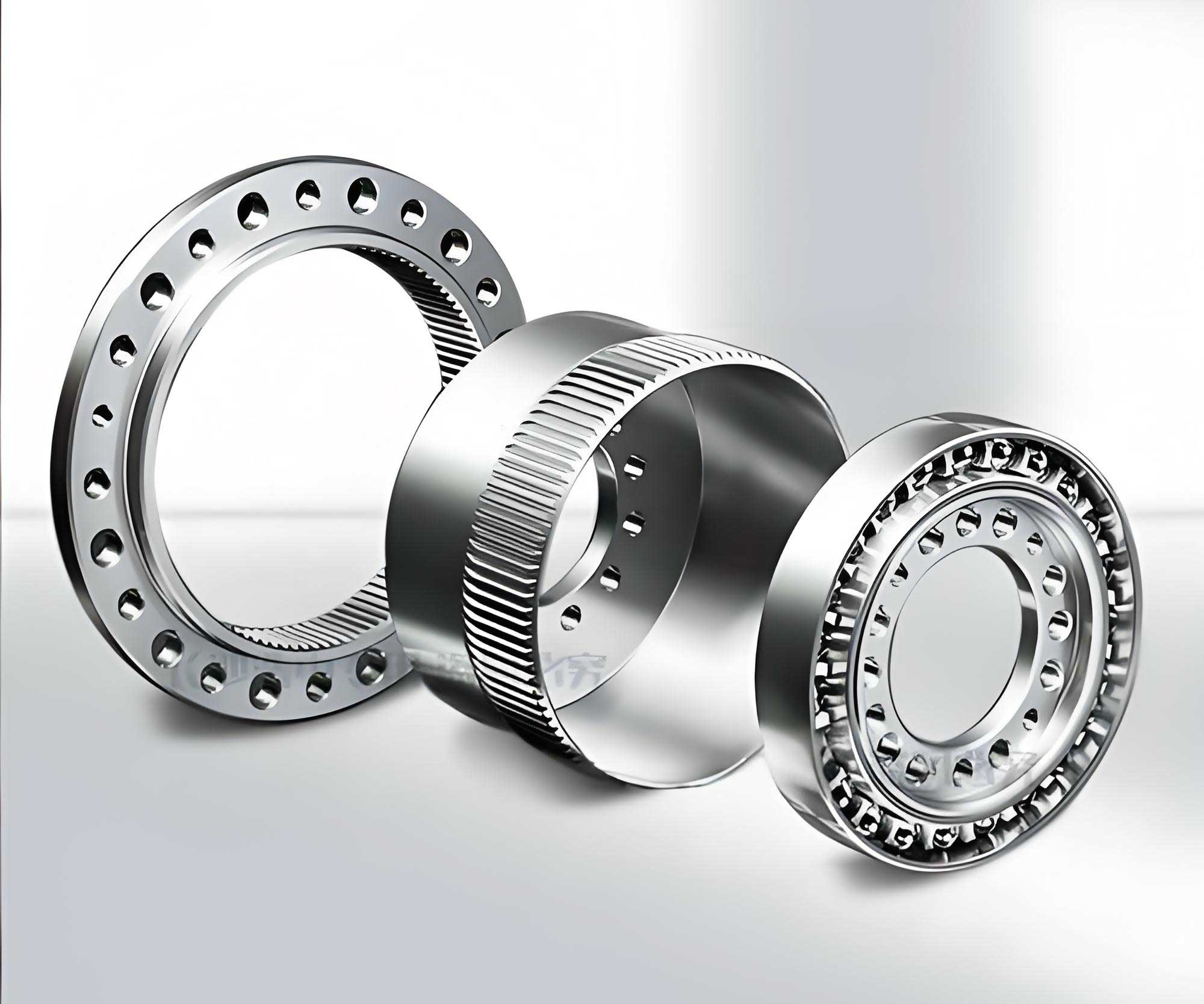
The operation of a harmonic drive gear revolves around the controlled deflection of a flexible component. The system primarily consists of three elements:
- The Circular Spline (CS): A rigid, internally-toothed ring.
- The Flexspline (FS): A thin-walled, externally-toothed cup or ring capable of elastic deformation. It typically has two fewer teeth than the circular spline.
- The Wave Generator (WG): An elliptical bearing assembly or a multi-lobed cam that deforms the flexspline.
The wave generator is inserted into the flexspline, forcing it into an elliptical shape. This deformation causes the teeth of the flexspline to engage with those of the circular spline at two diametrically opposite regions along the major axis of the ellipse. As the wave generator rotates, the engagement zones move, and due to the tooth count difference, a slow relative rotation is produced between the flexspline and the circular spline. For a standard configuration where the circular spline is fixed, the rotation of the wave generator (input) causes a reverse, reduced rotation of the flexspline (output). The fundamental reduction ratio, \( i \), is given by:
$$ i = -\frac{N_f}{N_c – N_f} $$
where \( N_f \) is the number of teeth on the flexspline and \( N_c \) is the number of teeth on the circular spline. The negative sign indicates direction reversal.
Research Focus and Evolving Dynamics
The pursuit of higher performance, reliability, and efficiency in harmonic drive gear systems has directed research efforts along several interconnected paths.
1. Meshing Theory and Kinematics
Establishing a precise theoretical model for tooth engagement is paramount, as it underpins performance prediction, tooth profile design, and manufacturing process development. The challenge lies in accounting for the dynamic, load-induced elastic deformation of the flexspline teeth and neutral line during meshing. Researchers have employed various analytical approaches:
| Method | Core Principle | Advantages | Limitations |
|---|---|---|---|
| Graphical Analysis | Uses geometric mapping based on the deformed neutral curve to determine conjugate profiles. | Intuitive visualization of the meshing process. | Low accuracy; becomes prohibitively complex under load conditions. |
| Envelope Theory (Analytical) | Treats flexspline deformation as part of a composite conjugate motion; solves for the envelope of family of curves. | Rigorous mathematical foundation suitable for computer implementation. | Requires complex coordinate transformations and solving differential equations. |
| Constant-Speed Curve Method | Assumes teeth move along defined “constant-speed curves” with equal velocities at the contact point. | Provides a direct kinematic interpretation of the speed ratio. | An idealized model that may not fully capture real contact conditions. |
| Power Series Method | Expands profile equations and contact conditions into power series, transforming spatial problems to planar ones. | High precision and a mathematically rigorous framework. | Extremely complex algebraic manipulation required. |
In kinematics, two primary models dominate. The Frictional (Pure Rolling) Model analyzes the system based on non-slip rolling contact between conjugate surfaces. The Planetary Gear Analogy Model abstracts the system into an equivalent epicyclic gear train, providing familiar analytical tools, though it requires careful adaptation due to the elastic nature of the engagement. More recently, novel geometric kinematic models based purely on motion transfer have been proposed. These models focus on the mapping relationship between points on the output (flexspline rim) and the deforming ellipse, offering clearer insight into the trajectory of individual teeth, which is beneficial for analyzing single-pair tooth contact conditions.
2. Tooth Profile Evolution and Optimization
The tooth profile is critical for ensuring smooth power transmission, minimizing wear, and preventing interference. The evolution of profiles reflects the ongoing trade-off between theoretical ideals and manufacturing practicality.
- Initial Straight-Sided Profile (α=28.6°): Proposed by C.W. Musser, this simple triangular profile was not a true conjugate shape for the deformed flexspline and posed tooling challenges.
- Involute Profile: Gained widespread adoption due to its manufacturing ease using standard gear cutting tools. Common pressure angles are 20° and 30°. The 20° profile, while tool-friendly, risks tooth interference and often requires modification (shortening and positive shifting).
- Circular-Arc and Substitute Profiles: Profiles with circular arcs offer wider tooth spaces, reducing stress concentration and facilitating lubrication. The “S” tooth profile, pioneered in Japan, is a significant modern development. It is generated based on the trajectory of the flexspline tooth tip relative to the circular spline, resulting in a profile composed of large-radius arcs near the tip and root. This design promotes better load distribution and higher torque capacity but requires specialized tooling.
| Profile Type | Pressure Angle | Key Advantages | Key Challenges | Prevalence |
|---|---|---|---|---|
| Straight-Sided | 28.6° | Simple conceptual geometry. | Non-conjugate, high stress, special tools needed. | Historical / Limited |
| Involute | 20°, 30° | Standardized manufacturing, good performance balance. | 20° profile requires anti-interference modifications. | Very High |
| Circular-Arc / “S” Profile | Varies | Excellent load distribution, high torque capacity, good lubrication. | Requires non-standard, specialized cutting tools. | Growing (High-performance apps) |
3. Flexspline Stress-Strain Analysis and Load Distribution
The flexspline is the heart and the most critical component of a harmonic drive gear. Its repeated elastic deformation under load makes fatigue life a primary design constraint. Accurately determining its stress state is therefore essential.
Analytical Methods often model the flexspline as a thin-walled cylindrical shell, applying theories from elastic stability and geometrically nonlinear shell analysis to derive stress formulas. These provide closed-form solutions but rely on significant simplifications.
Experimental Techniques, such as photoelasticity and strain gauge measurements, offer validation and insight into real-world behavior. However, they are cost-intensive and cannot easily capture full-field or internal stress states.
The Finite Element Method (FEM) has become the dominant tool. It allows for modeling complex geometries, material nonlinearities, and contact conditions with high fidelity. A typical static analysis involves simulating the assembly process (wave generator insertion) followed by the application of torque. The maximum stresses usually occur at the critical fillet region of the teeth and at the cup diaphragm junction. The von Mises stress, \( \sigma_{v} \), is commonly used for fatigue assessment:
$$ \sigma_{v} = \sqrt{\sigma_{x}^{2} + \sigma_{y}^{2} – \sigma_{x}\sigma_{y} + 3\tau_{xy}^{2}} $$
where \( \sigma_{x}, \sigma_{y}, \tau_{xy} \) are the in-plane stress components.
Advanced research focuses on dynamic load distribution. One innovative experimental-analytical hybrid method involves instrumenting the circular spline with radially movable “live teeth” equipped with sensors. By collecting force data under load and applying statistical regression and function approximation, researchers can derive equations for the tangential and radial force distribution along the arc of engagement, providing highly accurate input for stress and wear models.
4. Structural Parameter Optimization and Novel Configurations
Optimization aims to maximize performance metrics (torque density, efficiency, stiffness, life) while minimizing size and weight. This is a multi-variable, constrained problem often addressed with computational techniques.
A key trend is the reduction of axial length, particularly for robotics and compact servo systems. The length-to-diameter ratio (\( L/D \)) of the cup flexspline is a critical parameter. While traditional designs had \( L/D \) ratios around 0.7-1.0, modern “pancake” or “shallow cup” designs push this below 0.5, and even to 0.2 in some ultra-compact series. This reduction challenges engineers to maintain torsional rigidity and manage stress concentrations at the diaphragm.
Optimization now often involves a comprehensive approach, simultaneously considering meshing parameters (pressure angle, module, addendum coefficient) and structural parameters (cup wall thickness, diaphragm geometry, spline length). The objective function might target minimum volume or maximum fatigue life, subject to constraints on tooth strength, interference, and stress limits.
Innovative configurations continue to emerge. The Moving Teeth End-Face Harmonic Drive is a novel concept that combines principles from harmonic drives and cam-based indexing mechanisms. It theoretically replaces the flexspline’s torsional deformation with axial motion of individual “moving teeth,” potentially decoupling deformation from load capacity and allowing for larger modules and more simultaneously engaged teeth. This could significantly increase the power transmission capability of the drive.
5. Advanced Manufacturing Processes
Manufacturing precision directly determines the performance, backlash, and life of a harmonic drive gear. The complexity lies in machining the non-rigid flexspline and the elliptical wave generator.
- Wave Generator: High-precision CNC grinding and machining are standard for producing the elliptical cam and its following bearing.
- Gear Teeth Machining: This constitutes the bulk of the manufacturing effort. For flexsplines, hobbing and shaping are common. The “Transformed Meshing Reproduction Method” is a sophisticated approach where the flexspline is machined (e.g., by a shaping process) while it is elastically deformed to mimic its nominal working state within the assembly. This pre-compensates for deformation-induced errors, reducing running-in time and improving initial accuracy.
- Net-Shape and Advanced Processes: To improve efficiency and material properties, processes like fine-blanking for circular splines, cold-rolling or flow-forming for flexspline cups, and even powder metallurgy are being explored.
- Material Innovation: Beyond traditional alloy steels, composite materials are being investigated. For instance, carbon fiber-reinforced epoxy composites for flexsplines offer high specific stiffness and excellent damping properties. Research has shown such composite flexsplines can increase torsional stiffness by up to 50% and vibration damping at the fundamental frequency by 100%, though challenges in tooth formation and bonding remain.
6. Transmission Accuracy and Error Analysis
The multi-tooth engagement of the harmonic drive gear inherently averages errors, leading to high transmission accuracy. However, understanding and minimizing the sources of kinematic error is vital for ultra-precise applications. Total transmission error (\( TE \)) is a primary performance metric, defined as the difference between the actual and theoretical output position for a given input.
Error sources can be systematically categorized and their impact frequencies analyzed:
| Error Category | Specific Sources | Primary Effect Frequency |
|---|---|---|
| Component Manufacturing Errors | Tooth profile error, pitch error of flexspline/circular spline; Wave generator ellipticity error; Bearing raceway waviness. | High frequency (tooth mesh frequency and harmonics). |
| Assembly & Alignment Errors | Eccentricity of flexspline/circular spline mounting; Misalignment of axes; Radial clearance in bearings and fits. | Low frequency (once or twice per revolution of components). |
| Compliance & Load-Dependent Effects | Torsional wind-up of the flexspline cup; Variable tooth deflection under fluctuating load. | Depends on load spectrum; can introduce nonlinear hysteresis. |
The combined effect is often not a simple sum but a complex interaction. The classic formula for error estimation, while useful, is being supplemented by dynamic system models that treat transmission error as a key nonlinear excitation source, influencing vibration and noise characteristics.
Future Research Directions and Concluding Perspective
The journey of harmonic drive gear technology is far from complete. Several promising and necessary avenues for future research stand out:
- Advanced Nonlinear Dynamics Modeling: Current models often linearize contact stiffness or neglect coupling between torsional, radial, and axial vibrations. Developing comprehensive nonlinear dynamic models that incorporate time-varying mesh stiffness, backlash, friction, and transmission error excitation is crucial for predicting noise, vibration, and dynamic loads in high-speed or highly dynamic applications like robotic joints.
- Next-Generation Tooth Profiles and Topology Optimization: The search for the optimal conjugate profile continues. Leveraging computational power, generative design and topological optimization algorithms could propose novel, non-intuitive tooth geometries that maximize load sharing and minimize stress concentration. Further refinement and broader adoption of profiles like the “S”齿形, along with the development of cost-effective manufacturing routes, is essential.
- Integration of Smart Materials and Structures: Exploring functional materials beyond composites, such as shape memory alloys or piezoelectrics integrated into the flexspline or wave generator, could lead to active harmonic drive gears capable of on-demand stiffness modulation, vibration damping, or even self-sensing of load and wear.
- Digital Twin and AI-Enhanced Design: Building high-fidelity digital twins of harmonic drive gears—integrating FEM, multibody dynamics, and wear models—can enable virtual prototyping, lifetime prediction, and condition-based maintenance. Machine learning algorithms can assist in the multi-objective optimization of design parameters, discovering Pareto fronts that human designers might overlook.
- Life Prediction and Reliability Science: Moving from deterministic stress-life (S-N) approaches to probabilistic fatigue and reliability models that account for material scatter, manufacturing variability, and real-world load spectra will enhance the robustness of design and allow for more accurate maintenance scheduling.
- Standardization and Miniaturization for New Markets: While standard series exist, further work is needed for emerging applications in micro-electromechanical systems (MEMS), medical devices, and wearable robotics. This requires pioneering new fabrication techniques (e.g., LIGA, micro-molding) and establishing new standards for nano- and micro-scale strain wave gearing.
- Hybrid and Integrated Actuator Designs: The future lies in deeply integrating the harmonic drive gear with its motor and encoder into a single, optimized “actuator module.” Research into magnetic harmonic drives, where magnetic forces replace mechanical deformation for the wave generation principle, presents a completely non-contact alternative for clean or vacuum environments.
In conclusion, the harmonic drive gear represents a brilliant synthesis of elasticity theory and mechanical design. From its aerospace origins, it has proliferated into a cornerstone of modern precision engineering. The ongoing research—spanning advanced analysis, innovative design, smart manufacturing, and system integration—ensures that this unique transmission technology will continue to evolve, enabling ever more compact, precise, and reliable motion control solutions for the challenges of tomorrow.