
The control of dimensional and geometric changes during the heat treatment of gears remains one of the most persistent and complex challenges in mechanical manufacturing. These changes, collectively referred to as heat treatment defects, directly impact gear meshing accuracy, noise levels, and service life. In my experience, the transition to low-hardenability steels for gear manufacturing presents a unique opportunity to address these issues. These steels, when subjected to induction hardening processes such as medium or high-frequency heating, develop a hardened case that closely follows the tooth profile. While the resultant deformation is generally characterized by a uniform shrinkage and is often smaller in magnitude compared to carburized or medium-carbon steel gears undergoing similar processes, it still requires meticulous control. Uncontrolled distortion remains a primary heat treatment defect that can lead to costly scrap or rework. This article consolidates the methodologies and principles we have developed through extensive experimentation and production to effectively manage and minimize deformation in low-hardenability steel gears, thereby mitigating a critical category of heat treatment defects.
Understanding the Mechanism of Deformation in Induction Hardening
To control deformation, one must first understand its origins. During induction heating and subsequent quenching, several physical and metallurgical phenomena interact to cause dimensional shifts. The primary drivers of these heat treatment defects include:
- Thermal Stress: Rapid, localized heating creates steep temperature gradients. The expanding heated zone is constrained by the cooler core, generating compressive stresses that can cause plastic flow.
- Phase Transformation Stress: The transformation of austenite to martensite is accompanied by a volumetric expansion. The non-uniform nature of the hardened case—thicker at the tooth tip and thinner at the root—leads to non-uniform expansion, causing distortion. The core’s resistance to this expansion further complicates the stress state.
- Residual Stress Formation: The final state after quenching is a complex balance of residual stresses from both thermal gradients and transformation sequences.
For low-hardenability steels, the inherently shallow hardenability means the martensitic transformation is confined to a thin surface layer. The dominant deformation mode tends to be a homogeneous shrinkage, primarily due to the thermal contraction of the hot core pulling on the already transformed and rigid martensitic case during the final cooling stage. The magnitude of this shrinkage, $\delta$, can be conceptually related to processing parameters through a simplified model:
$$
\delta \approx \alpha \cdot \Delta T_{core} \cdot L – \beta \cdot V_m
$$
where $\alpha$ is the thermal contraction coefficient, $\Delta T_{core}$ is the effective temperature drop of the core, $L$ is a critical dimension, $\beta$ is a factor relating to martensite expansion, and $V_m$ is the volume fraction of martensite in the case. This equation highlights the competing effects of core shrinkage and case expansion. A key strategy in controlling these heat treatment defects is to manage the thermal profile and the cooling dynamics to balance these forces.
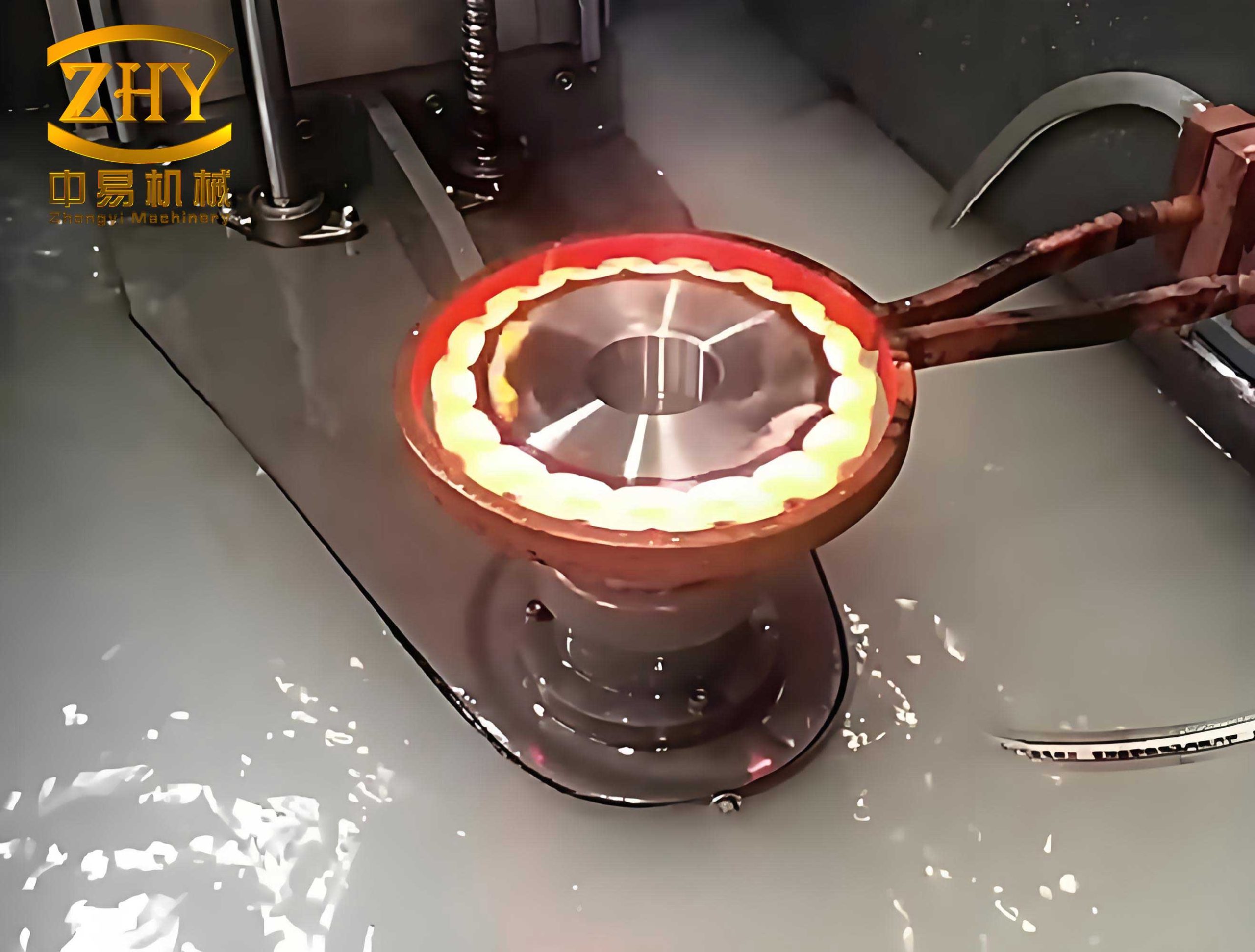
The visual complexity of distortion, as suggested above, underscores the need for a systematic approach. It is not merely a matter of shrinkage but often involves twisting, bending, and changes in roundness, all of which are critical heat treatment defects.
Critical Control Method: Precise Sizing Coordination Between Cold and Hot Working
The most fundamental and effective strategy is proactive compensation. Instead of attempting to eliminate all deformation, we precisely predict its magnitude and direction, then instruct the machining (cold working) department to pre-adjust the part dimensions accordingly. This requires rigorous data collection.
For instance, when substituting a low-hardenability steel for a carburizing steel in a final drive gear, we conducted multiple process validation runs, meticulously measuring post-quench dimensions. The representative data revealed a consistent pattern: the chordal tooth thickness (related to span measurement) shrank by 0.05–0.08 mm, and the spline bore major diameter shrank by 0.03–0.05 mm. Ovality change was minimal at ~0.01 mm.
Based on this predictable behavior, we established new machining tolerances:
- Chordal tooth thickness: machined to the upper limit of the drawing specification.
- Spline bore major diameter: machined to the upper limit.
- Tooth alignment error and runout tolerances: machined to half of the drawing tolerance.
After heat treatment, the parts reliably fell within the final product drawing limits. This data-driven handoff between manufacturing stages is crucial to preventing downstream heat treatment defects from rendering parts unusable.
The chemical composition, particularly carbon content, within the low-hardenability steel family also influences deformation. As shown in the comparative data below, a steel with a higher carbon content (e.g., 0.15% C vs. 0.10% C) typically exhibits slightly less shrinkage. This is attributed to the ability to use a lower austenitizing temperature and the presence of more pearlite in the initial microstructure, which increases the yield strength of the non-hardened core/webbing, offering greater resistance to deformation.
| Gear / Feature | Material A (Lower C) | Material B (Higher C) | Notes |
|---|---|---|---|
| Chordal Tooth Shrinkage | 0.06 – 0.10 mm | 0.04 – 0.07 mm | Post-quench |
| Spline Bore Shrinkage (De) | 0.04 – 0.07 mm | 0.02 – 0.04 mm | Post-quench |
| Additional Bore Shrinkage | 0.01 – 0.02 mm | 0.01 – 0.02 mm | Due to tempering |
Strategic Sequencing of Manufacturing Operations
For geometrically simple gears, sizing coordination may suffice. However, complex geometries—such as those with flanges, hubs, or thin webbing—require strategic sequencing of operations to counteract distortion tendencies. A classic example involves a gear with a flange on one side. The standard machining practice was to broach the bore starting from the flange side, resulting in a slight inherent machining taper (larger diameter at the flange entry side).
During induction hardening, only the toothed section is heated, causing the bore at the tooth-end to shrink significantly, while the unheated flange-end remains largely unchanged. This creates a natural heat treatment taper. If the machining taper and the heat treatment taper are in the same direction, they compound, leading to a total taper that exceeds specifications—a clear heat treatment defect. The solution was to reverse the broaching direction. By making the machining taper opposite to the expected heat treatment taper, the two effects compensated for each other, bringing the final bore geometry within tolerance. For outliers, a final sizing operation (e.g., broaching or burnishing) was added.
Another powerful technique involves postponing certain machining operations until after heat treatment. Large reduction gears with lightening holes in the web presented a problem: after hardening, the tooth segments aligned with these holes showed excessive shrinkage compared to the solid sections, causing a wavelike pattern in chordal thickness. This localized heat treatment defect was caused by the reduced structural rigidity in the hole sections, allowing greater inward contraction. By machining these lightening holes *after* the induction hardening process, the web’s integrity during quenching remained uniform, eliminating the irregular distortion pattern.
Adaptive Process Controls and Innovative Techniques
Process parameters must be optimized first for metallurgical quality (case depth, hardness, microstructure) and second for deformation control. We found a strong correlation between heat input and shrinkage. The total energy delivered, approximated by heating time ($t_h$) and power ($P$), directly affects the core temperature ($T_{core}$) and thus the shrinkage term in our deformation model. This relationship can be leveraged for adaptive control.
For a power take-off gear, the standard heating time provided optimal results. However, if a batch of gears arrived from machining with chordal thickness at the high limit or even slightly above, we could intentionally increase the heating time by 1-2 seconds. This increased core heat and resulted in an additional 0.02-0.03 mm of shrinkage, pulling the dimension back into spec. Conversely, for gears at the low limit, reducing heating time could minimize shrinkage. This real-time adjustment is a potent tool for correcting predictable heat treatment defects stemming from upstream machining variance.
For gears requiring hardening of both the teeth and an internal spline bore, sequential hardening caused excessive, cumulative bore shrinkage (>0.15 mm). Our innovative solution was a “single-cycle, dual-frequency” approach. Using a tailored induction coil setup, the gear is heated as a whole unit with carefully profiled power (initially high to penetrate, then modulated). The entire part—teeth and bore—is then quenched simultaneously using an integrated external spray and internal quench mandrel. This synchronizes the thermal cycles of both features, balancing the transformation stresses and reducing net bore distortion to a manageable 0.03-0.06 mm.
The most innovative technique developed for flanged gears is the “Segmented Heating, Single Quench” process. For a transmission gear where the toothed section needed hardening but the flange did not, standard practice caused severe bore taper: the tooth-end shrank, the flange-end did not. Our solution involved two induction coils on a common tooling plate: one for the flange and one for the teeth. The process sequence is:
- Activate the flange coil briefly to pre-heat the flange zone to a sub-critical temperature (e.g., 500-600°C).
- Immediately activate the tooth coil to austenitize the gear teeth to the hardening temperature.
- Quench the entire part.
The pre-heated flange undergoes thermal contraction during final cooling, causing its portion of the bore to shrink. By controlling the pre-heat energy, we can precisely dial in the amount of flange-end shrinkage to match that of the tooth-end, effectively eliminating the taper. This method directly addresses one of the most troublesome geometry-specific heat treatment defects.
| Strategy Category | Specific Method | Primary Mechanism | Applicable Distortion Type |
|---|---|---|---|
| Design & Sizing | Predictive Machining Allowances | Pre-compensates for predictable uniform shrinkage. | Size (Diameter, Thickness) |
| Material Selection | Optimizing Carbon Content / Grade | Utilizes higher core strength & lower processing temps. | Overall Magnitude of Shrinkage |
| Process Optimization | Polyvinyl Alcohol (PVA) Polymer Quenchant | Reduces thermal shock & slow cooling in martensite range minimizes stress. | Cracking, Warpage |
| Process Optimization | Adaptive Heating Time Control | Modulates core temperature to fine-tune shrinkage magnitude. | Size (Targeted Correction) |
| Operation Sequencing | Post-Hardening Machining of Non-Critical Features | Maintains structural uniformity during quenching. | Irregular/Patterned Distortion |
| Operation Sequencing | Reversed Machining Taper Direction | Uses cold-working defect to offset heat treatment defect. | Geometric Taper, Form Error |
| Innovative Hardening | Single-Cycle, Dual-Feature Hardening | Synchronizes thermal/transformation cycles to balance stresses. | Cumulative Bore Distortion |
| Innovative Hardening | Segmented Heating, Single Quench | Induces controlled thermal contraction in non-hardened zones. | Bore Taper on Flanged Gears |
Quenchant Selection: The Role of Polyvinyl Alcohol (PVA) Solution
The choice of quenchant is paramount in managing thermal and transformation stresses. We employ an aqueous solution of Polyvinyl Alcohol (PVA). Its cooling curve is particularly advantageous:
- High-Temperature Stage (above ~600°C): It exhibits a rapid cooling speed, exceeding that of oil, which is necessary to bypass the pearlite “nose” of the TTT diagram and ensure full hardening to martensite in low-hardenability steels.
- Low-Temperature Stage (Martensite Formation, below ~300°C): The cooling speed becomes markedly slower and more uniform, similar to or even gentler than oil. This reduces the thermal gradient between case and core during the vulnerable martensite transformation phase, minimizing the risk of quench cracking and reducing distortion.
The effective cooling velocity $v_c(T)$ of PVA can be described as piecewise:
$$
v_c(T) = \begin{cases}
k_1 \cdot (T – T_q) & \text{for } T > T_{Ms}, \text{ fast stage} \\
k_2 \cdot (T – T_q) & \text{for } T < T_{Ms}, \text{ slow stage}
\end{cases}
$$
where $k_1 > k_2$, $T_q$ is the quenchant temperature, and $T_{Ms}$ is the martensite start temperature. This tailored cooling characteristic makes it an ideal medium for controlling the very stresses that lead to heat treatment defects like cracking and warpage, while still achieving the required hardness.
Conclusion: A Framework for Managing Distortion
Controlling distortion in low-hardenability steel gears is not achieved by a single silver bullet but through a comprehensive, interconnected framework. It begins with understanding the predictable shrinkage behavior of the specific material and part geometry. This knowledge informs a closed-loop collaboration between design, machining, and heat treatment: machining provides pre-compensated dimensions, and heat treatment delivers a consistent, controlled process. Strategic sequencing of operations is used to eliminate distortion amplifiers like non-uniform rigidity. Finally, at the process level, the use of advanced quenchants like PVA and the development of innovative heating strategies (segmented heating, synchronized hardening) provide the fine control needed to tackle complex heat treatment defects like taper and cumulative bore shrinkage.
The successful implementation of this framework transforms distortion from an unpredictable heat treatment defect into a predictable, manageable, and compensatable outcome. It ensures that the significant advantages of low-hardenability steel gears—excellent contact fatigue strength with minimal distortion potential—are fully realized in high-precision applications, leading to reliable performance and reduced manufacturing costs associated with scrap and rework.