
In my extensive experience within heavy machinery manufacturing, managing dimensional changes during the heat treatment of large components is a paramount challenge. The case of large reducer gears, particularly after processes like carburizing, quenching, and tempering, presents a critical example of such challenges. This discussion is centered on analyzing the root causes of these significant heat treatment defects and formulating effective control strategies, primarily through the lens of martensitic transformation kinetics and process parameter optimization.
The core problem manifests as substantial and non-uniform distortion. For instance, a large gear shaft can exhibit outer diameter expansion exceeding 1.5 mm post-treatment. This expansion is not uniform along the axis, leading to severe taper. Consequently, after the final grinding operation to achieve the required dimensional accuracy, the effective case depth becomes uneven, often falling outside the specified design limits and resulting in scrap. This non-uniformity is a classic and costly heat treatment defect.
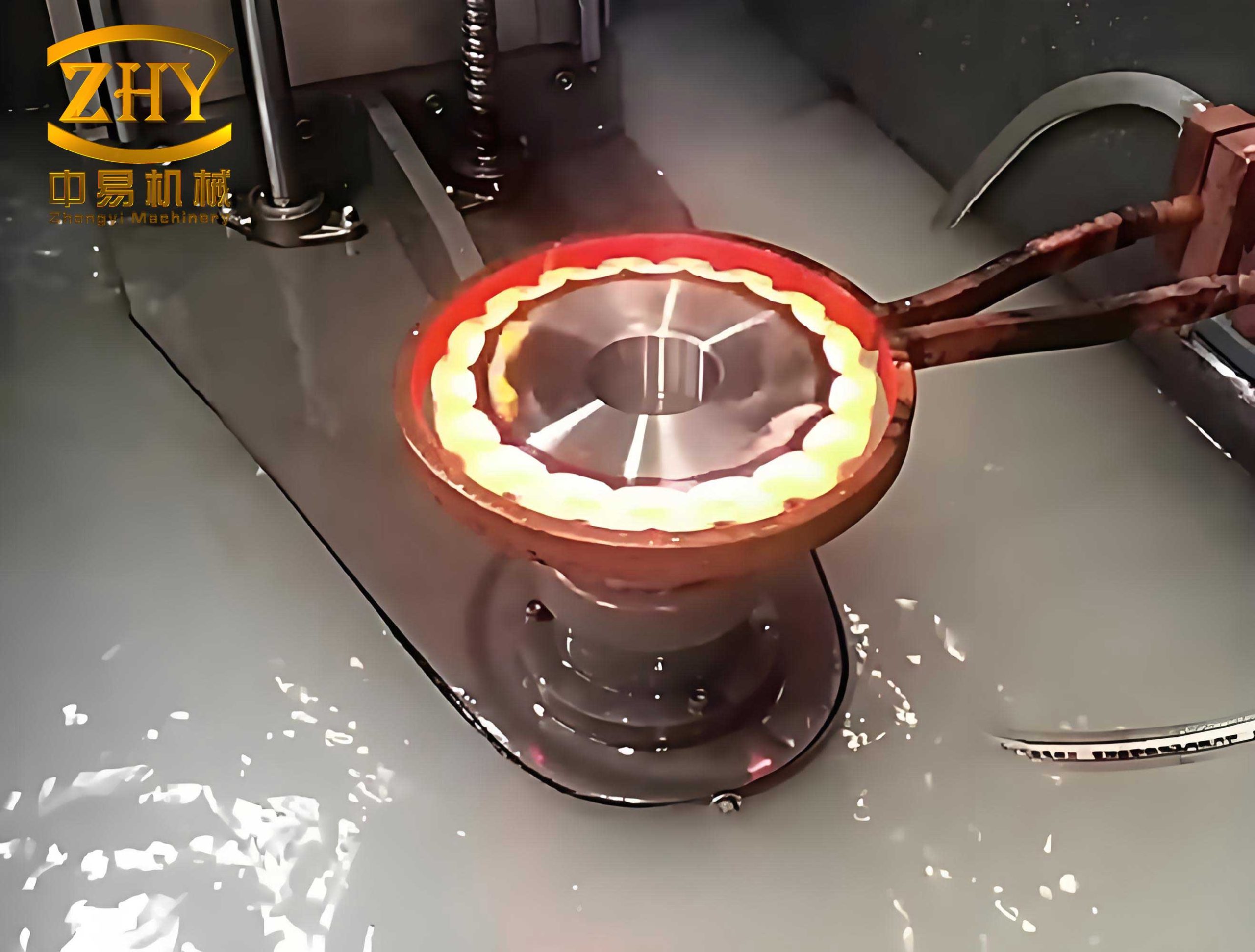
Mechanisms of Distortion: The Role of Martensitic Transformation
The primary driver for the irreversible dimensional change, particularly expansion, during quenching is the martensitic phase transformation. Unlike diffusional transformations, martensite forms via a shear mechanism, accompanied by a significant increase in specific volume. The critical concept explaining non-uniform expansion is the non-simultaneity of martensite formation across a large cross-section.
During oil quenching of a large-diameter gear, the cooling rate is not uniform. The surface regions, both the carburized case and the non-carburized core material near the bore, cool faster and transform to martensite first. This creates a hard, high-strength “shell” while the interior and the deeper regions of the case are still in the austenitic state. The martensite start (Ms) temperature for the high-carbon case is considerably lower than that of the low-carbon core. As this outer shell forms, it undergoes volumetric expansion. Since the interior is still soft and austenitic, it yields to this expansion, locking in a larger dimension.
Subsequently, as the interior cools further and transforms to martensite, it too attempts to expand. However, it is now constrained by the already-formed hard martensitic shell. This internal constraint leads to the development of complex residual stresses. The net effect, however, is that the component cannot contract back to its pre-quench dimensions, resulting in a permanent net expansion of the outer diameter. The degree of this heat treatment defect is directly related to the section size and the cooling characteristics.
The volumetric change associated with the transformation can be conceptually summarized. The total strain during quenching ($\epsilon_{total}$) is a superposition of thermal strain ($\epsilon_{th}$), transformational strain ($\epsilon_{tr}$), and strain from plastic deformation due to stress ($\epsilon_{pl}$):
$$
\epsilon_{total} = \epsilon_{th} + \epsilon_{tr} + \epsilon_{pl}
$$
The transformational strain from austenite ($\gamma$) to martensite ($\alpha’$) is a function of the volume change per atom ($\Delta V/V$) and the volume fraction of martensite formed ($f$):
$$
\epsilon_{tr} \approx f \cdot \frac{\Delta V}{V}
$$
For carbon steels, $\Delta V/V$ is positive and increases with carbon content, explaining why the high-carbon case expands more than the core. The non-uniformity in $f(x,y,z,t)$ due to varied cooling rates is what leads to distortion and residual stresses, core aspects of heat treatment defects.
Process Analysis and Distortion Data
A standard heat treatment cycle for such a gear involves carburizing, slow cooling, reheating for quench hardening, and multiple tempering stages. The quenching step from the austenitizing temperature (e.g., ~850°C) into oil is the most critical for distortion control.
Initial production trials with consistent fixture orientation (e.g., gear flange always positioned upwards during both carburizing and quenching) yielded unacceptable results. The data from such a process is summarized below, measuring expansion at different sections (A, B, C, D) along the gear’s axis.
| Gear Section | Measured Outer Diameter Expansion (mm) | Resulting Taper & Case Depth Issue |
|---|---|---|
| Section A (Top, near flange) | +1.10 to +1.50 | Severe taper. Calculated post-grind case depth insufficient. |
| Section D (Bottom) | +0.40 to +0.70 | Moderate expansion. Case depth within spec. |
The taper indicated that Section A expanded significantly more than Section D. This can be attributed to the quenching sequence: the top section (A) enters the quenchant first and is also closer to the massive flange, altering heat extraction. The faster initial cooling at the top enhances the non-simultaneity effect, leading to greater expansion. This is a direct illustration of a process-induced heat treatment defect.
The relationship between cross-sectional size (or “characteristic quenching dimension”) and expansion is clear. Thinner sections cool more uniformly, allowing more simultaneous transformation and greater potential for thermal contraction before martensite locks in the dimensions. This can even lead to negative expansion (shrinkage) in very small gears, as shown in the comparative table below.
| Component Name | Approximate Tooth-Ring Cross-Section (mm) | Typical OD Expansion after Quench (mm) | Note |
|---|---|---|---|
| Large Reducer Gear (Primary) | > 300 | +0.80 to +1.50 | Prone to large, non-uniform expansion. |
| Intermediate Pinion | ~150 | +0.30 to +0.60 | More uniform behavior. |
| High-Low Speed Small Gear | ~50 | -0.10 to -0.30 | Can exhibit net shrinkage. |
Control Strategies for Mitigating Distortion
Two primary corrective measures were identified and implemented to combat these heat treatment defects: (1) Reverse Fixturing During Quenching and (2) Controlled Reduction of Quenching Temperature.
1. Reverse Fixturing (Quench Orientation Flip)
If the gear is carburized with the flange up, it is subsequently quenched with the flange down. This strategy aims to reverse the thermal gradient and the sequence of martensite formation along the axis. The end that was previously at the top (and expanded most) is now at the bottom, entering the quenchant first. This subjects it to a different thermal history, promoting a more balanced final distortion pattern.
Data after implementing reverse fixturing showed a marked improvement:
| Gear Section | OD Expansion – Old Method (mm) | OD Expansion – Reverse Fixture (mm) | Improvement |
|---|---|---|---|
| Section A | +1.10 to +1.50 | +0.70 to +0.90 | Expansion reduced and more uniform. |
| Section D | +0.40 to +0.70 | +0.60 to +0.85 | Expansion increased slightly, reducing taper. |
The taper was significantly reduced, leading to a much more uniform effective case depth after final grinding, effectively correcting the previous heat treatment defect.
2. Quenching Temperature Reduction
The austenitizing temperature prior to quenching has a direct impact on distortion. A higher temperature increases the thermal strain component ($\epsilon_{th}$) due to greater thermal contraction from a larger starting volume. It also results in a higher concentration of vacancies and a generally more relaxed austenite structure with lower yield strength, making it more susceptible to plastic deformation during the quench.
By carefully lowering the quench temperature (e.g., from 850°C to 820°C) while ensuring complete austenitization and carbide dissolution, the driving force for distortion is reduced. The empirical data supports this:
| Quench Temperature (°C) | Typical OD Expansion (mm) | Remarks on Microstructure |
|---|---|---|
| 850 | +1.20 to +1.50 | Standard process, higher expansion. |
| 820 | +0.70 to +1.00 | Reduced expansion, maintained hardness. |
The relationship can be conceptually tied to thermal stress. The thermal stress ($\sigma_{th}$) generated during cooling is proportional to the temperature difference ($\Delta T$), the modulus of elasticity ($E$), and the coefficient of thermal expansion ($\alpha$), constrained by the geometry:
$$
\sigma_{th} \propto E \cdot \alpha \cdot \Delta T
$$
A lower starting (quench) temperature reduces the maximum $\Delta T$ experienced by the part, thereby reducing the thermal stress that can drive plastic deformation and exacerbate the non-uniform transformational expansion. Controlling this temperature is therefore a crucial lever in managing heat treatment defects.
Comprehensive Strategy and Conclusions
The control of distortion in large gears is not achievable through a single silver bullet but requires a systems-based understanding. The strategies discussed interact synergistically:
- Understand the Mechanism: The non-simultaneous martensite transformation in large sections is the fundamental cause of asymmetric expansion, a key heat treatment defect.
- Modify Thermal History: Reverse fixturing alters the quenching sequence to counterbalance inherent thermal gradients, promoting uniformity.
- Optimize Process Parameters: Reducing the quench temperature within a safe window minimizes the thermal and transformational driving forces for distortion.
- Predict and Compensate: Empirical rules, such as the relationship between OD expansion and required grinding allowance for case depth control, must be established for specific component geometries and steel grades.
In conclusion, significant heat treatment defects like the excessive and non-uniform distortion in large carburized gears are manageable. The interplay between martensite transformation kinetics and process-induced thermal gradients is the central theme. By strategically manipulating the quench orientation and carefully lowering the austenitizing temperature, the non-simultaneity of transformation can be mitigated. This leads to a more uniform dimensional change, ensuring that post-grind specifications for geometry and case depth are consistently achieved, thereby turning a major quality challenge into a controlled and predictable manufacturing outcome.