
In my extensive experience within the automotive and precision engineering industry, improving the fatigue resistance of motorcycle engine gears is a multifaceted challenge that hinges critically on post-machining heat treatment processes. While material selection forms the foundational step, the subsequent thermal and chemical treatments ultimately dictate the gear’s service life, noise characteristics, and transmission efficiency. The core objective is to create a component with a hard, wear-resistant surface capable of withstanding repeated contact stresses, while maintaining a tough, ductile core to absorb shock loads and prevent catastrophic failure. This duality is primarily achieved through surface hardening techniques like carburizing and nitriding. Throughout this discussion, I will emphasize that understanding and mitigating heat treatment defects is paramount to achieving consistent quality and performance. The interplay between process parameters, material composition, and resultant microstructure is complex, and even minor deviations can lead to significant heat treatment defects such as insufficient hardness, distortion, or undesirable residual stresses.
The majority of transmission gears in motorcycle engines are manufactured from low-carbon or low-alloy steels such as 20CrMnTi, 20CrMo, or similar grades. These materials are ideal for case hardening because their low carbon content ensures good core toughness. The primary method employed is carburizing followed by quenching, which enriches the surface layer with carbon before a rapid cooling transformation. Among the various techniques—solid, liquid, and gas carburizing—gas carburizing stands out for its superior controllability, efficiency, and working environment. The process involves exposing the gears to a carbon-rich atmosphere, typically derived from endothermic gas generators or direct injection of organic compounds like methanol and acetone, at temperatures between $$900^\circ C$$ and $$950^\circ C$$. During this stage, carbon atoms diffuse into the austenitic steel surface, and a subsequent quenching operation transforms this high-carbon layer into hard martensite.
Several critical factors must be meticulously controlled during carburizing and quenching to avoid common heat treatment defects. First is the case depth, often defined as the effective hardened depth to a specific hardness (e.g., 550 HV). For gears, it is generally recommended to be within a range of $$0.15 \times m$$ to $$0.25 \times m$$, where $$m$$ is the module. A shallow case favors bending fatigue resistance, while a deeper case enhances resistance to pitting (contact fatigue). However, an excessively deep case can be detrimental to impact strength. The relationship between applied shear stress ($$\tau$$) and required case depth ($$d_c$$) can be conceptualized by ensuring the case extends beyond the depth of maximum subsurface shear stress, which is approximated by:
$$ d_c \geq \frac{b}{2} \sqrt{\frac{2\tau_{max}}{S_y}} $$
where $$b$$ is the half-width of contact, $$\tau_{max}$$ is the maximum shear stress, and $$S_y$$ is the yield strength of the core material. Second, the surface microstructure must consist of fine-grained martensite with a controlled amount of retained austenite. A content between 15% to 30% can be beneficial for resisting sliding wear and micropitting by providing a slight degree of toughness. Third, surface cleanliness prior to treatment is non-negotiable. Residual cutting oils, lubricants, or debris can vaporize and disrupt the furnace atmosphere, leading to sooting and inconsistent carburization—a direct precursor to heat treatment defects like soft spots or uneven hardness.
The quenching strategy itself is a major source of potential heat treatment defects, particularly distortion. Two primary quenching methods are used:
| Quenching Method | Process Description | Advantages | Disadvantages & Associated Defects |
|---|---|---|---|
| Direct Quenching | Quenching immediately after carburizing at the carburizing temperature. | Minimizes thermal cycles, reduces distortion due to lower stress. | Promotes higher retained austenite; risk of excessive carbon at surface leading to low hardness; may require sub-zero treatment. |
| Reheat Quenching | Cooling after carburizing, then reheating to a lower austenitizing temperature (e.g., $$820^\circ C$$) before quenching. | Allows for carbon diffusion for a more uniform gradient; permits grain refinement. | Increased distortion risk from an additional thermal cycle; requires precise atmosphere control during reheating to prevent decarburization. |
Distortion in gears manifests as changes in tooth profile, lead (tooth alignment along the axis), and pitch. The volumetric expansion associated with the martensitic transformation ($$\Delta V \propto \text{%C}$$) is the primary driver. Non-uniform case depth exacerbates this, causing irregular expansion. For example, a gear with a tapered case will distort asymmetrically. The resulting lead error often appears as a crowning or barreling effect along the tooth width. To compensate, a pre-corrected “anti-distortion” tooth form is often machined prior to heat treatment. The change in pressure angle ($$\Delta \alpha$$) due to profile expansion can be approximated, and the pre-machining tool geometry is adjusted accordingly. Empirical data suggests that for a module 2 gear, the pressure angle might increase by $$0.1^\circ$$ to $$0.3^\circ$$ after carburizing and quenching. Therefore, the pre-machining pressure angle ($$\alpha_{pre}$$) is calculated as:
$$ \alpha_{pre} = \alpha_{spec} – k \cdot \Delta \alpha_{avg} $$
where $$\alpha_{spec}$$ is the specified pressure angle, $$k$$ is an empirical factor (often ~1), and $$\Delta \alpha_{avg}$$ is the average change observed from process qualification trials.
Another critical heat treatment defect is insufficient or non-uniform surface hardness. This can stem from multiple root causes: inadequate case depth, decarburization during reheating, low quenching speed, or improper tempering. The tempering process, while necessary to relieve quenching stresses, must be carefully controlled. Excessive tempering temperature or time will reduce hardness. The relationship between tempering temperature ($$T$$, in Kelvin), time ($$t$$, in hours), and hardness loss ($$\Delta H$$) for low-alloy steels can be described by the Hollomon-Jaffe parameter:
$$ P = T(C + \log t) $$
where $$C$$ is a material constant. A higher $$P$$ value correlates with greater softening. For gear steels like 20CrMnTi, tempering is typically performed at $$160^\circ C$$ to $$200^\circ C$$ for 1-2 hours to stabilize the microstructure without significant hardness drop.
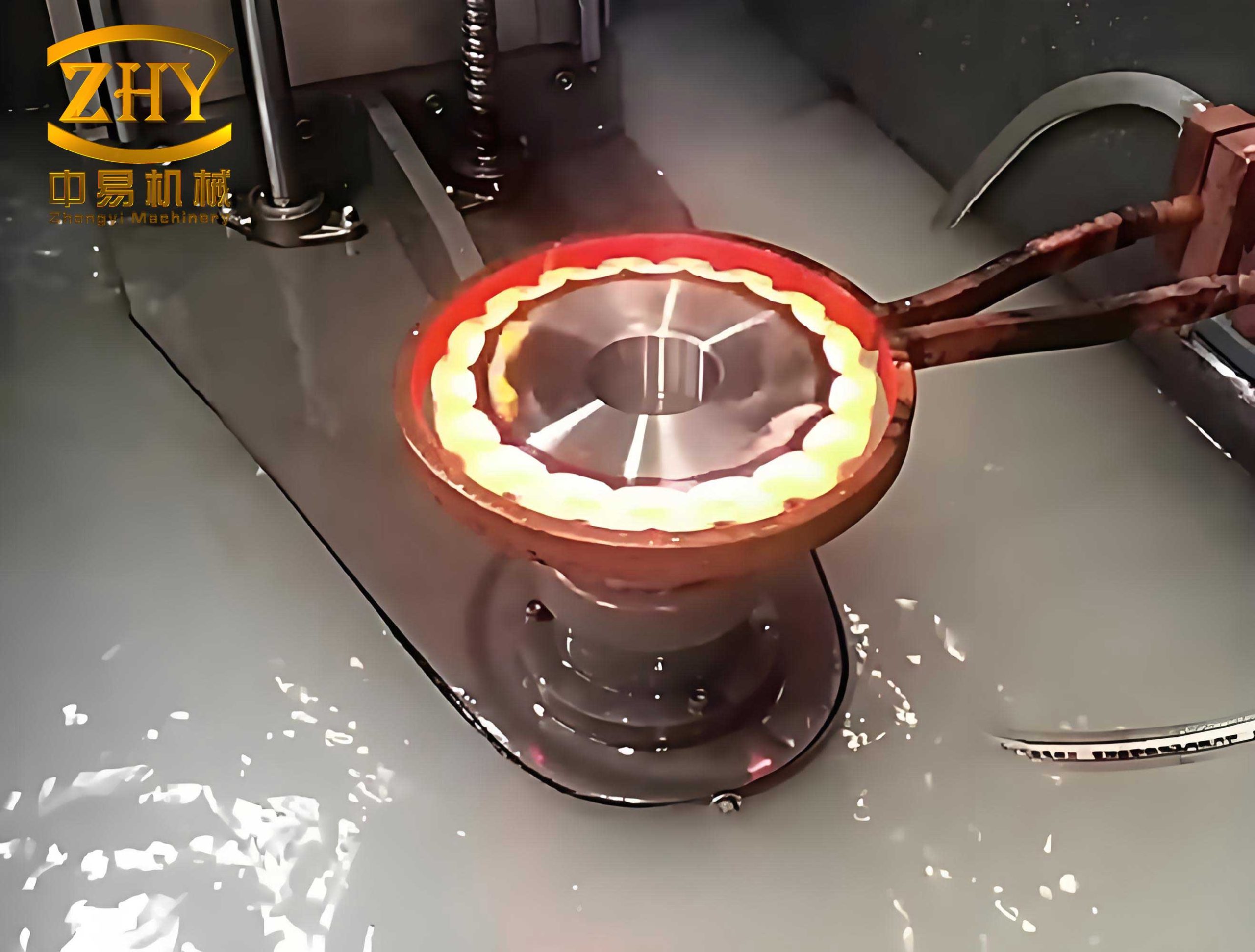
Visual inspection and analysis of such defects are crucial for process correction. As illustrated, common heat treatment defects can range from surface cracking and oxidation to catastrophic distortion. In my practice, we rigorously monitor these parameters using statistical process control (SPC) charts for case depth, surface hardness (target: 58-62 HRC, approximately 680-780 HV), and core hardness (target: 30-40 HRC). The following table summarizes key quality attributes and their control limits to prevent heat treatment defects in carburized gears:
| Quality Attribute | Target Range | Measurement Method | Common Defect if Out-of-Spec |
|---|---|---|---|
| Effective Case Depth (to 550 HV) | 0.6 – 1.0 mm (for module ~4) | Microhardness Traverse | Bending fatigue failure (too shallow) or impact brittle fracture (too deep). |
| Surface Hardness | 58 – 62 HRC | Rockwell C / Vickers | Rapid wear, pitting initiation. |
| Core Hardness | 30 – 40 HRC | Rockwell C | Insufficient support for case, tooth breakage. |
| Retained Austenite | 15% – 30% | X-ray Diffraction / Metallography | Dimensional instability, soft surface if too high; brittleness if too low. |
| Tooth Profile Deviation | ≤ 0.02 mm | Gear Measuring Machine | Increased noise, non-uniform load distribution, premature failure. |
While carburizing is predominant, an increasingly important alternative for high-volume, precision gear production is soft nitriding (also known as ferritic nitrocarburizing). This process addresses one of the most persistent heat treatment defects associated with quenching: distortion. Soft nitriding is conducted at significantly lower temperatures, typically between $$570^\circ C$$ and $$580^\circ C$$, in an atmosphere containing both nitrogen and carbon (from gases like ammonia and endothermic gas, or in salt baths). At these temperatures, the steel remains in the ferritic phase, eliminating phase transformation stresses. The process forms a thin, hard compound layer ($$ \epsilon$$-Fe2-3N and/or $$ \gamma’$$-Fe4N) on the surface, typically 5-20 μm thick, supported by a diffusion zone of several hundred microns where nitrogen is dissolved in the ferrite matrix.
The advantages are compelling for mass production: minimal dimensional change, excellent anti-scuffing and anti-wear properties due to the compound layer’s low friction coefficient, and improved fatigue strength from the diffusion zone which induces compressive residual stresses. The fatigue limit improvement can be quantified. For a standard alloy steel like 42CrMo4, the bending fatigue strength ($$\sigma_{f}$$) after nitriding can be estimated as:
$$ \sigma_{f, nitrided} = \sigma_{f, base} + K \cdot \sigma_{res} \cdot \sqrt{\frac{d_N}{\rho}} $$
where $$\sigma_{f, base}$$ is the base material’s fatigue strength, $$K$$ is a constant, $$\sigma_{res}$$ is the surface compressive stress induced, $$d_N$$ is the effective depth of the nitrided layer, and $$\rho$$ is the notch root radius. In my applications, I have observed increases in bending fatigue strength of 30% to 80% compared to the quenched and tempered state, often matching or even surpassing the performance of carburized gears for certain loading conditions.
However, soft nitriding is not immune to heat treatment defects. The key to success lies in meticulous pre-treatment and process control. Since the compound layer forms on the existing surface, the initial gear quality is paramount. The best results are achieved with gears that have high geometric accuracy and superior surface finish, preferably after finishing operations like shaving or grinding. The process flow before nitriding is critical and typically follows this sequence: Forging → Rough Machining → Stress Relieving (or Quenching & Tempering for high-strength cores) → Finish Machining → Cleaning → Soft Nitriding. Inadequate stress relief prior to nitriding can lead to distortion as residual machining stresses are relaxed at the nitriding temperature, even though no phase change occurs.
Another potential heat treatment defect in nitriding is the formation of a brittle, excessively thick compound layer or a phenomenon known as “white layer” spalling under high Hertzian contact stress. Controlling the nitriding potential (a function of ammonia dissociation rate and carbon activity) and time is essential. The growth kinetics of the compound layer ($$d_{cl}$$) often follow a parabolic law:
$$ d_{cl} = k \sqrt{t} $$
where $$k$$ is a temperature and atmosphere-dependent rate constant, and $$t$$ is time. For most motorcycle gears, a nitriding time of 2 to 4 hours is optimal to achieve a compound layer of 8-15 μm and a diffusion zone of 0.2-0.4 mm, maximizing fatigue benefit without brittleness. The table below provides a direct comparison between gas carburizing and gas soft nitriding, highlighting their propensity for different heat treatment defects:
| Aspect | Gas Carburizing & Quenching | Gas Soft Nitriding |
|---|---|---|
| Process Temperature | High (900-950°C) | Low (570-580°C) |
| Primary Strengthening Mechanism | High-carbon martensitic case | Nitrogen compound layer + diffusion zone with compressive stress |
| Typical Surface Hardness | 700-800 HV (58-62 HRC) | 500-700 HV (Compound Layer) |
| Case/Diffusion Zone Depth | 0.5-1.5 mm | 0.2-0.5 mm (Diffusion Zone) |
| Dimensional Change/Distortion | Significant, requires compensation | Minimal, often negligible |
| Common Defects | Distortion, soft spots, excessive retained austenite, cracking. | Brittle compound layer, porosity in white layer, insufficient depth if time/temp is low. |
| Best Suited For | Heavily loaded gears requiring deep case strength; components needing high wear resistance. | High-precision gears where distortion is unacceptable; components requiring good scuffing resistance and fatigue improvement. |
| Fatigue Strength Improvement | Excellent for both bending and pitting fatigue. | Excellent for bending fatigue; very good for pitting if compound layer is controlled. |
The choice between these processes, therefore, involves a careful trade-off analysis based on gear design, load spectrum, production volume, and cost. In modern motorcycle engine development, we often employ a hybrid approach or advanced variants. For instance, plasma (ion) nitriding offers even better control of the compound layer and is suitable for stainless steels, while low-pressure carburizing with high-pressure gas quenching reduces oxidation and distortion. Regardless of the method selected, a robust quality assurance system is essential to detect and analyze heat treatment defects. Techniques like eddy current testing for case depth consistency, batch monitoring of furnace atmosphere carbon potential ($$C_p$$) calculated via the relationship:
$$ C_p \approx \frac{K \cdot P_{CO}^2}{P_{CO_2}} $$
where $$K$$ is the equilibrium constant for the reaction $$2CO \leftrightarrow C_{(in \gamma-Fe)} + CO_2$$, and $$P$$ denotes partial pressures, and regular metallographic audits are part of my standard protocol.
In conclusion, enhancing the fatigue resistance of motorcycle gears is an engineering endeavor deeply rooted in mastering heat treatment science. From the high-temperature diffusion of carbon in gas carburizing to the low-temperature interstitial incorporation of nitrogen in soft nitriding, each process imparts unique characteristics to the gear tooth. The persistent challenge lies in navigating the myriad of potential heat treatment defects that can arise from improper parameter control, material inconsistencies, or pre-treatment oversights. By leveraging a combination of empirical knowledge, thermodynamic modeling, and rigorous process monitoring—summarized effectively through tables and predictive formulas—we can consistently produce gears that meet the demanding durability and performance standards of modern motorcycle engines. The ultimate goal is not just to harden a surface, but to engineer a stress-state and microstructure that optimally resists the complex, cyclic loading encountered in service, thereby ensuring reliability and longevity.