
In my years of experience as a metallurgical engineer, I have extensively studied the heat treatment of low hardenability steel gears, often referred to as low-quench steels. The performance of these gears is entirely dependent on correct heat treatment processes, which if not properly controlled, can lead to various heat treatment defects. This article delves into the heat treatment techniques, their impact on microstructure and properties, and the strategies to mitigate common heat treatment defects. Through rigorous experimentation, I have found that low-quench steels can match or even surpass the mechanical properties of carburized alloy steels, making them suitable for applications in automotive, tractor, locomotive, and mining machinery gears. The elimination of carburization simplifies the process, saves over 20% in energy, and offers significant economic benefits. However, achieving these advantages requires precise control over heat treatment parameters to avoid heat treatment defects such as cracks, soft spots, and undesirable microstructures.
The foundation of gear quality lies in the initial heat treatment steps. For low hardenability steels, the as-forged or as-machined gear blanks must undergo normalizing to refine the grain structure and ensure uniformity. The chemical composition of typical low-quench steels is critical, as it influences hardenability and response to heat treatment. Based on my research, the standard compositions are summarized in Table 1.
| Steel Grade | C | Si | Mn | S | P | Other Elements |
|---|---|---|---|---|---|---|
| 55Ti | 0.50-0.60 | 0.10-0.35 | 0.10-0.30 | ≤0.040 | ≤0.040 | Ti: 0.04-0.10 |
| 60Ti | 0.55-0.65 | 0.10-0.35 | 0.10-0.30 | ≤0.040 | ≤0.040 | Ti: 0.04-0.10 |
| 70Ti | 0.65-0.75 | 0.10-0.35 | 0.10-0.30 | ≤0.040 | ≤0.040 | Ti: 0.04-0.10 |
Normalizing aims to produce a fine-grained structure of ferrite and pearlite, with an actual grain size strictly controlled at Grade 8 or higher. Improper normalizing can lead to heat treatment defects like coarse ferrite blocks, which may not dissolve during quenching, resulting in soft spots and reduced machinability. From my trials, the optimal normalizing temperatures are derived from critical points and grain growth tendencies. The recommended temperatures are: 55Ti at 880±10°C, 60Ti at 870±10°C, and 70Ti at 860±10°C. Cooling should be conducted by air cooling or forced air cooling in high-temperature environments to achieve a hardness range of 170-207 HB. The microstructure should consist of uniformly distributed ferrite and pearlite, as deviations can propagate heat treatment defects into subsequent stages.
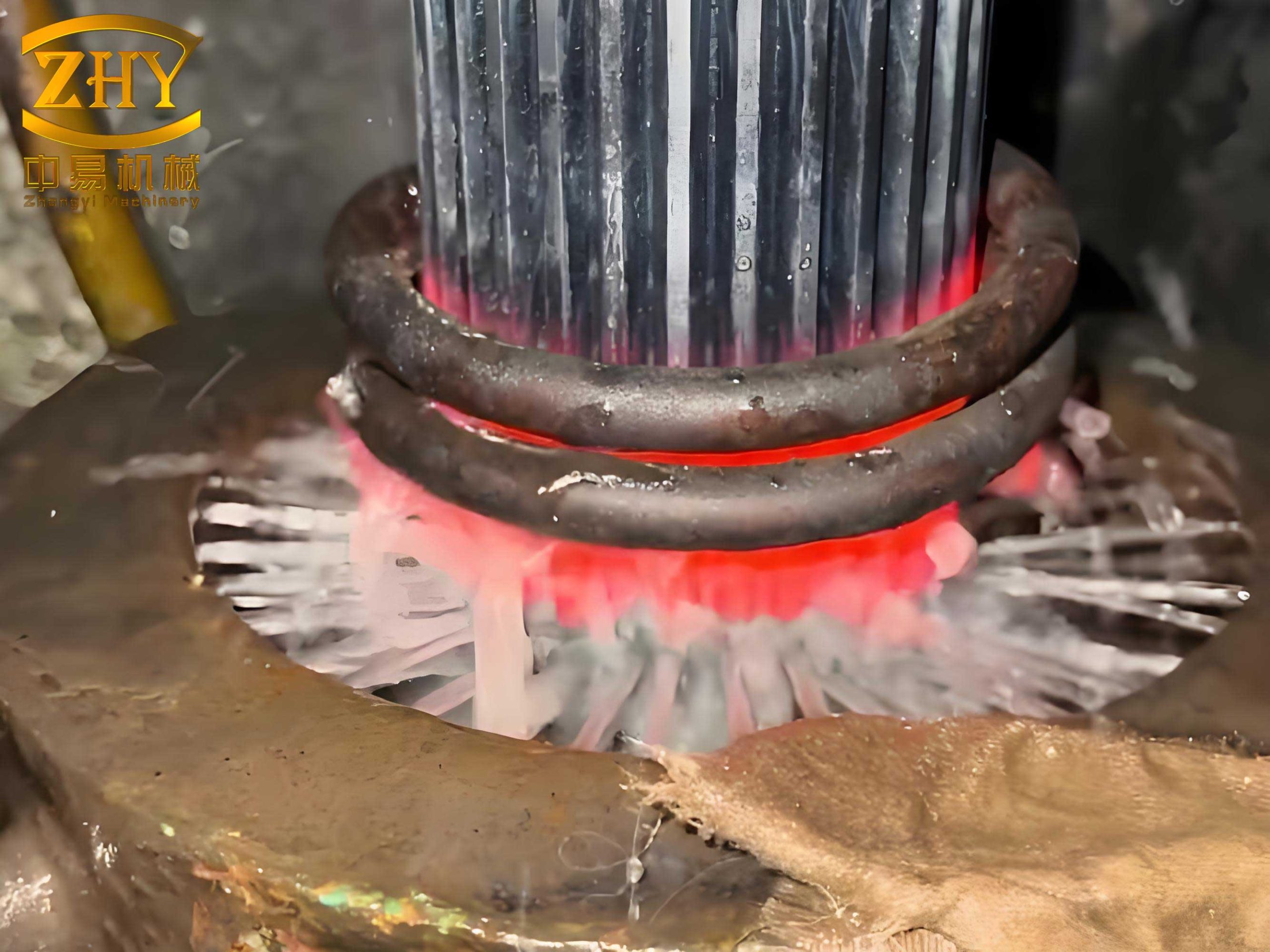
Quenching is the most critical step for low hardenability steel gears, directly influencing their performance and lifespan. It requires careful management of factors such as heating temperature, speed, and cooling conditions to prevent heat treatment defects. I have observed that induction heating is predominantly used, with the goal of through-heating the entire tooth profile to ensure a martensitic case and a tough core of troostite or sorbitte. The heating speed must be balanced: too fast causes temperature gradients and austenite inhomogeneity, leading to soft spots—a common heat treatment defect; too slow coarsens grains and increases cracking tendency. In practice, I employ a power density of 0.8-1.0 kW/cm² initially, slowing down as the temperature approaches the Curie point, which aligns with recommended heating rates in the phase transformation zone of 20-30°C/s. The final heating temperature should be maintained at 850-880°C; exceeding 900°C coarsens martensite, reduces impact toughness, and heightens cracking risks, as shown in Table 2.
| Quenching Temperature (°C) | Austenite Grain Size (Grade) | Martensite Level | Impact Value (J/cm²) | Notes on Heat Treatment Defects |
|---|---|---|---|---|
| 850 | 8-9 | Fine (Level 1-2) | 50-60 | Minimal defects |
| 900 | 7-8 | Moderate (Level 3-4) | 40-50 | Risk of coarse martensite |
| 950 | 6-7 | Coarse (Level 5-6) | 30-40 | High cracking tendency |
The cooling medium is paramount due to the high critical cooling velocity of low-quench steels, typically 500-600°C/s compared to 600°C/s for plain carbon steels. To avoid heat treatment defects like inadequate hardening or excessive distortion, the cooling medium must have sufficient intensity. I have tested various water pressures and flow rates, finding that a pressure of 4-6 kgf/cm² and a flow rate tailored to gear module and diameter are essential. The spray ring design also matters; slit-type rings outperform chessboard-type ones in achieving continuous hardened layers. For instance, with a gear module of 6 mm, a flow rate of 20 m³/h and pressure of 5 kgf/cm² yield optimal results, as lower flows cause discontinuous layers—a severe heat treatment defect. Rotation speed during cooling should be controlled at 30-60 rpm to ensure even quenching, especially in root areas.
Cracking is a prevalent heat treatment defect in low-quench steel gears, particularly for small modules. I have encountered three types: tooth tip cracks, root cracks, and transverse cracks. These often stem from overheating and rapid cooling in the martensite transformation range. After testing numerous methods, I found that using polyvinyl alcohol (PVA) aqueous solutions at 0.1-0.3% concentration effectively prevents cracks while maintaining hardness. The cooling curve of PVA solution shows similar speed to water in the pearlite formation range (600-400°C) but reduced speed in the martensite range (300-200°C), mitigating thermal stresses. This insight is crucial for avoiding heat treatment defects in production. For medium and large modules, adjusting inductors, electrical parameters, and employing water quenching with controlled self-tempering can also prevent cracks. Therefore, the quenching philosophy for low-quench steels involves through-heating, intensified cooling, and moderated cooling in the martensite zone to sidestep heat treatment defects.
The relationship between microstructure and mechanical properties is vital for setting quality standards. In mass production, variations in heat treatment can cause microstructural fluctuations, so I have conducted extensive tests to define acceptable ranges. Key findings include: undissolved ferrite at the tooth root significantly reduces static bending strength and fatigue resistance, making it a critical heat treatment defect to avoid; martensite coarseness above Level 4 lowers impact toughness and can lead to early tooth fracture, another heat treatment defect; troostite at the tooth flank accelerates pitting and spalling, particularly near the pitch circle, so it should be minimized; and the hardened layer must be continuously distributed along the tooth profile, with depth less than the full tooth height to prevent brittle fracture. Tables 3 and 4 summarize these effects, highlighting how heat treatment defects impact performance.
| Sample ID | Tooth Root Ferrite | Martensite Level | Static Bending Load (kN) | Pulsating Fatigue Cycles (×10⁶) | Multi-Impact Resistance (Cycles to Failure) | Identified Heat Treatment Defects |
|---|---|---|---|---|---|---|
| A1 | None | 2 | 120-130 | 2.5-3.0 | 15,000-20,000 | None |
| A2 | Moderate | 3 | 100-110 | 1.8-2.2 | 10,000-15,000 | Undissolved ferrite |
| A3 | None | 5 | 115-125 | 2.0-2.5 | 8,000-12,000 | Coarse martensite |
| Gear Condition | Hardened Layer Depth Relative to Tooth Height | Presence of Troostite at Pitch Circle | Bench Test Life (hours) | Primary Heat Treatment Defects Observed |
|---|---|---|---|---|
| Optimal | 80-90% | No | 500-600 | None |
| Suboptimal | 100% (full hardening) | Yes | 200-300 | Brittle fracture, pitting |
| Defective | Discontinuous | Yes | 100-150 | Soft spots, early failure |
Based on these results, I recommend the following suitable microstructural criteria for low-quench steel gears after heat treatment: a macroscopically continuous hardened layer with depth less than the full tooth height; no undissolved ferrite at the tooth root surface; no apparent troostite on the working flank; and martensite level not exceeding 4. Adhering to these guidelines helps minimize heat treatment defects and ensures reliable gear operation.
To quantify the cooling process, I often use formulas related to critical cooling velocity and heat transfer. For instance, the critical cooling velocity \( v_c \) can be expressed as: $$ v_c = \frac{T_{\text{Austenitization}} – T_{\text{Martensite start}}}{t_{\text{cooling}}} $$ where \( T_{\text{Austenitization}} \) is around 850-880°C and \( T_{\text{Martensite start}} \) is approximately 250°C for these steels. The time \( t_{\text{cooling}} \) must be short enough to avoid pearlite formation, typically requiring \( v_c > 500°C/s \). Another useful formula estimates the heat extraction rate during quenching: $$ Q = h \cdot A \cdot \Delta T $$ where \( Q \) is the heat flux, \( h \) is the heat transfer coefficient (dependent on medium and pressure), \( A \) is the surface area, and \( \Delta T \) is the temperature difference. For water quenching, \( h \) can range from 5000-10,000 W/m²K, but with PVA solutions, it drops in the martensite range, reducing stress and heat treatment defects. These equations aid in designing quenching systems to prevent heat treatment defects.
In conclusion, the heat treatment of low hardenability steel gears is a delicate balance of parameters to achieve high surface hardness and a tough core without incurring heat treatment defects. Through my experiments, I have established that proper normalizing at lower temperature ranges, controlled induction heating at 850-880°C, and intensified cooling with adequate pressure and flow are essential. The use of PVA solutions for small modules effectively prevents cracking, a common heat treatment defect. Microstructurally, avoiding undissolved ferrite, coarse martensite, and excessive troostite is crucial for performance. By implementing these practices, heat treatment defects can be minimized, and low-quench steel gears can reliably replace carburized alloy gears, offering economic and energy-saving benefits. Continuous monitoring and adjustment based on gear geometry and production conditions are key to sustaining quality and mitigating heat treatment defects in industrial applications.