
In my years of experience in materials engineering, I have focused extensively on the heat treatment of tool steels, particularly high-speed steels like W18Cr4V. This steel is renowned for its exceptional red hardness, making it ideal for cutting tools such as gear milling cutters. However, achieving optimal performance requires a deep understanding of its alloying elements and precise heat treatment processes. One critical aspect often overlooked is the management of heat treatment defects, which can severely impact tool durability and machining quality. In this article, I will delve into the intricacies of W18Cr4V heat treatment, emphasizing how to mitigate common heat treatment defects through controlled parameters.
W18Cr4V, commonly known as high-speed steel or “fast steel,” contains a total alloy content exceeding 10%, which imparts superior properties like high hardness and wear resistance even at elevated temperatures up to 600°C. This makes it suitable for high-speed machining applications. The key to unlocking these properties lies in its composition and the subsequent heat treatment cycles. I will start by analyzing the alloy elements and their roles, then detail the specific heat treatment processes for disk-shaped gear milling cutters, and finally discuss how variations in these processes can address different performance requirements while minimizing heat treatment defects.
The alloying elements in W18Cr4V include tungsten (W), chromium (Cr), vanadium (V), and carbon (C), with carbon content typically ranging from 0.70% to 1.50%. Carbon is crucial for forming alloy carbides that enhance hardness and wear resistance. From my research, tungsten is the primary element conferring red hardness; it forms carbides like Fe4W2C that dissolve partially during heating, increasing tempering stability and contributing to secondary hardening. Chromium improves hardenability and wear resistance, but excessive amounts can lead to retained austenite, a common heat treatment defect that reduces dimensional stability. Vanadium refines grain structure and boosts hardness through stable carbides. To summarize, I have compiled their functions in Table 1.
| Element | Primary Role | Effect on Heat Treatment Defects |
|---|---|---|
| Tungsten (W) | Enhances red hardness and secondary hardening | Reduces overheating sensitivity; improper dissolution can cause carbide segregation, leading to brittleness. |
| Chromium (Cr) | Improves hardenability and wear resistance | High levels increase retained austenite, a key heat treatment defect affecting dimensional stability. |
| Vanadium (V) | Refines grains and increases hardness | Fine carbides prevent grain growth; insufficient dissolution may result in uneven hardness. |
| Carbon (C) | Forms alloy carbides for hardness | Excessive carbon can promote cracking during quenching, a severe heat treatment defect. |
Now, let’s focus on the heat treatment process for disk-shaped gear milling cutters. These tools are simple in structure but require precise heat treatment to ensure long service life. The process typically involves several stages: spheroidizing annealing, quenching, and multiple tempering. Each stage must be carefully controlled to avoid heat treatment defects such as distortion, cracking, or soft spots.
First, spheroidizing annealing is performed after forging to reduce hardness and improve machinability. The steel is heated to a temperature range of 850–880°C, held for several hours, and then slowly cooled. This process transforms the microstructure into spheroidized carbides in a ferritic matrix, preparing it for subsequent hardening. If not done properly, it can lead to incomplete softening or excessive decarburization, both of which are common heat treatment defects that compromise tool performance. In my practice, I use the following formula to estimate the annealing time based on part thickness: $$ t = k \cdot D^2 $$ where \( t \) is the time in hours, \( D \) is the thickness in millimeters, and \( k \) is a constant typically around 0.5 for W18Cr4V. This helps prevent under-annealing, which might cause cracking during quenching.
Next, quenching is critical for achieving high hardness. W18Cr4V has a high hardening temperature, usually around 1270°C. Due to its high alloy content, preheating at 800–850°C is essential to minimize thermal shock and reduce heat treatment defects like warping. For complex shapes like gear milling cutters, I often employ a stepped quenching method: first, quenching into a neutral salt bath at 580–620°C for uniform temperature distribution, followed by air cooling. This reduces residual stresses and prevents cracking. The quenching process can be modeled using the following heat transfer equation: $$ \frac{\partial T}{\partial t} = \alpha \nabla^2 T $$ where \( T \) is temperature, \( t \) is time, and \( \alpha \) is thermal diffusivity. Controlling cooling rates is vital; too fast can induce martensitic transformation stresses, leading to quench cracks—a severe heat treatment defect.
After quenching, tempering is performed to relieve stresses, stabilize the microstructure, and enhance red hardness. W18Cr4V requires triple tempering at 550–570°C, each cycle lasting 1–2 hours. This repeated tempering reduces retained austenite from about 30% after quenching to less than 2%, thereby minimizing dimensional instability, a common heat treatment defect. The tempering kinetics can be expressed using the Arrhenius equation: $$ k = A e^{-E_a/(RT)} $$ where \( k \) is the rate constant, \( A \) is the pre-exponential factor, \( E_a \) is activation energy, \( R \) is the gas constant, and \( T \) is temperature. Multiple tempering cycles ensure that any newly formed martensite from secondary quenching is tempered, avoiding brittleness. Table 2 summarizes the typical heat treatment parameters and associated heat treatment defects if deviations occur.
| Process Stage | Temperature Range | Time | Cooling Method | Common Heat Treatment Defects |
|---|---|---|---|---|
| Spheroidizing Annealing | 850–880°C | 2–4 hours | Slow furnace cool | Decarburization, incomplete softening |
| Preheating | 800–850°C | 30–60 min | Air or salt bath | Thermal shock, warping |
| Quenching | 1270°C | Short hold (e.g., 5 min) | Salt bath at 580–620°C, then air cool | Cracking, distortion, oxidation |
| Tempering (Triple) | 550–570°C | 1–2 hours per cycle | Air cool | Retained austenite, over-tempering softness |
In my work, I have encountered numerous instances where heat treatment defects arose due to improper parameter control. For example, overheating during quenching can cause excessive grain growth, reducing toughness. This is often quantified by the grain size number \( G \), related to temperature by the equation: $$ G = G_0 + k_G \cdot (T – T_0) $$ where \( G_0 \) is the initial grain size, \( k_G \) is a growth constant, and \( T_0 \) is a reference temperature. To mitigate such defects, I recommend using controlled atmosphere furnaces to prevent oxidation and decarburization. Additionally, residual stresses from quenching can be analyzed using the formula for stress intensity: $$ \sigma = E \cdot \alpha \cdot \Delta T $$ where \( \sigma \) is stress, \( E \) is Young’s modulus, \( \alpha \) is the coefficient of thermal expansion, and \( \Delta T \) is the temperature gradient. By optimizing cooling rates, these stresses can be minimized, reducing the risk of cracking.
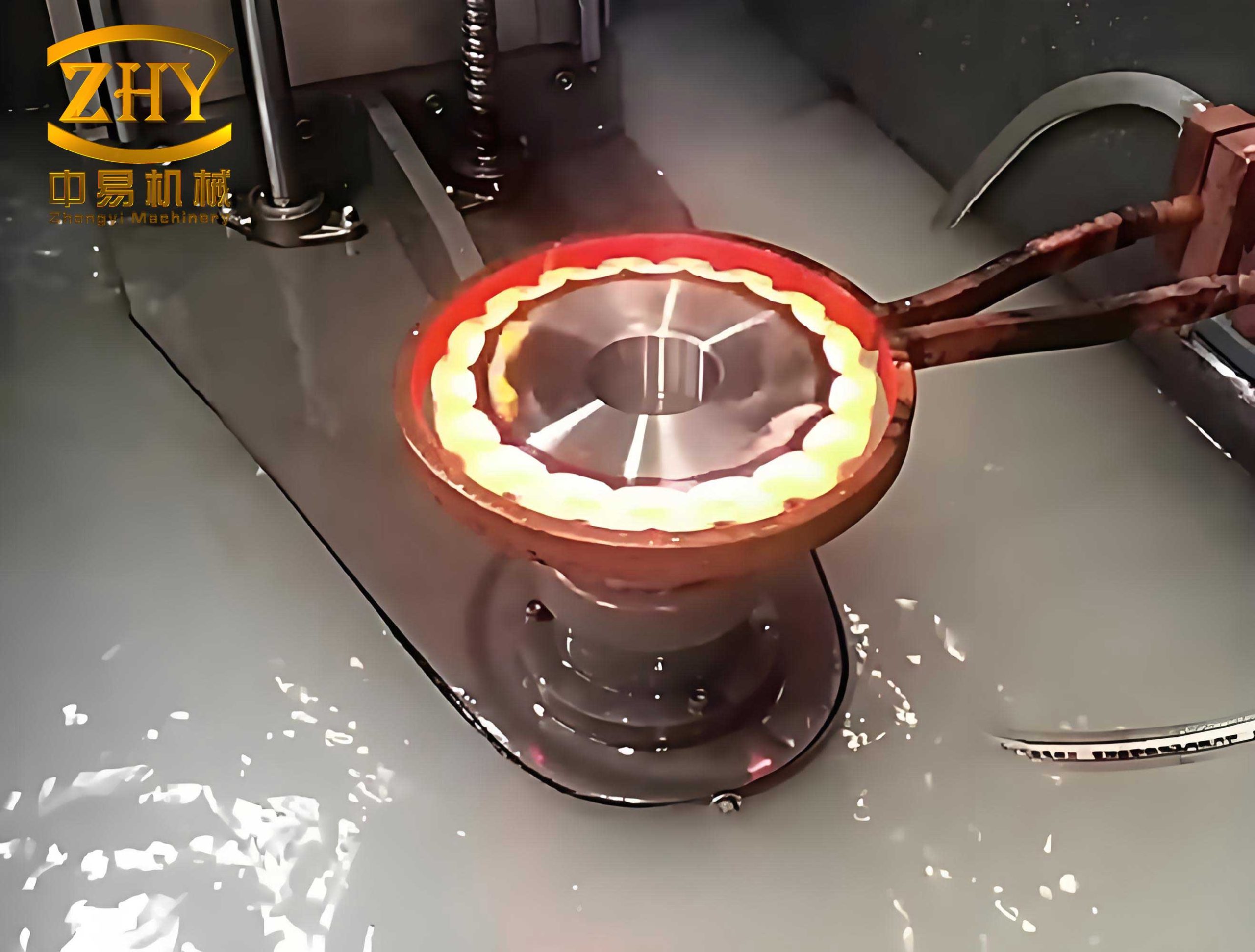
The image above illustrates common heat treatment defects such as cracks and distortion, which I often analyze in failure cases. For gear milling cutters, even minor defects can lead to premature tool failure, affecting machining accuracy. Therefore, understanding and preventing heat treatment defects is paramount. In my experience, using statistical process control (SPC) helps monitor parameters like temperature and time, reducing variability. For instance, the hardness after tempering can be predicted using a regression model: $$ H = H_0 – a \cdot t + b \cdot T $$ where \( H \) is hardness, \( H_0 \) is initial hardness, \( t \) is tempering time, \( T \) is tempering temperature, and \( a, b \) are constants. This allows for fine-tuning to avoid over-tempering, which softens the steel.
Beyond W18Cr4V, other high-speed steels like tungsten-molybdenum types (e.g., W6Mo5Cr4V2) are also used for gear milling cutters. These steels offer better toughness and hot plasticity but are more prone to decarburization—a significant heat treatment defect that requires protective atmospheres. In recent years, ultra-hard high-speed steels containing cobalt or aluminum have emerged, providing enhanced red hardness at the cost of increased brittleness and sensitivity to heat treatment defects. Comparing these steels, W18Cr4V remains popular due to its balance of properties and relatively manageable heat treatment response. However, all high-speed steels share the challenge of minimizing heat treatment defects through precise control.
In conclusion, the heat treatment of W18Cr4V for gear milling cutters is a complex interplay of chemistry and process engineering. From spheroidizing annealing to triple tempering, each step must be optimized to achieve high hardness, wear resistance, and toughness while avoiding heat treatment defects. Key takeaways include the importance of preheating to reduce thermal stresses, controlled quenching to prevent cracking, and multiple tempering cycles to stabilize the microstructure. I have found that by adjusting parameters like temperature, time, and cooling rates, different performance profiles can be achieved to meet diverse working conditions. Ultimately, mastering these processes not only extends tool life but also improves machining quality, making it essential for manufacturing excellence. As I continue to research this field, I emphasize the need for ongoing vigilance against heat treatment defects through advanced monitoring and modeling techniques.
To further elaborate, let’s consider some advanced topics. The formation of alloy carbides during heat treatment can be described using thermodynamic models. For example, the solubility product of carbides in austenite is given by: $$ [C][Me] = K e^{-Q/(RT)} $$ where [C] and [Me] are the concentrations of carbon and alloy elements, \( K \) is a constant, \( Q \) is the activation energy, \( R \) is the gas constant, and \( T \) is temperature. This helps predict carbide dissolution and precipitation, which influence hardness and heat treatment defects. Additionally, residual austenite transformation during tempering follows a kinetic equation: $$ f = 1 – e^{-k t^n} $$ where \( f \) is the fraction transformed, \( k \) is a rate constant, \( t \) is time, and \( n \) is an exponent. By understanding this, we can optimize tempering cycles to minimize retained austenite, a persistent heat treatment defect.
In practice, I often use finite element analysis (FEA) to simulate heat treatment processes and predict defects like distortion. The governing heat conduction equation in 3D is: $$ \rho c_p \frac{\partial T}{\partial t} = \nabla \cdot (k \nabla T) + q $$ where \( \rho \) is density, \( c_p \) is specific heat, \( k \) is thermal conductivity, and \( q \) is heat generation rate. This allows for virtual testing of different quenching media and rates, reducing trial-and-error in real production. Moreover, non-destructive testing methods such as eddy current or ultrasonic inspection are employed to detect subsurface heat treatment defects like inclusions or cracks before they cause tool failure.
Another aspect is the environmental impact of heat treatment. Energy consumption and emissions can be optimized by using efficient furnaces and recycling quenching oils. From a sustainability perspective, reducing heat treatment defects not only saves material but also lowers energy waste. For instance, implementing predictive maintenance based on data analytics can prevent furnace malfunctions that lead to inconsistent heating—a common source of heat treatment defects.
Finally, I want to stress that education and training are crucial for operators to recognize early signs of heat treatment defects. In my workshops, I teach how to interpret microstructures using metallography; for example, examining etched samples under a microscope can reveal grain boundaries, carbides, and signs of overheating. The Hall-Petch equation relates grain size \( d \) to yield strength \( \sigma_y \): $$ \sigma_y = \sigma_0 + k_y d^{-1/2} $$ where \( \sigma_0 \) and \( k_y \) are material constants. This underscores the importance of grain control to prevent brittleness, a subtle heat treatment defect.
In summary, the journey from raw W18Cr4V steel to a high-performance gear milling cutter is fraught with potential heat treatment defects. However, through scientific understanding, careful process design, and continuous improvement, these challenges can be overcome. I hope this detailed exposition provides valuable insights for engineers and practitioners aiming to excel in tool manufacturing. Remember, every heat treatment cycle is an opportunity to refine quality and push the boundaries of material performance.