
In my work within the automotive and machinery manufacturing sectors, helical bevel gears are a ubiquitous and critical component. Their ability to transmit power efficiently between intersecting, typically perpendicular, shafts makes them indispensable in applications like differentials. However, the complexity of their geometry directly translates into a significantly intricate manufacturing and setup process. The cornerstone of this process is the cutting calculation—a meticulous procedure to determine the precise machine settings for generating the correct gear tooth form. This article details my comprehensive approach to mastering helical bevel gear cutting calculations, culminating in the development of a robust computer program that drastically enhances accuracy and efficiency, particularly for small-batch production.
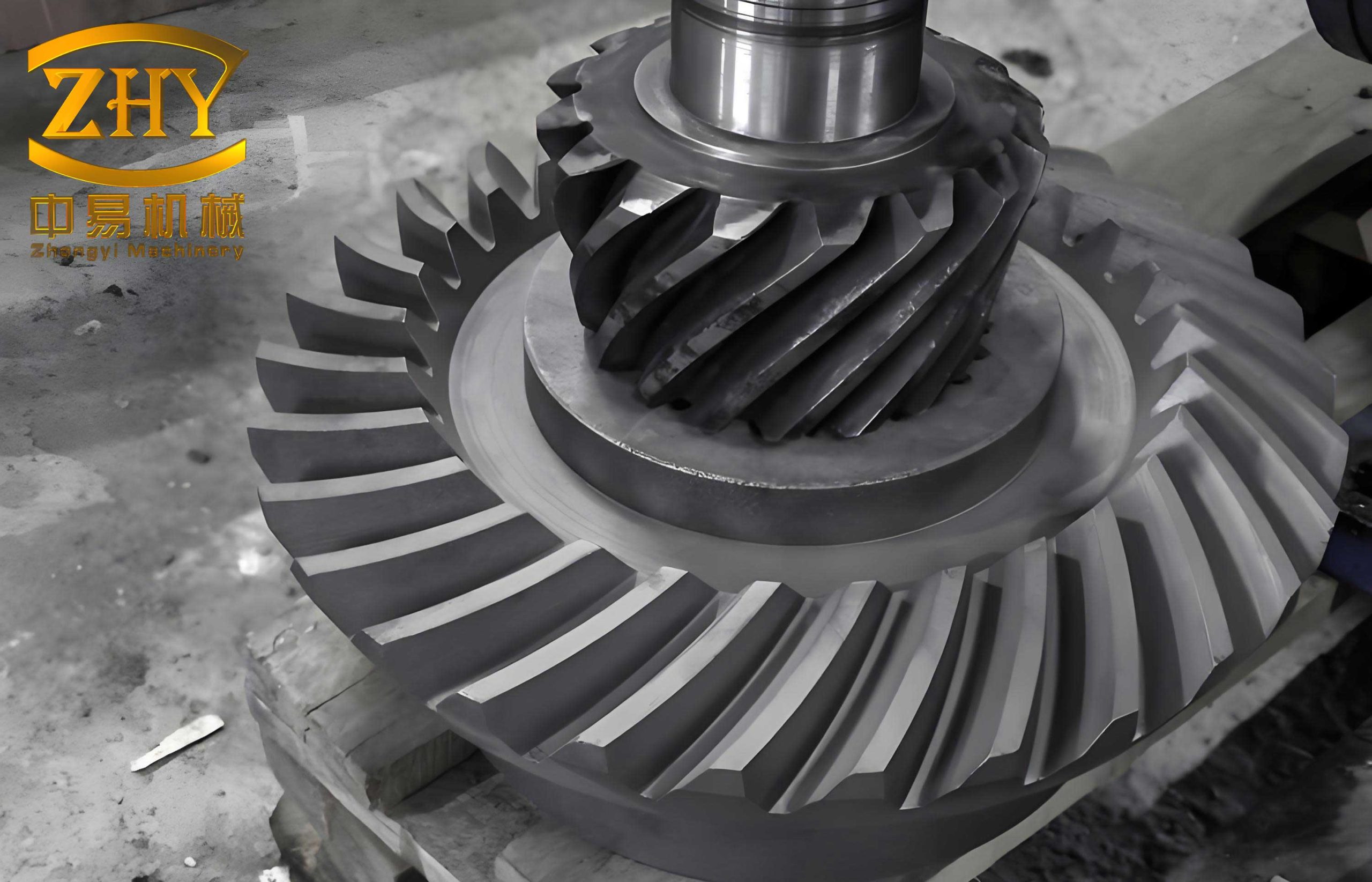
The fundamental challenge in machining a helical bevel gear lies in its geometry. Unlike spur gears, the teeth are curved and oblique relative to the gear axis. This requires specialized machine tools and methods. Among the various techniques, the “Single-Side Method” or “Modified Roll Method” is particularly well-suited for small-lot production on universal-type gear generators. This method involves separate finishing cuts for the convex and concave sides of the gear teeth, allowing for high precision and flexibility. The calculations for this method, while systematic, are notoriously voluminous and prone to human error when performed manually. My objective was to codify this entire calculation logic into a deterministic algorithmic process suitable for computerization.
Algorithmic Foundation: The Modified Roll Method Formulas
The core of my program is built upon the established kinematic and geometric relationships of the modified roll method for helical bevel gear generation. The primary goal is to compute the specific settings for the gear-cutting machine: gear train ratios for indexing and roll, cutter head tilt (swivel angle), and the critical machine center adjustments (gear blank position). The formulas are derived from the principle of simulating the meshing of a imaginary generating gear (the cradle) with the workpiece. Below are the key groups of formulas I implemented.
1. Basic Gear Geometry Calculations
Before any machine settings can be determined, the fundamental dimensions of the mating gear pair must be calculated. These serve as inputs for all subsequent steps. Let $m$ be the module, $z_p$ and $z_g$ the number of teeth on the pinion and gear respectively, $\beta_m$ the mean spiral angle, $\alpha$ the pressure angle, and $F$ the face width.
The pitch diameter for the gear is given by: $$d_g = m \cdot z_g$$
The pitch cone angle for the gear is: $$\delta_g = \arctan\left(\frac{z_g}{z_p}\right)$$
The outer cone distance is: $$A_o = \frac{d_g}{2 \sin \delta_g}$$
The mean cone distance is: $$A_m = A_o – \frac{F}{2}$$
The mean spiral angle $\beta_m$ is typically specified. The mean circular pitch is: $$p = \pi m$$
The tooth working depth is usually: $$h_k = 1.7m$$
The gear addendum and dedendum are calculated based on a specified tooth thickness coefficient $K$, which allocates the backlash and thinning between the mating gears. For the gear (large wheel):
$$h_{ag} = (0.46 + 0.39 \cdot K) \cdot m \quad \text{(Addendum)}$$
$$h_{fg} = h_k – h_{ag} \quad \text{(Dedendum)}$$
The root angle for the gear is: $$\theta_{fg} = \arctan\left(\frac{h_{fg}}{A_o}\right)$$
The distance from the crossing point to the gear outer diameter (for setup) is: $$X_g = A_o \cos \delta_g – \frac{h_{ag} \sin \delta_g}{\tan \alpha}$$
Equivalent formulas are applied for the pinion.
2. Cutter Head and Blade Specification (The “Tool Library”)
A critical parameter is the cutter head radius $R_c$. It is not arbitrary but selected based on the outer cone distance $A_o$ to ensure proper tooth curvature generation. In practice, we select from a standard set of cutter heads. My program incorporates this logic through a conditional “tool library” table. The selection rule is as follows:
| Outer Cone Distance $A_o$ (mm) | Recommended Cutter Radius $R_c$ (mm) | Typical Standard Tool Number |
|---|---|---|
| $A_o \leq 75$ | 75 | 7.5″ (190.5mm) |
| $75 < A_o \leq 100$ | 100 | 10″ (254mm) |
| $100 < A_o \leq 125$ | 125 | 12.5″ (317.5mm) |
| $125 < A_o \leq 150$ | 150 | 15″ (381mm) |
| $A_o > 150$ | 1.0 ~ 1.2 $\times A_o$ | Corresponding Size |
Another vital tool parameter is the point width or blade tip distance $W$. This directly controls the tooth slot width at the root. The theoretical point width required to produce the correct normal chordal tooth thickness $S_{cn}$ must be calculated, considering a finishing allowance $\Delta W$. The calculation for the gear’s convex side (using an inner blade) is:
$$W_{calc} = S_{cn} – 2 h_{fg} \tan \alpha – \Delta W$$
This calculated $W_{calc}$ is then compared against standard blade sets available for the chosen cutter head radius $R_c$. The program logic selects the standard blade with the largest point width that is less than or equal to $W_{calc}$ to ensure the finishing allowance is maintained. This emulates the practical process of selecting from a physical “tool crib.” Managing a virtual library of common blades for different $R_c$ values within the program is essential for complete automation.
3. Machine Setting Calculations for the Gear (Large Wheel)
For the helical bevel gear itself, the following machine settings are computed. These formulas are specific to the kinematics of machines like the Gleason No. 116.
Index Gear Ratio ($i_{index,g}$): This ratio controls the rotation of the workpiece between cuts.
$$i_{index,g} = \frac{C_{index}}{z_g}$$
where $C_{index}$ is a machine-specific constant (e.g., 120 for many models).
Roll Gear Ratio ($i_{roll,g}$): This critical ratio synchronizes the cutter head rotation (cradle) with the workpiece rotation to generate the spiral.
$$i_{roll,g} = \frac{C_{roll} \cdot \sin \beta_m}{R_c \cdot z_g}$$
where $C_{roll}$ is another machine constant related to the generating mechanism.
Cradle Swivel Angle ($q_g$): This angle positions the cutter head relative to the plane of generation.
$$q_g = \arcsin\left(\frac{A_m \cdot \sin \beta_m}{R_c}\right)$$
4. Machine Setting Calculations for the Pinion (Small Wheel) – The Core of Modification
The pinion calculations are more complex because its tooth surfaces must be modified to achieve localized bearing contact under load. This is achieved by introducing corrections to the basic machine settings derived from the gear’s geometry.
Gear Blank Position Correction ($\Delta X_p$, $\Delta E_p$): The pinion is shifted horizontally ($\Delta X_p$) and vertically ($\Delta E_p$) from its theoretical position. One common formula for the horizontal correction is:
$$\Delta X_p = \frac{m \cdot (K – 0.5)}{\tan \alpha}$$
where $K$ is the same tooth thickness coefficient.
Pinion Roll Ratio ($i_{roll,p}$): This is modified from the gear’s roll ratio.
$$i_{roll,p} = i_{roll,g} \cdot \left(1 + \frac{\Delta X_p}{A_m \cdot \sin \beta_m}\right)$$
Pinion Cradle Swivel Angle ($q_p$): This is also modified.
$$q_p = q_g + \Delta q$$
where $\Delta q$ is a small correction angle, often calculated based on machine eccentricity $e$ and other factors: $$\Delta q = \arctan\left(\frac{e}{R_c}\right)$$
Program Design and Implementation
Translating this intricate web of formulas into reliable software required a structured, step-by-step approach. I chose a procedural language suitable for mathematical computation. The program’s architecture follows a clear sequential logic, mirroring the manual calculation process but with absolute precision and instant iteration.
Program Flowchart and Logic
The core algorithm can be visualized as a sequential flow:
- Input Phase: The user inputs the basic helical bevel gear parameters: $m$, $z_p$, $z_g$, $\beta_m$, $\alpha$, $F$. Additionally, machine-specific constants ($C_{index}$, $C_{roll}$, eccentricity $e$) and the tooth thickness coefficient $K$ are entered.
- Basic Geometry Computation: The program calculates all fundamental gear dimensions as outlined in Section 1: $d_g$, $\delta_g$, $A_o$, $A_m$, $h_{ag}$, $h_{fg}$, $\theta_{fg}$, $X_g$, and their pinion equivalents.
- Cutter Head Selection: Based on $A_o$, the program consults its internal “tool library” table (like the one above) to assign a standard cutter head radius $R_c$.
- Tooth Thickness & Blade Selection: The normal chordal tooth thickness $S_{cn}$ is calculated. From this, the required theoretical point width $W_{calc}$ is derived. The program then searches its database of standard blades for the selected $R_c$ and chooses the appropriate one, outputting the actual $W$ to be used.
- Gear Machine Settings Calculation: The program computes $i_{index,g}$, $i_{roll,g}$, and $q_g$ using the formulas in Section 3.
- Pinion Machine Settings Calculation: This is the heart of the algorithm. It calculates the corrections $\Delta X_p$ and $\Delta E_p$, then uses them to compute the modified pinion settings $i_{roll,p}$ and $q_p$ as per Section 4. The pinion index ratio $i_{index,p} = C_{index} / z_p$ is also calculated.
- Output Formatting: Finally, all results are formatted and printed in a clear, organized report. Crucially, the computed gear ratios are often converted into the actual tooth counts for the change gears available on the specific machine (e.g., expressing $i_{roll}$ as a compound gear train like $\frac{A}{B} \times \frac{C}{D}$). This direct translation is vital for the machine operator.
Key Programming Considerations
Several aspects were critical for creating a practical tool:
- Error Handling and Validation: The program includes checks for invalid inputs (e.g., negative dimensions, spiral angle out of typical range) and flags geometrically impossible configurations.
- “Tool Library” Management: Implementing the cutter and blade selection as a configurable data structure, rather than hard-coded values, makes the program adaptable to different workshops’ tool inventories.
- Precision: All trigonometric and inverse trigonometric functions are computed with high precision to avoid cumulative errors that could affect final gear quality.
- User Interface: While the core is computational, a simple menu-driven or form-based input/output system makes it accessible to technicians who may not be programmers.
Practical Impact and Conclusion
The implementation of this computerized calculation system for helical bevel gears has profound implications for manufacturing efficiency and quality.
Dramatic Reduction in Calculation Time: What previously took an experienced engineer several hours—with a high risk of arithmetic error—can now be accomplished in seconds. This accelerates the entire production preparation process.
Unparalleled Accuracy and Consistency: The program eliminates human calculation errors. Every helical bevel gear pair calculated with the same input data will have identical, optimal machine settings. This consistency is paramount for quality control, especially in small batches where each gear set is critical.
Facilitation of Optimization and “What-If” Analysis: With instantaneous calculation, it becomes practical to explore the effects of slight adjustments to parameters like the tooth thickness coefficient $K$ or pressure angle $\alpha$. One can instantly see the resulting changes in machine settings and predicted tooth contact pattern, enabling fine-tuning for specific performance requirements before any metal is cut.
Standardization of Process Knowledge: The program encapsulates expert knowledge and a specific calculation methodology (the modified roll method) into a permanent, transferable tool. This safeguards against the loss of expertise and allows less experienced personnel to generate correct setups reliably.
In summary, the transition from manual calculation to algorithm-driven program design for helical bevel gear cutting parameters is not merely a convenience; it is a strategic enhancement of manufacturing capability. The helical bevel gear, with its complex geometry, demands the highest precision in its creation. By systematizing the underlying mathematics into a robust software tool, I have consistently achieved levels of accuracy, speed, and reliability that are simply unattainable through manual methods. This approach forms a solid foundation for advanced manufacturing and is readily adaptable to other gear generation methods or integrated into broader CAD/CAM systems for helical bevel gears.