
The helical bevel gear stands as a critical component within mechanical power transmission systems, particularly in demanding applications such as automotive final drives. Its ability to transmit high torque loads smoothly, with minimal noise and vibration, is paramount to vehicle performance and safety. For decades, the primary method for manufacturing these complex components has been machining from a forged or cast blank. While functional, this subtractive process severs the natural grain flow of the metal, interrupting the continuity of the metallic fibers. This disruption can lead to reduced fatigue strength, compromised durability, and unpredictable heat treatment distortions—factors that ultimately limit the gear’s service life and reliability.
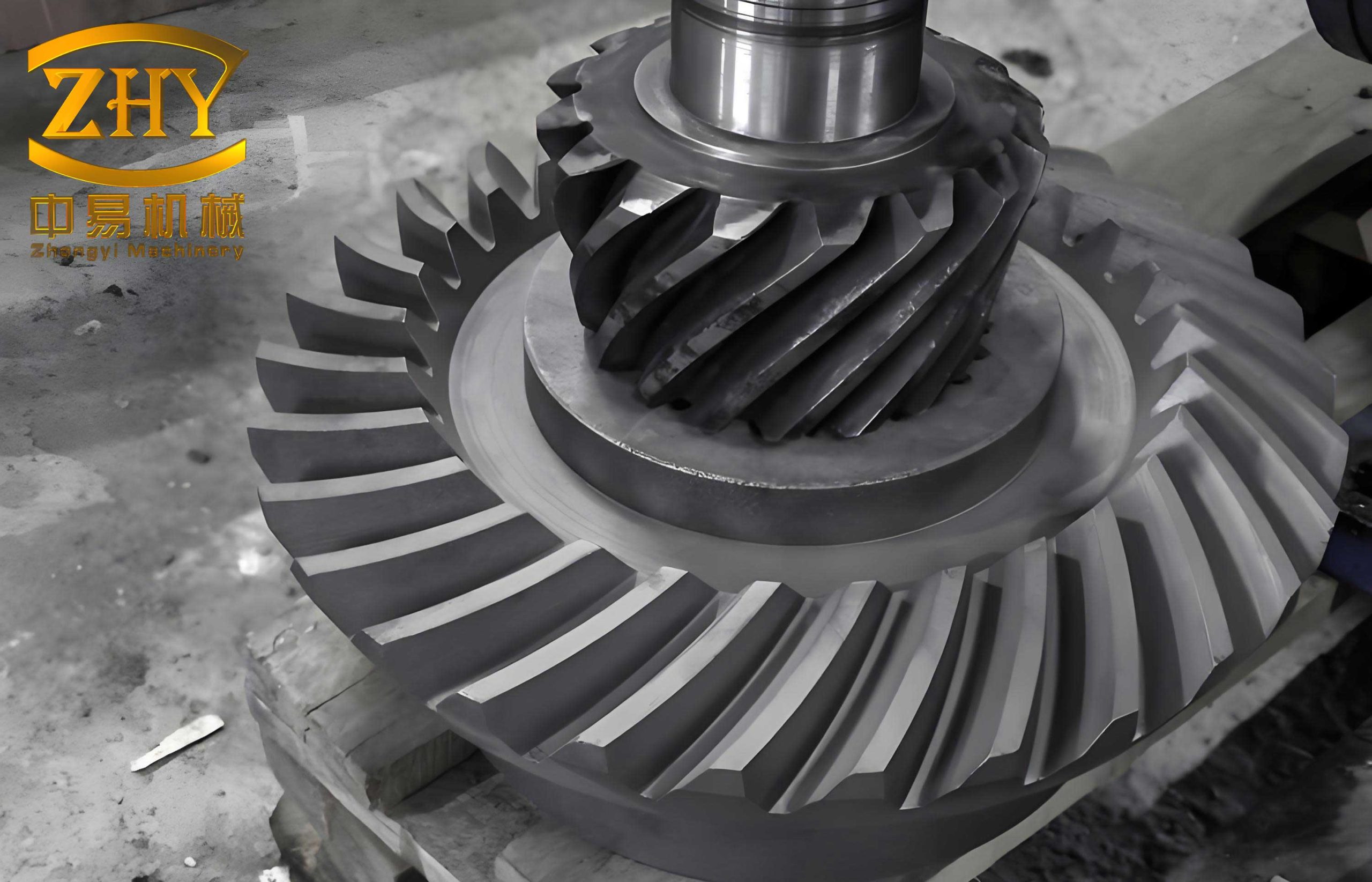
In contrast, precision plastic forming technologies, such as forging, offer a transformative alternative for producing helical bevel gears. By shaping the metal through controlled plastic deformation, these processes align the metal’s grain structure along the intricate contours of the gear teeth. This results in a continuous, uninterrupted fiber flow that follows the gear’s geometry, significantly enhancing its mechanical properties. The benefits are substantial: markedly increased load-bearing capacity, superior resistance to wear and fatigue, greater dimensional consistency after heat treatment, and reduced operational noise. The pursuit of high-performance, net-shape, or near-net-shape forming for complex components like the helical bevel gear represents a significant frontier in advanced manufacturing. Among the various forging techniques, rotary forging, also known as swing or orbital forging, presents a particularly compelling approach due to its characteristic of being a continuous, incremental, and locally concentrated forming process, which can lead to reduced forming loads and improved material utilization.
This article delves into a detailed technical exploration of applying rotary forging to the forming of a helical bevel gear, specifically focusing on the driven gear of an automotive rear axle. The discussion is framed from the perspective of experimental investigation and process development, drawing upon foundational principles to explain observed phenomena.
Fundamental Principles of Rotary Forging for Gear Formation
Rotary forging distinguishes itself from conventional die forging through its unique kinematics. Instead of applying a full-face, simultaneous pressure, the process utilizes a conical die (the oscillating die or “wobble die”) that presses against the workpiece with a localized, rolling contact. This is combined with a relative feed motion between the workpiece and the die. The essential kinematic elements for forming a helical bevel gear via rotary forging involve three synchronized movements, as illustrated in the standard process schematic:
- The conical die rotates about its own axis with an angular velocity $\omega_s$.
- The entire die assembly (or the workpiece holder) performs an orbital precession around the machine’s central axis with an angular velocity $\omega_a$.
- The workpiece is fed axially towards the die with a constant or variable speed.
The core condition for successfully rolling the gear teeth without significant slippage between the die surface and the workpiece is a specific kinematic relationship. When the contact between the conical die surface and the workpiece is pure rolling, the linear velocities of a corresponding point on the die ($A_d$) and the workpiece ($A_w$) must be equal. Given the conical geometry, where the effective rolling radius on the workpiece $R_A$ is related to the die’s contact radius $r_A$ by $r_A = R_A \cos \gamma$ (with $\gamma$ being the cone half-angle), the velocity equality condition leads to:
$$ \omega_s \cdot r_A = \omega_a \cdot R_A $$
Substituting $r_A = R_A \cos \gamma$ yields the fundamental synchronisation condition for gear rolling:
$$ \omega_s \cos \gamma = \omega_a \quad \text{or} \quad \frac{\omega_a}{\omega_s} = \cos \gamma $$
This relationship is crucial. It implies that the conical die can form a workpiece with a number of teeth (or circumferential features) that is a factor of $\cos \gamma$ of the number of teeth engraved on the die itself. For instance, to form a workpiece with $Z_w$ teeth, the die must be designed with $Z_d$ teeth such that $Z_w / Z_d = \cos \gamma$. This principle guides the initial design parameters for the rotary forging die intended to produce a specific helical bevel gear.
Preform Design and Experimental Setup
The success of any closed-die forging process, including rotary forging, is heavily dependent on the design of the initial billet or preform. An optimal preform guides material flow efficiently, minimizes forging loads, prevents defects like folds or underfills, and ensures complete die cavity filling with minimal excess flash. For a complex helical bevel gear, the preform geometry must approximate the final part’s volume distribution to facilitate smooth metal flow into the intricate tooth profiles.
Considering the driven gear of a passenger car rear axle with 39 teeth, a pressure angle of 22.5°, and a spiral angle of approximately 32°, the forging objective was to produce a near-net-shape gear blank. To isolate and study the core forming challenge—the tooth formation—the experimental gear blank was simplified by omitting minor back-face features, focusing purely on the conical gear body and teeth. A standard machining allowance (e.g., 2 mm on critical surfaces) was retained for final finishing. The target forging shape dictates the preform design. The guiding principle is to align the preform’s external conical angle with the root cone angle (or face angle) of the gear. This alignment ensures the shortest and most direct metal flow path into the tooth cavities during forging. A mismatched angle would create unnecessary radial flow resistance, making it difficult to fill the tooth cavities, especially at the inner and outer edges (toe and heel) of the gear face. Therefore, the preform was designed as a truncated cone whose sidewall angle matched that of the final gear’s root cone. The volume of the preform was calculated to be slightly less than the final forged gear volume to account for controlled flash formation in an open-die configuration, which was used in initial trials to study material flow.
| Parameter | Value / Description |
|---|---|
| Gear Type | Driven Spiral/Helical Bevel Gear |
| Number of Teeth (Z) | 39 |
| Spiral Angle (β) | 32° 13′ (Right Hand) |
| Pressure Angle (α) | 22.5° |
| Forging Material (Simulant) | Lead (Pb) |
| Process Type | Open-Die Rotary Forging |
| Preform Shape | Truncated Cone matching root cone angle |
The experimental setup was based on a modified 100-ton hydraulic press. The rotary forging die assembly consisted of an upper conical die (the oscillating tool) mounted to the press ram and a lower female die (containing the negative impression of the gear teeth) seated on a rotary table. The lower die assembly was allowed to rotate freely. The process sequence was as follows: The lead preform, lubricated with machine oil, was placed in the lower die. The upper conical die was set into rotation ($\omega_s$). The press ram then descended, bringing the rotating conical die into contact with the preform. The friction at the contact patch caused the preform and the lower die to begin rotating in sync with the upper die’s orbital motion ($\omega_a$), satisfying the kinematic condition. The ram continued its stroke, incrementally deforming the preform until the final forged height was reached, after which the ram retracted. A notable adaptation for lead, which has a very low coefficient of friction against steel, was the engraving of a cross-hatch pattern on the conical die surface to increase the traction force necessary to initiate and maintain rotation of the workpiece.
Experimental Investigation of Deformation Behavior
Lead was chosen as the simulant material due to its recrystallization temperature being below room temperature, meaning its deformation behavior at ambient conditions replicates the hot working characteristics of steel—exhibiting similar work hardening and flow stress trends without the need for heating equipment. This allows for cost-effective and accessible process feasibility studies.
Tooth Filling Sequence and Metal Flow
A series of interrupted tests was conducted to capture the progressive filling of the tooth cavities. Preforms were forged to different intermediate heights (e.g., 5 mm, 10 mm, and the final 13.76 mm of displacement) and then extracted for examination. The visual analysis of these partially formed gears revealed a distinct and consistent filling pattern for the helical bevel gear in open-die rotary forging.
The tooth cavities did not begin to fill uniformly from one end. Instead, initial metal flow into the tooth impressions commenced at a region around the mid-face width of the gear. As the axial stroke (or reduction in height) increased, the filled zone progressively extended both towards the inner diameter (the “toe”) and the outer diameter (the “heel”) of the gear. The very ends of the teeth, particularly at the outer diameter (heel), were the last regions to fill completely. This phenomenon can be attributed to the frictional constraints and flow patterns. The central region is relatively less constrained by die walls in the radial direction during the initial phase, allowing material to flow more easily into the cavities. The tooth ends, however, represent “closed corners” with material needing to flow around three die surfaces, experiencing significantly higher frictional resistance. The outer edge, having a larger circumference and being the point where flash formation is most active, often exhibits the greatest difficulty in filling, sometimes resulting in a condition known as “underfill” or “short fill.”
Internal Strain Distribution and Grid Analysis
To gain a deeper, quantitative understanding of the metal flow and strain distribution within the deforming helical bevel gear blank, a grid technique was employed. The lead preforms were carefully bisected along a longitudinal (axial) plane, and a fine square grid was scribed onto the exposed surface. This gridded preform was then forged to various stages, and the distortion of the grid patterns was analyzed.
The deformed grids provided a clear visual map of the internal material movement. The analysis confirmed several key deformation characteristics:
- Primary Axial Compression: The overall process is one of axial upsetting. The vertical grid lines showed significant shortening, indicating large negative compressive strain in the axial (Z) direction: $\varepsilon_z << 0$.
- Complex Radial and Tangential Flow: The horizontal grid lines bulged outward, indicating radial expansion ($\varepsilon_r > 0$). However, this expansion was not uniform. In the central bulging zone of the preform (which becomes the gear’s web), the grid cells enlarged and became less dense, indicating lower strain intensity. In contrast, near the tooth root regions and especially towards the outer periphery, the horizontal lines became severely distorted and densely packed, signaling high local shear and compressive strains.
- Material Flow into Teeth: Most instructively, the grid lines in the region corresponding to the tooth roots curved smoothly to follow the contour of the die cavity. The lines remained continuous, demonstrating the absence of internal shear failures or laps. This curvature visualizes how surface material from the preform’s conical face is drawn into the tooth spaces, undergoing a combination of bending and shear.
The strain state can be summarized by considering the strain tensor components. In the central region, a near-triaxial compression state exists. In the tooth-forming region, a complex state of plane strain or generalized strain occurs, with significant shear components. The effective strain $\bar{\varepsilon}$ can be estimated using the standard formulation for large deformation, varying significantly from a minimum in the gear’s core to a maximum at the tooth root fillets and surface:
$$ \bar{\varepsilon} = \sqrt{\frac{2}{9}\left[(\varepsilon_r – \varepsilon_\theta)^2 + (\varepsilon_\theta – \varepsilon_z)^2 + (\varepsilon_z – \varepsilon_r)^2\right]} $$
where $\varepsilon_r$, $\varepsilon_\theta$, and $\varepsilon_z$ are the radial, tangential (hoop), and axial true strains, respectively.
| Region | Primary Deformation Mode | Strain State | Observations from Grid Analysis |
|---|---|---|---|
| Central Core / Web | Axial Compression, Radial Expansion | $\varepsilon_z < 0$, $\varepsilon_r > 0$, $\varepsilon_\theta > 0$; Moderate Effective Strain | Grid cells enlarge; lines become less dense. |
| Tooth Root Region | Bending, Shear, Compression | High localized $\bar{\varepsilon}$; Complex shear strains. | Grid lines curve sharply into tooth profile; lines are compressed and dense. |
| Outer Periphery / Flash Zone | Extrusion, High Shear | Very high $\bar{\varepsilon}$; Dominated by radial and shear flow. | Grid lines are highly distorted and elongated tangentially. |
Process Force Analysis
Monitoring the forging force throughout the stroke is essential for understanding process mechanics and for machine sizing. A force-stroke curve was recorded during the complete rotary forging of the lead helical bevel gear. The curve exhibited a characteristic non-linear shape. The force remained relatively low during the initial contact and early stage of deformation, as only the central part of the conical die was in contact, and the material was yielding. The force then rose steeply as the contact area between the die and workpiece increased and as the material began to flow into the restrictive tooth cavities, requiring higher pressure. The peak force was reached near the end of the stroke when the tooth cavities were nearly completely filled and material was being forced out to form the flash. The relationship can be conceptually described by integrating the pressure over the instantaneous contact area $A_c$:
$$ F = \int_{A_c} p \, dA $$
Where the local pressure $p$ is a function of the material’s flow stress $\sigma_f$ (itself dependent on strain, strain-rate, and temperature), and the friction and geometry conditions. For a simple estimate, the mean forging pressure $\bar{p}$ can be related to the flow stress by a shape factor $K$: $\bar{p} = K \cdot \sigma_f$. For complex shapes like a helical bevel gear, $K$ becomes quite large due to the high surface-to-volume ratio and complex flow, explaining the significant forces required at the end of the stroke.
Critical Analysis and Mitigation Strategies for Defects
The experimental results highlight a primary challenge in the rotary forging of a helical bevel gear: ensuring complete filling of the tooth ends, especially at the heel (outer diameter). The root cause is the intense frictional resistance in these corner regions, which acts against the radial inward flow of material needed to fill the cavity. As the metal flows, it experiences a “frictional pull” from the die walls, which can hinder complete filling, leading to a rounded or unfilled corner—a defect unacceptable for a precision gear.
Based on the process understanding gained, several key mitigation strategies can be proposed and are generally applicable to the forging of any helical bevel gear:
- Optimized Preform Volume and Flash Design: Moving from an open-die to a precision closed-die forging with a controlled flash gutter is the most direct improvement. The flash land acts as a pressure relief valve and, more importantly, creates a high back-pressure in the die cavity as it fills. This high hydrostatic pressure is essential for forcing material into the most difficult-to-fill sections of the tooth cavities. The preform volume must be precisely calculated to provide just enough material to fill the cavity completely while forming a thin flash.
- Advanced Lubrication and Die Surface Finish: Minimizing friction is paramount. Employing high-performance forging lubricants (e.g., graphite-based) and ensuring an exceptionally smooth, polished surface finish on the die cavities, especially near the tooth ends, drastically reduces flow resistance. This allows material to slide more easily into the corners.
- Process Parameter Optimization: Increasing the final forging force (within machine limits) is a direct method to overcome frictional resistance. Furthermore, controlling the strain rate and temperature (for hot forging of steel) can lower the material’s flow stress $\sigma_f$, thereby reducing the required pressure $\bar{p}$ for a given fill condition.
- Design for Manufacturability (Forging Draft & Allowance): A pragmatic approach involves slightly extending the radial length of the die cavity beyond the theoretical gear face width. This ensures that any minor, unavoidable underfill occurs in an area designated as machining allowance. This defective portion is subsequently removed during the final tooth grinding or cutting operation, guaranteeing a flawless final tooth profile. This is a common and reliable practice in precision gear forging.
Conclusion and Forward Perspective
This technical exploration, grounded in experimental methodology, substantiates the fundamental feasibility of employing rotary forging as a viable manufacturing route for high-performance helical bevel gears. The process successfully replicates the complex geometry of a spiral bevel gear, promising the associated benefits of superior metallurgical integrity and mechanical properties inherent to forging processes. The investigation elucidated the specific metal flow sequence during forming, where filling initiates at the mid-face and propagates towards the ends, with the outer heel being the most challenging region. Internal grid analysis provided a vivid depiction of the strain distribution, confirming high strain intensities in the tooth root areas—a factor contributing to grain refinement and strength.
The measurement of the force-stroke relationship provides crucial empirical data for scaling the process to industrial equipment capable of forging steel components. Most importantly, the analysis identifies incomplete tooth filling as the principal defect mechanism and outlines a suite of strategic countermeasures centered on friction reduction, pressure maximization via flash design, and intelligent allowance allocation.
The pathway forward for the rotary forging of helical bevel gears involves several advanced steps: transitioning to hot forging trials with alloy steels to validate the process with real materials; implementing closed-die designs with optimized flash geometry; and employing modern finite element analysis (FEA) software to simulate the process virtually. FEA can be used to fine-tune preform design, predict forming loads and stress on dies, and optimize process parameters before costly physical trials, accelerating the development cycle for this advanced manufacturing technology. The ultimate goal remains the industrial production of durable, high-strength helical bevel gears that leverage the full potential of precision plastic forming to meet the escalating demands of modern automotive and mechanical transmission systems.