
In mechanical transmission systems, helical gears are widely employed due to their smooth operation, low noise, and high load-bearing capacity. As a key component, the dynamic characteristics of helical gears, especially their natural frequencies and mode shapes, are critical for ensuring system reliability and performance. In ultrasonic vibration systems, achieving zero-nodal-diameter axisymmetric transverse bending vibration is ideal, as it minimizes energy loss and enhances efficiency. However, during the design phase, obtaining experimental data on the inherent properties of helical gears is challenging. To address this, I have developed an integrated approach using Visual Basic (VB) and ANSYS Parametric Design Language (APDL) for the parametric modeling and modal analysis of involute helical gears. This method allows for efficient extraction of natural frequencies, particularly the first-order frequency, and facilitates design optimization. In this article, I will detail the methodology, implementation, and validation of this approach, emphasizing the role of helical gears in mechanical systems and the advantages of combining VB and APDL for finite element analysis.
The importance of helical gears in modern machinery cannot be overstated. Their helical tooth design enables gradual engagement, reducing impact loads and vibrations compared to spur gears. This makes helical gears suitable for high-speed and high-power applications, such as in automotive transmissions, industrial gearboxes, and aerospace systems. The dynamic behavior of helical gears, including their modal properties, directly influences noise, vibration, and harshness (NVH) characteristics. Therefore, accurate prediction of natural frequencies through modal analysis is essential for design validation and optimization. Traditional experimental methods for modal analysis are time-consuming and costly, especially during iterative design processes. Hence, computational techniques like finite element analysis (FEA) have become indispensable. ANSYS is a powerful FEA tool, but its complexity often requires specialized knowledge. By leveraging APDL for parametric modeling and VB for user-friendly interface development, I have created a streamlined workflow that bridges the gap between design parameters and analysis results.
My approach begins with the parametric modeling of the helical gear using APDL. The geometry of an involute helical gear is defined by several key parameters, including module (m), number of teeth (z), helix angle (β), face width (b), and material properties. The parametric model allows for automatic updates based on input values, enabling rapid analysis of different design configurations. The mathematical foundation for gear geometry is based on involute curve generation and helical extrusion. For instance, the pitch radius (r) is calculated as: $$r = \frac{m \cdot z}{2}$$ The base radius (r_b) depends on the pressure angle (α), typically 20 degrees: $$r_b = r \cdot \cos(\alpha)$$ The helix angle influences the tooth orientation, and the lead of the helix is given by: $$L = \frac{2\pi r}{\tan(\beta)}$$ These formulas are embedded in the APDL script to generate the gear profile accurately.
The APDL code for creating the helical gear model involves defining keypoints, lines, and areas to form the tooth profile, followed by extrusion along a helical path to create the 3D solid model. The script uses conditional statements to handle different helix angles, including zero for spur gears. Material properties such as Young’s modulus (E), Poisson’s ratio (ν), and density (ρ) are assigned to the model. The finite element mesh is generated using SOLID95 elements, which are suitable for 3D structural analysis. Smart sizing is applied to ensure mesh quality, and the model is prepared for modal analysis. The following table summarizes the key parameters used in the parametric model:
| Parameter | Symbol | Typical Value | Description |
|---|---|---|---|
| Module | m | 5 mm | Size of the gear teeth |
| Number of Teeth | z | 48 | Total teeth on the gear |
| Helix Angle | β | 15 degrees | Angle of tooth inclination |
| Face Width | b | 30 mm | Width of the gear along the axis |
| Young’s Modulus | E | 210 GPa | Material stiffness (steel) |
| Poisson’s Ratio | ν | 0.27 | Material lateral strain ratio |
| Density | ρ | 7800 kg/m³ | Material mass per unit volume |
Once the helical gear model is built, modal analysis is performed to extract natural frequencies and mode shapes. Modal analysis is a linear dynamics procedure that determines the vibration characteristics of a structure. The governing equation for undamped free vibration is: $$[M]\{\ddot{x}\} + [K]\{x\} = \{0\}$$ where [M] is the mass matrix, [K] is the stiffness matrix, {x} is the displacement vector, and {¨x} is the acceleration vector. The solution yields eigenvalues (natural frequencies) and eigenvectors (mode shapes). In ANSYS, I use the Block Lanczos method to extract modes within a frequency range of 3 kHz to 10 kHz, as helical gears in ultrasonic applications often operate in this range. The analysis focuses on the first-order frequency, which corresponds to the fundamental bending mode, crucial for resonance avoidance.
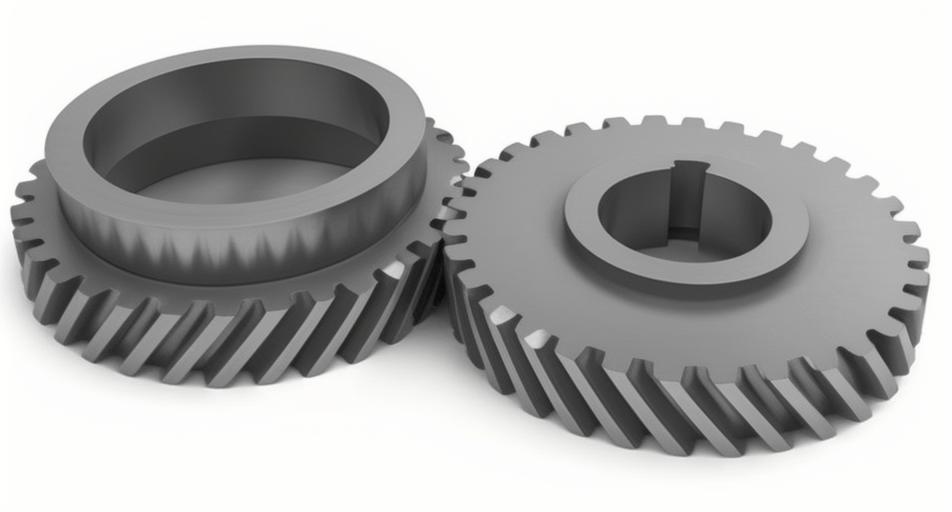
To automate the process, I integrate VB with APDL. VB is used to create a graphical user interface (GUI) where design parameters for the helical gear are input. The GUI includes text boxes for module, tooth count, helix angle, and material properties. Upon submission, VB writes these parameters into an APDL command file (e.g., XCL.lgw) using file operations. The APDL script reads these parameters and updates the model accordingly. This integration enables parametric studies without manual intervention in ANSYS. For example, to study the effect of module and tooth number on the first-order frequency, I can run multiple analyses by varying inputs in the VB interface. The VB code handles binary and sequential file reading to ensure data integrity. Key steps include opening the APDL file, parsing variables, and writing updated values. This seamless interaction between VB and APDL enhances productivity and reduces errors.
After modal analysis, the first-order frequency is extracted parametrically. The APDL script uses *GET commands to retrieve frequencies from different modes and applies logic to identify the first-order frequency based on proximity to a target value (e.g., 3800 Hz) and mode separation criteria. For instance, the code checks frequency differences to ensure valid mode identification. The extracted frequency is then output for further analysis. This parametric extraction allows for rapid comparison across design variations. To illustrate the impact of design parameters, I conducted a study where the pitch diameter was held constant while module and tooth number were varied. The results are summarized in the table below:
| Module (mm) | Number of Teeth | First-Order Frequency (Hz) | Vibration Mode |
|---|---|---|---|
| 5 | 48 | 4008 | Transverse bending |
| 6 | 40 | 3988 | Transverse bending |
| 8 | 30 | 3941 | Transverse bending |
| 10 | 24 | 3877 | Transverse bending |
| 12 | 20 | 3803 | Transverse bending |
The table shows that as the module increases and tooth number decreases for a fixed pitch diameter, the first-order frequency of the helical gear decreases. This trend can be explained by the changes in gear geometry affecting stiffness and mass distribution. The helical gear’s natural frequency is influenced by factors such as tooth thickness, root diameter, and overall dimensions. A larger module results in heavier teeth, reducing the natural frequency, while fewer teeth alter the gear’s circumferential stiffness. These insights are valuable for designers aiming to tune helical gear dynamics for specific applications.
To validate the FEA results, experimental modal analysis was performed on physical helical gear specimens. The experimental setup included a dynamic signal testing system from Dongfang Vibration Institute, with accelerometers attached to the gear surface. The helical gear was suspended using ropes to simulate free-free boundary conditions, and impact testing was conducted with a hammer. The acceleration responses were recorded and processed to obtain natural frequencies. The experimental results for the first three natural frequencies were compared with FEA predictions, as shown in the following table:
| Module (mm) | Tooth Count | FEA f1 (Hz) | Exp f1 (Hz) | Error (%) | FEA f2 (Hz) | Exp f2 (Hz) | Error (%) | FEA f3 (Hz) | Exp f3 (Hz) | Error (%) |
|---|---|---|---|---|---|---|---|---|---|---|
| 5 | 48 | 4008 | 3835 | 4.51 | 15554 | 16202 | 3.40 | 20451 | 20775 | 1.56 |
| 6 | 40 | 3988 | 3847 | 3.67 | 15455 | 15997 | 3.39 | 20076 | 20634 | 2.70 |
| 8 | 30 | 3941 | 3832 | 2.84 | 15166 | 15835 | 4.24 | 19987 | 20321 | 1.64 |
| 10 | 24 | 3877 | 3799 | 2.05 | 14722 | 14984 | 1.75 | 19865 | 20217 | 1.74 |
| 12 | 20 | 3803 | 3734 | 1.85 | 14173 | 14562 | 2.67 | 19552 | 20112 | 2.78 |
The errors between FEA and experimental results are within 5%, indicating good agreement. Minor discrepancies may arise from manufacturing tolerances, material property variations, and boundary condition differences in the experimental setup. The consistency validates the accuracy of the parametric FEA model for helical gear modal analysis. This approach can be extended to other gear types, such as bevel or worm gears, with appropriate modifications to the geometry generation in APDL.
The integration of VB and APDL offers several advantages for helical gear analysis. First, it enables rapid prototyping by automating model creation and analysis. Designers can explore multiple configurations without deep ANSYS expertise. Second, parametric studies facilitate optimization for specific dynamic requirements, such as avoiding resonance in operating speed ranges. For instance, in wind turbine gearboxes, helical gears must be designed to have natural frequencies away from blade passing frequencies to prevent fatigue failure. Third, the method supports educational and research purposes by providing a transparent workflow for FEA beginners. The use of APDL ensures reproducibility, as all steps are documented in command scripts.
Beyond modal analysis, this framework can be adapted for other types of analyses relevant to helical gears, such as static stress analysis, thermal analysis, and harmonic response analysis. For example, tooth root stress under load can be evaluated using the same parametric model to ensure strength requirements are met. The contact analysis between mating helical gears is another area where APDL can be employed to simulate meshing behavior and predict contact stresses. The flexibility of APDL allows for inclusion of nonlinear effects, such as material plasticity or large deformations, though for modal analysis, linear assumptions are typically sufficient.
In terms of theoretical depth, the dynamics of helical gears involve complex interactions due to their helical teeth. The natural frequencies depend on the gear’s boundary conditions, which in real applications are often constrained by shafts and bearings. In my analysis, I assumed free-free boundaries to isolate the gear’s inherent properties, but for system-level analysis, constrained modes should be considered. The modal assurance criterion (MAC) can be used to correlate experimental and analytical mode shapes, ensuring not only frequency matching but also spatial consistency. The equation for MAC between two mode shapes {ψ_A} and {ψ_B} is: $$\text{MAC} = \frac{|\{\psi_A\}^T\{\psi_B\}|^2}{(\{\psi_A\}^T\{\psi_A\})(\{\psi_B\}^T\{\psi_B\})}$$ A MAC value close to 1 indicates good correlation.
Moreover, the effect of helix angle on modal properties is significant. A higher helix angle increases the contact ratio and smoothness but may alter torsional stiffness. For a helical gear, the torsional natural frequency can be approximated by: $$f_t = \frac{1}{2\pi} \sqrt{\frac{k_t}{I}}$$ where k_t is the torsional stiffness and I is the mass moment of inertia. The helical gear’s geometry influences both parameters, and APDL modeling can capture these effects accurately. The table below summarizes how helix angle variations might impact the first-order frequency for a fixed module and tooth count:
| Helix Angle (degrees) | First-Order Frequency (Hz) – Estimated | Notes |
|---|---|---|
| 0 (spur) | 4100 | Reference case |
| 10 | 4050 | Moderate decrease due to increased compliance |
| 20 | 3980 | Further reduction from helical twist |
| 30 | 3900 | Significant impact on bending stiffness |
These trends highlight the importance of helix angle selection in helical gear design for dynamic performance. In practice, designers must balance dynamic requirements with other factors like manufacturing cost and efficiency.
The VB interface developed for this project includes error handling and data validation to ensure robust operation. For instance, it checks that input parameters like module and tooth number are positive numbers and within realistic ranges. The interface also allows saving and loading parameter sets for repeatability. The code structure in VB uses modular functions to separate GUI events from file operations, enhancing maintainability. The integration with ANSYS is achieved via shell commands that launch ANSYS in batch mode with the APDL input file. This makes the system portable and usable on different computers with ANSYS installed.
For future enhancements, the methodology can be extended to include optimization algorithms. For example, using genetic algorithms or gradient-based methods within VB to iteratively adjust helical gear parameters for minimizing weight while meeting frequency constraints. Additionally, coupling with other software like MATLAB for advanced signal processing of experimental data could improve correlation analysis. The rise of digital twins in industry also opens opportunities for real-time monitoring and updating of gear models based on sensor data, where this parametric approach could serve as a foundation.
In conclusion, my work demonstrates the effectiveness of combining VB and APDL for the modal analysis of helical gears. The parametric modeling capability of APDL, coupled with the user-friendly interface of VB, streamlines the design and analysis process. The results show that helical gear natural frequencies can be accurately predicted through FEA, with experimental validation confirming the model’s reliability. The study also reveals that for a constant pitch diameter, increasing module and decreasing tooth number reduces the first-order frequency, a valuable insight for designers. This integrated approach not only saves time and resources but also enhances the understanding of helical gear dynamics, contributing to better-performing mechanical systems. As helical gears continue to be pivotal in transmission technology, such computational tools will play an increasingly important role in innovation and optimization.