
Herringbone gears represent a crucial class of power transmission components, distinguished by their high contact ratio, superior load-carrying capacity, and the inherent ability to cancel axial thrust forces. These attributes make them indispensable in demanding applications such as aerospace propulsion systems, marine main propulsion drives, and heavy-duty industrial machinery. A fundamental characteristic governing the dynamic performance and noise-vibration-harshness (NVH) behavior of any gear system, including the herringbone gear, is its time-varying mesh stiffness (TVMS). The TVMS acts as a primary internal excitation source, and its fluctuations are directly linked to vibration and acoustic emissions.
To enhance performance and durability, profile modification—intentionally deviating the tooth flank from the ideal involute geometry near the tip and/or root—is a widely adopted practice. While effective in mitigating mesh impacts and reducing transmission error, profile modification inevitably alters the tooth compliance and the contact pattern. For herringbone gears, an additional unique geometric feature, the central “undercut” or “run-out” groove, further complicates the stiffness calculation. This groove, necessary for manufacturing, affects the gear body’s structural rigidity. Therefore, developing an accurate analytical method to compute the TVMS of a herringbone gear pair, which comprehensively accounts for profile modification parameters, load-induced deformations, and the undercut groove’s influence, is of paramount importance for precise dynamic modeling and design optimization.
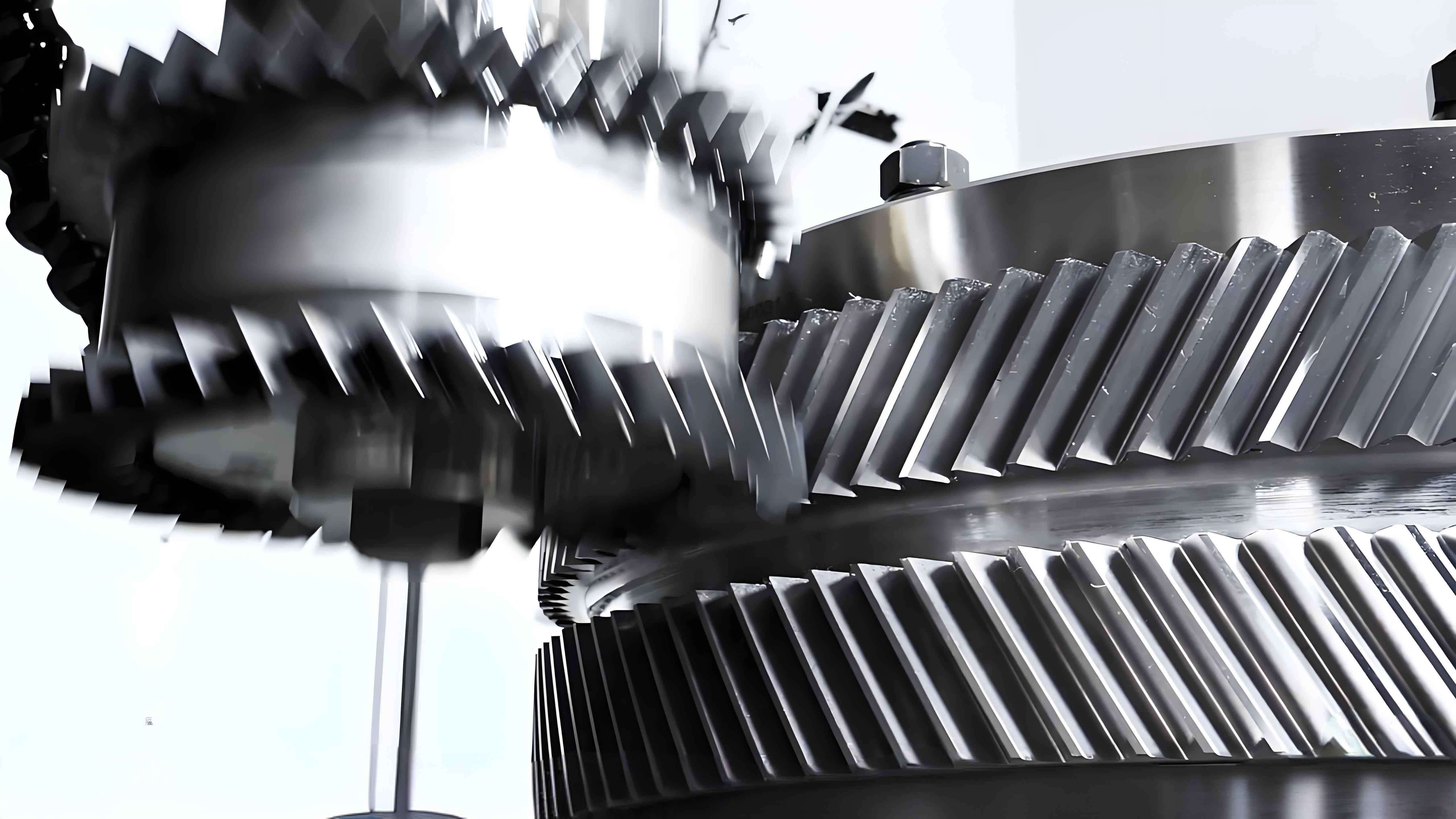
The foundation for calculating the mesh stiffness of a modified herringbone gear lies in a precise mathematical description of its tooth surface. A common and effective approach is the generating process using a hypothetical rack cutter. The transverse profile of this cutter is designed to produce the desired modifications. As shown in the methodology, the profile consists of four distinct segments: a straight line generating the involute region (Segment 1), higher-order curves for tip relief (Segment 2) and root relief (Segment 3), and an elliptical arc for the root fillet (Segment 4).
The equation for the tip and root relief segments on the cutter in its local coordinate system \( S_a \) or \( S_b \) can be defined by a power function:
$$ y = a u^n $$
where \( a \) is the modification coefficient determined by the modification parameters, \( u \) is the profile length parameter, and \( n \) is the order of the modification curve (e.g., \( n=2 \) for parabolic relief).
Through a series of coordinate transformations from the cutter coordinate system \( S_0 \) to the gear coordinate system \( S_2 \), and by enforcing the condition of conjugacy (the common normal at the contact point must pass through the pitch point), the mathematical equation of the modified herringbone gear tooth surface can be derived. The final surface point \( \mathbf{R}_{S_2, i} \) for a segment \( i \) is given by:
$$ \mathbf{R}_{S_2, i} = \begin{bmatrix}
R_{S_{1, ix}} \cos \phi_i – R_{S_{1, iy}} \sin \phi_i + r (\cos \phi_i + \phi_i \sin \phi_i) \\
R_{S_{1, ix}} \sin \phi_i + R_{S_{1, iy}} \cos \phi_i + r (\sin \phi_i – \phi_i \cos \phi_i) \\
R_{S_{1, iz}}
\end{bmatrix} $$
Here, \( R_{S_{1, ix}}, R_{S_{1, iy}}, R_{S_{1, iz}} \) are the coordinates of the cutter surface point, \( \phi_i \) is the gear rotation angle during generation, and \( r \) is the pitch radius of the gear. This equation forms the geometric basis for all subsequent contact and stiffness analyses of the profile-modified herringbone gear.
Fundamentals of Time-Varying Mesh Stiffness Calculation for Herringbone Gears
The total effective mesh stiffness of a herringbone gear pair at any instant is the sum of the stiffnesses of all tooth pairs in simultaneous contact. For a single tooth pair, the combined stiffness \( k \) results from the series combination of the flexibilities of the pinion and gear teeth, their gear bodies, and the local Hertzian contact deformation. According to the potential energy method, the total elastic potential energy \( U \) stored under a mesh force \( F \) is the sum of energies from various deformation components. This relationship provides a direct way to calculate the inverse of the stiffness.
For a herringbone gear, the deformation must be resolved into two principal directions due to the angled contact lines: the transverse (in the plane of rotation) and the axial directions. The total potential energy can be expressed as:
$$ U = \frac{F^2}{2k} = U_h + \sum_{j=1}^{2} \left( U_{tb_j} + U_{ts_j} + U_{ta_j} + U_{tf_j} + U_{ab_j} + U_{at_j} + U_{af_j} \right) $$
where \( j=1,2 \) denotes the pinion and gear, respectively. The contributing energy (and corresponding stiffness \( k_* \)) terms are:
- \( U_h, k_h \): Hertzian contact energy/stiffness.
- \( U_{tb}, k_{tb} \): Bending energy/stiffness in the transverse plane.
- \( U_{ts}, k_{ts} \): Shear energy/stiffness in the transverse plane.
- \( U_{ta}, k_{ta} \): Axial compressive energy/stiffness in the transverse plane.
- \( U_{tf}, k_{tf} \): Gear body foundation deflection energy/stiffness in the radial direction.
- \( U_{ab}, k_{ab} \): Bending energy/stiffness in the axial direction (due to axial force component).
- \( U_{at}, k_{at} \): Torsional energy/stiffness in the axial direction.
- \( U_{af}, k_{af} \): Gear body foundation deflection energy/stiffness in the axial direction (primarily influenced by the undercut groove).
Thus, the single-tooth-pair mesh stiffness \( k \) is:
$$ k = \frac{1}{ \sum_{j=1}^{2} \left( \frac{1}{k_{tb_j}} + \frac{1}{k_{ts_j}} + \frac{1}{k_{ta_j}} + \frac{1}{k_{tf_j}} + \frac{1}{k_{ab_j}} + \frac{1}{k_{at_j}} + \frac{1}{k_{af_j}} \right) + \frac{1}{k_h} } $$
Transverse Plane Mesh Stiffness Components
To handle the varying contact conditions along the face width of the herringbone gear, the “slice method” is employed. The tooth is discretized into \( N \) thin slices along its axis. The stiffness contributions for each slice are calculated based on its local contact point and geometry, and then summed. For a slice of width \( \Delta z \), its local transverse pressure angle \( \alpha_z \) and contact point coordinates \( (x(\alpha_z), y(\alpha_z)) \) are determined from the derived tooth surface equation. The bending, shear, and axial compression stiffnesses for one slice of a single herringbone gear tooth are given by the following integrals, which are then summed over all engaged slices:
Bending Stiffness (Transverse):
$$ \frac{1}{k_{tb}^{slice}} = \int_{x_M}^{x(\alpha_z)} \frac{3 \cos^2 \beta [\cos \alpha_z (x(\alpha_z)-x) – \sin \alpha_z y(\alpha_z)]^2}{2E \Delta z \, y^3} dx $$
Shear Stiffness (Transverse):
$$ \frac{1}{k_{ts}^{slice}} = \int_{x_M}^{x(\alpha_z)} \frac{0.6 \cos^2 \beta \cos^2 \alpha_z}{G \Delta z \, y} dx $$
Compressive Stiffness (Transverse):
$$ \frac{1}{k_{ta}^{slice}} = \int_{x_M}^{x(\alpha_z)} \frac{\cos^2 \beta \sin^2 \alpha_z}{2E \Delta z \, y} dx $$
where \( E \) and \( G \) are Young’s modulus and shear modulus, \( \beta \) is the helix angle, and \( x_M \) is the x-coordinate at the tooth root. The total stiffness for the gear is \( k_{tb} = \left( \sum_{\text{slices}} 1/k_{tb}^{slice} \right)^{-1} \), and similarly for \( k_{ts} \) and \( k_{ta} \).
The Hertzian contact stiffness for the herringbone gear pair is:
$$ k_h = \frac{\pi E L}{4(1-\mu^2)} $$
where \( \mu \) is Poisson’s ratio and \( L \) is the total instantaneous contact line length, a critical time-varying parameter for herringbone gears.
The gear body foundation stiffness in the radial direction for a slice can be modeled using an empirical formula:
$$ k_{tf}^{slice} = \frac{\Delta z}{\cos^2 \beta \cos^2 \alpha_z} \cdot \frac{E}{ \left[ L^* \left( \frac{u_f}{S_f} \right)^2 + M^* \left( \frac{u_f}{S_f} \right) + P^* (1 + Q^* \tan^2 \alpha_z) \right] } $$
where \( L^*, M^*, P^*, Q^* \) are dimensionless coefficients dependent on tooth geometry, \( u_f \) is the distance from the root to the point of force application along the tooth centerline, and \( S_f \) is the tooth thickness at the root.
Axial Direction Mesh Stiffness Components
The helical nature of the herringbone gear tooth generates an axial force component \( F \sin \beta \). This force creates bending and torsion of the tooth as a cantilever beam in the axial direction, and also causes bending deformation of the gear body, which is significantly affected by the undercut groove. The axial bending moment \( M_a \) and torsional moment \( M_T \) about the tooth’s axes are averaged over the engaged slices (\( N_s \)):
$$ M_a = F \sin \beta \cdot \frac{1}{N_s} \sum_{i=1}^{N} \left[ x(\alpha_z) – \bar{x} \right] $$
$$ M_T = F \sin \beta \cdot \frac{1}{N_s} \sum_{i=1}^{N} \left[ y(\alpha_z) \right] $$
where \( \bar{x} \) is a reference coordinate. The resulting axial bending and torsional stiffnesses for the tooth are:
$$ \frac{1}{k_{ab}} = \int_{x_M}^{x(\alpha)} \frac{3 \sin^2 \beta \left\{ \frac{1}{N_s} \sum_{i=1}^{N} \left[ x(\alpha_z) – x \right] \right\}^2}{E B^3 y} dx $$
$$ \frac{1}{k_{at}} = \int_{x_M}^{x(\alpha)} \frac{3 \sin^2 \beta \left\{ \frac{1}{N_s} \sum_{i=1}^{N} \left[ y(\alpha_z) \right] \right\}^2}{G (4B y^3 + B^3 y / \cos^2 \beta)} dx $$
Here, \( B \) is the single helical flank width, and \( x(\alpha) \) is the averaged contact point x-coordinate.
The most distinctive part of herringbone gear stiffness calculation is the axial gear body stiffness \( k_{af} \), which accounts for the undercut groove. The gear body is treated as a variable-cross-section beam. The bending moment \( M_{af} \) at a distance \( x_1 \) from the gear center is:
$$ M_{af}(x_1) = F \sin \beta \cdot \frac{1}{N_s} \sum_{i=1}^{N} \left[ x(\alpha_z) – x_1 \right] $$
The area moment of inertia \( I_{af}(x_1) \) varies along \( x_1 \) due to the groove:
$$
I_{af}(x_1) =
\begin{cases}
\frac{1}{3} \left[ B^3 (\sqrt{r_f^2 – x_1^2} – \sqrt{r_0^2 – x_1^2}) + \left( \frac{B_t}{2} \right)^3 (\sqrt{r_t^2 – x_1^2} – \sqrt{r_0^2 – x_1^2}) \right] & 0 \le x_1 \le r_0 \\
\frac{1}{3} \left[ B^3 \sqrt{r_f^2 – x_1^2} + \left( \frac{B_t}{2} \right)^3 \sqrt{r_t^2 – x_1^2} \right] & r_0 \le x_1 \le r_t \\
\frac{1}{3} B^3 \sqrt{r_f^2 – x_1^2} & r_t \le x_1 \le r_f
\end{cases}
$$
where \( B_t \) is the undercut groove width, \( r_t \) is the radius at the groove bottom, \( r_0 \) is the bore radius, and \( r_f \) is the root radius. The axial body stiffness is then:
$$ \frac{1}{k_{af}} = \int_{0}^{r_f} \frac{ \sin^2 \beta \left\{ \frac{1}{N_s} \sum_{i=1}^{N} \left[ x(\alpha_z) – x_1 \right] \right\}^2 }{E I_{af}(x_1)} dx_1 $$
This integral captures the significant effect of the undercut groove geometry on the overall compliance of the herringbone gear.
Incorporating Loaded Contact Analysis for Modified Herringbone Gears
Under operational load, the teeth deform elastically. For a profile-modified herringbone gear, this means that the initial “geometric” contact points may shift, and portions of the modified (relieved) zones may come into contact, altering the actual contact ratio and line of action. Therefore, a loaded tooth contact analysis (LTCA) step is essential for accurate TVMS calculation. The process involves determining the actual start and end points of contact along the line of action under the applied load \( F \).
The total deformation \( \delta \) at a potential contact point must equal the sum of the geometric separation (due to modification) \( \Delta \) and the elastic approach \( \delta_{el} \):
$$ \delta_{el} = \frac{F \cos \beta}{\sum_{m=1}^{N_c} k_m} = \delta – \Delta $$
where \( N_c \) is the number of tooth pairs in contact and \( k_m \) is the single-pair stiffness of the m-th pair. By iteratively solving for the load distribution that satisfies this compatibility condition across all potential contact points, the true loaded contact boundaries \( r’_{s} \) and \( r’_{e} \) (distances from the gear center to the start and end of contact) are found.
The loaded transverse contact ratio \( \epsilon’_{\alpha} \) is then:
$$ \epsilon’_{\alpha} = \frac{ \sqrt{r’^{2}_{e1} – r^{2}_{b1}} + \sqrt{r’^{2}_{s2} – r^{2}_{b2}} – a \sin \alpha_{wt} }{ p_{bt} } $$
where \( r_{b} \) is the base radius, \( a \) is the center distance, \( \alpha_{wt} \) is the operating transverse pressure angle, and \( p_{bt} \) is the transverse base pitch. The total contact ratio for the herringbone gear is \( \epsilon = \epsilon’_{\alpha} + \epsilon_{\beta} \), where the overlap ratio \( \epsilon_{\beta} \) remains unchanged by profile modification: \( \epsilon_{\beta} = \frac{B \sin \beta}{\pi m_n} \).
The instantaneous contact line length \( L(t) \), a key input for \( k_h \), becomes a function of load and modification:
$$ L(F, \Delta, h, n) = f(vt, \epsilon’_{\alpha}, \epsilon_{\beta}, \beta_b, B) $$
where \( vt \) is the distance traveled along the line of action. Its piecewise form depends on whether \( \epsilon’_{\alpha} \) is greater or less than \( \epsilon_{\beta} \).
Parametric Analysis of Influencing Factors
Using the developed comprehensive model, the influence of key design and operational parameters on the TVMS of a herringbone gear pair can be systematically analyzed. The base parameters for a sample herringbone gear pair are listed below.
| Parameter | Symbol | Value |
|---|---|---|
| Number of Teeth (Pinion/Gear) | \( Z_1 / Z_2 \) | 34 / 31 |
| Normal Module | \( m_n \) | 2 mm |
| Normal Pressure Angle | \( \alpha_n \) | 22.5° |
| Helix Angle | \( \beta \) | 30° |
| Single Flank Width | \( B \) | 24 mm |
| Undercut Groove Width | \( B_t \) | 10 mm |
| Center Distance | \( a \) | 75.5 mm |
| Young’s Modulus | \( E \) | 210 GPa |
| Poisson’s Ratio | \( \mu \) | 0.3 |
1. Effect of Undercut Groove Width (\( B_t \)): Holding the single-flank width \( B \) constant, increasing \( B_t \) reduces the effective span of the gear body, increasing its axial rigidity. Consequently, the mean mesh stiffness increases, while the stiffness fluctuation amplitude remains largely unchanged as the contact ratio is unaffected.
| \( B_t \) (mm) | Mean \( k_{mesh} \) (N/(μm·mm)) | Fluctuation (N/(μm·mm)) |
|---|---|---|
| 0 | 17.62 | 1.78 |
| 10 | 17.65 | 1.78 |
| 20 | 17.87 | 1.78 |
| 30 | 18.29 | 1.77 |
| 40 | 18.77 | 1.78 |
2. Effect of Profile Modification Amount (\( \Delta_g \)): Increasing the tip/root relief amount reduces material in the modified zones, locally decreasing tooth stiffness. Under load, a larger relief amount can prevent the modified zones from fully engaging, reducing the loaded contact ratio \( \epsilon’_{\alpha} \). This leads to a decrease in the mean mesh stiffness. The fluctuation amplitude is highly sensitive to the total contact ratio \( \epsilon \); it peaks when \( \epsilon \) is close to an integer.
| \( \Delta_g \) (μm) | \( \epsilon’_{\alpha} \) | \( \epsilon \) | Mean \( k_{mesh} \) | Fluctuation |
|---|---|---|---|---|
| 0 | 1.260 | 3.170 | 18.32 | 1.66 |
| 5 | 1.249 | 3.159 | 18.07 | 1.94 |
| 10 | 1.101 | 3.011 | 16.92 | 2.04 |
| 12 | 1.035 | 2.945 | 16.14 | 1.89 |
| 15 | 0.982 | 2.892 | 15.42 | 1.57 |
3. Effect of Profile Modification Length (\( h_g \)): A longer modified zone extends the region of reduced stiffness. Similar to increasing the modification amount, this reduces the load-bearing involute region, decreasing \( \epsilon’_{\alpha} \) and the mean mesh stiffness. The fluctuation amplitude again correlates with the proximity of \( \epsilon \) to an integer value.
| \( h_g \) (mm) | \( \epsilon’_{\alpha} \) | Mean \( k_{mesh} \) | Fluctuation |
|---|---|---|---|
| 0.6 | 1.228 | 17.81 | 1.49 |
| 0.8 | 1.153 | 17.23 | 1.94 |
| 1.0 | 1.101 | 16.92 | 2.04 |
| 1.2 | 1.013 | 16.13 | 1.85 |
4. Effect of Modification Curve Order (\( n \)): A higher-order curve (e.g., \( n=4 \) vs. \( n=2 \)) provides a more gradual transition into the relief zone, effectively removing less material near the start of modification. This results in a slightly higher local stiffness in the transition region, allowing a marginally larger loaded contact ratio and thus a higher mean mesh stiffness. The effect diminishes for \( n > 4 \).
| Order \( n \) | \( \epsilon’_{\alpha} \) | Mean \( k_{mesh} \) | Fluctuation |
|---|---|---|---|
| 2 | 1.196 | 17.89 | 1.71 |
| 3 | 1.239 | 18.04 | 1.87 |
| 4 | 1.249 | 18.07 | 1.94 |
| 6 | 1.251 | 18.08 | 1.97 |
5. Effect of Input Torque (\( T_{in} \)): Increasing torque increases the mesh force \( F \), leading to larger elastic deformations. This allows the contacting teeth to “sink” further into each other, bringing more of the relieved zones into contact. Therefore, the loaded contact ratio \( \epsilon’_{\alpha} \) increases with torque, causing an increase in mean mesh stiffness. The fluctuation amplitude varies non-monotonically. Beyond a certain torque level, the relieved zones become fully engaged, and the contact ratio saturates, leading to a stable mesh stiffness independent of further torque increase. Insufficient torque for a given modification can result in \( \epsilon’_{\alpha} < 1 \), causing discontinuous contact and severe vibration.
| \( T_{in} \) (N·m) | \( \epsilon’_{\alpha} \) | Mean \( k_{mesh} \) | Fluctuation |
|---|---|---|---|
| 250 | 0.948 | 15.15 | 1.37 |
| 375 | 1.024 | 16.09 | 1.71 |
| 500 | 1.101 | 16.92 | 2.04 |
| 625 | 1.175 | 17.79 | 1.65 |
| 750 | 1.253 | 18.10 | 1.70 |
| 875 | 1.254 | 18.12 | 1.70 |
Conclusion
A comprehensive analytical methodology for calculating the time-varying mesh stiffness of profile-modified herringbone gear pairs has been established. This method integrates the precise geometry of modified tooth flanks, the load-dependent elastic contact conditions, and the unique structural influence of the central undercut groove. The formulation decomposes the total mesh stiffness into transverse and axial components, calculating each via the potential energy method applied to discretized tooth slices. The model’s validity is confirmed through favorable comparison with finite element analysis results.
The parametric study reveals significant insights for the design of herringbone gears:
- The undercut groove width is a critical design parameter for the herringbone gear’s structural rigidity; increasing it (while keeping flank width constant) raises the mean mesh stiffness.
- Profile modification reduces the mean mesh stiffness of the herringbone gear, with the reduction being more pronounced for larger modification amounts and lengths.
- The order of the modification curve has a modest effect; higher-order curves lead to slightly less stiffness reduction in the herringbone gear.
- The input torque has a two-stage effect on herringbone gear mesh stiffness: an initial increase due to the expansion of the loaded contact zone, followed by saturation once the modification zones are fully engaged.
- The amplitude of stiffness fluctuation is highly sensitive to the total loaded contact ratio, peaking when the ratio is near an integer, a crucial consideration for dynamic excitation in herringbone gear systems.
This analytical framework provides an efficient and accurate tool for predicting the TVMS of herringbone gears, forming a essential foundation for advanced dynamic modeling, noise prediction, and performance optimization of power transmission systems utilizing this important gear type.