
In my years working with gear transmission systems, I have found that the herringbone gear offers a unique combination of advantages: it provides the smoothness and high load capacity of helical gears while canceling out axial thrust forces through opposing helix angles. However, practical applications reveal a critical challenge: manufacturing errors in the tooth alignment—specifically what I call tooth同位度误差 (tooth alignment error)—inevitably cause axial shaft movements that must be properly accommodated in bearing design. This article presents my analysis of how such axial displacements arise and my recommendations for selecting appropriate bearings in herringbone gear shafts.
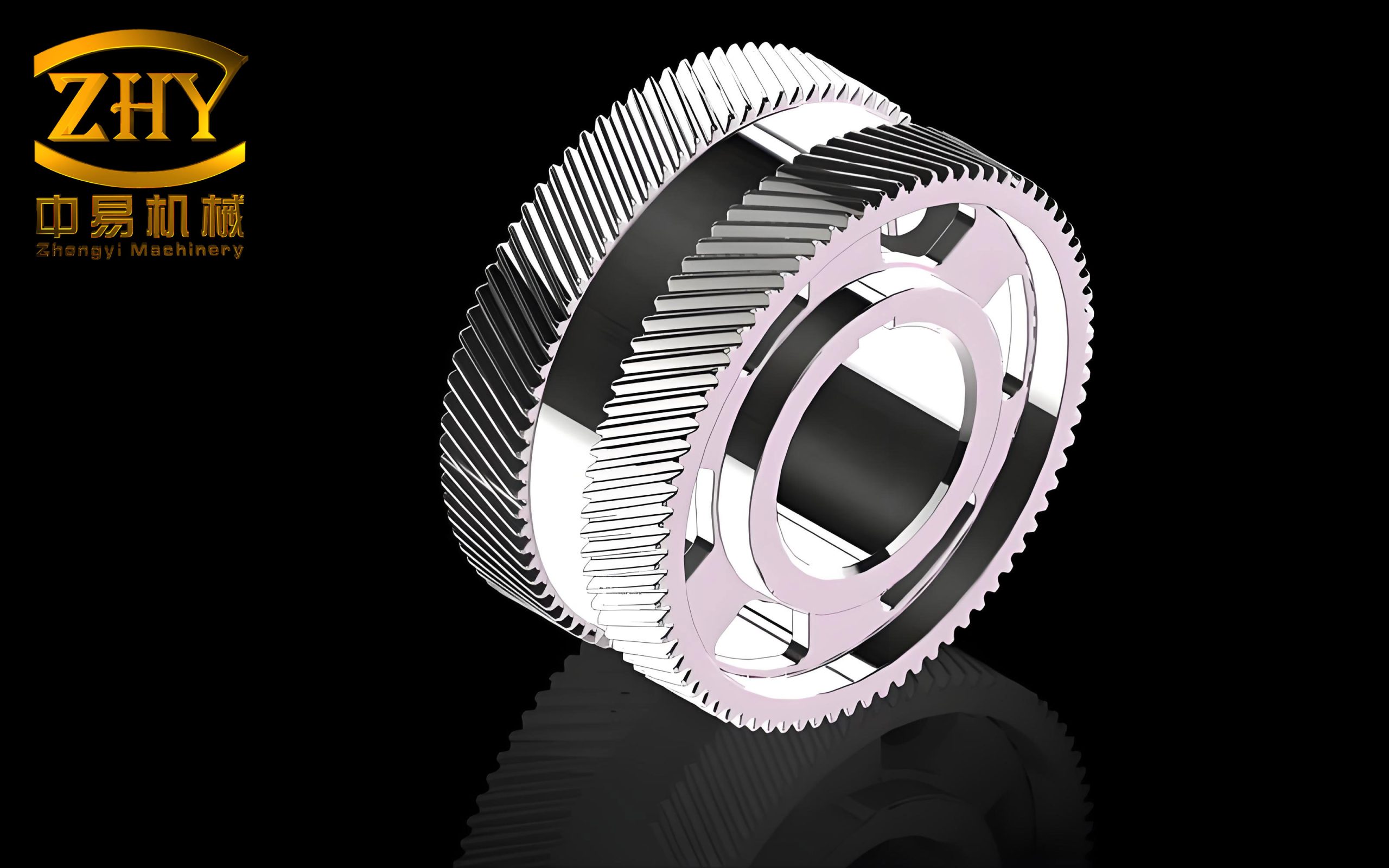
Understanding Tooth Alignment Error and Axial Movement in Herringbone Gears
A herringbone gear is essentially a pair of helical gears with opposite helix directions on the same shaft. Ideally, the tooth traces on both halves should be perfectly aligned—a property I term tooth同位度 (tooth congruence). Manufacturing imperfections cause deviations, defined as tooth alignment error \(\Delta\). To achieve proper meshing between a driving and a driven herringbone gear, one shaft must shift axially by a distance \(\delta\) to compensate for this error.
Consider a scenario where the driven shaft has a perfectly aligned herringbone gear, while the driving shaft has a misaligned right-hand helical section offset by \(\Delta\). The required axial shift \(\delta\) to bring both halves into simultaneous mesh is given by:
$$ \delta = \frac{\Delta}{\tan \beta} $$
where \(\beta\) is the helix angle of the gear teeth. For a more realistic case where both shafts have alignment errors \(\Delta_1\) and \(\Delta_2\), the total axial displacement needed becomes:
$$ \delta = \frac{\Delta_1 + \Delta_2}{2 \tan \beta} $$
The smaller the helix angle \(\beta\), the larger the axial movement required for a given error. To illustrate, I present the following table summarizing the relationship between alignment error, helix angle, and axial displacement.
| Helix Angle \(\beta\) (deg) | Alignment Error \(\Delta\) (mm) | Axial Displacement \(\delta\) (mm) |
|---|---|---|
| 15 | 0.1 | 0.373 |
| 20 | 0.1 | 0.275 |
| 25 | 0.1 | 0.214 |
| 30 | 0.1 | 0.173 |
| 15 | 0.2 | 0.746 |
| 25 | 0.2 | 0.429 |
Clearly, controlling \(\Delta\) and choosing a reasonable helix angle are vital. In my experience, if the alignment error exceeds 0.1 mm, axial movement becomes substantial, potentially causing interference with adjacent components or excessive bearing loads.
Bearing Selection to Accommodate Axial Float
When designing a shaft system for a herringbone gear pair, the bearings must allow the necessary axial movement to ensure both helical halves engage simultaneously. If I use bearings that rigidly fix the shaft axially—such as deep groove ball bearings or angular contact bearings in a fixed arrangement—the herringbone gear cannot self-align. This forces one helical half to carry the full load, converting the transmission into an ineffective single helical gear set, doubling stress on that half and risking premature failure.
Conversely, if I first mesh the herringbone gear correctly and then lock the bearings, any instantaneous variation in alignment error (due to thermal expansion or load fluctuations) will induce axial forces on the bearings, again causing overload. Therefore, a floating bearing arrangement is essential for at least one shaft.
| Bearing Type | Axial Float Capability | Application Recommendation |
|---|---|---|
| Cylindrical Roller Bearing (NU type) | High axial float (free) | Floating shaft – allows axial movement |
| Needle Roller Bearing (with loose rings) | Moderate float | Compact designs with limited axial space |
| Deep Groove Ball Bearing (fixed) | Negligible float | Not recommended for floating shaft |
| Angular Contact Bearing (paired) | Controlled float via preload | Only for lightly loaded, low-error applications |
| Self-Aligning Ball Bearing | Limited axial float | Can accommodate small misalignments, but not sufficient for large \(\delta\) |
In my designs, I typically place the driven shaft (larger load) on fixed bearings (e.g., a pair of angular contact bearings back-to-back to withstand residual axial forces), while the driving shaft uses a floating arrangement with cylindrical roller bearings. This allows the driving shaft to slide axially as needed, ensuring both halves of the herringbone gear mesh correctly.
Impact of Helix Angle and Error Tolerance
From the formula \(\delta = (\Delta_1 + \Delta_2) / (2 \tan \beta)\), I derive the following design guidelines:
- Do not use a too-small helix angle (e.g., \(\beta < 20^\circ\)), because even small alignment errors produce large axial movements. This leads to excessive shaft displacement, destabilizing the system.
- Control tooth alignment error rigorously. In production, I specify that the sum \(\Delta_1 + \Delta_2\) must not exceed 0.15 mm for most industrial gears. For high-speed or precision applications, 0.05 mm is preferable.
- Larger helix angles (e.g., 30°–35°) reduce axial movement sensitivity, but they increase the gear’s axial width and manufacturing complexity.
| Application | Typical Helix Angle \(\beta\) (deg) | Maximum Allowable Total Error \(\Delta_1+\Delta_2\) (mm) | Expected Axial Float \(\delta\) (mm) |
|---|---|---|---|
| General industrial gearbox | 25 | 0.15 | 0.16 |
| High-speed turbine drive | 30 | 0.05 | 0.043 |
| Heavy mining equipment | 20 | 0.20 | 0.275 |
| Automotive transmission (low noise) | 28 | 0.10 | 0.094 |
Practical Considerations for Bearing Layout
When laying out the shaft system for a herringbone gear, I follow these steps:
- Identify the floating shaft. Typically, the input (driving) shaft is lighter and easier to float. The output shaft is often fixed to maintain axial position for coupling alignment.
- Select bearings that permit free axial movement. For the floating shaft, I use cylindrical roller bearings (NU type) or needle roller bearings with loose inner rings. These have low friction and allow smooth sliding.
- Provide axial guidance only at one end. The fixed shaft uses bearings that limit axial movement (e.g., deep groove ball bearings with shoulder or angular contact bearings). A small axial clearance may be left to avoid binding from thermal expansion.
- Ensure lubrication of sliding interfaces. Axial movement creates sliding friction between bearing rollers and raceways; adequate oil supply prevents wear.
- Consider a thrust bearing for residual forces. Even with perfect herringbone gear, slight helix angle asymmetry or load variations can produce small thrust forces. On the fixed shaft, a moderate-capacity thrust bearing (or paired angular contact bearings) can absorb these.
Example Calculation for a Typical Herringbone Gearbox
Suppose I design a herringbone gear with helix angle \(\beta = 25^\circ\). The driving and driven gears each have alignment errors of 0.08 mm (total \(\Delta_1+\Delta_2 = 0.16\) mm). The required axial displacement is:
$$ \delta = \frac{0.16}{2 \times \tan 25^\circ} = \frac{0.16}{2 \times 0.4663} \approx 0.172 \text{ mm} $$
This 0.172 mm axial movement must be accommodated. I choose the driving shaft to float, using NU212 cylindrical roller bearings (with free axial displacement up to 1–2 mm). The driven shaft uses two 7212 angular contact bearings arranged back-to-back, preloaded to handle any incidental axial force. The system operates with no binding and even load distribution across both helical halves of the herringbone gear.
Conclusion
Through my analysis of herringbone gear shaft systems, I have demonstrated that unavoidable tooth alignment errors cause axial movements necessary for correct meshing. Selecting the wrong bearings—those that fix axial position—leads to improper load sharing, increased stress, and premature failure. The correct approach is to provide one shaft with axial float using bearings like cylindrical roller or needle roller types, while the other shaft is fixed. Additionally, controlling the helix angle and manufacturing tolerances (tooth alignment error) is critical to limit the magnitude of axial displacement. By following these guidelines, engineers can ensure that herringbone gear transmissions achieve their full potential: smooth, high-capacity, and reliable operation.