
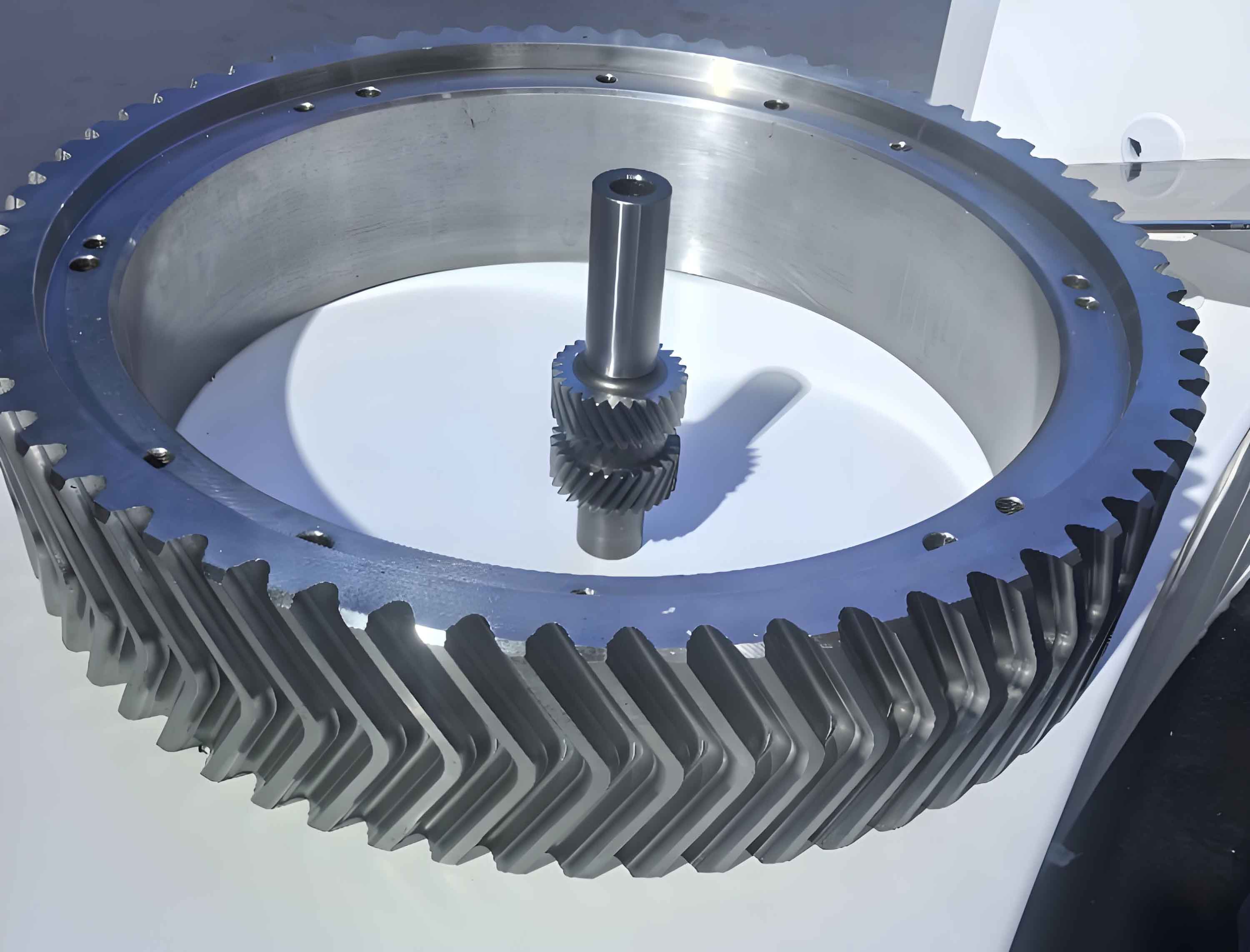
In my investigation of marine propulsion systems, I have focused on the dynamic behavior of herringbone gears, which are critical components in large ship gearboxes due to their ability to handle high loads and provide smooth power transmission. The presence of tooth flank backlash, an inevitable clearance between meshing teeth resulting from manufacturing tolerances, assembly errors, and operational wear, poses significant challenges to system stability. This backlash can lead to periodic impact vibrations, noise generation, and reduced reliability. In this study, I aim to explore the specific effects of backlash on the dynamic characteristics of marine herringbone gears through simulation and theoretical analysis. My goal is to provide insights that can guide the optimization of herringbone gears for enhanced vibration and noise reduction performance.
To begin, I established a dynamic model of herringbone gears using Adams simulation software. The model was parameterized based on typical marine gear specifications, ensuring accuracy by comparing simulation results with theoretical calculations. The key geometric parameters for the herringbone gear pair are summarized in the table below. These parameters are essential for understanding the meshing behavior and backlash effects in herringbone gears.
| Parameter | Pinion | Gear |
|---|---|---|
| Number of Teeth | 48 | 80 |
| Module (mm) | 2 | 2 |
| Helix Angle (°) | 18 | 18 |
| Pressure Angle (°) | 20 | 20 |
The relationship between backlash and center distance is crucial for modeling herringbone gears accurately. For involute gears, the actual center distance \(a’\) can be derived from the gear parameters. The normal backlash \(j_{bn}\) is calculated using the formula:
$$j_{bn} = P_{bn} – (s_{bn1} + s_{bn2}) + 2(r_{b1} + r_{b2}) \cdot \text{inv} \alpha_{wt} \cdot \cos \beta_b$$
where \(P_{bn}\) is the normal base pitch, \(s_{bn}\) is the normal base tooth thickness, \(r_b\) is the base circle radius, \(\alpha_{wt}\) is the working pressure angle, and \(\beta_b\) is the base helix angle. Based on this, I computed the center distances for different backlash values, as shown in the following table. This data was used to set up the simulation models for herringbone gears with varying backlash levels.
| Backlash (mm) | Center Distance (mm) |
|---|---|
| 0 | 67.2942 |
| 0.1 | 67.4393 |
| 0.2 | 67.5824 |
In my simulation setup, I imported the herringbone gear model into Adams and applied boundary conditions and constraints to replicate real-world operating scenarios. The model included step functions for torque and speed to avoid sudden oscillations: from 0 to 0.02 seconds, the pinion accelerated from rest to 60 rpm, and a load torque of up to 10,000 N·mm was gradually applied to the gear from 0 to 0.04 seconds. I used the GSTIFF integrator with S12 format and an integration error of 0.0001, running the simulation for 0.5 seconds with 10,000 steps. To validate the model, I compared the simulated meshing forces with theoretical values derived from helical gear force calculations. The theoretical forces are given by:
$$F_t = \frac{2T_1}{d_1}, \quad F_r = \frac{F_t \tan \alpha_n}{\cos \beta}, \quad F_a = F_t \tan \beta, \quad F_n = \frac{F_t}{\cos \alpha_n \cos \beta}$$
where \(F_t\) is the tangential force, \(F_r\) is the radial force, \(F_a\) is the axial force, \(F_n\) is the normal force, \(T_1\) is the pinion torque, \(d_1\) is the pitch diameter, \(\alpha_n\) is the normal pressure angle, and \(\beta\) is the helix angle. The comparison revealed an average error of less than 1.5%, confirming the reliability of my herringbone gear model for further analysis of backlash effects.
During the simulation, I observed the meshing forces in various directions, which exhibited fluctuations due to the periodic engagement and disengagement of teeth in herringbone gears. The axial force \(F_a\) showed symmetric oscillations, with an average value representing only 1.68% of the peak axial force, indicating effective cancellation of axial forces in herringbone gears—a key advantage that enhances stability. This behavior underscores the importance of accurately modeling herringbone gears to capture their dynamic responses.
In the startup phase, I analyzed the dynamic characteristics of herringbone gears under different backlash conditions. The angular velocity of the driven gear displayed three distinct stages: initial reverse acceleration due to load, impact-induced oscillations upon contact, and gradual stabilization. As backlash increased, the oscillation amplitudes grew significantly. For instance, with 0 mm backlash, the maximum angular velocity fluctuation was 18.36°/s, while with 0.2 mm backlash, it surged to 173.11°/s. The time to reach steady-state also prolonged from 0.0306 seconds at 0 mm backlash to 0.051 seconds at 0.2 mm backlash. This indicates that backlash exacerbates vibrations in herringbone gears during startup, delaying system stabilization. The meshing force patterns mirrored these trends, with peak forces escalating from 317.11 N at 0 mm backlash to 3774.90 N at 0.2 mm backlash. The table below summarizes the meshing force parameters during startup, highlighting the impact of backlash on herringbone gear dynamics.
| Backlash (mm) | Peak Meshing Force (N) | End of Stage 1 (s) | End of Stage 2 (s) |
|---|---|---|---|
| 0 | 317.11 | 0.0188 | 0.0305 |
| 0.1 | 2245.12 | 0.0297 | 0.0338 |
| 0.2 | 3774.90 | 0.0313 | 0.0495 |
Transitioning to the steady-speed phase, I examined the stability of herringbone gears under constant operational conditions. With the system stabilized at 60 rpm, I monitored angular velocity and meshing force variations. The angular velocity exhibited periodic fluctuations aligned with the meshing frequency of 24 Hz, reflecting the time-varying stiffness inherent in herringbone gears due to changing contact ratios. Backlash amplified these fluctuations: at 0 mm backlash, the maximum velocity jump was 24.14°/s, but at 0.2 mm backlash, it increased to 75.96°/s. This demonstrates that backlash intensifies the dynamic instability in herringbone gears, even during steady operation. The meshing forces also showed cyclic patterns, with amplitudes expanding as backlash grew. For example, the meshing force jump ranged from 413.07 N at 0 mm backlash to 1163.84 N at 0.2 mm backlash, and at higher backlash levels, forces occasionally dropped to zero, indicating tooth separation. The data is consolidated in the following tables, emphasizing the role of backlash in modulating the dynamic response of herringbone gears.
| Backlash (mm) | Min Angular Velocity (°/s) | Max Angular Velocity (°/s) | Max Fluctuation (°/s) |
|---|---|---|---|
| 0 | 202.06 | 226.20 | 24.14 |
| 0.1 | 195.18 | 236.62 | 41.44 |
| 0.2 | 184.06 | 260.02 | 75.96 |
| Backlash (mm) | Min Meshing Force (N) | Max Meshing Force (N) | Fluctuation Amplitude (N) |
|---|---|---|---|
| 0 | 53.60 | 469.67 | 413.07 |
| 0.1 | 0 | 688.73 | 688.73 |
| 0.2 | 0 | 1163.84 | 1163.84 |
To further elucidate the dynamics, I derived additional formulas related to herringbone gear behavior. The time-varying meshing stiffness \(k(t)\) can be expressed as a function of the contact ratio \(\epsilon\) and backlash \(j\):
$$k(t) = k_0 + \Delta k \cdot \sin(2\pi f_m t) \cdot H(j)$$
where \(k_0\) is the average stiffness, \(\Delta k\) is the stiffness variation, \(f_m\) is the meshing frequency, and \(H(j)\) is a Heaviside function accounting for backlash-induced discontinuities. This nonlinearity contributes to the observed oscillations in herringbone gears. Additionally, the impact force \(F_i\) during tooth collision can be approximated using a Hertzian contact model:
$$F_i = \sqrt[3]{\frac{16 E^* R^2}{9} \cdot \delta^{3/2}}$$
where \(E^*\) is the equivalent Young’s modulus, \(R\) is the effective radius, and \(\delta\) is the penetration depth influenced by backlash. These equations help quantify the vibrational energy in herringbone gears, which scales with backlash magnitude.
In discussing the implications, I note that the stability of herringbone gears is highly sensitive to backlash. My simulations reveal that backlash not only prolongs transient responses but also amplifies steady-state vibrations, leading to increased noise and potential fatigue failures. For marine applications, where reliability is paramount, optimizing herringbone gears to minimize backlash—through precision manufacturing or adaptive control strategies—is essential. The periodic fluctuations tied to meshing frequency suggest that dynamic tuning of herringbone gear systems, such as incorporating damping elements, could mitigate backlash effects. Moreover, the axial force cancellation in herringbone gears, while beneficial, can be compromised by excessive backlash, underscoring the need for balanced design.
In conclusion, my analysis demonstrates that tooth flank backlash significantly impacts the dynamic stability of marine herringbone gears. Through parametric modeling and simulation, I have shown that backlash exacerbates impact vibrations during startup and intensifies time-varying stiffness effects during steady operation, leading to larger fluctuations in angular velocity and meshing forces. These findings highlight the importance of controlling backlash in herringbone gear design to enhance performance and reduce vibrational noise. Future work could explore real-time monitoring of herringbone gears or advanced materials to further improve their resilience in marine environments. Overall, this study provides a foundation for optimizing herringbone gears, ensuring they meet the rigorous demands of ship propulsion systems while maintaining operational tranquility.