
In the field of mechanical power transmission, the design of herringbone gear drives is a subject of continuous refinement. While extensive research exists on parameters affecting gear performance and load capacity, the calculation for the undercut width—the necessary gap between the two opposing helices of a herringbone gear machined by hobbing—though addressed in standards, often remains imprecise in practical application. This necessitates a more detailed investigation. The actual undercut width is intricately linked to the parameters of the gear being cut, the hob, and the combination of their helical directions. I have previously established a computational method to determine this width based on these multiple parameters and verified it through examples. Comparative analysis reveals that values from existing standards, which primarily consider module and helix angle while neglecting hob diameter and length, can be overly simplistic and sometimes unreasonable. Therefore, using the established method and program, I have calculated the minimum undercut width for hobbing gears of various sizes with different hob parameters. This article presents these results in the form of practical data tables for direct use in design, alongside a detailed explanation of the underlying calculation process.
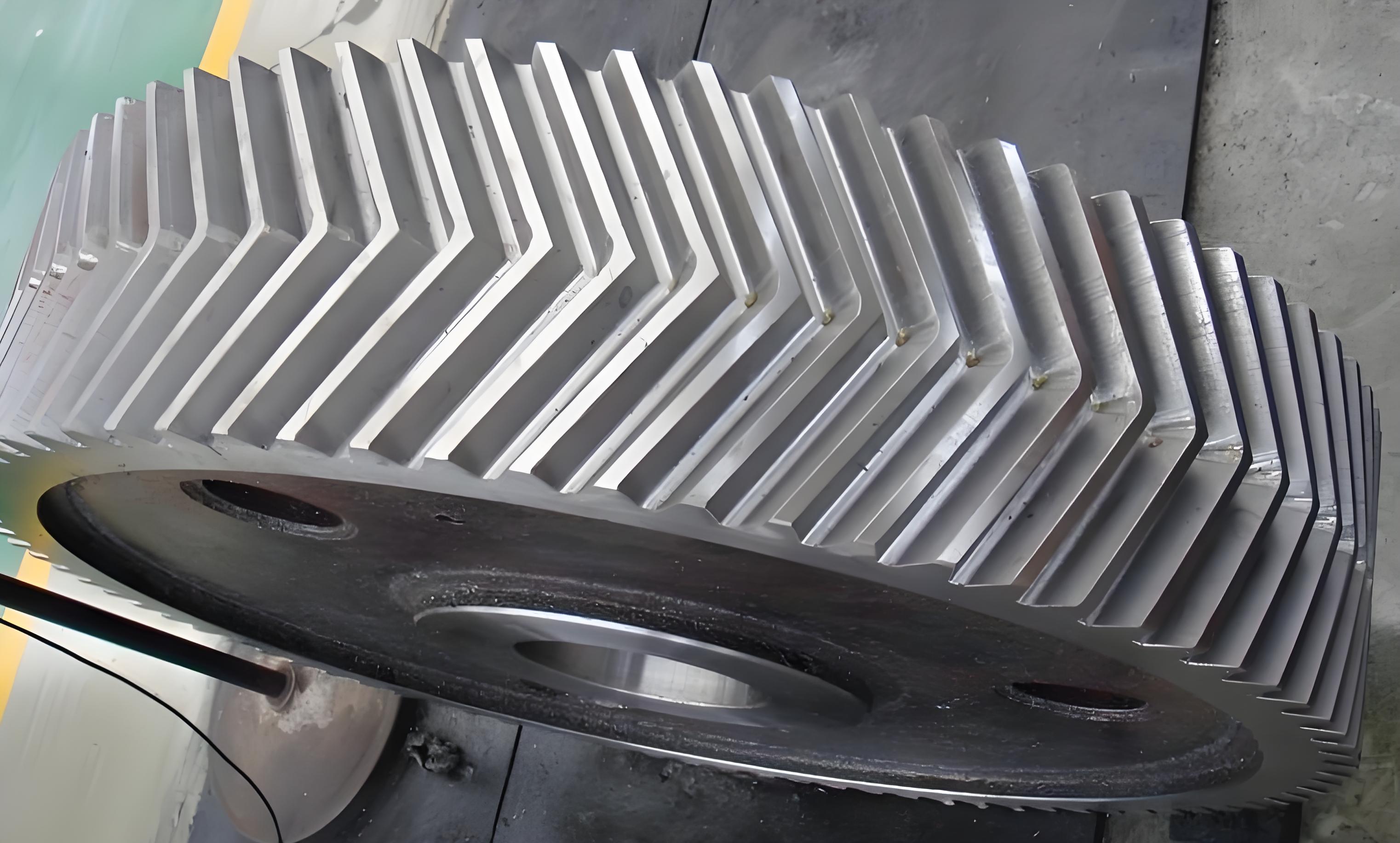
The fundamental challenge in designing a herringbone gear is ensuring the hob has sufficient clearance to exit the cut at the apex (the “V”) without interfering with the opposing gear half. The minimum undercut width $W_{min}$ is defined as the smallest axial distance between the two helical halves that allows for complete tooth generation. Its determination depends on the relative geometry of the gear blank and the hob at the critical point of cutting.
Calculation Methodology and Process
The core of the method involves modeling the spatial interaction between the gear’s internal end face (the face at the gear’s center plane) and the hob’s cylindrical body or its end face. Two primary scenarios are identified, dictated by the relative sizes of the gear and the hob.
To analyze this, two coordinate systems are established as shown in the referenced illustration (though image citations are not used per instruction, the description is based on the typical setup). Let $O_g – X_g Y_g Z_g$ be the gear coordinate system, fixed to the gear blank. Let $O_c – X_c Y_c Z_c$ be the hob coordinate system, fixed to the hob and inclined by the hob installation angle $\gamma$, which is the sum or difference of the gear helix angle $\beta$ and the hob lead angle $\lambda$, depending on the hand combination. The origin $O_c$ is at the hobbing center distance $A$.
Scenario 1: Tangency between the Gear Internal End Face and the Hob Outer Cylinder.
This occurs when the gear is relatively small and the hob is relatively long. The condition is that the cylindrical surface of the hob is tangent to the circular edge of the gear’s internal end face. The equations are written in their respective coordinate systems and then transformed into a common system (typically the gear system).
The circle representing the gear’s internal end face, with radius $R_g$ (the gear’s root or tip radius, depending on the critical condition), is given in $O_g$ by:
$$\vec{r_g}(t) = \begin{pmatrix} R_g \cos t \\ R_g \sin t \\ 0 \end{pmatrix}$$
where $t$ is a parameter.
The outer cylindrical surface of the hob, with radius $R_c$, is given in $O_c$ by:
$$\vec{r_c}(u, v) = \begin{pmatrix} R_c \cos u \\ R_c \sin u \\ v \end{pmatrix}$$
where $u$ and $v$ are parameters. This must be transformed via rotation (by the installation angle $\gamma$) and translation (by the center distance $A$) into the $O_g$ system: $\vec{r_c’}(u, v) = \mathbf{T}(\gamma, A) \cdot \vec{r_c}(u, v)$.
The tangency condition requires that at the contact point, the surfaces share a common normal vector. This leads to a system of non-linear equations. Solving this system for the parameters $t$, $u$, $v$ and the axial coordinate $Z_g$ of the contact point yields the undercut width $W_{min}$, which is related to this $Z_g$ coordinate.
Scenario 2: Intersection between the Gear Internal End Face and the Hob’s Cutting-Off End Face.
This occurs when the gear is relatively large or the hob has a relatively large diameter and short length. Here, the circular edge of the gear’s internal end face intersects directly with the circular edge of the hob’s end face.
The gear’s internal end face circle equation remains $\vec{r_g}(t)$.
The hob’s cutting-off end face is a circle of radius $R_c$ located at an axial position $L_{out}$ along the hob axis (measured from the hobbing node or reference point). Its equation in $O_c$ is:
$$\vec{r_{c, end}}(s) = \begin{pmatrix} R_c \cos s \\ R_c \sin s \\ L_{out} \end{pmatrix}$$
where $s$ is a parameter. This is also transformed into the gear system: $\vec{r_{c, end}’}(s) = \mathbf{T}(\gamma, A) \cdot \vec{r_{c, end}}(s)$.
The intersection condition requires $\vec{r_g}(t) = \vec{r_{c, end}’}(s)$ for some $t$ and $s$. Solving this system determines the intersection point and consequently the required $W_{min}$.
Selection Criterion and Hob Axial Shift (Staggering).
For a given set of gear and hob parameters, the actual $W_{min}$ corresponds to one of the two scenarios. The determining criterion is computational: if the contact point found under the tangency condition (Scenario 1) lies within the physical length of the hob (i.e., its axial position $v$ is less than $L_{out}$), then the tangency condition governs. Otherwise, the intersection condition (Scenario 2) applies.
A critical practical factor is hob axial shift, or “staggering.” This technique is used to distribute hob wear evenly. Staggering changes the axial position of the hobbing “node” (the theoretical point of tangency on the pitch cylinder) relative to the gear center. This directly impacts the calculated minimum undercut width. Generally, positioning the node closer to the hob’s cutting-off end reduces $W_{min}$. To ensure complete tooth generation, the hob must have a minimum length $L_{min}$ protruding beyond the node at the cutting-off end. This $L_{min}$ is found by determining the intersection of the hob tip line with the line of action in the axial plane. The formula can be expressed as:
$$L_{min} \approx \frac{\sqrt{R_{c,a}^2 – (A \sin \alpha_n)^2}}{\tan \lambda} + \Delta$$
where $R_{c,a}$ is the hob tip radius, $\alpha_n$ is the normal pressure angle, $\lambda$ is the hob lead angle, and $\Delta$ is a safety margin. This minimum length constraint must be considered alongside the undercut calculation. Strategic use of staggering can significantly reduce the required undercut width for a herringbone gear, leading to substantial weight savings, especially in large gearboxes like those used in rolling mills.
Given the non-linear, transcendental nature of the governing equations, an analytical solution is not feasible. Therefore, a computational solution using the Newton-Raphson iterative method is implemented in a program to solve for $W_{min}$ accurately under all parameter combinations and staggering positions.
Practical Data Tables for Herringbone Gear Design
The following tables provide calculated minimum undercut width values for standard spur and helical gear geometries (normal pressure angle $\alpha_n = 20^\circ$). Hob parameters are sourced from relevant standards: solid hobs conform to common dimensional guidelines, while inserted-tooth hobs follow typical industrial specifications. For a herringbone gear, the values from these tables are directly applicable. It is important to note that arc gears (double-circular-arc teeth) typically require less cutting depth than involute gears, while hob dimensions are similar. Therefore, the undercut widths listed here, when used for a herringbone arc gear, will provide a conservative margin of safety.
Two key scenarios are tabulated: 1) when the hobbing node is at the hob’s midpoint (a common starting setup), and 2) when the hob is staggered to its maximum usable limit to minimize $W_{min}$. The tables also include the corresponding minimum hob protruding length $L_{min}$ required for complete tooth generation, which includes a safety margin. For the opposing helix of the herringbone gear, the required minimum length at the hob’s entry end is equal to this $L_{min}$ value.
Table 1: Minimum Undercut Width for Solid Hobs (Hobbing Node at Midpoint)
| Module $m_n$ (mm) | Number of Teeth $z$ | Helix Angle $\beta$ (deg) | Min. Undercut $W_{min}$ (mm) | Hob Min. Length $L_{min}$ (mm) |
|---|---|---|---|---|
| 4 | 20 | 15 | 27.5 | 52 |
| 4 | 20 | 25 | 31.8 | 58 |
| 4 | 30 | 15 | 32.1 | 52 |
| 4 | 30 | 25 | 36.5 | 58 |
| 6 | 25 | 15 | 41.2 | 68 |
| 6 | 25 | 25 | 46.7 | 76 |
| 6 | 40 | 15 | 48.3 | 68 |
| 6 | 40 | 25 | 53.9 | 76 |
| 8 | 30 | 15 | 54.8 | 85 |
| 8 | 30 | 25 | 61.6 | 95 |
| 8 | 50 | 15 | 64.4 | 85 |
| 8 | 50 | 25 | 71.3 | 95 |
| 10 | 40 | 15 | 72.5 | 102 |
| 10 | 40 | 25 | 80.9 | 114 |
| 10 | 60 | 15 | 84.5 | 102 |
| 10 | 60 | 25 | 92.9 | 114 |
Table 2: Minimum Undercut Width for Inserted-Tooth Hobs (Hobbing Node at Midpoint)
| Module $m_n$ (mm) | Number of Teeth $z$ | Helix Angle $\beta$ (deg) | Min. Undercut $W_{min}$ (mm) | Hob Min. Length $L_{min}$ (mm) |
|---|---|---|---|---|
| 10 | 30 | 12 | 85.2 | 125 |
| 10 | 30 | 20 | 92.7 | 132 |
| 10 | 50 | 12 | 98.1 | 125 |
| 10 | 50 | 20 | 105.6 | 132 |
| 12 | 35 | 12 | 102.8 | 138 |
| 12 | 35 | 20 | 111.8 | 147 |
| 12 | 55 | 12 | 118.9 | 138 |
| 12 | 55 | 20 | 127.9 | 147 |
| 16 | 45 | 10 | 138.5 | 162 |
| 16 | 45 | 18 | 150.3 | 172 |
| 16 | 70 | 10 | 161.2 | 162 |
| 16 | 70 | 18 | 173.0 | 172 |
| 20 | 50 | 10 | 173.4 | 185 |
| 20 | 50 | 18 | 188.3 | 197 |
| 20 | 80 | 10 | 202.1 | 185 |
| 20 | 80 | 18 | 217.0 | 197 |
Table 3: Minimum Undercut Width for Solid Hobs with Maximum Staggering
| Module $m_n$ (mm) | Number of Teeth $z$ | Helix Angle $\beta$ (deg) | Min. Undercut $W_{min}$ (mm) | Hob Min. Length $L_{min}$ (mm) |
|---|---|---|---|---|
| 4 | 20 | 15 | 22.1 | 52 |
| 4 | 20 | 25 | 25.4 | 58 |
| 4 | 30 | 15 | 25.7 | 52 |
| 4 | 30 | 25 | 29.2 | 58 |
| 6 | 25 | 15 | 33.0 | 68 |
| 6 | 25 | 25 | 37.4 | 76 |
| 6 | 40 | 15 | 38.6 | 68 |
| 6 | 40 | 25 | 43.1 | 76 |
| 8 | 30 | 15 | 43.8 | 85 |
| 8 | 30 | 25 | 49.3 | 95 |
| 8 | 50 | 15 | 51.5 | 85 |
| 8 | 50 | 25 | 57.0 | 95 |
| 10 | 40 | 15 | 58.0 | 102 |
| 10 | 40 | 25 | 64.7 | 114 |
| 10 | 60 | 15 | 67.6 | 102 |
| 10 | 60 | 25 | 74.3 | 114 |
Table 4: Minimum Undercut Width for Inserted-Tooth Hobs with Maximum Staggering
| Module $m_n$ (mm) | Number of Teeth $z$ | Helix Angle $\beta$ (deg) | Min. Undercut $W_{min}$ (mm) | Hob Min. Length $L_{min}$ (mm) |
|---|---|---|---|---|
| 10 | 30 | 12 | 68.2 | 125 |
| 10 | 30 | 20 | 74.2 | 132 |
| 10 | 50 | 12 | 78.5 | 125 |
| 10 | 50 | 20 | 84.5 | 132 |
| 12 | 35 | 12 | 82.2 | 138 |
| 12 | 35 | 20 | 89.4 | 147 |
| 12 | 55 | 12 | 95.1 | 138 |
| 12 | 55 | 20 | 102.3 | 147 |
| 16 | 45 | 10 | 110.8 | 162 |
| 16 | 45 | 18 | 120.2 | 172 |
| 16 | 70 | 10 | 129.0 | 162 |
| 16 | 70 | 18 | 138.4 | 172 |
| 20 | 50 | 10 | 138.7 | 185 |
| 20 | 50 | 18 | 150.6 | 197 |
| 20 | 80 | 10 | 161.7 | 185 |
| 20 | 80 | 18 | 173.6 | 197 |
Usage Guidelines and Conclusions
The provided tables offer a reliable reference for determining the undercut width in a herringbone gear design. Comparison of the values in Tables 1 and 2 with those derived from simplified standard formulas shows that the latter can be non-conservative for smaller modules and overly conservative for larger modules. The data given here, accounting for hob geometry, provides a more accurate and optimized basis for design.
The strategic importance of the hob staggering process cannot be overstated for herringbone gear manufacturing. Tables 3 and 4 demonstrate the significant reduction in $W_{min}$ achievable through maximum staggering. For high-module gears or transmissions where space and weight are critical constraints (such as in heavy industrial machinery), designing the undercut based on a staggering process is essential. This approach leads to a more rational and lightweight herringbone gear design and, consequently, a more optimized overall transmission structure.
To use the tables:
- Identify your basic gear parameters: normal module ($m_n$), number of teeth ($z$), and helix angle ($\beta$).
- Select the appropriate hob type (solid or inserted-tooth) based on your manufacturing setup.
- Choose the relevant table based on whether you plan to use hob staggering. For initial conservative design, use Tables 1 or 2. For an optimized, weight-saving design where staggering is planned, use Tables 3 or 4.
- Locate the row matching your parameters (interpolate if necessary) to find the minimum undercut width $W_{min}$.
- Also note the corresponding $L_{min}$ value to ensure your selected hob has sufficient length for complete tooth generation.
- For a herringbone gear, the total minimum axial space required at the center is approximately $2 \times W_{min}$ plus any desired additional clearance.
In summary, the accurate determination of the undercut width is a vital step in the design of efficient and compact herringbone gear drives. The methodology outlined, which rigorously considers gear and hob geometry and the effects of hob axial shift, provides a solid engineering foundation. The accompanying practical data tables serve as a direct tool for designers to implement this knowledge, moving beyond rule-of-thumb estimates towards optimized, reliable gearbox designs.