
The analysis of gear performance, particularly for components like spiral bevel gears where tooth surface modifications are on the order of microns, demands computational models of exceptional fidelity. Traditional finite element modeling workflows, often involving geometric reconstruction from CAD software, introduce random and non-uniform errors that can mask the subtle effects of deliberate micro-geometry changes. This work presents a robust, high-precision finite element method for spiral bevel gear analysis, where the model generation is entirely numerical and directly integrated with the solver’s input format. This approach bypasses intermediate geometric approximations, enabling the accurate simulation of contact patterns, bending stresses, and contact stresses for gears with micron-level tooth surface modifications, such as those designed for high contact ratio.
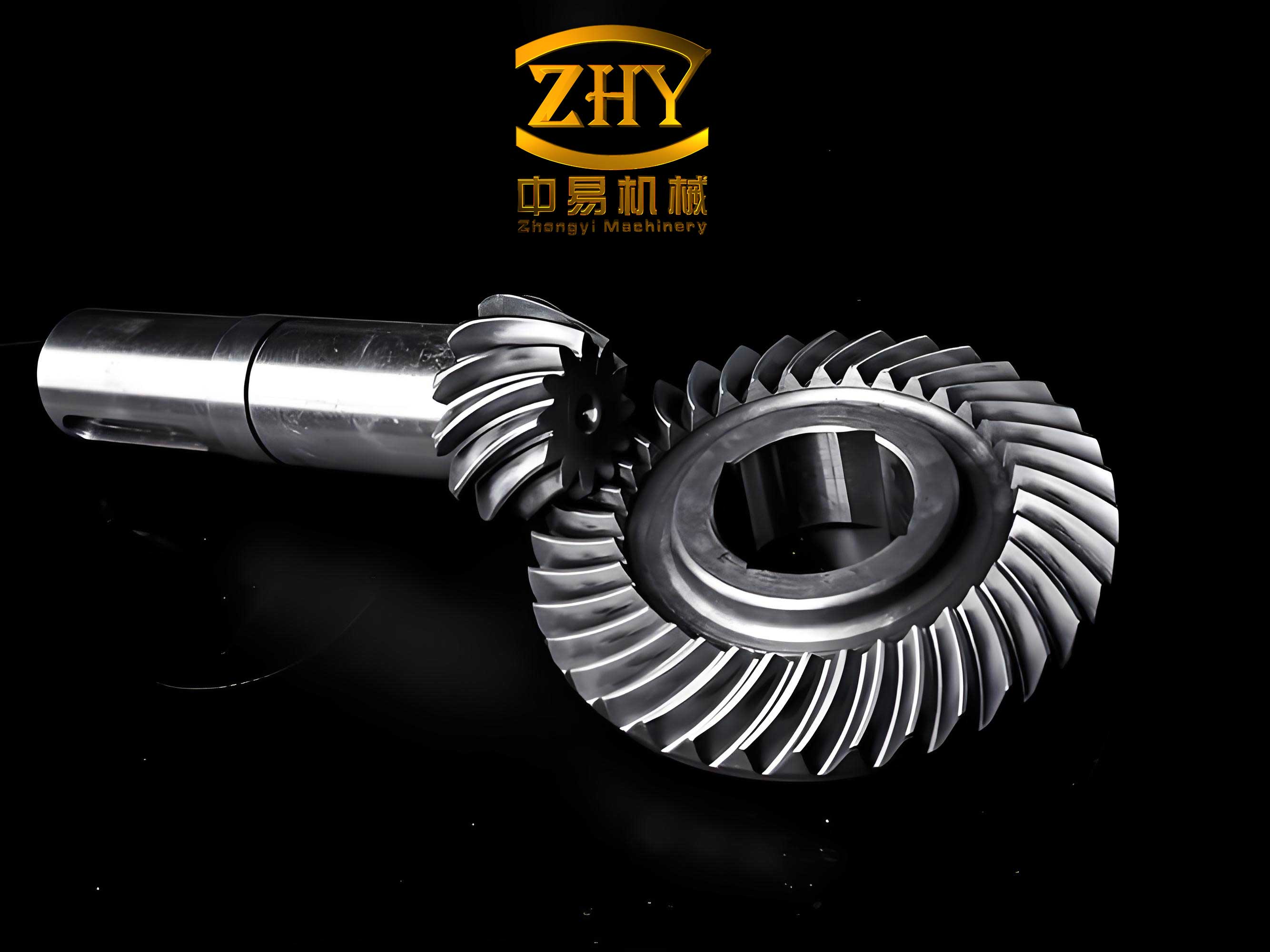
The design of advanced spiral bevel gears, including those optimized for high contact ratio, relies on precise control of the tooth surface topography. Slight alterations in machine tool settings during generation grinding or cutting translate into minute changes in the surface coordinates. To reliably predict the performance implications of these changes—such as shifts in the contact path, fluctuations in transmission error, and redistributions of stress—the underlying finite element model must be geometrically exact. The core of the proposed methodology is the direct computation of the finite element mesh nodes from the theoretical gear geometry. The mathematical model of the spiral bevel gear tooth surface is derived from the generating process. The surface of the generating tool (cutter head) is defined in its local coordinate system. Through a series of coordinate transformations governed by the machine-tool settings and the kinematic relationship between the cutter and the blank, the family of tool surfaces is enveloped to form the gear tooth surface in the workpiece coordinate system.
The mathematical foundation begins with the surface equation of the cutting tool, typically a cone for the straight-sided blade. A point on the cutter surface is defined by parameters $\mu$ and $\theta$:
$$ \mathbf{r}_c(\mu, \theta) = [x_c(\mu, \theta), y_c(\mu, \theta), z_c(\mu, \theta), 1]^T $$
The transformation from the cutter coordinate system $S_c$ to the gear blank coordinate system $S_g$ involves a sequence of rotations and translations representing the machine setup: cradle angle $\phi_c$, swivel angle $\gamma_m$, tilt angle $i$, and sliding base settings, among others. This is encapsulated in a homogeneous transformation matrix $\mathbf{M}_{cg}(\phi_c)$:
$$ \mathbf{r}_g(\mu, \theta, \phi_c) = \mathbf{M}_{cg}(\phi_c) \cdot \mathbf{r}_c(\mu, \theta) $$
This equation represents the family of surfaces. The specific member that belongs to the envelope (the actual gear tooth surface) is found by solving the equation of meshing, which states that the common normal vector at the contact point between the tool and the gear surface is perpendicular to their relative velocity:
$$ \mathbf{n}_g \cdot \mathbf{v}_g^{(cg)} = f(\mu, \theta, \phi_c) = 0 $$
Here, $\mathbf{n}_g$ is the unit normal vector of the surface in $S_g$, and $\mathbf{v}_g^{(cg)}$ is the relative velocity vector. Therefore, the spiral bevel gear tooth surface is defined by the system:
$$ \begin{cases}
\mathbf{r}_g = \mathbf{r}_g(\mu, \theta, \phi_c) \\
f(\mu, \theta, \phi_c) = 0
\end{cases} $$
This system is solved numerically. For a discrete set of $\phi_c$ values, the corresponding $(\mu, \theta)$ pairs satisfying $f=0$ are found, yielding discrete points $\mathbf{r}_g^{ij}$ on the gear tooth surface. This numerical generation forms the precise cloud of points from which the finite element nodes are derived.
The process of converting this point cloud into a ready-to-run finite element model is systematic and automated. A key advantage is the direct generation of the model in the solver-specific input file format (e.g., an ABAQUS .inp file), eliminating manual geometry handling. The steps are outlined below:
| Step | Description | Implementation |
|---|---|---|
| 1. Node Generation | Generate surface nodes from the solved $\mathbf{r}_g^{ij}$. Create internal nodes by interpolating or offsetting from the surface to form a solid layer structure. | Algorithmically compute 3D coordinates for all nodes. Assign unique, consecutive integer IDs. |
| 2. Element Connectivity | Connect nodes to form 8-node hexahedral (brick) elements (e.g., C3D8R). | Define each element by a list of 8 node IDs, following a consistent ordering (e.g., right-hand rule). |
| 3. Gear Assembly | Position the pinion and gear in their correct meshing orientation based on tooth contact analysis (TCA). | Use TCA to find the reference meshing position (e.g., entry point). Apply the calculated rotation angles $\varphi_1$ and $\varphi_2$ to the pinion and gear node coordinates via transformation matrices. |
| 4. Input File Creation | Write the assembled model data (nodes, elements) into the solver input file according to its syntax. | Structure the file with *NODE and *ELEMENT sections. Define element type and material section properties. |
This method ensures that the finite element mesh of the spiral bevel gear is a direct, high-fidelity discretization of the theoretical tooth surface, with micron-level accuracy. The assembly is also mathematically exact, removing any “slop” or interference that might occur in a manual CAD assembly process. To illustrate the application and validation of this high-precision modeling technique, a case study involving high contact ratio spiral bevel gears is presented. High contact ratio in spiral bevel gears is achieved by intentionally tilting the contact path across the tooth face. This is done by modifying the pinion tooth surface geometry while keeping the gear geometry constant. The tilt is controlled by the “contact path inclination angle.” Three different designs were analyzed, with basic parameters held constant except for the pinion machine settings.
| Basic Parameter | Value |
|---|---|
| Module | 7 mm |
| Number of Gear Teeth | 27 |
| Number of Pinion Teeth | 18 |
| Mean Spiral Angle | 35° |
| Pressure Angle | 20° |
The pinion modifications resulted in contact paths with nominal inclination angles of 20°, 50°, and 80° relative to the root line. The theoretical contact ratio increases significantly with a more tilted path (smaller inclination angle). Transmission error curves from TCA clearly show the transition from a predominantly two-tooth contact zone to pronounced three-tooth contact zones as the inclination angle decreases.
For the finite element analysis, a multi-tooth segment model (e.g., five teeth) is typically generated for both the pinion and gear. The model setup within the solver environment is crucial for obtaining accurate dynamic contact results. A dynamic explicit solution procedure is often preferred for complex contact problems due to its robustness. The key settings are summarized as follows:
| Category | Setting | Rationale |
|---|---|---|
| Element Type | 8-node linear brick, reduced integration (C3D8R) | Efficient for large deformation contact analysis; hourglass control is activated. |
| Material | Steel: E = 206 GPa, ν = 0.3, ρ = 7800 kg/m³ | Standard material properties for gear steel. |
| Contact Definition | Surface-to-surface contact; “Hard” normal behavior; Frictionless or small friction. | Accurately models non-penetration and pressure transmission between tooth flanks. |
| Constraints | Coupling of gear bores to reference points located on their axes. | Applies loads and boundary conditions to rigid body motions correctly. |
| Boundary Conditions | Pinion RP: Free rotation about its axis, all other DOFs fixed. Gear RP: Free rotation about its axis, all other DOFs fixed. | Simulates the realistic mounting of the spiral bevel gear pair. |
| Loads | Pinion: Applied angular velocity (smoothed step). Gear: Applied resistive torque (smoothed step). | Simulates a motor-driven pinion driving a loaded gear. Smoothing aids dynamic stability. |
| Analysis Step | Dynamic, Explicit | Solves the equations of motion directly; well-suited for complex, changing contact conditions. |
The analysis yields detailed time-history data. A snapshot of the Mises stress distribution clearly visualizes the state of multi-tooth contact in the high contact ratio spiral bevel gear design. The contact ellipses move across the face width as the gears rotate, and the stress concentrations follow this path. One of the primary benefits of a high contact ratio design for spiral bevel gears is the reduction and smoothing of load sharing. The finite element results quantitatively demonstrate this. By extracting the contact force or pressure over a full mesh cycle for each design, the load distribution can be compared.
The following table contrasts the peak contact pressure and the nature of the load-sharing curve for the three spiral bevel gear designs:
| Contact Path Inclination Angle | Approx. Contact Ratio | Peak Contact Pressure (FEA) | Load Sharing Characteristic |
|---|---|---|---|
| 80° | ~1.25 | Maximum (Reference) | Pronounced transitions between 2 and 1-tooth contact; steep load spikes. |
| 50° | ~1.75 | Reduced by ~8-12% | Smoother transitions; load is shared more evenly between 2-3 teeth. |
| 20° | >2.0 | Reduced by ~15-20% | Very smooth curve; extended periods of 3-tooth contact significantly lower peak pressure. |
The bending stress at the root fillet is another critical performance metric. The high-precision finite element model allows for the extraction of stress time histories at specific nodes corresponding to the location of experimental strain gauges. In parallel, physical tests were conducted on the same spiral bevel gear designs using a back-to-back test rig. Strain gauges were mounted at the midpoint of the gear tooth root on the convex side. The comparison between the FEA-predicted bending stress history and the experimentally measured strain signal (converted to stress) for the gear with a 20° inclination angle shows remarkable agreement in both the waveform shape and the absolute stress levels. The characteristic “M”-shaped curve, indicating the load passing through the tooth, is captured accurately by the simulation.
| Design (Inclination Angle) | Experimental Peak Stress (MPa) | FEA Peak Stress (MPa) | Deviation |
|---|---|---|---|
| 20° | ~125 | 126.1 | < 1% |
| 50° | ~102 | 100.8 | ~1-2% |
| 80° | ~85 | 83.3 | ~2% |
The validation extends to the contact pattern, a critical visual indicator of spiral bevel gear mesh quality. The finite element analysis provides the coordinates of all nodes in contact (where contact pressure > 0) throughout a meshing cycle. By aggregating these points and projecting them onto the plane of rotation, the simulated contact pattern is obtained. This is compared directly with the contact pattern observed in the static roll test of the physical gear pair, where a marking compound is used. For all three spiral bevel gear designs, the FEA-predicted contact pattern—its location, orientation, length, and shape—closely matches the experimental pattern. The simulation correctly predicts the increased length and more central, oval shape of the contact path as the inclination angle decreases, confirming its ability to model the effects of micro-geometric modifications.
In conclusion, the high-precision finite element modeling methodology presented herein, which directly generates the mesh from the mathematical definition of the spiral bevel gear tooth surface, is proven to be exceptionally accurate and reliable. It successfully bridges the gap between theoretical gear design—where modifications are often in the micron range—and predictive performance analysis. The method was rigorously validated against experimental data for high contact ratio spiral bevel gears, showing excellent agreement in bending stress history, contact stress distribution, and contact pattern geometry. This approach provides engineers with a powerful virtual prototyping tool. It enables the detailed exploration of design variants for spiral bevel gears, such as those optimized for low noise, high durability, or specialized load conditions, with confidence that the simulation results reflect the true, micro-scale geometry of the gear teeth. This capability is invaluable for advancing the development of high-performance transmission systems in aerospace, maritime, and other demanding applications.
The governing equations for the spiral bevel gear tooth surface, central to this high-fidelity modeling, can be expanded. The transformation matrix $\mathbf{M}_{cg}(\phi_c)$ is a product of matrices representing rotations ($\theta$, $\phi$, $\gamma$) and translations ($\Delta X$, $\Delta Y$, $\Delta Z$) specific to the generator machine (e.g., Gleason or Klingelnberg systems):
$$ \mathbf{M}_{cg}(\phi_c) = \mathbf{T}_Z(\Delta Z) \cdot \mathbf{R}_Y(\gamma) \cdot \mathbf{T}_X(\Delta X) \cdot \mathbf{R}_Z(\phi_c) \cdot \mathbf{T}_Y(\Delta Y) \cdot \mathbf{R}_X(\theta) \cdot \mathbf{M}_{cs} $$
where $\mathbf{M}_{cs}$ is the fixed transformation from the cutter to the cradle. The equation of meshing for a generated spiral bevel gear can be expressed more specifically. The relative velocity is derived from the kinematic chain. A common form is:
$$ f(\mu, \theta, \phi_c) = \left( \frac{\partial \mathbf{r}_g}{\partial \mu} \times \frac{\partial \mathbf{r}_g}{\partial \theta} \right) \cdot \left( \boldsymbol{\omega}^{(cg)} \times \mathbf{r}_g + \mathbf{V}^{(cg)} \right) = 0 $$
Here, $\boldsymbol{\omega}^{(cg)}$ and $\mathbf{V}^{(cg)}$ are the relative angular velocity and linear velocity of the cutter relative to the gear blank, respectively. These are functions of the cradle angular velocity $d\phi_c/dt$, the gear ratio, and the machine geometry. Solving this system numerically for each parameter line defines the exact spiral bevel gear tooth surface grid $\mathbf{r}_g^{ij}$.
For the finite element analysis of contact, the explicit dynamics formulation solves the equation of motion at time step $n$:
$$ \mathbf{M} \ddot{\mathbf{u}}^n = \mathbf{F}_{ext}^n – \mathbf{F}_{int}^n $$
where $\mathbf{M}$ is the diagonal mass matrix, $\ddot{\mathbf{u}}^n$ is the nodal acceleration vector, $\mathbf{F}_{ext}^n$ is the applied external force vector (including contact forces from other surfaces), and $\mathbf{F}_{int}^n$ is the internal force vector arising from element stresses. The central difference method is used for time integration. The stable time increment $\Delta t$ is limited by the Courant condition:
$$ \Delta t \le \frac{L_{min}}{c_d} $$
where $L_{min}$ is the smallest element dimension in the mesh and $c_d$ is the dilatational wave speed of the material, $c_d = \sqrt{\frac{E(1-\nu)}{\rho(1+\nu)(1-2\nu)}}$. The use of a mass scaling factor can increase $\Delta t$ for quasi-static analyses like gear meshing, improving computational efficiency while maintaining accuracy. The contact force $\mathbf{F}_{contact}$ between the pinion and gear tooth surfaces is computed using a penalty method in the explicit scheme. When a node on the slave surface penetrates the master surface by a distance $g$, a restoring force proportional to $g$ is applied:
$$ \mathbf{F}_{contact} = k_{penalty} \cdot g \cdot \mathbf{n} $$
where $k_{penalty}$ is the penalty stiffness (a function of the material and element stiffness) and $\mathbf{n}$ is the normal vector to the master surface. This algorithm is robust for the complex, changing contact conditions found in spiral bevel gear meshing.
The bending stress $\sigma_b$ at the root can be related to the applied torque $T$ and gear geometry through a simplified Lewis formula, though FEA provides a far more accurate distribution:
$$ \sigma_b \approx \frac{F_t}{b m_n Y} $$
where $F_t = \frac{2T}{d_m}$ is the tangential force at the mean diameter $d_m$, $b$ is the face width, $m_n$ is the normal module, and $Y$ is the Lewis form factor (highly complex for spiral bevel gears). The high-precision FEA directly computes the full stress tensor $\boldsymbol{\sigma}$ at each integration point, from which the von Mises stress $\sigma_{vm}$ or the maximum principal stress $\sigma_1$ (often critical for bending fatigue) can be derived:
$$ \sigma_{vm} = \sqrt{\frac{(\sigma_{11}-\sigma_{22})^2 + (\sigma_{22}-\sigma_{33})^2 + (\sigma_{33}-\sigma_{11})^2 + 6(\sigma_{12}^2+\sigma_{23}^2+\sigma_{31}^2)}{2}} $$
$$ \sigma_1 = \max(\lambda_i), \quad \text{where } \lambda_i \text{ are eigenvalues of } \boldsymbol{\sigma} $$
The contact pressure $p_0$ at the center of the theoretical Hertzian contact ellipse for spiral bevel gears can be estimated by:
$$ p_0 = \frac{3F_n}{2\pi a b} $$
where $F_n$ is the normal contact force, and $a$ and $b$ are the semi-major and semi-minor axes of the contact ellipse, respectively. The radii of curvature and the angle between their principal directions, which determine $a$ and $b$, vary continuously along the path of contact for spiral bevel gears. The FEA inherently calculates the true pressure distribution, which deviates from the Hertzian ideal due to edge effects, finite face width, and the complex macro- and micro-geometry of the spiral bevel gear tooth.
The entire workflow, from gear design parameters to finite element results, underscores the synergy between advanced gear theory and computational mechanics. By ensuring the geometric integrity of the spiral bevel gear model at the micron level, this method allows for trustworthy predictions of performance gains from advanced tooth flank modifications. This is essential for industries pushing the boundaries of power density, efficiency, and reliability in geared transmissions. Future work may involve coupling this high-precision stress analysis with system-level dynamic models or integrating it with automated design optimization loops to rapidly converge on the optimal spiral bevel gear geometry for a given application.