
In the realm of mechanical power transmission, gear drives stand as one of the most critical and ubiquitous systems, prized for their compact design, high transmission efficiency, precise motion control, and long operational life. Among these, bevel gears, which facilitate power transmission between intersecting axes, hold a position of paramount importance across industries such as automotive, aerospace, and defense. Bevel gears are broadly categorized by their tooth line direction into straight and curved types. Straight bevel gears, which include both standard straight teeth and helical variants, are often the preferred choice for applications requiring simplicity and cost-effectiveness. A specific and highly common subset of straight bevel gears is the miter gear, defined as a pair of straight bevel gears with a 1:1 ratio and typically a 90-degree shaft angle. The efficient manufacturing of small-module miter gears presents a persistent industrial challenge, as traditional methods like gear planing are often characterized by low productivity and complex machine setup. This study addresses this challenge by developing and validating a high-speed hobbing-milling process for small-module straight bevel gears, leveraging a modified H120C CNC spiral bevel gear milling machine. The core innovation lies in adapting this machine for continuous generation hobbing using a carbide-tipped single-position hob, dramatically enhancing production rates while maintaining satisfactory geometrical accuracy for small-module miter gear applications.
The conventional machining landscape for straight bevel gears encompasses several methods, each with its own principles and limitations. Generative processes like gear planing and dual-cutter face milling are based on the principles of a planar or crown gear generating surface. In contrast, form-cutting methods, such as those employing a single-position hob, disk-type milling cutters, or finger-type milling cutters, create the tooth profile directly from the cutter’s form. For high-volume production of automotive differential gears, precision forging is common, while powder metallurgy or injection molding may be used for less demanding, high-volume small gears. However, the equipment and technology for straight bevel gears have evolved more slowly compared to their curved-tooth counterparts. Many existing dedicated machines rely on intricate mechanical linkages, necessitating tedious adjustments and resulting in suboptimal efficiency and precision. The pursuit of higher productivity has led to the exploration of CNC-based solutions. The method explored herein utilizes a single-position hob in a continuous indexing, form-cutting process. This approach is particularly suitable for small-module miter gears where the face width is less than 25% of the outer cone distance, as the inherent profile deviation from the theoretical involute at the toe of the tooth has a negligible impact on meshing performance.
The fundamental principle of hobbing small-module straight bevel gears with a single-position hob is a form-cutting, continuous indexing process. The hob, as shown in the following inserted figure, is a critical component. Its tooth profile is designed based on the developed tooth form of the gear’s back cone at the large end. Consequently, only the large-end tooth profile of the machined gear is a true involute; the profile at the small end is slightly fuller. For small-module gears, this deviation is acceptable within the specified face width constraint. The hob’s basic worm thread is limited to a single turn to avoid interference. Hobs are typically of the staggered-tooth design, with teeth arranged in opposing pairs (often 5 or 7 teeth total) that are axially offset by half the thread pitch. Each pair is responsible for cutting the left and right flanks of a tooth space simultaneously.
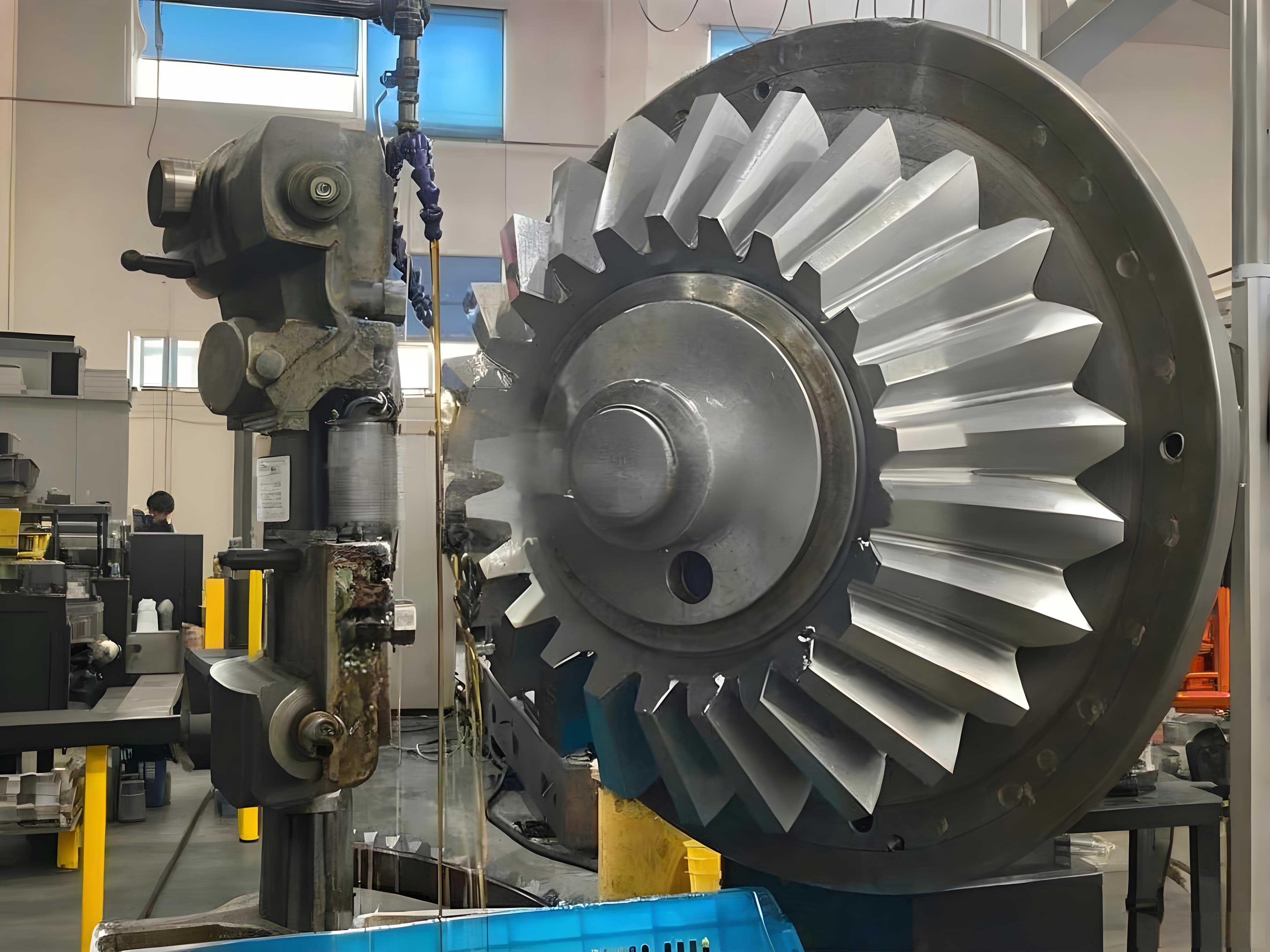
The determination of the hob’s cutting edge profile generally follows two paths: the circular-arc approximation method or the precise conjugate profile method based on the developed back-cone geometry. Given the complexity of precise design and grinding, the circular-arc approximation is predominantly used in practice for small-module gears, offering a favorable balance between accuracy and manufacturability. The kinematic relationship during machining is straightforward yet efficient: the hob rotates continuously at a high speed, while the workpiece rotates synchronously at a ratio defined by the hob’s number of starts and the gear’s tooth count. This continuous rotation eliminates the non-cutting time associated with tool retraction and indexing in traditional planing, constituting the primary source of efficiency gain. The relationship between hob rotation and workpiece rotation for a single-start hob is given by the fundamental indexing equation:
$$ N_w = \frac{N_h}{Z} $$
where \( N_w \) is the workpiece speed (rpm), \( N_h \) is the hob speed (rpm), and \( Z \) is the number of teeth on the workpiece miter gear. The toolpath involves two primary linear motions relative to the workpiece: first, an infeed motion perpendicular to the pitch cone element to reach full tooth depth at the large end, and second, a generating motion along the pitch cone element to complete the tooth face width. This path ensures proper clearance and form generation across the entire tooth flank of the miter gear.
The successful implementation of this process hinges on a versatile and precise machine tool. The H120C CNC spiral bevel gear milling machine serves as the platform for this development. This is a 6-axis, 5-axis simultaneous CNC machine, comprising three linear axes (X, Y, Z) and three rotary axes (A, B, C). The workpiece is mounted on the A-axis, the tool on the C-axis, and the B-axis adjusts the angle between the workpiece and tool axes. Its original design purpose was the efficient machining of small-module spiral bevel and hypoid gears. The machine’s specifications, which make it suitable for adapting to straight bevel gear hobbing, are summarized in the table below.
| Parameter Category | Parameter Name | Value |
|---|---|---|
| Workpiece Capacity | Maximum Gear Outer Diameter | 120 mm |
| Maximum Module | 4 mm | |
| Maximum Face Width | 30 mm | |
| Maximum Whole Depth | 10 mm | |
| Workpiece Capacity | Number of Teeth Range | 1 – 200 |
| Tool Capacity | Maximum Tool Diameter | 101.6 mm |
| Minimum Tool Diameter | 25.4 mm | |
| Axis Travel Range | X-axis | -210 to +210 mm |
| Y-axis | -100 to +45 mm | |
| Z-axis | -25 to +240 mm | |
| B-axis | -95° to +95° | |
| Spindle Speed Range | A-axis (Workpiece) | 0 – 200 rpm |
| C-axis (Tool) | 0 – 3500 rpm |
To adapt this machine for miter gear hobbing, a dedicated CNC program was developed. This program calculates the necessary coordinated motions based on input parameters such as gear geometry, hob data, and fixture offsets. The mathematical model governing the tool center position (TCP) relative to the workpiece coordinate system is crucial. For a straight bevel gear, the pitch cone angle \( \delta \) is a key parameter. For a miter gear pair with a 90-degree shaft angle and equal numbers of teeth, \( \delta = 45^\circ \). The relationship between the machine coordinates and the gear parameters during the linear feed motions can be described. The first infeed motion (from point 1 to point 2 in the process diagram) is along a direction perpendicular to the pitch cone element. If we define a coordinate system attached to the gear blank with its origin at the cone apex, the tool path must compensate for the cone angle. The second motion (from point 2 to point 3) is along the pitch cone element to generate the face width. The total length of this motion \( L_f \) relates to the face width \( F \) and pitch cone angle:
$$ L_f = \frac{F}{\cos(\delta)} $$
The machine’s X, Y, Z, and B axes movements are interpolated to achieve this compound path while the A and C axes maintain the continuous synchronized rotation. The CNC program automates the calculation of these paths, enabling the efficient production of miter gears.
Prior to physical machining, a comprehensive virtual machining and simulation phase was conducted using Vericut software to verify the feasibility of the process and the correctness of the post-processed CNC code. The simulation development workflow involved several systematic steps: constructing the digital twin of the H120C machine, modeling the hob and workpiece, configuring the control system, importing the NC program, and finally executing the virtual machining cycle. The three-dimensional models of all machine components, the hob assembly, and the gear blank were created in CAD software and imported into Vericut. The kinematic chain and topology of the machine axes were meticulously defined to mirror the actual machine’s behavior. The hob model was carefully set up in the tool library, including its geometry, reference points, and holder dimensions. A critical aspect was ensuring the correct alignment of the hob’s axis relative to the workpiece axis, which is set by the B-axis angle to be equal to the root angle of the gear \( \delta_f \). For a standard miter gear, this is typically very close to the pitch angle.
The virtual machining environment allowed for the simulation of the entire cutting process. Collision detection between all machine components, the hob, and the fixture was continuously monitored. Any interference or programming error could be identified and corrected in this risk-free virtual space, significantly reducing development time and cost. The simulation confirmed that the coordinated motions—the simultaneous rotation of the C-axis (hob) and A-axis (workpiece) coupled with the linear feeds of the X, Y, and Z axes—correctly generated the tooth spaces of a straight bevel gear. The simulation results provided visual confirmation of the material removal process and the final gear form, validating the underlying mathematical model and post-processing algorithms before any metal was cut. This step is indispensable for developing a reliable process for manufacturing precision miter gears.
Following the successful simulation, physical machining trials were conducted on the H120C machine to validate the process empirically. A pair of small-module straight bevel gears, functioning as a miter gear pair, was selected for testing. The basic gear parameters are summarized in the following table.
| Parameter | Pinion | Gear (Wheel) |
|---|---|---|
| Number of Teeth (Z) | 37 | 74 |
| Module (m) – at large end | 0.5 mm | |
| Pressure Angle (α) | 20° | |
| Shaft Angle (Σ) | 90° | |
| Face Width (F) | 5 mm | |
| Pitch Cone Angle (δ) | ~45° | ~45° |
A carbide-tipped, staggered-tooth single-position hob with a diameter of 25.4 mm and a nominal helix angle of 1° was used. The cutting parameters were set with a hob rotational speed (C-axis) of 1500 rpm. The corresponding workpiece speed (A-axis) for the gear with 74 teeth was calculated as:
$$ N_{w\text{(gear)}} = \frac{1500}{74} \approx 20.27 \text{ rpm} $$
And for the 37-tooth pinion:
$$ N_{w\text{(pinion)}} = \frac{1500}{37} \approx 40.54 \text{ rpm} $$
The machining cycle included the two-stage linear feed as described. The actual cutting time for each gear was recorded. For performance benchmarking, the same gear pair was machined on a conventional mechanical gear planing machine, the HARBECK 12H. The machining time comparison reveals the dramatic efficiency improvement offered by the high-speed hobbing process on the CNC platform.
| Machine Tool | Machining Time per Gear (minutes) | |
|---|---|---|
| Gear (74 teeth) | Pinion (37 teeth) | |
| H120C (Hobbing-Milling) | 6 | 6 |
| HARBECK 12H (Planing) | 60 | 45 |
The results show that the hobbing-milling process reduced machining time to merely 10% (for the gear) and approximately 13.3% (for the pinion) of the time required by traditional planing. This order-of-magnitude reduction in cycle time is a transformative advantage for the batch production of small-module miter gears.
To assess the geometrical accuracy of the machined gears, both the pinion and gear were inspected on a precision gear measurement center (L65G model). The key evaluation criteria were single pitch deviation \( f_p \), cumulative pitch deviation \( F_p \), and tooth flank form error relative to the theoretical profile. The theoretical profile for a straight bevel gear is derived from its basic geometry and the law of gearing in a spatial coordinate system. The inspection involved scanning the actual tooth flanks and comparing them to the digital nominal model. The pitch accuracy results demonstrated that both gears achieved a level of DIN 4, which is considered very good for gears of this size and application. The form error analysis showed that the maximum deviation between the actual tooth surface and the theoretical surface was within a tight tolerance band. The results are quantified below.
| Gear | Single Pitch Deviation \( f_p \) (max, μm) | Cumulative Pitch Deviation \( F_p \) (μm) | Tooth Flank Form Error (max absolute value, μm) |
|---|---|---|---|
| Gear (Wheel) | Below DIN 4 limit | Below DIN 4 limit | 5.4 |
| Pinion | Below DIN 4 limit | Below DIN 4 limit | 7.4 |
The form error is attributed primarily to the inherent approximation of the hob’s circular-arc profile and minor dynamic effects during cutting. Nevertheless, these errors are well within acceptable limits for the functional performance of small-module miter gears in many applications. Subsequent assembly and operational testing in the customer’s intended application confirmed that the gears performed satisfactorily, meeting all functional requirements for noise, vibration, and torque transmission. This practical validation underscores the viability of the high-speed hobbing process as a replacement for slower traditional methods in the production of miter gears.
The development and implementation of this process involve several deeper technical considerations. The design of the single-position hob is paramount. The hob’s profile is calculated based on the geometry of the gear at the large end. For a standard involute straight bevel gear, the tooth profile on the back-cone development is an involute. The coordinates of points on this involute can be expressed parametrically. Using the radius of the back cone \( R_b \) and the base circle radius \( r_b \) of the equivalent spur gear, the involute equations are:
$$ x = r_b (\cos \theta + \theta \sin \theta) $$
$$ y = r_b (\sin \theta – \theta \cos \theta) $$
where \( \theta \) is the roll angle. The back-cone radius for a gear with pitch radius \( R \) and pitch angle \( \delta \) is:
$$ R_b = \frac{R}{\cos \delta} = \frac{m Z}{2 \cos \delta} $$
For a miter gear with \( \delta = 45^\circ \), this simplifies to \( R_b = \frac{m Z}{\sqrt{2}} \). The hob profile is then derived from this curve, often approximated by circular arcs to facilitate grinding. The machine kinematics require precise coordination. The relationship between the angular positions of the hob (C-axis) and the workpiece (A-axis) must be maintained synchronously throughout the cut, which is governed by the electronic gearing function of the CNC system. The linear axes (X, Y, Z) must move in a coordinated fashion to follow the prescribed toolpath. The position of the tool center point (TCP) in the workpiece coordinate system during the generating motion (along the pitch cone) can be modeled. If we define a parameter \( s \) representing the distance along the pitch cone element from the large end, the coordinates of a point on the pitch cone surface are:
$$ X_w = (R – s \sin \delta) \cos \phi $$
$$ Y_w = (R – s \sin \delta) \sin \phi $$
$$ Z_w = s \cos \delta $$
where \( \phi \) is the rotational position angle of the workpiece. The tool center must be offset from this surface by the tool radius and the required clearance. This involves transformations between the workpiece coordinate system and the machine coordinate system, which includes the B-axis tilt. The transformation matrix accounting for the B-axis rotation is essential for accurate path calculation. Let \( T_{machine} \) be the homogeneous transformation matrix from the workpiece coordinate system to the machine base. It incorporates the B-axis rotation \( \beta \) (set equal to the root angle \( \delta_f \)), and the positions of the linear axes:
$$ T_{machine} = Trans(X, Y, Z) \cdot Rot(B, \beta) $$
The tool path in machine coordinates is then computed by applying this transformation to the desired TCP path in workpiece coordinates. This mathematical framework ensures the CNC program generates the correct commands for producing an accurate miter gear.
Furthermore, the process economics and flexibility are noteworthy. The use of a standard CNC spiral bevel gear milling machine for this application increases its utilization and provides manufacturers with a multi-capability platform. The quick changeover between spiral bevel gear cutting and straight bevel gear hobbing is managed primarily through software and tooling change, enhancing operational flexibility. For job shops or industries with mixed production needs, such as those producing various types of small power transmission gears including miter gears, this is a significant advantage. The reduction in machining time directly translates to lower cost per part, higher throughput, and reduced energy consumption per gear. When considering the total cost of ownership, the ability to use hard, wear-resistant carbide hobs at high cutting speeds further extends tool life and maintains consistent quality over larger batch sizes, which is critical for the economic production of miter gears.
In conclusion, this study successfully developed and demonstrated a high-speed hobbing-milling process for small-module straight bevel gears on a modified H120C CNC spiral bevel gear milling machine. The process leverages a carbide-tipped single-position hob and continuous indexing to achieve a dramatic reduction in machining time—to just 10-13.3% of that required by conventional planing—while maintaining geometrical accuracy sufficient for demanding applications, as evidenced by DIN 4 grade pitch accuracy and tooth flank form errors below 7.5 μm. The integration of virtual machining simulation via Vericut provided a robust platform for validating the CNC program and process kinematics prior to physical trials, mitigating risk and accelerating development. This approach effectively addresses the longstanding challenge of low productivity in small-module straight bevel gear manufacturing, offering a compelling, efficient, and precise alternative for the production of miter gears and other straight bevel gear types. The adaptability of standard CNC gear milling machines for this purpose opens new avenues for flexible, high-performance gear production, promising significant benefits for industries reliant on high-quality, cost-effective bevel gear drives.