
In modern mechanical engineering, the demand for high-performance gear systems has driven significant advancements in manufacturing technologies. Among these, spiral bevel gears are critical components in power transmission systems, especially in automotive, aerospace, and industrial machinery. Their complex geometry and high load-bearing requirements necessitate precise and efficient machining processes. We explore the integration of high-speed cutting (HSC) technology with computerized simulation for the hard-tooth-surface finishing of formate spiral bevel gears, aiming to enhance productivity and reduce costs.
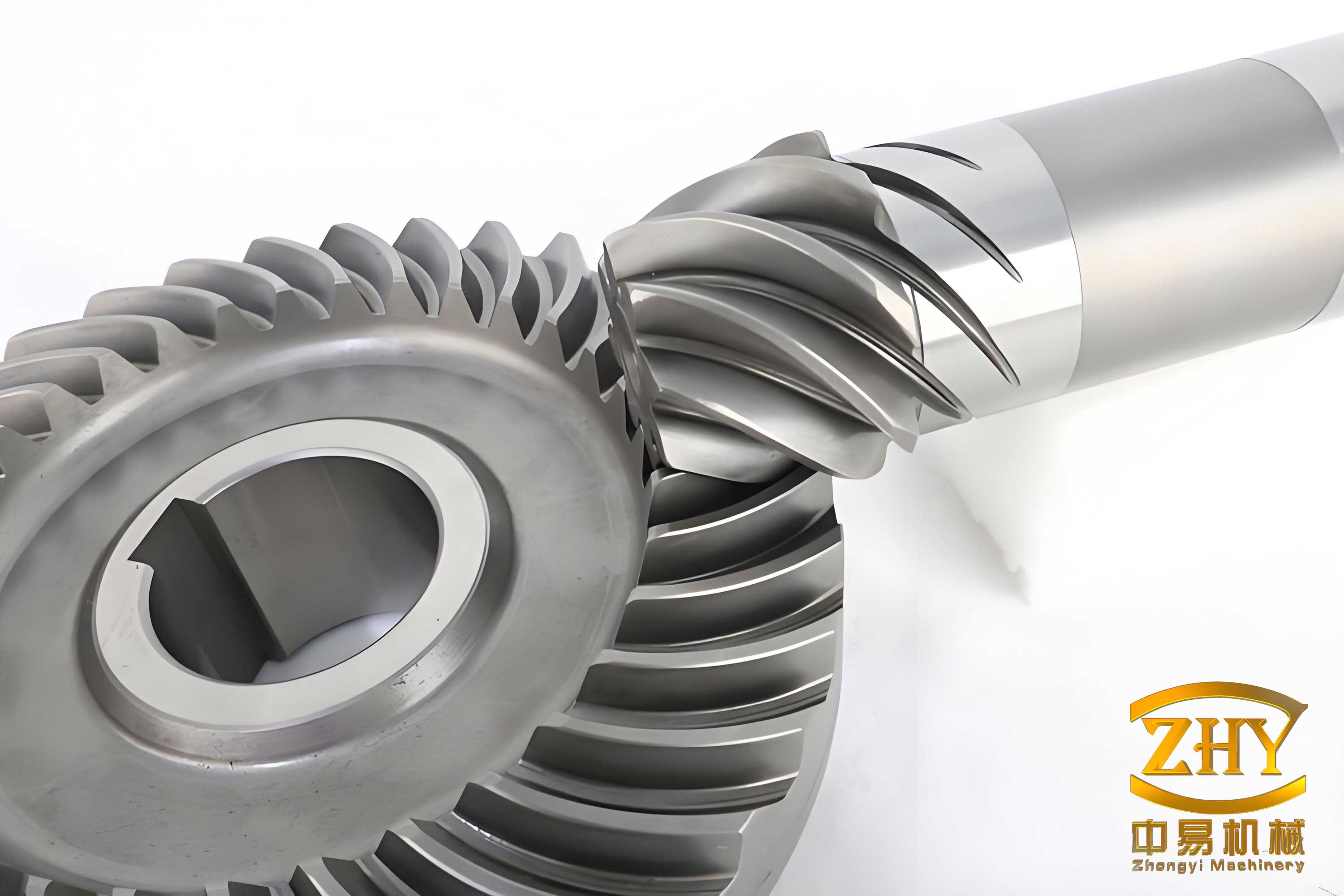
The concept of high-speed cutting, introduced in the 1930s, has evolved into a practical manufacturing solution, offering benefits such as increased productivity, reduced cutting forces, improved accuracy, and the ability to machine hardened materials. For mass-produced spiral bevel gears, particularly the formate gear (the larger gear in a pair), post-heat-treatment grinding is often inefficient due to the large number of teeth and straight flank profiles. We propose that high-speed milling with appropriate form cutters on universal vertical machining centers can replace grinding, providing a viable alternative for hard-tooth-surface finishing.
To achieve this, we employ the Local Synthesis Method for designing machining parameters, which allows precise control over gear meshing characteristics. This method, combined with computer-aided simulation, enables virtual tooth cutting and three-dimensional modeling of spiral bevel gears before physical machining. Such an approach facilitates early detection of tooth anomalies, measurement of tooth dimensions, and optimization of cutter specifications, laying the groundwork for finite element analysis. In this article, we detail the feasibility analysis, parameter design, simulation techniques, and implementation strategies, emphasizing the repeated importance of spiral bevel gears in advanced manufacturing.
Feasibility Analysis of High-Speed Milling for Hardened Spiral Bevel Gears
High-speed milling of hardened spiral bevel gears requires careful consideration of machine tools, cutting tools, and surface integrity. Traditional grinding of heat-treated gears relies on specialized equipment, which is costly and often imported. In contrast, high-speed machining centers, with capabilities such as high spindle speeds (e.g., 10,000–100,000 rpm), rapid feed rates, and advanced CNC controls, can be adapted for gear milling using custom fixtures. The key lies in selecting suitable tool materials and optimizing cutting conditions to ensure surface quality comparable to grinding.
For spiral bevel gears, common materials include alloy steels like 20CrMo or 20CrMnTi, which after carburizing and quenching, achieve hardness of 60–62 HRC with a case depth of 0.2–0.3 times the module. In grinding, depths of cut are typically 0.1–0.2 mm; similarly, in high-speed milling, shallow cuts of 0.1–0.15 mm are feasible, minimizing thermal effects and deformation. We analyze three critical aspects: tool selection, surface roughness, residual stresses, and work hardening.
Tool Material Selection
Tool materials for high-speed milling of hardened steels must exhibit high hardness, toughness, wear resistance, and thermal stability. Based on industry practices, we compare common options in the context of spiral bevel gears:
| Tool Material | Hardness (HV) | Suitable for Hardness (HRC) | Advantages for Spiral Bevel Gears |
|---|---|---|---|
| Coated Carbide | ~1500–2000 | Up to 50 | Cost-effective for small batches |
| Al2O3-Based Ceramics (e.g., SG-4) | ~2000–2500 | 58–65 | Good for speeds of 100–150 m/min; affordable |
| PCBN (Polycrystalline Cubic Boron Nitride) | ~3000–5000 | > 45 | Excellent for hardened steels; superior wear resistance |
| PCD (Polycrystalline Diamond) | ~10000 | Not suitable for ferrous metals | Used for non-ferrous materials |
For spiral bevel gears, Al2O3-based ceramics or PCBN are recommended. Ceramic tools offer a balance of performance and cost, while PCBN excels in high-volume production due to its durability. The brittle nature of PCBN necessitates small depths of cut, aligning with our requirements for spiral bevel gears.
Surface Quality Assessment
Surface quality after high-speed milling is paramount for gear performance. We evaluate key parameters using empirical data from machining hardened steels with ceramic and PCBN tools.
Surface Roughness: Experiments show that with cutting speeds of 120–150 m/min, axial depths of 0.5 mm, and feed per tooth of 0.1 mm, surface roughness (Ra) ranges from 0.12 to 0.16 μm. At higher speeds (400–600 m/min), Ra improves to 0.06–0.12 μm, comparable to grinding. For spiral bevel gears with reduced depths of 0.1–0.15 mm, further optimization can achieve Ra < 0.1 μm, meeting precision standards.
Residual Stresses: Residual stresses influence fatigue life. Ceramic tools typically induce compressive stresses on the workpiece surface, beneficial for gears. For PCBN tools with negative rake angles, compressive stresses dominate at shallow cuts. The minimal heat input in high-speed milling helps maintain favorable stress profiles for spiral bevel gears.
Work Hardening: The hardened substrate of spiral bevel gears (60–62 HRC) limits additional hardening. With controlled cutting parameters, the increase in hardness is negligible, ensuring dimensional stability.
Thus, high-speed milling of spiral bevel gears is feasible, offering surface quality akin to grinding while reducing dependency on specialized gear grinders.
Local Synthesis Method for Machining Parameter Design
The Local Synthesis Method, pioneered by Litvin, enables precise design of machining parameters for spiral bevel gears by controlling contact conditions at a reference point on the tooth surface. This method is crucial for optimizing the meshing performance of spiral bevel gears before actual cutting. We outline the mathematical framework and implementation steps.
Mathematical Foundation
For a pair of spiral bevel gears, the tooth surface equations are derived from machine tool settings and cutter geometry. Let the gear surfaces be represented parametrically. The Local Synthesis Method involves specifying at a reference point M on the pinion (small gear) tooth surface: the tangent direction of the contact path (η2), the rate of change of transmission ratio (m′21), and the semi-major axis length (a) of the instantaneous contact ellipse. From these, principal curvatures and directions are computed using differential geometry.
Define the position vector of a point on the gear tooth surface as r(u, θ), where u and θ are surface parameters. The unit normal vector is n(u, θ). The fundamental forms of the surface are:
$$I = d\textbf{r} \cdot d\textbf{r} = E du^2 + 2F du d\theta + G d\theta^2$$
$$II = -d\textbf{r} \cdot d\textbf{n} = L du^2 + 2M du d\theta + N d\theta^2$$
where E, F, G and L, M, N are coefficients of the first and second fundamental forms, respectively. The principal curvatures κ1 and κ2 are solutions of:
$$(EG – F^2)\kappa^2 – (EN – 2FM + GL)\kappa + (LN – M^2) = 0$$
For the reference point M on the spiral bevel gear, given the desired contact ellipse length a and transmission error coefficients, the relative curvature parameters are derived. The relationship between principal curvatures of pinion and gear is expressed as:
$$\kappa_{g}^{(1)} + \kappa_{g}^{(2)} = \kappa_{p}^{(1)} + \kappa_{p}^{(2)} + 2m’_{21} \sin^2 \alpha$$
where subscripts g and p denote gear and pinion, α is the pressure angle, and m′21 is the second derivative of transmission ratio. This equation ensures controlled contact patterns for spiral bevel gears.
Step-by-Step Procedure
- Determine gear blank data: Specify geometric parameters for the spiral bevel gear pair.
- Calculate machining parameters for the formate gear (large gear): Use conventional face-milling or formate methods to derive initial settings.
- Select reference point M: Typically at the mid-point of the tooth surface.
- Compute principal curvatures at M for the gear: Based on cutter geometry and machine settings.
- Specify design parameters: Set η2, m′21, and a to define contact behavior.
- Solve for pinion principal curvatures: Using the Local Synthesis equations.
- Derive pinion machining parameters: Adjust machine tool settings (e.g., cutter tilt, swivel angles) to achieve computed curvatures.
This method allows pre-control of contact zone location and size, reducing trial-and-error in manufacturing spiral bevel gears. Table 1 summarizes example blank data for a hypoid gear pair (a type of spiral bevel gear), and Table 2 shows resulting machining parameters.
| Parameter | Pinion (Small Gear) | Gear (Large Gear) |
|---|---|---|
| Number of Teeth | 7 | 43 |
| Pitch Diameter (mm) | — | 295.02 |
| Offset Distance (mm) | 25.4 | — |
| Face Width (mm) | 41 | 41 |
| Mean Spiral Angle (°) | 45 | — |
| Hand of Spiral | Left | Right |
| Shaft Angle (°) | 90 | 90 |
| Mean Pressure Angle (°) | 22.5 | 22.5 |
| Setting | Gear (Formate) | Pinion (Concave Flank) | Pinion (Convex Flank) |
|---|---|---|---|
| Cutter Diameter (mm) | 304.8 | 303.5 | 306.5 |
| Blade Angle (Inner/Outer) (°) | -22.5 / 22.5 | -33 / 12 | 14 / -31 |
| Machine Root Angle (°) | 75.00 | -2.720 | -4.271 |
| Vertical Cutter Position (mm) | 124.861 | -128.889 | -132.792 |
| Horizontal Cutter Position (mm) | 49.372 | 6.776 | 26.560 |
| Ratio of Roll | 1.00626 | 5.83269 | 6.25558 |
| Workpiece Offset (mm) | 0.333 | -3.035 | 4.427 |
These parameters ensure optimal contact for spiral bevel gears, minimizing noise and maximizing load capacity.
Computerized Tooth Cutting Simulation and 3D Modeling
With machining parameters from the Local Synthesis Method, we generate tooth surface equations for spiral bevel gears and perform computer simulations. This virtual prototyping allows inspection of tooth geometry before physical machining, saving time and cost.
Tooth Surface Equation Derivation
The tooth surface of a spiral bevel gear is generated by the envelope of cutter surfaces relative to the workpiece. For a formate gear with a circular cutter, the surface equation in machine coordinate system is:
$$\textbf{R}_g(u, \phi) = \textbf{M}_{gc}(\phi) \cdot \textbf{r}_c(u)$$
where rc(u) is the cutter profile vector, φ is the rotation angle, and Mgc(φ) is the transformation matrix incorporating machine settings like tilt and swivel. For a pinion cut by a hypothetical generating gear, the equation becomes:
$$\textbf{R}_p(u, \theta, \psi) = \textbf{M}_{pg}(\psi) \cdot \textbf{M}_{gc}(\theta) \cdot \textbf{r}_c(u)$$
Here, ψ and θ are motion parameters related to gear rotation and cutter feed. These equations are solved numerically to define discrete points on the tooth surfaces of spiral bevel gears.
Simulation Workflow
- Point Cloud Generation: Compute surface points using the above equations with boundary conditions (e.g., tip, root, heel, toe).
- Surface Fitting: Use B-spline or NURBS interpolation to create smooth tooth surfaces. The B-spline surface is defined as:
$$S(u,v) = \sum_{i=0}^{n} \sum_{j=0}^{m} N_{i,p}(u) N_{j,q}(v) P_{i,j}$$
where Ni,p and Nj,q are basis functions, and Pi,j are control points derived from gear data.
- 3D Assembly: Assemble pinion and gear in CAD software (e.g., AutoC AD) to visualize meshing. The simulation shows tooth contact patterns, root fillets, and potential interferences.
- Measurement and Analysis: Extract dimensions such as tooth thickness, pressure angle, and lead curvature. This data validates cutter design for high-speed milling of spiral bevel gears.
Figure 1 illustrates a simulated spiral bevel gear pair, highlighting the complex curvature that necessitates precise machining. The simulation also enables Tooth Contact Analysis (TCA) and Loaded Tooth Contact Analysis (LTCA) to predict performance under operational conditions.
Implementation Strategy for High-Speed Milling
To realize high-speed milling of hardened spiral bevel gears, we propose a setup on a vertical machining center with multi-axis capabilities. The formate gear, having straight flanks, is milled along a circular path corresponding to the cutter radius. The pinion is machined separately on a dedicated gear generator using modified roll or tilt methods.
Machine Tool Configuration
A high-speed machining center with the following features is required:
- Spindle speed: ≥ 6000 rpm (adjustable based on cutter material).
- Feed rate: 10–20 m/min, with high acceleration (10–20 m/s²).
- CNC system: Capable of circular interpolation and synchronized 4th-axis rotation.
- Fixture: Custom fixture with worm gear mechanism for indexing teeth of spiral bevel gears.
The setup schematic shows the workpiece mounted on a rotary table (4th axis), with the form cutter aligned to the gear axis. Cutting parameters are optimized based on tool material: for ceramic cutters, speed vc = 100–150 m/min, feed fz = 0.05–0.1 mm/tooth, depth ap = 0.1–0.15 mm; for PCBN, vc can exceed 200 m/min with similar feeds.
Cutter Design and Optimization
The form cutter for spiral bevel gears is designed based on simulated tooth geometry. Key dimensions include:
- Cutter radius: Equal to the gear’s root fillet radius or derived from tooth slot geometry.
- Blade profile: Straight or slightly curved to match tooth flank.
- Material: Ceramic (e.g., SG-4) for cost-effectiveness or PCBN for high wear resistance.
The cutter dimensions are verified through simulation to ensure accurate tooth generation for spiral bevel gears. For example, the cutter radius Rc is computed from the gear’s pitch cone distance and pressure angle:
$$R_c = \frac{D_p}{2 \sin \gamma} + \Delta R$$
where Dp is pitch diameter, γ is pitch angle, and ΔR is a correction factor from simulation data.
Advanced Analysis and Future Directions
Beyond simulation, the virtual models of spiral bevel gears enable advanced analyses using finite element method (FEM) software. Stress distribution, contact fatigue, and thermal effects can be studied to further optimize gear design. The integration of high-speed milling with digital twin technology represents a paradigm shift in gear manufacturing.
Finite Element Modeling
Export the 3D CAD model to FEM tools (e.g., ANSYS or Abaqus). Mesh the tooth surfaces with fine elements, apply boundary conditions and loads. The stress analysis helps validate the durability of high-speed milled spiral bevel gears. For instance, the contact stress σH can be estimated using Hertzian theory:
$$\sigma_H = \sqrt{\frac{F_n}{\pi b} \cdot \frac{1/\rho_1 + 1/\rho_2}{1-\nu_1^2/E_1 + 1-\nu_2^2/E_2}}$$
where Fn is normal load, b is face width, ρ are radii of curvature, ν are Poisson’s ratios, and E are elastic moduli for the spiral bevel gear pair.
Benefits and Economic Impact
High-speed milling of spiral bevel gears offers:
- Reduced machining time: Compared to grinding, milling can be 2–3 times faster.
- Lower capital investment: Utilizing existing machining centers avoids costly gear grinders.
- Flexibility: Quick changeover for different gear sizes via CNC programming.
- Improved sustainability: Dry cutting or minimal coolant use reduces environmental impact.
These advantages make spiral bevel gears more accessible for mass production, particularly in automotive and renewable energy sectors.
Conclusion
We have demonstrated the feasibility and methodology for high-speed milling of hardened spiral bevel gears combined with computerized tooth cutting simulation. By employing the Local Synthesis Method, machining parameters can be designed to control contact patterns, ensuring high-performance gear pairs. Computer simulations enable virtual prototyping, allowing early detection of tooth anomalies and precise cutter dimensioning. The integration of high-speed milling technology with advanced CAD/FEM tools paves the way for efficient, cost-effective manufacturing of spiral bevel gears. Future work may focus on real-time monitoring of the milling process and adaptive control for further optimization. As industries demand higher efficiency and precision, spiral bevel gears will continue to benefit from such innovative approaches, reinforcing their critical role in modern machinery.
In summary, the synergy between high-speed machining and digital simulation transforms the production of spiral bevel gears, offering a robust alternative to traditional grinding. This approach not only enhances productivity but also supports the development of next-generation gear systems with superior reliability and performance.