
In the realm of power transmission systems, bevel gears play a pivotal role, especially in applications like electric tools where compact design and efficient torque transfer are essential. As a practitioner in powder metallurgy, I have observed the growing adoption of powder metallurgy bevel gears due to their cost-effectiveness and suitability for mass production. However, the inherent limitation in density compared to wrought steel gears often leads to strength deficiencies, posing challenges in demanding environments. This article delves into the methodologies for enhancing the strength of powder metallurgy bevel gears, focusing on material selection, structural design, and processing techniques. Through first-hand experience and analysis, I will explore how these factors intertwine to produce high-performance bevel gears capable of withstanding rigorous operational conditions. The goal is to provide a detailed, actionable framework that leverages advanced powder metallurgy principles to overcome strength barriers, ensuring that bevel gears meet the stringent requirements of modern applications while maintaining economic viability.
The foundation of high-strength powder metallurgy bevel gears lies in the meticulous selection of raw materials. In iron-based powder systems, alloying elements are critical for enhancing mechanical properties. For instance, nickel (Ni) is commonly added to improve toughness and strength, with its content optimized within a specific range to avoid brittleness. Carbon (C) content, on the other hand, significantly influences hardness; however, for bevel gears subjected to high impact and friction, a lower carbon content is often preferred to balance wear resistance and ductility. The choice of alloy composition must be tailored to the operational context of the bevel gears, such as power output, rotational speed, torque loads, and potential shock events. Below is a table summarizing the effects of key alloying elements on the properties of powder metallurgy bevel gears:
| Alloying Element | Typical Range (wt%) | Primary Effect on Bevel Gears | Considerations for High Strength |
|---|---|---|---|
| Nickel (Ni) | 1-5% | Increases tensile strength and toughness | Higher Ni content enhances impact resistance but may raise cost |
| Copper (Cu) | 1-3% | Improves hardness and wear resistance | Can promote dimensional stability during sintering |
| Carbon (C) | 0.2-0.8% | Boosts hardness and compressive strength | Lower C reduces brittleness; optimal for dynamic loading in bevel gears |
| Molybdenum (Mo) | 0.5-2% | Enhances hardenability and high-temperature strength | Useful for bevel gears in thermally stressful environments |
Beyond chemical composition, the manufacturing process of the powder itself affects homogeneity and, consequently, the performance of bevel gears. Simple blending of powders can lead to segregation, resulting in inconsistent properties across the gear teeth. In contrast, pre-alloyed or diffusion-bonded powders offer superior uniformity, which is crucial for high-strength bevel gears. The density of the compacted powder directly correlates with strength; thus, achieving a homogeneous microstructure is paramount. The relationship between density and mechanical properties can be expressed through empirical models, such as:
$$ \sigma_b = \sigma_0 \cdot \left( \frac{\rho}{\rho_0} \right)^m $$
where $\sigma_b$ is the bending strength of the bevel gear, $\sigma_0$ is the strength at full density, $\rho$ is the actual density, $\rho_0$ is the theoretical density, and $m$ is an exponent typically ranging from 2 to 3 for iron-based materials. This underscores the importance of maximizing density through advanced processing techniques.
Structural design optimization is another critical avenue for enhancing the strength of powder metallurgy bevel gears. The unique geometry of bevel gears, with tapered teeth and significant height differences between the tooth tip and root, often leads to density variations during compaction. In conventional designs, the tooth tips may exhibit lower density due to insufficient powder flow, creating weak points prone to failure under load. To address this, I have implemented design modifications that minimize height disparities, thereby promoting uniform density distribution. For example, by adjusting the tooth profile and flank angles, the compacted density can be made more consistent, as illustrated in the following comparison:
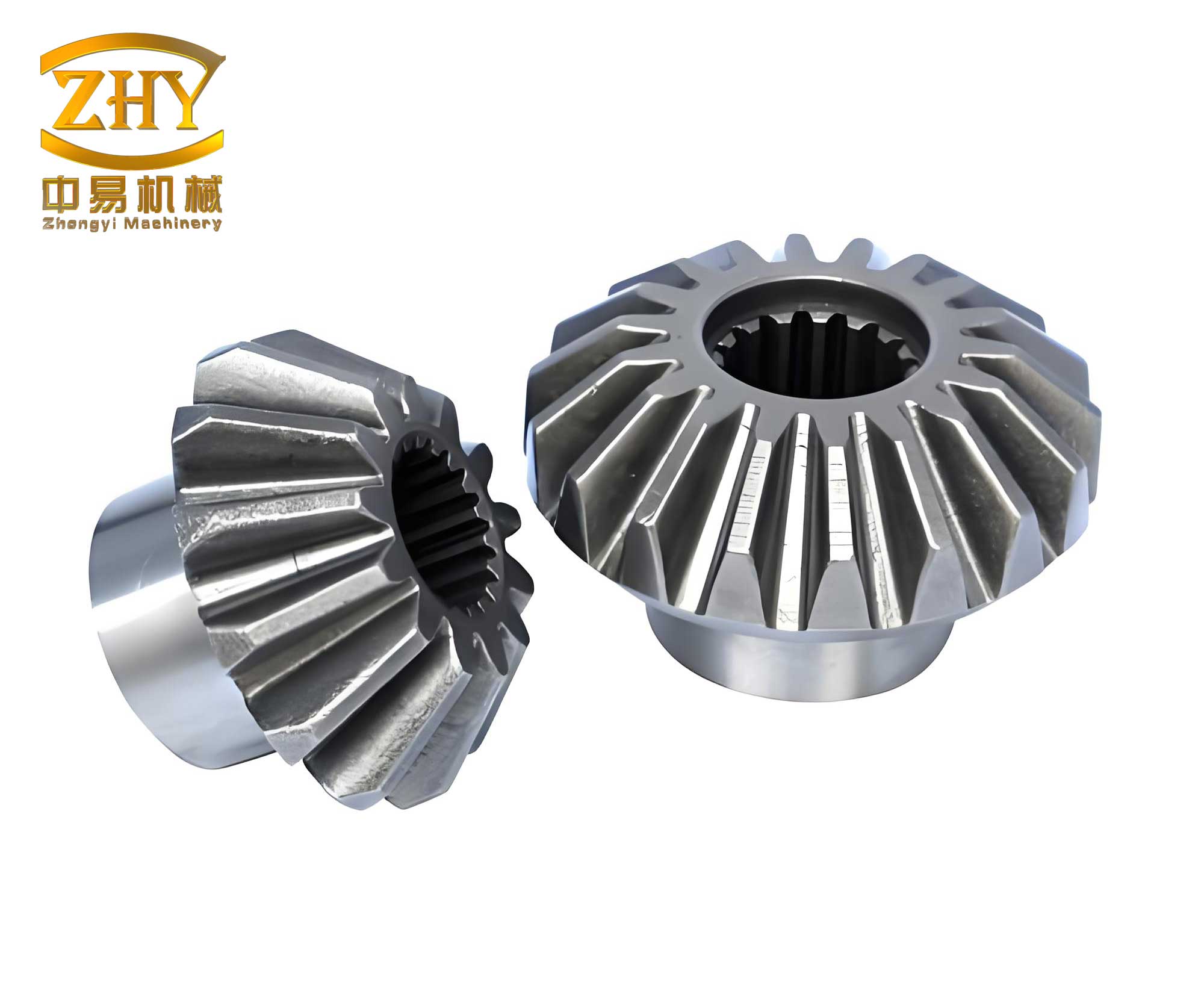
The image above highlights the typical geometry of bevel gears, emphasizing the need for structural refinements. In improved designs, the tooth root and tip are engineered to have similar projected areas, reducing density gradients. This can be quantified using a density uniformity index $U_d$, defined as:
$$ U_d = 1 – \frac{\Delta \rho}{\rho_{avg}} $$
where $\Delta \rho$ is the density difference between the tooth tip and root, and $\rho_{avg}$ is the average density. A higher $U_d$ (closer to 1) indicates better uniformity, directly contributing to the overall strength of bevel gears. Such design optimizations are essential for ensuring that the working surfaces of the teeth—where stress concentration occurs—are sufficiently dense and resilient.
Processing techniques play a pivotal role in achieving high-strength powder metallurgy bevel gears. Among these, warm compaction stands out as a method to elevate density beyond conventional limits. By heating the powder and dies to temperatures around 100–150°C, the plasticity of the powder particles increases, allowing for higher green densities. For instance, a material like FD-0504C (a common iron-based powder) can achieve densities from 6.9 g/cm³ to over 7.4 g/cm³ with warm compaction, corresponding to a substantial improvement in mechanical properties. The benefits of warm compaction for bevel gears include enhanced tooth integrity and reduced porosity, which are critical for load-bearing applications. The following table summarizes key parameters for warm compaction:
| Parameter | Typical Range | Effect on Bevel Gear Properties |
|---|---|---|
| Compaction Temperature | 100–150°C | Increases density by 0.1–0.3 g/cm³; improves strength |
| Pressure | 600–800 MPa | Higher pressure yields denser compacts but may require robust tooling |
| Powder Lubricant | 0.5–1.0 wt% | Reduces friction; ensures uniform filling in bevel gear cavities |
| Cooling Rate | Controlled ambient | Prevents distortion; maintains dimensional accuracy of bevel gears |
Sintering is another vital step that dictates the final properties of powder metallurgy bevel gears. Standard sintering at 1120°C for 30 minutes in a 90% N₂ + 10% H₂ atmosphere may suffice for general-purpose bevel gears, but high-strength applications demand optimized cycles. Increasing the sintering temperature or duration enhances diffusion bonding, leading to better strength and fatigue resistance. However, this must be balanced against dimensional stability, as excessive heat can cause warping. For bevel gears, I recommend a tailored sintering profile based on gear modulus and alloy composition. The sintering kinetics can be described by the Arrhenius equation:
$$ k = A \exp\left(-\frac{E_a}{RT}\right) $$
where $k$ is the sintering rate constant, $A$ is the pre-exponential factor, $E_a$ is the activation energy, $R$ is the gas constant, and $T$ is the absolute temperature. By adjusting $T$ and time $t$, the microstructure of bevel gears can be fine-tuned for optimal strength. Below is a comparison of sintering parameters for high-strength bevel gears:
| Sintering Temperature | Sintering Time | Resultant Density (g/cm³) | Impact on Bevel Gear Strength |
|---|---|---|---|
| 1090°C | 45 minutes | 7.0–7.1 | Moderate strength; suitable for low-load bevel gears |
| 1120°C | 30 minutes | 7.1–7.2 | Balanced strength and dimensional control |
| 1150°C | 15 minutes | 7.3–7.4 | High strength but risk of distortion; requires careful monitoring |
Heat treatment is indispensable for further enhancing the surface hardness and wear resistance of powder metallurgy bevel gears. Given that bevel gears often operate under high-impact and frictional conditions, case hardening through carburizing is highly effective. This process involves enriching the surface with carbon to form a hard martensitic layer while retaining a tough core. For bevel gears, the case depth should be proportional to the gear modulus, typically set at 0.25 to 0.4 times the modulus to prevent fatigue failure. Surface hardness targets range from 650 to 820 HV0.1, with larger bevel gears intentionally kept about 50 HV0.1 softer than smaller mating gears to optimize lifespan. The carburizing process can be modeled using Fick’s law of diffusion:
$$ \frac{\partial C}{\partial t} = D \frac{\partial^2 C}{\partial x^2} $$
where $C$ is the carbon concentration, $t$ is time, $D$ is the diffusion coefficient, and $x$ is the depth from the surface. By controlling atmosphere composition and temperature, the case depth and hardness profile of bevel gears can be precisely managed. Additionally, subsequent tempering may be applied to relieve stresses and improve toughness, ensuring that the bevel gears withstand cyclic loading without cracking.
Beyond these core techniques, auxiliary measures such as furnace insulation and pressure control can indirectly influence the quality of powder metallurgy bevel gears by optimizing the sintering environment. For instance, effective insulation reduces heat loss, ensuring consistent temperature distribution during sintering, which is crucial for complex shapes like bevel gears. Similarly, maintaining an appropriate furnace pressure minimizes air ingress, preventing oxidation and ensuring a reducing atmosphere that promotes proper sintering. These factors contribute to the overall reproducibility and strength of the final bevel gears. In practice, I have observed that integrating these elements into a cohesive manufacturing protocol yields bevel gears with superior performance, often exceeding industry standards for strength and durability.
In conclusion, the production of high-strength powder metallurgy bevel gears is a multifaceted endeavor that requires synergistic optimization of materials, design, and processes. From selecting alloyed powders with tailored compositions to implementing warm compaction and precise sintering cycles, each step contributes to enhancing density and mechanical integrity. Structural refinements that promote uniform density distribution are equally vital, as they eliminate weak points in the gear teeth. Heat treatment further augments surface properties, ensuring that bevel gears can endure harsh operational conditions. Throughout this discussion, the term “bevel gears” has been emphasized to underscore the specific application context, and the methodologies outlined here are grounded in practical experience. By adopting these strategies, manufacturers can overcome the inherent strength limitations of powder metallurgy, paving the way for wider adoption of bevel gears in demanding sectors like electric tools and automotive systems. The continuous evolution of powder metallurgy technology promises even greater advancements, potentially enabling bevel gears to rival their wrought counterparts in performance while retaining cost advantages.