
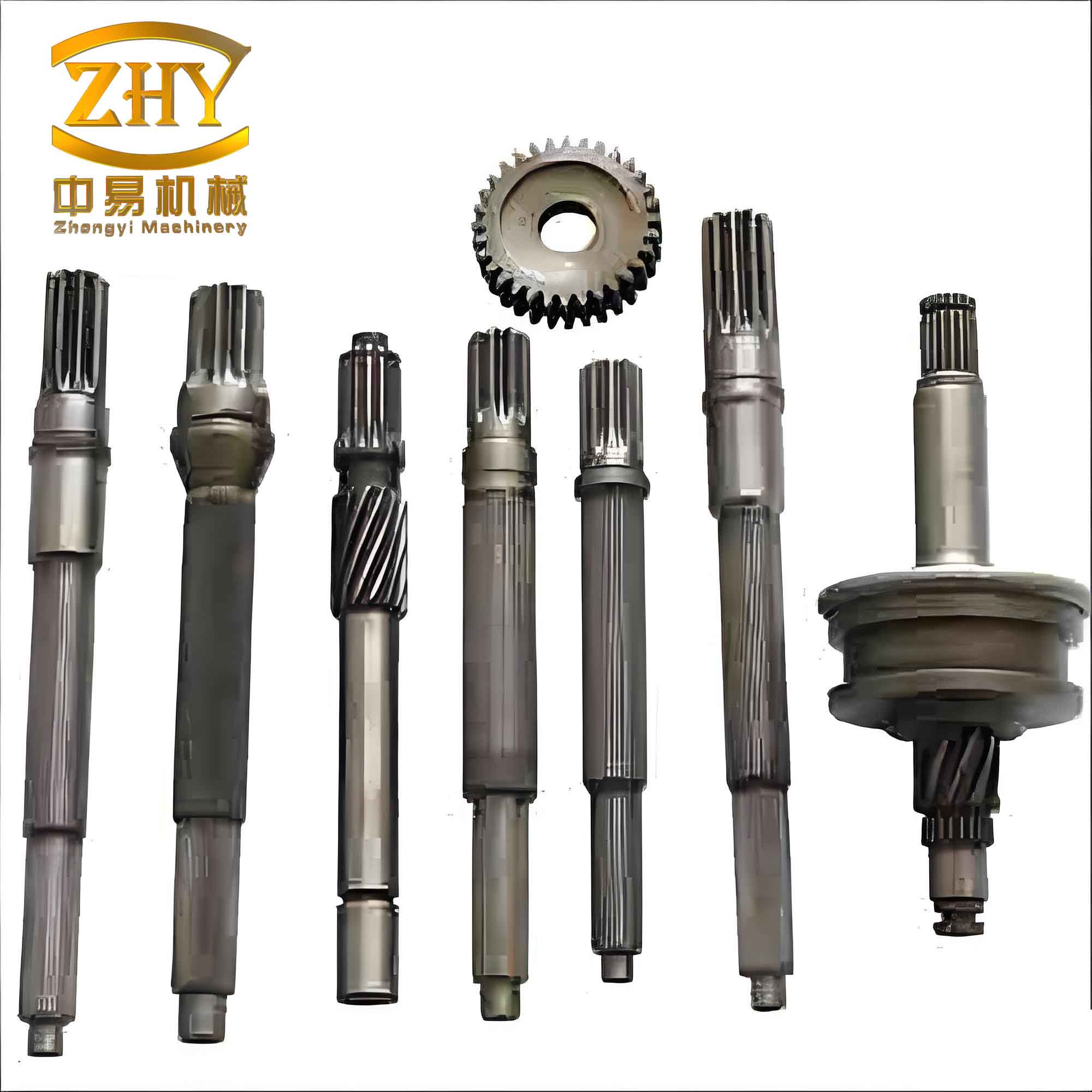
In modern industrial applications, gear shafts are critical components that require high surface hardness, wear resistance, and core toughness to withstand heavy loads and cyclic stresses. Traditional carburizing processes, while effective, often involve prolonged treatment times and high energy consumption, which limit production efficiency and increase costs. To address these challenges, high-temperature carburizing has emerged as a promising alternative, offering accelerated diffusion rates and reduced processing times. However, elevated temperatures can lead to austenite grain coarsening, degrading mechanical properties such as fatigue resistance and impact strength. This issue is particularly critical for gear shafts, where fine microstructures are essential for durability and performance. In this study, I investigate the application of niobium (Nb) microalloying in 17CrNiMo6 steel, a widely used material for gear shafts due to its excellent hardenability and strength. By incorporating Nb, I aim to suppress grain growth during high-temperature carburizing, enabling faster processing without compromising the microstructure or mechanical integrity of the gear shaft.
The 17CrNiMo6 steel, as per standard specifications, contains key alloying elements like chromium, nickel, and molybdenum, which enhance its淬透性 and toughness. However, to counteract grain coarsening at high temperatures, I introduced Nb in varying amounts to form stable carbonitride precipitates that pin austenite grain boundaries. The chemical compositions of the base steel and Nb-microalloyed variants are summarized in Table 1. As shown, the Nb content ranges from 0.026% to 0.040%, while other elements remain consistent to isolate the effects of microalloying. This approach ensures that any improvements in grain refinement can be attributed directly to Nb addition, which is crucial for optimizing the performance of gear shafts under demanding operational conditions.
| Steel Type | C | Si | Mn | P | S | Cr | Ni | Mo | Nb | N |
|---|---|---|---|---|---|---|---|---|---|---|
| 17CrNiMo6 | 0.19 | 0.09 | 0.75 | 0.0096 | 0.0027 | 1.67 | 1.47 | 0.29 | – | – |
| 17CrNiMo6Nb1 | 0.20 | 0.10 | 0.80 | 0.0040 | 0.0100 | 1.69 | 1.58 | 0.32 | 0.026 | 0.0082 |
| 17CrNiMo6Nb2 | 0.17 | 0.06 | 0.54 | 0.0050 | 0.0070 | 1.55 | 1.53 | 0.30 | 0.032 | 0.0078 |
| 17CrNiMo6Nb3 | 0.18 | 0.10 | 0.57 | 0.0040 | 0.0060 | 1.75 | 1.70 | 0.32 | 0.040 | 0.0088 |
To design an effective high-temperature carburizing process for gear shafts, I first determined the critical transformation temperatures of the steels using established empirical formulas. The Ac1 and Ac3 temperatures, which define the onset and completion of austenitization, were calculated to ensure that the carburizing temperatures exceed these points for full microstructural transformation. The formulas used are as follows:
$$ Ac_3 = 910 – 210C – 15.2Ni + 44.7Si + 104V + 31.5Mo + 13.1W $$
$$ Ac_1 = 723 – 10.7Mn – 16.9Ni + 29Si + 16.9Cr + 290As + 16.38W $$
In these equations, the element symbols represent their mass fractions in the steel. The calculated critical temperatures for all steel variants are presented in Table 2. Notably, the addition of Nb does not significantly alter the Ac1 and Ac3 values, indicating that the microalloying primarily affects grain boundary pinning rather than phase transformation kinetics. This consistency is advantageous for industrial applications, as it allows for standardized heat treatment cycles across different Nb contents in gear shaft production.
| Steel Type | Ac1 (°C) | Ac3 (°C) |
|---|---|---|
| 17CrNiMo6 | 734 | 812 |
| 17CrNiMo6Nb1 | 722 | 810 |
| 17CrNiMo6Nb2 | 723 | 815 |
| 17CrNiMo6Nb3 | 722 | 813 |
The core of my investigation involved evaluating the austenite grain growth behavior in Nb-microalloyed steels under high-temperature conditions. Samples were subjected to austenitization at temperatures ranging from 870°C to 990°C for 5 hours, followed by water quenching to preserve the austenite grain boundaries. Microstructural analysis revealed that Nb addition markedly refines the austenite grains compared to the base steel. For instance, at 910°C, the base 17CrNiMo6 steel exhibited coarse grains, while the Nb-containing variants maintained finer structures due to the pinning effect of NbC, NbN, and Nb(C,N) precipitates. The pinning force exerted by these second-phase particles can be described by the equation:
$$ F = \frac{6}{\pi} \frac{f \gamma}{r} $$
where \( F \) is the pinning force, \( f \) is the volume fraction of particles, \( \gamma \) is the grain boundary energy, and \( r \) is the particle radius. This relationship highlights that finer particles with higher volume fractions provide greater resistance to grain boundary migration, which is essential for maintaining a fine-grained microstructure in gear shafts during high-temperature exposure.
To quantify the grain refinement, I measured the austenite grain size grades across different temperatures, as summarized in Table 3. The results show that as Nb content increases, the grain size grade improves, with the most significant refinement observed in the 17CrNiMo6Nb3 steel containing 0.040% Nb. However, at temperatures exceeding 970°C, abnormal grain growth occurred in all Nb-microalloyed steels due to the dissolution of NbN particles, leading to mixed grain structures. The dissolution temperatures of these precipitates were calculated using solubility products:
$$ \lg\{ [\text{Nb}][\text{C}] \} = 2.96 – \frac{7510}{T} $$
$$ \lg\{ [\text{Nb}][\text{N}] \} = 2.89 – \frac{8500}{T} $$
$$ \lg\{ [\text{Nb}][\text{C} + \frac{12}{14}\text{N}] \} = 2.26 – \frac{6770}{T} $$
where \( [\text{Nb}] \), \( [\text{C}] \), and \( [\text{N}] \) represent the dissolved concentrations in austenite, and \( T \) is the absolute temperature. Based on these calculations, I determined that an optimal Nb content of 0.03% to 0.04% effectively refines grains up to 970°C, making it suitable for high-temperature carburizing of gear shafts without excessive coarsening.
| Steel Type | 870°C | 890°C | 910°C | 930°C | 950°C | 970°C | 990°C |
|---|---|---|---|---|---|---|---|
| 17CrNiMo6 | 7.5 | 7.0 | 6.5 | 6.0 | 5.5 | 5.0 | 4.0 |
| 17CrNiMo6Nb1 | 8.5 | 8.0 | 7.5 | 7.0 | 6.5 | 6.0 | 5.0 |
| 17CrNiMo6Nb2 | 9.0 | 8.5 | 8.0 | 7.5 | 7.0 | 6.5 | 5.5 |
| 17CrNiMo6Nb3 | 9.5 | 9.0 | 8.5 | 8.0 | 7.5 | 7.0 | 6.0 |
Building on these findings, I developed a high-temperature carburizing process for the 17CrNiMo6Nb2 steel, which contains 0.032% Nb and demonstrates a balanced combination of grain refinement and cost-effectiveness. The carburizing temperatures were set at 910°C, 930°C, and 940°C, using nitrogen-methanol as a carrier gas and isopropanol as an enriching gas to maintain a controlled atmosphere. To prevent excessive carbon buildup and carbide network formation, I modified the conventional single-stage boost-diffusion process into a two-stage approach. This adjustment reduces surface carbon concentration gradients in the later stages of carburizing, aligning with Fick’s second law of diffusion, which governs carbon penetration in gear shafts:
$$ \frac{\partial C}{\partial t} = D \frac{\partial^2 C}{\partial x^2} $$
where \( C \) is the carbon concentration, \( t \) is time, \( D \) is the diffusion coefficient, and \( x \) is the depth. By optimizing the boost and diffusion phases, I minimized the risk of detrimental carbide precipitation, ensuring a uniform hardened layer essential for the longevity of gear shafts.
The effectiveness of the high-temperature carburizing process was evaluated by measuring the effective hardened layer depth after various treatment durations. As presented in Table 4, increasing the carburizing temperature from 910°C to 940°C significantly enhances the penetration depth. For example, after 168 hours, the hardened layer depth increased from 6.0 mm at 910°C to 6.9 mm at 940°C, corresponding to a carburizing rate improvement of 15.0%. This acceleration is attributed to the higher diffusion coefficients at elevated temperatures, which follow an Arrhenius-type relationship:
$$ D = D_0 \exp\left(-\frac{Q}{RT}\right) $$
where \( D_0 \) is a pre-exponential factor, \( Q \) is the activation energy for diffusion, \( R \) is the gas constant, and \( T \) is the absolute temperature. The data clearly demonstrate that raising the temperature by 20-30°C can reduce processing times by 8.3% to 15.3%, offering substantial efficiency gains in the manufacturing of gear shafts without requiring extended cycles.
| Boost Time (h) | 910°C Depth (mm) | 930°C Depth (mm) | 930°C Rate Improvement (%) | 940°C Depth (mm) | 940°C Rate Improvement (%) |
|---|---|---|---|---|---|
| 96 | 4.5 | 4.9 | 8.9 | 5.1 | 13.3 |
| 120 | 5.2 | 5.7 | 9.6 | 5.9 | 13.5 |
| 168 | 6.0 | 6.5 | 8.3 | 6.9 | 15.0 |
| 216 | 6.7 | 7.5 | 11.9 | 7.7 | 14.9 |
| 288 | 7.8 | 8.7 | 11.5 | 9.0 | 15.3 |
To assess the impact of high-temperature carburizing on mechanical properties, I conducted tensile and impact tests on specimens subjected to carburizing at 910°C, 930°C, and 940°C, followed by oil quenching from 820°C and tempering at 200°C. The results, compiled in Table 5, indicate that the yield strength, tensile strength, elongation, reduction of area, and impact energy remain comparable across all temperatures. For instance, the yield strength varies between 1280 MPa and 1310 MPa, while the impact energy ranges from 118 J to 135 J, with no significant degradation observed at higher carburizing temperatures. Moreover, the austenite grain size after carburizing and heat treatment consistently registers at grade 8, confirming that Nb microalloying effectively stabilizes the microstructure against coarsening. This consistency in mechanical properties is vital for gear shafts, which must maintain high fatigue resistance and toughness under dynamic loading conditions.
| Carburizing Temperature (°C) | Yield Strength (MPa) | Tensile Strength (MPa) | Elongation (%) | Reduction of Area (%) | Impact Energy (J) | Grain Size (Grade) |
|---|---|---|---|---|---|---|
| 910 | 1280 | 1430 | 14.0 | 60.5 | 135 | 8 |
| 930 | 1300 | 1460 | 14.5 | 60.0 | 120 | 8 |
| 940 | 1310 | 1450 | 14.0 | 57.0 | 118 | 8 |
In summary, my research demonstrates that Nb microalloying significantly enhances the austenite grain refinement of 17CrNiMo6 steel, with an optimal Nb content of 0.03% to 0.04% providing the best results up to 970°C. The high-temperature carburizing process at 930°C and 940°C increases the effective hardened layer depth by 8.3% to 15.3% compared to 910°C, without adversely affecting mechanical properties or grain size. This improvement is largely due to the pinning action of Nb-based precipitates, which stabilize the microstructure during prolonged high-temperature exposure. For industrial applications, such as in the production of gear shafts, this approach allows for faster carburizing cycles, reduced energy consumption, and maintained performance, contributing to more efficient and sustainable manufacturing practices. Future work could explore the long-term fatigue behavior and wear resistance of Nb-microalloyed gear shafts under operational conditions to further validate their suitability for high-stress environments.