
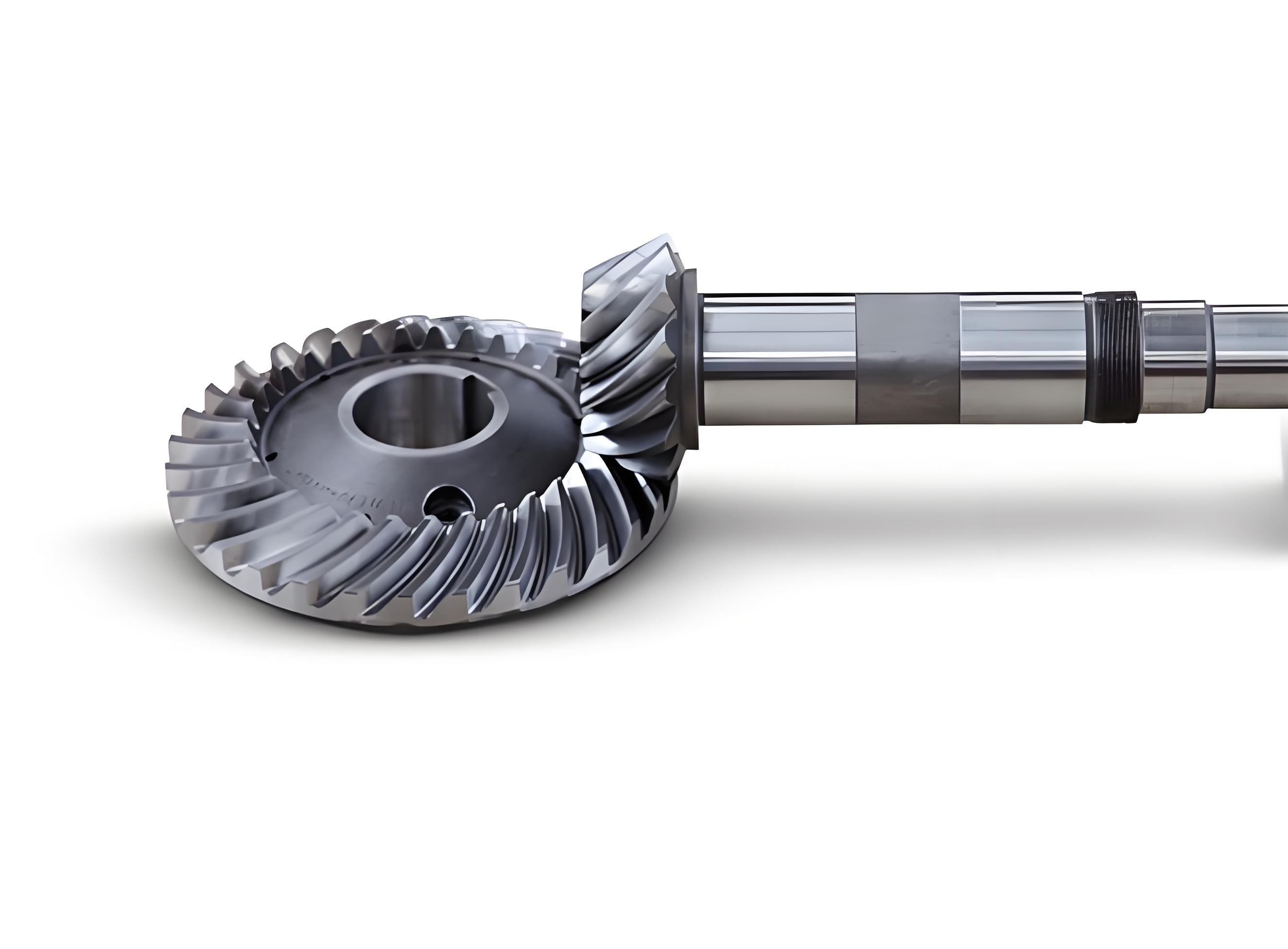
Spiral bevel gears, as critical components in intersecting or staggered shaft transmissions, require advanced manufacturing techniques to enhance strength and service life. This study proposes a novel rolling process for spiral bevel gear pinions using localized induction heating, addressing challenges in traditional milling and forging methods. Through thermal simulation, numerical modeling, and experimental validation, we establish a comprehensive framework for quality control in gear rolling成形.
1. High-Temperature Flow Behavior of 20CrMnTiH Gear Steel
Compression tests on Gleeble-1500D revealed temperature/strain rate dependence:
$$ \dot{\epsilon} = A[\sinh(\alpha\sigma)]^n \exp\left(-\frac{Q}{RT}\right) $$
| Temperature (°C) | Strain Rate (s⁻¹) | Peak Stress (MPa) |
|---|---|---|
| 900 | 0.01 | 98.3 |
| 1000 | 0.1 | 76.4 |
| 1100 | 5 | 52.1 |
The constitutive equation was implemented in DEFORM-3D for subsequent simulations.
2. Mathematical Modeling of Spiral Bevel Gear Tooth Surfaces
Using local synthesis theory, the tooth surface equations were derived:
$$ \mathbf{r}^{(1)}(\theta_p, u_p, \phi_1) = M_{1c}M_{c2}M_{2q}M_{qm}M_{mr}M_{r1} \mathbf{r}_c^{(1)} $$
| Parameter | Pinion | Die Gear |
|---|---|---|
| Teeth | 9 | 39 |
| Module (mm) | 5.69 | – |
| Pressure Angle | 22.5° | – |
3. Local Induction Heating Mechanism
The electromagnetic-thermal coupling model satisfies:
$$ \nabla \times \left(\frac{1}{\mu}\nabla \times \mathbf{A}\right) + j\omega\sigma\mathbf{A} = \mathbf{J}_s $$
$$ \rho C_p\frac{\partial T}{\partial t} = \nabla \cdot (k\nabla T) + \frac{|\mathbf{J}_{eddy}|^2}{\sigma} $$
Key heating parameters:
| Parameter | Value |
|---|---|
| Frequency | 15 kHz |
| Current Density | 50 kW/m² |
| Heating Time | 12 s |
4. Rolling Process Optimization
The multi-objective response surface model for folding height (Y):
$$ Y = 6.344 – 4.726X_1 + 0.0247X_2 – 3.459X_3 + 0.141X_1X_2 + 1.51 \times 10^{-3}X_2X_3 $$
| Factor | Range | Optimal |
|---|---|---|
| Feed Rate (mm/s) | 0.1-0.3 | 0.3 |
| Rotation Speed (rpm) | 30-70 | 30 |
| Friction Coefficient | 0.1-0.3 | 0.1 |
5. Material Flow Uniformity Enhancement
The material compensation coefficient k was established:
$$ k = \frac{A_2 – A_1}{A_1} \times 100\% $$
| Position | k (%) | Effective Height (mm) |
|---|---|---|
| Toe-end | +7.2 | 9.8 |
| Mid-length | -3.1 | 10.5 |
| Heel-end | +5.6 | 10.1 |
6. Reverse Finishing Process
The angular velocity relationship during reversal:
$$ \omega_{\text{workpiece}}^{(t)} = \begin{cases}
+\frac{Z_{\text{die}}}{Z_{\text{workpiece}}} \omega_{\text{die}} & t \in [0, t_1] \\
-\frac{Z_{\text{die}}}{Z_{\text{workpiece}}} \omega_{\text{die}} & t \in [t_1, t_2]
\end{cases} $$
This reduced tooth profile asymmetry by 42% compared to conventional rolling.
7. Experimental Validation
Key results from rolling trials:
| Metric | Simulation | Experiment |
|---|---|---|
| Folding Height (mm) | 6.72 | 6.85 |
| Effective Tooth Height (mm) | 10.42 | 10.31 |
| Spline Damage (%) | 8.7 | 9.2 |
The developed process demonstrates significant improvements in spiral bevel gear manufacturing, achieving 89.7% material utilization and reducing post-machining allowance by 63% compared to traditional methods.