
In the field of mechanical engineering, the transmission of motion and power between intersecting shafts is commonly achieved using bevel gears. Among these, the straight bevel gear is a fundamental component due to its simplicity and efficiency. However, traditional manufacturing methods for straight bevel gears, such as gear shaping or planing on specialized machines, often involve intermittent processes that lead to low production efficiency and limited accuracy. As an engineer with experience in gear manufacturing, I have explored an alternative approach: hobbing straight bevel gears using a variable-module hob. This method aims to enhance productivity and precision by leveraging continuous generation principles similar to those used in cylindrical gear hobbing. In this article, I will delve into the principles, tool design, and computational aspects of this innovative technique, with a focus on practical applications and mathematical modeling.
The conventional machining of straight bevel gears typically relies on dedicated equipment like bevel gear planers or generators, which operate on an intermittent basis. For each tooth, the tool disengages, reverses, and indexes before proceeding to the next tooth. This stop-and-start process not only slows down production but also introduces potential errors due to mechanical vibrations and alignment issues. In contrast, hobbing offers a continuous cutting action, which can significantly improve throughput and consistency. The core idea here is to adapt the hobbing process, commonly used for cylindrical gears, to handle the conical geometry of straight bevel gears. This requires addressing the varying module along the gear’s axis, from the small end to the large end, which is a key characteristic of straight bevel gears. By employing a variable-module hob, we can simulate a rack with continuously changing tooth dimensions that meshes with the gear profile during cutting.
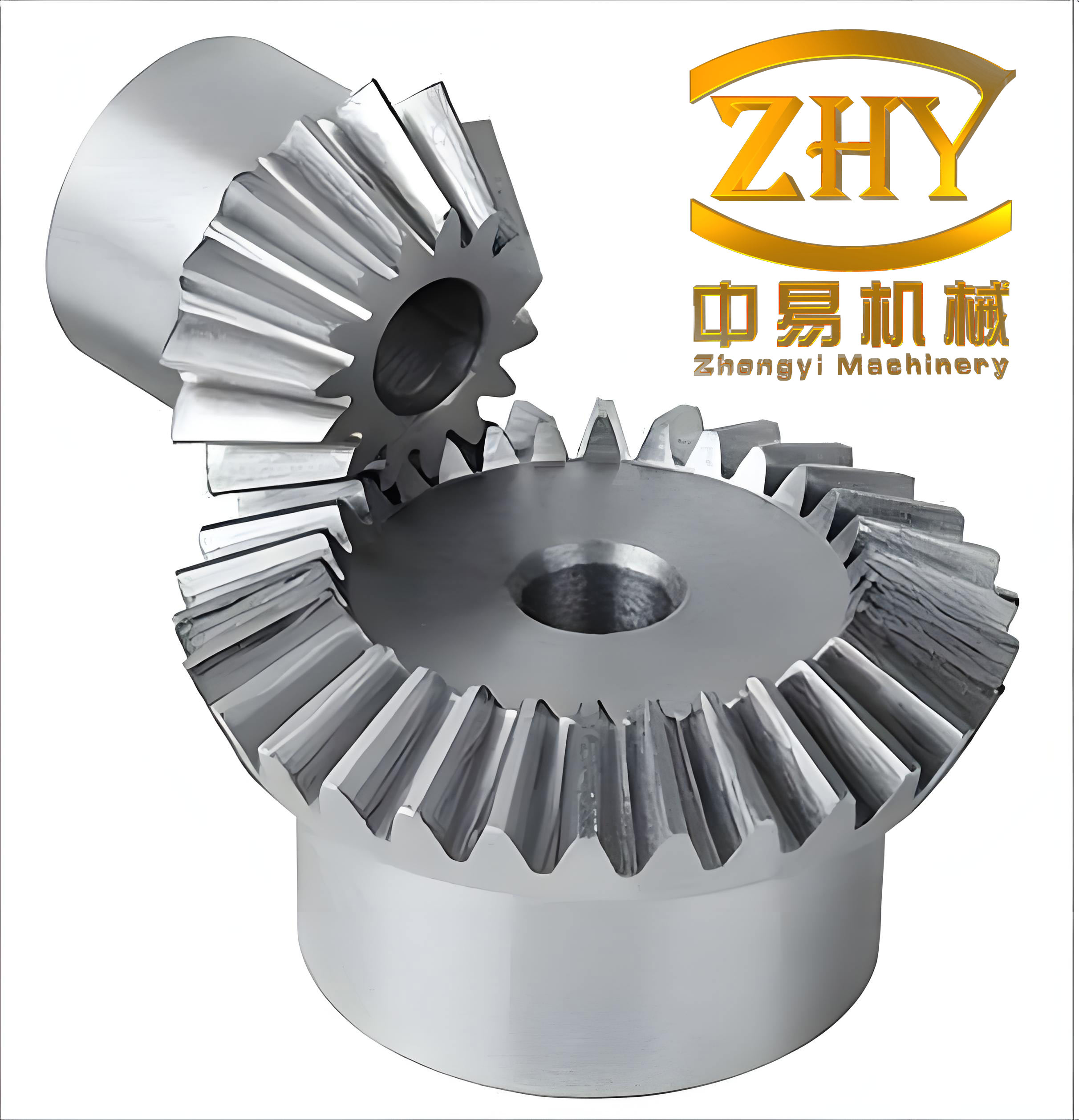
To understand the hobbing process for straight bevel gears, consider the analogy with cylindrical gear hobbing. In standard hobbing, a hob rotates at a speed \( \omega_h \) while the workpiece rotates at \( \omega_w \), with a fixed speed ratio between them. Additionally, the hob moves vertically at a feed rate \( v_f \). For a straight bevel gear, the pitch cone angle introduces a taper, meaning the module changes linearly along the axis. If we treat the straight bevel gear as a cylindrical gear with a cone angle of 90 degrees, the difference lies in the cone angle and module variation. By incorporating a coordinated motion between the hob’s vertical feed and the workpiece’s horizontal feed, we can generate the required cone angle. This is achieved through the machine’s ability to perform simultaneous linear movements, effectively creating the tapered profile of the straight bevel gear.
The principle behind the variable-module hob involves modeling the cutting process as the engagement between the straight bevel gear and a rack whose tooth pitch varies continuously. Imagine a series of superimposed gears, each with a different module corresponding to a cross-section perpendicular to the axis. The module increases from \( m_{\text{small}} \) at the small end to \( m_{\text{large}} \) at the large end. Similarly, the hob is designed with a variable tooth pitch that matches this progression. During hobbing, the hob’s teeth move axially, and their pitch changes in sync with the gear’s module variation. This allows for continuous generation of the tooth profile without the need for intermittent indexing, thereby improving efficiency. The mathematical representation of this module variation can be expressed as:
$$ m(x) = m_{\text{small}} + \frac{x}{L} (m_{\text{large}} – m_{\text{small}}) $$
where \( m(x) \) is the module at axial position \( x \), and \( L \) is the length of the gear along the axis. This linear relationship ensures that the tooth dimensions evolve smoothly, which is crucial for achieving accurate gear geometry in straight bevel gears.
Now, let’s examine the structure of the variable-module hob, which is also referred to as a variable-pitch hob. The hob consists of a central mandrel, similar to an external splined sleeve, that interfaces with a drive shaft via an inner bore and keyway to transmit torque. The outer surface of the mandrel features rectangular slots that house individual hob teeth. Each tooth is manufactured separately with a straight tooth profile and a length proportional to the large-end module of the straight bevel gear. The tooth thickness, however, corresponds to the small-end module to accommodate the varying engagement conditions. This modular design allows for precise control over the cutting edges as they traverse the gear blank. The hob teeth are arranged along a helical path with a pitch that changes according to the module progression. Below is a table summarizing the key parameters of the variable-module hob for straight bevel gears:
| Parameter | Symbol | Description |
|---|---|---|
| Number of Hob Teeth | \( N \) | Total teeth on the hob, e.g., 9 for a sample design |
| Large-End Module | \( m_{\text{large}} \) | Module at the large end of the straight bevel gear |
| Small-End Module | \( m_{\text{small}} \) | Module at the small end of the straight bevel gear |
| Axial Pitch Variation | \( \Delta T \) | Change in pitch per tooth along the axis |
| Vertical Feed Rate | \( v_f \) | Speed of hob movement along the gear axis |
Calculating the corresponding pitch for each hob tooth is critical for ensuring accurate tooth generation in straight bevel gears. The pitch \( T \) is related to the module by \( T = m \pi \), where \( m \) is the module. For a straight bevel gear with modules \( m_{\text{large}} \) and \( m_{\text{small}} \), the pitches at the ends are \( T_{\text{large}} = m_{\text{large}} \pi \) and \( T_{\text{small}} = m_{\text{small}} \pi \), respectively. In the variable-module hob, the pitch changes linearly along the hob’s axis. Suppose we have a hob with \( N \) teeth distributed over a length corresponding to one pitch of the large-end module. The pitch for the \( i \)-th tooth can be derived based on its position. For instance, if the middle tooth (index 0) has a pitch of \( T_{\text{small}} \), and the pitch increases uniformly, the pitch for tooth \( i \) is given by:
$$ T(i) = T_{\text{small}} + \frac{i}{N-1} (T_{\text{large}} – T_{\text{small}}) $$
where \( i \) ranges from 0 to \( N-1 \). This ensures that the hob teeth align with the varying module of the straight bevel gear during the cutting process. Additionally, the axial movement of the hob must be synchronized with the rotation of the hob’s threaded sleeve to account for pitch variations. The required angular adjustment \( \Delta \theta \) for the sleeve can be calculated based on the vertical feed and the pitch change rate. For example, if the hob moves axially by a distance \( \Delta x \), the corresponding pitch change \( \Delta T \) is proportional to \( \Delta x \), and the sleeve must rotate by an angle \( \Delta \theta = \frac{2\pi \Delta T}{T_{\text{avg}}} \), where \( T_{\text{avg}} \) is the average pitch. This compensation is essential to maintain proper meshing and avoid errors in the tooth profile of the straight bevel gear.
To illustrate this with a practical example, consider a straight bevel gear with \( m_{\text{large}} = 5 \, \text{mm} \) and \( m_{\text{small}} = 3 \, \text{mm} \). The corresponding pitches are \( T_{\text{large}} = 5\pi \, \text{mm} \) and \( T_{\text{small}} = 3\pi \, \text{mm} \). For a hob with \( N = 9 \) teeth, the pitch for each tooth can be computed as shown in the table below. This table provides a step-by-step calculation for the pitch values, emphasizing the linear progression that mirrors the module variation in straight bevel gears.
| Tooth Index \( i \) | Pitch \( T(i) \) (mm) | Description |
|---|---|---|
| 0 | \( 3\pi \approx 9.42 \) | Small-end pitch, reference tooth |
| 1 | \( 3\pi + \frac{1}{8}(2\pi) \approx 10.21 \) | First incremental change |
| 2 | \( 3\pi + \frac{2}{8}(2\pi) \approx 10.99 \) | Linear increase continues |
| 3 | \( 3\pi + \frac{3}{8}(2\pi) \approx 11.78 \) | Mid-range pitch value |
| 4 | \( 3\pi + \frac{4}{8}(2\pi) \approx 12.57 \) | Average pitch region |
| 5 | \( 3\pi + \frac{5}{8}(2\pi) \approx 13.35 \) | Approaching large-end pitch |
| 6 | \( 3\pi + \frac{6}{8}(2\pi) \approx 14.14 \) | Near large-end module |
| 7 | \( 3\pi + \frac{7}{8}(2\pi) \approx 14.92 \) | Final incremental step |
| 8 | \( 5\pi \approx 15.71 \) | Large-end pitch |
In the hobbing process for straight bevel gears, the vertical feed rate \( v_f \) is selected based on material properties and desired surface finish. Once chosen, it determines the rotational speed of the hob’s threaded sleeve. The relationship between the vertical feed and the pitch variation can be derived from the geometry of the straight bevel gear. Specifically, the cone angle \( \gamma \) influences the required axial movement. If the gear has a pitch cone length \( R \), the module change per unit axial distance is \( \frac{dm}{dx} = \frac{m_{\text{large}} – m_{\text{small}}}{R} \). Integrating this, the pitch change rate is \( \frac{dT}{dx} = \pi \frac{dm}{dx} \). Therefore, for a vertical feed \( v_f \), the time rate of pitch change is \( \frac{dT}{dt} = v_f \frac{dT}{dx} \), and the sleeve rotation must compensate for this to maintain synchronization. This ensures that each hob tooth engages the workpiece at the correct pitch, resulting in a precise tooth profile for the straight bevel gear.
However, implementing this method requires careful adjustment of machine parameters. The hobbing machine must coordinate multiple motions: the rotation of the hob and workpiece, the vertical feed, and the horizontal feed to generate the cone angle. Additionally, the threaded sleeve of the hob may need angular corrections to account for practical factors like backlash and manufacturing tolerances. For instance, if the theoretical pitch change is not perfectly achieved due to machine dynamics, an empirical correction factor \( k \) can be applied, so the actual sleeve rotation angle becomes \( \theta = \theta_{\text{theory}} + k \Delta \theta \). This factor depends on the specific equipment, tool wear, and material characteristics. Moreover, the cutting speed \( v_c \) must be optimized to balance tool life and productivity. The formula for cutting speed is \( v_c = \pi d_h \omega_h \), where \( d_h \) is the hob diameter and \( \omega_h \) is the hob rotational speed. For straight bevel gears, this speed may need variation along the axis due to changing module, but in practice, a constant speed is often used for simplicity.
In conclusion, the hobbing of straight bevel gears using a variable-module hob presents a promising alternative to traditional methods. By enabling continuous cutting and precise control over tooth geometry, this approach can enhance both efficiency and accuracy in manufacturing straight bevel gears. The key lies in the design of the hob, with its variable pitch and synchronized motions, which allows it to adapt to the conical shape of the gear. Through mathematical modeling and careful calibration, as discussed in this article, engineers can implement this technique to overcome the limitations of intermittent processes. Future work could focus on optimizing the hob design for different sizes of straight bevel gears and integrating digital controls for real-time adjustments. Ultimately, this method underscores the importance of innovation in gear manufacturing, particularly for applications requiring high-performance straight bevel gears in industries such as automotive and aerospace.