
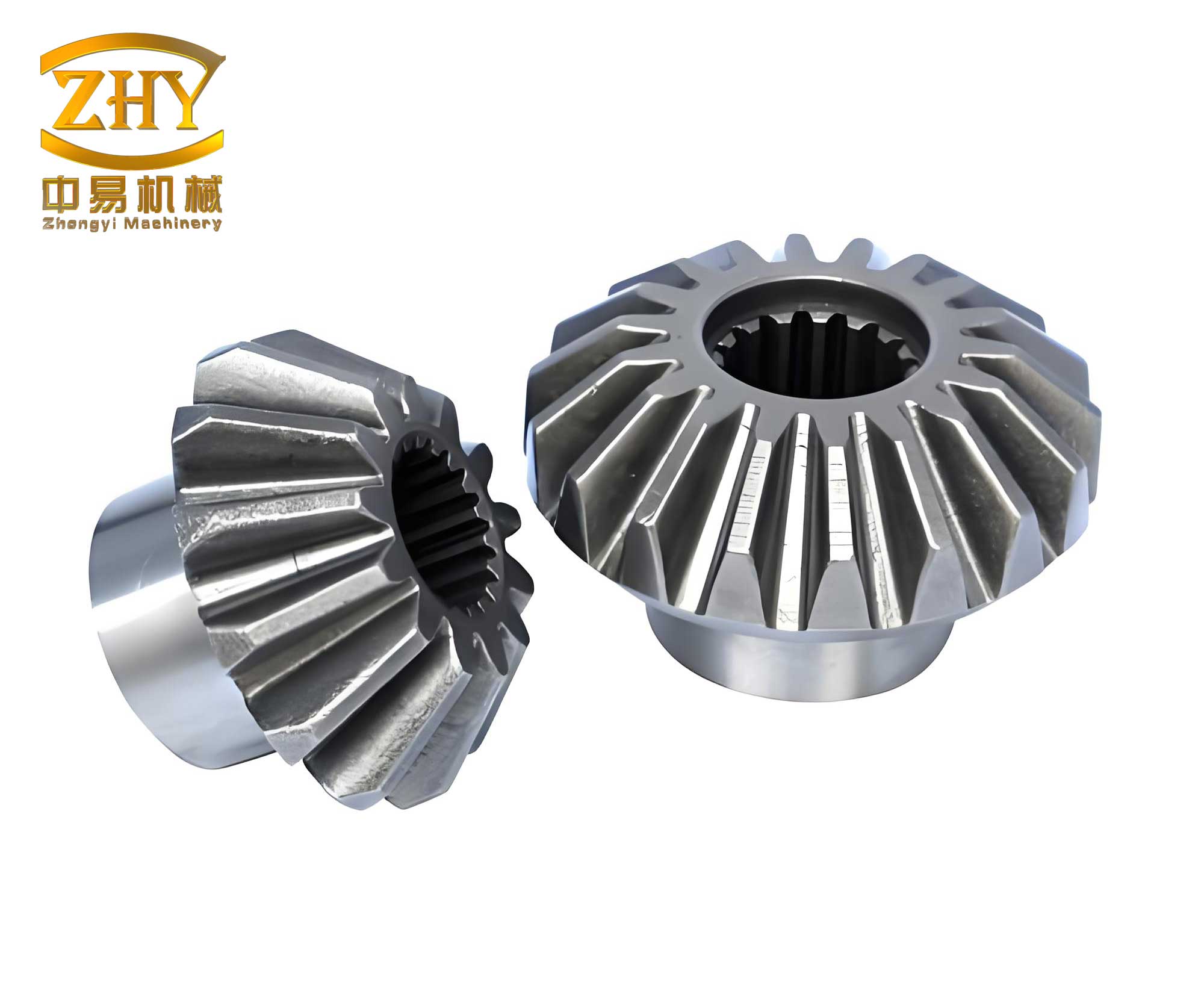
The relentless pursuit of performance and efficiency in modern aerospace engineering has led to the widespread adoption of high-strength and ultra-high-strength steels for critical structural components. Among these, bevel gear assemblies, which transmit power between intersecting shafts, are fundamental to many mechanical systems, including helicopter transmissions and auxiliary power units. However, the very property that makes these materials desirable—their high strength—also renders them exceptionally susceptible to a dangerous and often insidious failure mode: hydrogen embrittlement (HE). The susceptibility to HE increases dramatically for steels with tensile strengths exceeding 1000 MPa. This analysis delves into a specific case of crack formation in a reduction bevel gear assembly, employing a systematic investigative approach to determine the root cause and establish robust preventive measures.
The subject component was a welded assembly consisting of a shaft and a bevel gear, both manufactured from 18CrNi4A steel, a high-strength, case-hardening grade. The manufacturing sequence included inertia friction welding, machining, and a final chromium plating process on the internal diameter of the shaft section. Non-destructive magnetic particle inspection conducted post-final grinding revealed linear, axially-oriented indications on the inner surface of the shaft, specifically in the region between the chromium-plated zone and the weld zone. This prompted a detailed failure analysis to characterize the crack and identify its origin, as such defects in a bevel gear assembly pose a significant reliability risk.
Investigative Methodology and Analytical Results
A multi-faceted analytical protocol was executed to gather comprehensive data on the failure. The methodology included visual and microscopic examination, metallographic analysis, hardness testing, residual stress measurement, and hydrogen content analysis. The systematic application of these techniques provided a holistic view of the component’s condition.
Macroscopic and Fractographic Analysis
Initial visual inspection confirmed the magnetic particle indications were located precisely at the transition area between the chrome-plated inner diameter and the friction weld heat-affected zone. The indications were parallel to the component’s axis. To examine the fracture mechanism, the crack was carefully opened. Scanning Electron Microscopy (SEM) revealed a stark contrast between the crack fracture surface and the subsequent forced fracture. The key characteristics are summarized below:
| Feature | Crack Fracture Surface | Forced (Ductile) Fracture |
|---|---|---|
| General Morphology | Relatively clean, flat, and perpendicular to the surface. | Characteristic dimpled rupture. |
| Microscopic Feature | Predominantly intergranular cracking. | Microvoid coalescence (dimples). |
| Secondary Evidence | No signs of oxidation, corrosion, or decarburization. | N/A |
| Crack Depth | Approximately 0.52 mm. | N/A |
The intergranular nature of the original crack, combined with the absence of environmental damage, is a classic signature of hydrogen-assisted cracking. Energy Dispersive Spectroscopy (EDS) conducted on both fracture surfaces detected only the base alloying elements (Fe, Cr, Ni), ruling out contamination or corrosive agents as primary contributors.
Metallurgical and Mechanical Property Assessment
Cross-sectional samples through the cracked region were prepared for metallographic examination. The analysis confirmed the presence of multiple cracks propagating inward from the surface. Crucially, these cracks also exhibited an intergranular path. The microstructure adjacent to the cracks, as well as in the core of the bevel gear tooth and shaft, was found to be tempered martensite with a small amount of ferrite, which is the expected and acceptable microstructure for 18CrNi4A in its heat-treated condition. No abnormal phases or microstructural anomalies were observed. The weld fusion zone and heat-affected zone (HAZ) were also examined and found to be free from welding defects such as porosity or lack of fusion. The crack initiation site was measured to be approximately 2.30 mm from the HAZ and 0.35 mm from the edge of the chromium plating.
Microhardness traverses were performed across various sections of the component to ensure the material met specified strength levels. The measured values, converted to Rockwell C scale, were uniform and within the required range, confirming proper heat treatment.
| Component Region | Hardness (HRC) | Specification (HRC) |
|---|---|---|
| Chromium-Plated Zone Core | 44.1, 43.7 | 40.0 – 47.0 |
| Crack-Affected Region | 43.1, 42.5 | |
| Bevel Gear Spline Core | 44.4, 44.2 |
Quantification of Hydrogen Content and Residual Stress
Given the fractographic evidence pointing towards HE, quantitative analysis of hydrogen became paramount. Small samples were extracted from distinct zones of the failed bevel gear assembly using a controlled drilling technique and analyzed using a dedicated hydrogen analyzer. The results were revealing:
| Sampling Location | Hydrogen Content (ppm, by mass) |
|---|---|
| Chromium-Plated Zone | 27.4, 25.9 |
| Transition Zone (near plating) | 13.8, 17.6 |
| Crack Initiation Area | 7.4, 6.3 |
| Weld Metal Zone | 4.5, 5.1 |
| Bevel Gear Spline Area | 6.2, 4.9 |
The data shows a steep hydrogen concentration gradient, with the highest levels found in and directly adjacent to the chromium-plated surface. The crack initiation area, while lower than the plated zone, still contained hydrogen concentrations above the critical threshold often cited for high-strength steels (typically >5 ppm). The hydrogen diffusion can be conceptually described by Fick’s second law:
$$ \frac{\partial C}{\partial t} = D \frac{\partial^2 C}{\partial x^2} $$
where \(C\) is the hydrogen concentration, \(t\) is time, \(D\) is the diffusion coefficient, and \(x\) is the distance. The plating process created a high surface concentration, leading to inward diffusion.
Furthermore, residual stress measurements using X-ray diffraction were taken at the critical locations. The results indicated that the surface at the crack site, as well as in the weld area, was under a state of tensile residual stress.
| Measurement Location | Residual Stress (MPa) |
|---|---|
| Crack Initiation Area | +37.8, +63.4 |
| Weld Zone | +39.6, +66.8 |
| Bevel Gear Spline | +48.3, +10.9 |
Discussion: Synthesis of Failure Mechanism
The convergence of evidence from all analytical techniques allows for a definitive conclusion regarding the failure of the bevel gear shaft assembly. The crack properties are diagnostic of hydrogen embrittlement: intergranular fracture morphology, absence of corrosive products, and association with a high-strength steel. For hydrogen embrittlement to occur, three concurrent factors are generally required: a susceptible material, a source of hydrogen, and a tensile stress.
- Susceptible Material: The 18CrNi4A steel, with a tensile strength well over 1300 MPa, is inherently highly susceptible to hydrogen embrittlement.
- Hydrogen Source: The hydrogen content analysis irrefutably identifies the chromium plating process as the primary source. Electroplating, especially hard chromium plating, is a known prolific generator of atomic hydrogen, a portion of which absorbs into the steel substrate. The data confirms a massive ingress of hydrogen during plating, with concentrations in the plated layer nearing 30 ppm.
- Tensile Stress: The residual stress measurements confirmed the presence of tensile stresses at the surface in the crack initiation region. While not excessively high, these stresses were sufficient to act in concert with the internal hydrogen.
The specific location of the cracking—between the weld and the plated zone—is significant. The weld zone, due to thermal cycles, can have altered microstructure and residual stress fields. However, the metallography showed no defects in the weld itself. The more critical factor was identified through a review of the manufacturing process records. The specified procedure for finishing the shaft’s inner diameter after welding involved sequential grinding steps, each followed by a stress-relief heat treatment. It was discovered that in the case of the failed batch, this process had been altered: grinding was replaced with turning operations, and the final polishing step was omitted, leaving visible machining marks. Most importantly, the vital stress-relief cycles were not performed as per the original sequence.
The omission of polishing is particularly crucial. A polishing operation, unlike turning or grinding, typically imparts a beneficial compressive residual stress layer at the surface. The change in machining method and sequence left the surface in a net tensile stress state. This region, now containing elevated hydrogen from the nearby plating process and under tensile stress, became the ideal site for hydrogen atoms to accumulate at microstructural traps (e.g., grain boundaries, inclusions) and eventually cause brittle, intergranular fracture. The failure can be modeled as a threshold phenomenon where crack initiation occurs when the local hydrogen concentration \(C_{local}\) at a stress concentration exceeds a critical value \(C_{crit}(\sigma)\), which is a function of the local tensile stress \(\sigma\):
$$ C_{local} \geq C_{crit}(\sigma) $$
In this case, the combined state of \(C_{local}\) (from plating) and \(\sigma\) (from machining-induced tensile stress) satisfied this condition.
Process Investigation and Corrective Validation
To conclusively validate the root causes and establish effective controls, a series of targeted process experiments were conducted.
Experiment 1: Influence of Plating Parameters on Hydrogen Ingress
The relationship between chrome plating duration and the resultant hydrogen concentration in the substrate was quantified. Components were plated for different time intervals, and hydrogen levels in the plated zone were measured.
| Chrome Plating Duration | Average Hydrogen Content in Plated Zone (ppm) |
|---|---|
| 4 hours | 6.9 |
| 7 hours | 23.8 |
The results demonstrate a clear correlation: extended plating times lead to significantly higher hydrogen absorption. This underscores the necessity of controlling plating time to the minimum required to achieve the specified coating thickness.
Experiment 2: Impact of Welding on Residual Stress State
The effect of the inertia friction welding process on the surface stress profile was measured. Residual stress was recorded before and after welding at various distances from the weld centerline.
| Location Relative to Weld | Residual Stress Before Welding (MPa) | Residual Stress After Welding (MPa) |
|---|---|---|
| Weld Zone | -375.4 (Compressive) | +33.5 (Tensile) |
| Near Weld Area | -108.0 (Compressive) | +69.4 (Tensile) |
| Far from Weld Area | -318.0 (Compressive) | -311.4 (Compressive) |
This experiment confirmed that the welding process itself transforms the surface stress state in and near the weld from compressive to tensile. If not promptly addressed via stress-relief annealing, this tensile field remains as a persistent driver for hydrogen-assisted cracking.
Experiment 3: Effect of Finishing Operations on Surface Stress
The most critical experiment evaluated how different machining sequences after welding and stress relief affect the final surface stress. The process was simulated step-by-step, with stress measurements taken after each operation in the critical shaft inner diameter region.
| Processing Step | Resultant Surface Residual Stress (MPa) |
|---|---|
| After Welding | +528.0 (High Tensile) |
| After Stress Relief (140°C, 8h) | +258.6 (Reduced Tensile) |
| After First Turning Operation | +163.5 (Tensile) |
| After First Polishing Operation | -219.6 (Compressive) |
| After Subsequent Turning | +161.9 (Tensile) |
| After Final Polishing | -311.4 (Compressive) |
The data is unequivocal: turning operations consistently leave a tensile residual stress on the surface of the high-strength bevel gear steel. In contrast, polishing operations are highly effective at converting that tensile stress into a beneficial compressive stress layer. The omission of the final polishing step in the failed batch directly resulted in the final tensile stress condition measured on the fault components.
Integrated Preventive Measures and Conclusion
Based on the root cause analysis and validating experiments, an integrated set of corrective and preventive actions was implemented for the manufacturing of the bevel gear assembly:
- Control of Hydrogen Source: The chrome plating process is strictly controlled. The plating time is minimized to the essential duration needed to meet coating thickness specs, thereby reducing total hydrogen ingress.
- Mandatory Hydrogen Baking: A dedicated and timely hydrogen embrittlement relief bake is performed immediately after the plating process and before any further machining. This thermal treatment allows absorbed hydrogen to diffuse out of the steel before it can cause damage.
- Restoration of Machining Sequence: The original machining sequence is strictly enforced. Crucially, the final finishing operation on the shaft’s inner diameter, particularly in the weld-affected zone, must be a polishing step, not a turning operation. This is defined as a critical control point in the manufacturing process.
- Timely Stress Relief: Stress relief annealing is performed immediately after welding and after any significant material removal step to dissipate tensile stresses introduced by thermal or mechanical processes.
The effectiveness of these measures was validated through the production of subsequent batches. Following the implementation of the revised, controlled process, multiple production lots of the bevel gear component were manufactured. Post-plating and final grinding, magnetic particle inspection confirmed a complete absence of the cracking indications that had plagued the initial batch.
In conclusion, the failure of the reduction bevel gear assembly was conclusively determined to be hydrogen embrittlement cracking. The primary hydrogen source was the chromium plating process, while the enabling condition was a state of tensile residual stress resulting from an unauthorized change in the machining sequence that omitted a critical polishing operation. This case underscores the extreme sensitivity of high-strength bevel gear components to synergistic threats. It highlights the non-negotiable requirement for integrated process control: managing hydrogen introduction, ensuring its timely removal, and meticulously controlling final surface finishing to generate compressive stresses. For engineers and metallurgists, this analysis serves as a robust framework for diagnosing and preventing similar failures in high-strength steel aerospace components.