
In my years of experience in automotive engineering and maintenance, I have encountered numerous misconceptions regarding lubricants, particularly those used in gear systems. One of the most prevalent and damaging myths is the belief that hyperboloid gear oil is universally superior and can be substituted for ordinary gear oil in all applications. This practice, often driven by a well-intentioned but misguided desire to “protect” the vehicle, leads to unnecessary economic loss and accelerated component wear. Through this article, I aim to elucidate the distinct characteristics, applications, and mechanisms of hyperboloid gear oils, emphasizing why their misuse is detrimental. The core of the discussion will revolve around the unique demands of the hyperboloid gear system, a critical component in modern automotive drivetrains.
The fundamental reason for the specialization of lubricants lies in the mechanical and thermal conditions within different gear types. Ordinary gear transmissions, such as those using involute spur or helical gears, typically operate under moderate conditions. The contact pressure between tooth faces is relatively low, generally not exceeding $$p_{ordinary} \approx 2.5 \times 10^9 \, \text{Pa}$$, and the operational temperatures remain comfortably below $$T_{ordinary} \approx 90^\circ \text{C}$$. Under these parameters, the lubricant film remains stable, and primary lubrication is achieved through the viscosity and film-strength properties of the base oil enhanced with standard anti-wear additives. The primary function here is to reduce friction and prevent adhesive wear.
In stark contrast, the hyperboloid gear, predominantly used in the final drive or differential of automotive rear axles, operates in an extreme environment. The unique geometry of the hyperboloid gear—characterized by its hyperbolic pitch surfaces—allows for a larger reduction ratio, smoother engagement, and more compact design compared to conventional gears. However, this comes at a cost. The contact mechanics involve a combination of rolling and significant sliding motion. The specific properties of this engagement can be summarized by the following key parameters:
| Parameter | Typical Range for Hyperboloid Gears | Typical Range for Ordinary Gears |
|---|---|---|
| Maximum Contact Pressure (p) | $$3.0 \times 10^9 \, \text{Pa} \leq p \leq 4.0 \times 10^9 \, \text{Pa}$$ | $$1.5 \times 10^9 \, \text{Pa} \leq p \leq 2.5 \times 10^9 \, \text{Pa}$$ |
| Relative Sliding Velocity (v_s) | $$8 \, \text{m/s} \leq v_s \leq 15 \, \text{m/s}$$ | $$< 2 \, \text{m/s}$$ |
| Instantaneous Flash Temperature (T_f) | $$600^\circ \text{C} \leq T_f \leq 800^\circ \text{C}$$ | $$< 150^\circ \text{C}$$ |
The combination of ultra-high pressure and high sliding velocity generates immense localized heat at the contact interface. This flash temperature can momentarily exceed $$800^\circ \text{C}$$, a point at which conventional lubricant additives—typically organic compounds adsorbed onto metal surfaces—desorb or decompose. The protective oil film shears and fails, leading to a condition known as boundary lubrication. If unmitigated, this results in severe wear, scuffing, scoring, and ultimately catastrophic gear failure. It is precisely for the hyperboloid gear that specialized lubricants were developed.
The formulation of a true hyperboloid gear oil is centered on a class of additives known as Extreme Pressure (EP) agents. These are organic compounds containing reactive elements such as Sulfur (S), Phosphorus (P), and Chlorine (Cl). Their mode of action is fundamentally chemical rather than purely physical. At the microscale contact points where metal-to-metal contact occurs due to film breakdown, the high flash temperature activates these EP additives. They react chemically with the nascent metal surface (typically iron) to form a sacrificial layer of metallic compounds. This layer, often called a “friction polymer” or “tribofilm,” has a lower shear strength and melting point than the base metal, thereby preventing direct metallic adhesion (welding). The formation reactions can be simplified as:
For Sulfur-based EP additives (e.g., sulfurized olefins):
$$\text{Fe} + \text{R-S}_x\text{-R’} \xrightarrow{\Delta T} \text{FeS} + \text{Other products}$$
The iron sulfide (FeS) layer acts as a solid lubricant.
For Chlorine-based EP additives (e.g., chlorinated paraffins):
$$\text{Fe} + \text{R-Cl} \xrightarrow{\Delta T} \text{FeCl}_2$$
The iron chloride film is effective but can be hydrolytically unstable.
For Phosphorus-based EP additives (e.g., zinc dialkyldithiophosphates, ZDDP):
$$\text{Fe} + (\text{RO})_2\text{P(S)S-Zn-S(S)P(OR)}_2 \xrightarrow{\Delta T} \text{FePO}_4, \text{Zn}_3(\text{PO}_4)_2, \text{FeS}$$
Forming a complex glassy phosphate film.
It is crucial to understand that this protective mechanism is inherently corrosive. The EP additives are designed to selectively “attack” the metal surface at precisely the points of extreme stress and temperature to form protective compounds. This is a controlled corrosion process essential for the survival of the hyperboloid gear under load. However, this very property makes hyperboloid gear oil entirely unsuitable for applications where such extreme conditions do not exist. The following table contrasts the additive packages and primary functions:
| Lubricant Type | Primary Additive System | Primary Function | Optimal Application |
|---|---|---|---|
| Ordinary Gear Oil (GL-4/GL-5 for mild conditions) | Anti-wear (e.g., mild ZDDP), rust inhibitors, foam suppressants, viscosity index improvers. | Reduce friction and wear under elastohydrodynamic (EHD) and mixed lubrication regimes. | Manual transmissions, transfer cases, industrial gearboxes with involute gears. |
| Hyperboloid Gear Oil (e.g., GL-5, MT-1) | High-activity Sulfur-Phosphorus EP agents, corrosion inhibitors for yellow metals, thermal stabilizers. | Prevent scoring and wear under boundary lubrication via controlled chemical reaction with metal surfaces. | Hypoid and hyperboloid gear final drives, high-torque differentials. |
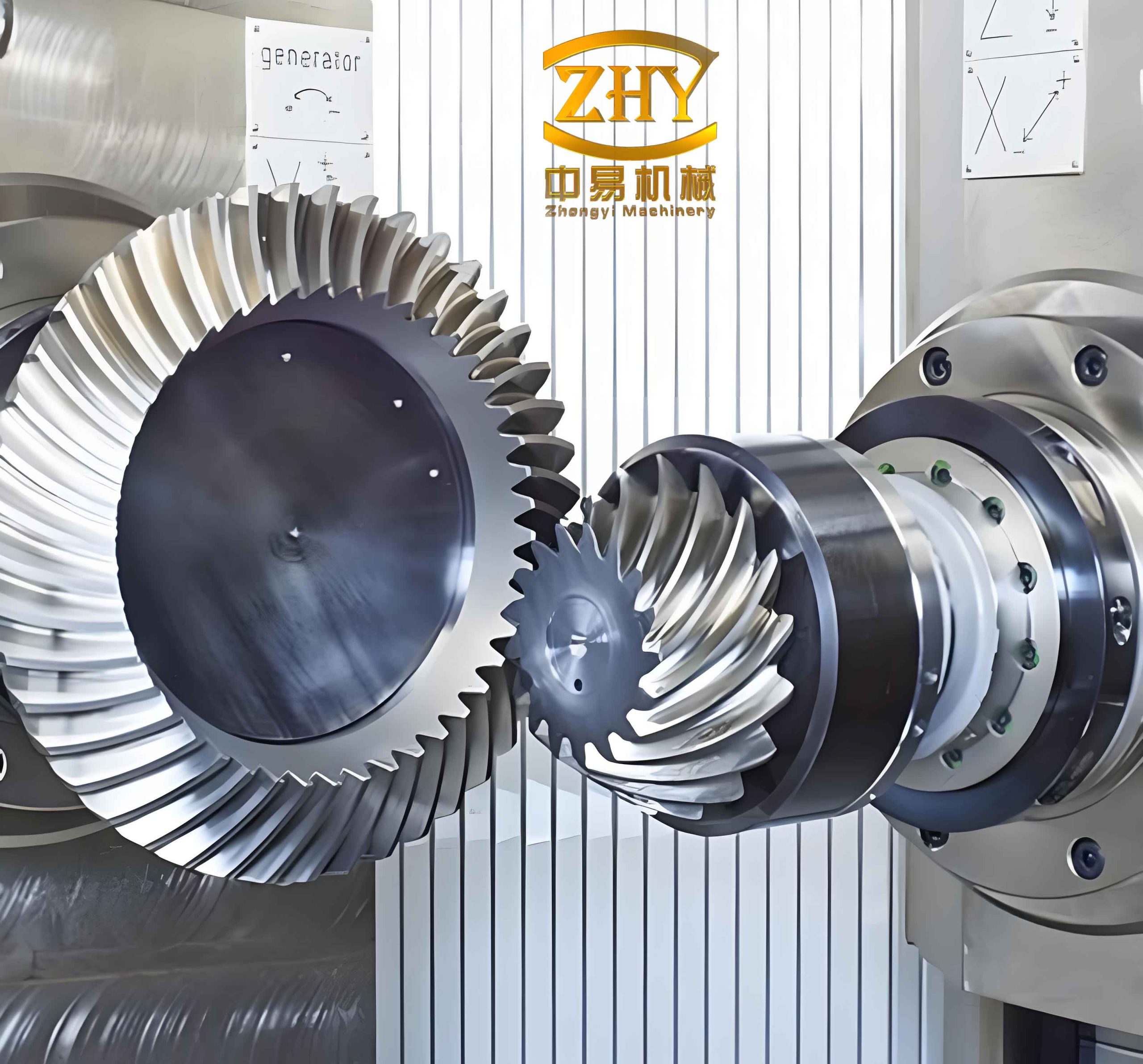
The visual complexity and precision of a hyperboloid gear set underscore why its lubrication demands are so specific. To appreciate the geometry that necessitates such a specialized lubricant, consider the following image which illustrates the intricate mating surfaces of a hyperboloidal gear pair.
When hyperboloid gear oil is incorrectly used in a standard transmission equipped with involute gears, several detrimental processes occur. The operational temperature in such a transmission is insufficient to fully activate the EP additives in their intended manner. However, the chemically active sulfur and chlorine compounds can still slowly react with gear and synchronizer surfaces, especially those made from copper alloys (e.g., brass synchronizer rings). This leads to chemical corrosive wear, which is progressive and insidious. The wear mechanism can be modeled as a low-temperature corrosion rate accelerated by mechanical action. The material removal rate might be approximated by a modified Archard’s wear equation, where the wear coefficient K is no longer purely mechanical but has a chemical component:
$$V = K_{chem} \cdot \frac{F_N \cdot s}{H}$$
Here, \(V\) is the wear volume, \(F_N\) is the normal load, \(s\) is the sliding distance, \(H\) is the material hardness, and \(K_{chem}\) is a chemically augmented wear coefficient that is a function of additive concentration \([A]\) and temperature \(T\):
$$K_{chem} = K_0 + \alpha [A] e^{-E_a/(RT)}$$
where \(K_0\) is the base mechanical wear coefficient, \(\alpha\) is a reactivity constant, \(E_a\) is the activation energy for the corrosive reaction, and \(R\) is the gas constant. In a low-temperature environment, the exponential term is small but non-zero, leading to a higher net \(K_{chem}\) than \(K_0\), resulting in accelerated wear compared to using a proper non-EP oil.
Furthermore, the high-EP additives can degrade other transmission components. Seal materials, particularly certain elastomers, may harden, crack, or swell when exposed to the aggressive chemistry of hyperboloid gear oil. The result is leakage, contamination, and ultimately, transmission failure. Therefore, the economic argument is twofold: not only is hyperboloid gear oil more expensive per liter, but its misuse precipitates premature, costly repairs. The financial impact \(C_{total}\) of such a substitution error over a vehicle’s lifecycle can be expressed as:
$$C_{total} = (P_{hyp} – P_{ord}) \cdot V_{oil} + \int_{0}^{T_{fail}} \left( \beta \cdot R_{wear}(t) \right) dt + C_{repair}$$
where \(P_{hyp}\) and \(P_{ord}\) are the unit prices of hyperboloid and ordinary gear oil, \(V_{oil}\) is the volume used, \(T_{fail}\) is the reduced time to failure, \(\beta\) is a cost factor for wear-induced damage, \(R_{wear}(t)\) is the accelerated wear rate function, and \(C_{repair}\) is the cost of the eventual repair.
The selection of the correct gear oil is therefore a critical engineering decision. For vehicles employing a hyperboloid gear in the rear axle, the manufacturer’s specification—usually an API GL-5 or similar rating—must be followed rigorously. For manual transmissions, which may use a separate lubricant, specifications like API GL-4, MTF, or specific OEM standards apply. It is a common error to assume GL-5 is “better” than GL-4 and thus suitable for both; while some GL-5 oils may be labeled as suitable for certain manual transmissions, many are not due to their high EP activity harming synchronizers. The compatibility matrix is essential:
| Component | Gear Type | Required Oil Performance | Typical API Classification / Specification |
|---|---|---|---|
| Rear Axle / Final Drive | Hypoid / Hyperboloid | High EP, High Thermal Stability | API GL-5, MIL-PRF-2105E, OEM-specific (e.g., SAE 75W-90) |
| Manual Transmission | Mostly Involute Helical/Spur Gears | Moderate EP, Friction Modification for Synchros | API GL-4, MT-1, OEM-specific (e.g., Ford MERCON®, GM Synchromesh) |
| Transfer Case | Involute Gears, Chain Drives | Moderate to High EP (depending on design), Shear Stability | API GL-4, GL-5 (if specified), ATF, Dedicated Transfer Case Fluid |
Beyond the chemical composition, the rheological properties of the lubricant are vital. The viscosity grade (e.g., SAE 75W-90) must be chosen for the operational climate to ensure proper film formation at startup and maintained protection at temperature. The pressure-viscosity coefficient \(\alpha\) is a key parameter in elastohydrodynamic lubrication (EHL) theory, which governs film thickness \(h\) in gear contacts. The central film thickness for a line contact can be estimated by the Dowson-Higginson equation:
$$\frac{h_c}{R} = 2.65 \frac{(U \eta_0)^{0.7} \alpha^{0.54}}{E’^{0.03} W^{0.13}}$$
where \(R\) is the reduced radius of curvature, \(U\) is the mean rolling speed, \(\eta_0\) is the atmospheric dynamic viscosity, \(\alpha\) is the pressure-viscosity coefficient, \(E’\) is the reduced elastic modulus, and \(W\) is the load per unit length. For a hyperboloid gear, the severe sliding component means that maintaining even a minimal EHL film is challenging, hence the reliance on EP additives when the film collapses. The base oil’s \(\alpha\) value is thus carefully selected in hyperboloid gear oil formulations to maximize film thickness under high pressure.
In my practice, I have also observed that the performance window for hyperboloid gear oil is narrow. Prolonged use beyond its drain interval, contamination with water, or mixing with incompatible lubricants can degrade its effectiveness. Water ingress is particularly dangerous as it can hydrolyze chlorine-based EP additives, generating hydrochloric acid (HCl):
$$\text{FeCl}_2 + 2\text{H}_2\text{O} \rightleftharpoons \text{Fe(OH)}_2 + 2\text{HCl}$$
The liberated HCl causes aggressive acid corrosion, pitting gear teeth and bearings. This underscores the importance of regular maintenance and using the correct fluid from the outset.
The evolution of hyperboloid gear technology has been paralleled by advances in lubricant chemistry. Modern hyperboloid gear oils often use synergistic combinations of sulfur and phosphorus EP agents that offer a better balance between extreme pressure performance and corrosion control. Some advanced formulations also incorporate solid lubricants like graphite or boron nitride nanoparticles to provide an additional safety margin. However, the fundamental principle remains: these additives are tailored for the brutal environment of the hyperboloid gear mesh. They are not benign in milder settings.
To further illustrate the point, consider the thermal dynamics within a gearbox. The heat generation \(Q\) in a gear pair is a function of transmitted power \(P\), efficiency \(\eta\), and sliding friction:
$$Q \approx P(1 – \eta) + \mu_s F_N v_s$$
where \(\mu_s\) is the sliding friction coefficient. For a hyperboloid gear, the sliding term dominates the losses, leading to high \(Q\). The lubricant must not only protect but also effectively carry away this heat. Ordinary gear oil, not formulated for such high thermal loads, may oxidize and form sludge, further impeding performance. The oxidation stability is quantified by tests like the Rotary Bomb Oxidation Test (RBOT), and hyperboloid gear oils score highly on these metrics to ensure longevity under thermal stress.
In conclusion, the choice between hyperboloid gear oil and ordinary gear oil is not one of generic quality but of specific suitability. The hyperboloid gear, a marvel of mechanical engineering enabling powerful and efficient drivetrains, demands a lubricant that operates on the very edge of chemistry and tribology. Using this specialized fluid in a standard transmission is akin to using a high-octane racing fuel in a lawnmower—it is not only wasteful but potentially destructive. The controlled corrosive action of EP additives, essential for protecting hyperboloid gears, becomes a source of insidious wear in ordinary gearing. As custodians of automotive machinery, our goal should be to understand these principles deeply. Always consult the vehicle manufacturer’s specifications, understand the gear types present in each lubrication sump, and select the oil whose performance profile matches the mechanical and thermal environment it will face. The integrity of the hyperboloid gear system, and indeed the entire drivetrain, depends on this disciplined approach to lubrication.