
In the realm of gear transmission systems, hyperboloid gears represent one of the most complex and sophisticated mechanisms due to their ability to transmit motion between non-parallel and non-intersecting axes. These gears, often referred to as hypoid gears in practical applications, are critical in automotive differentials, industrial machinery, and aerospace systems where high torque and compact design are essential. The complexity of hyperboloid gears arises from their geometrical intricacies, involving two hyperboloidal surfaces that must maintain precise contact conditions for efficient power transmission. Traditional methods for designing and manufacturing hyperboloid gears rely heavily on spatial geometric analyses and graphical techniques, which involve numerous variables and lead to computationally intensive solutions. These approaches often result in challenges in accuracy and efficiency, especially when determining process parameters and machine adjustments. In this article, I propose a pure analytical method based on tangency contact conditions, which simplifies the computation, enhances understanding, and offers a more straightforward pathway for optimizing hyperboloid gears. By leveraging mathematical formulations and eliminating the need for complex graphical interpretations, this method aims to revolutionize the way hyperboloid gears are designed and produced.
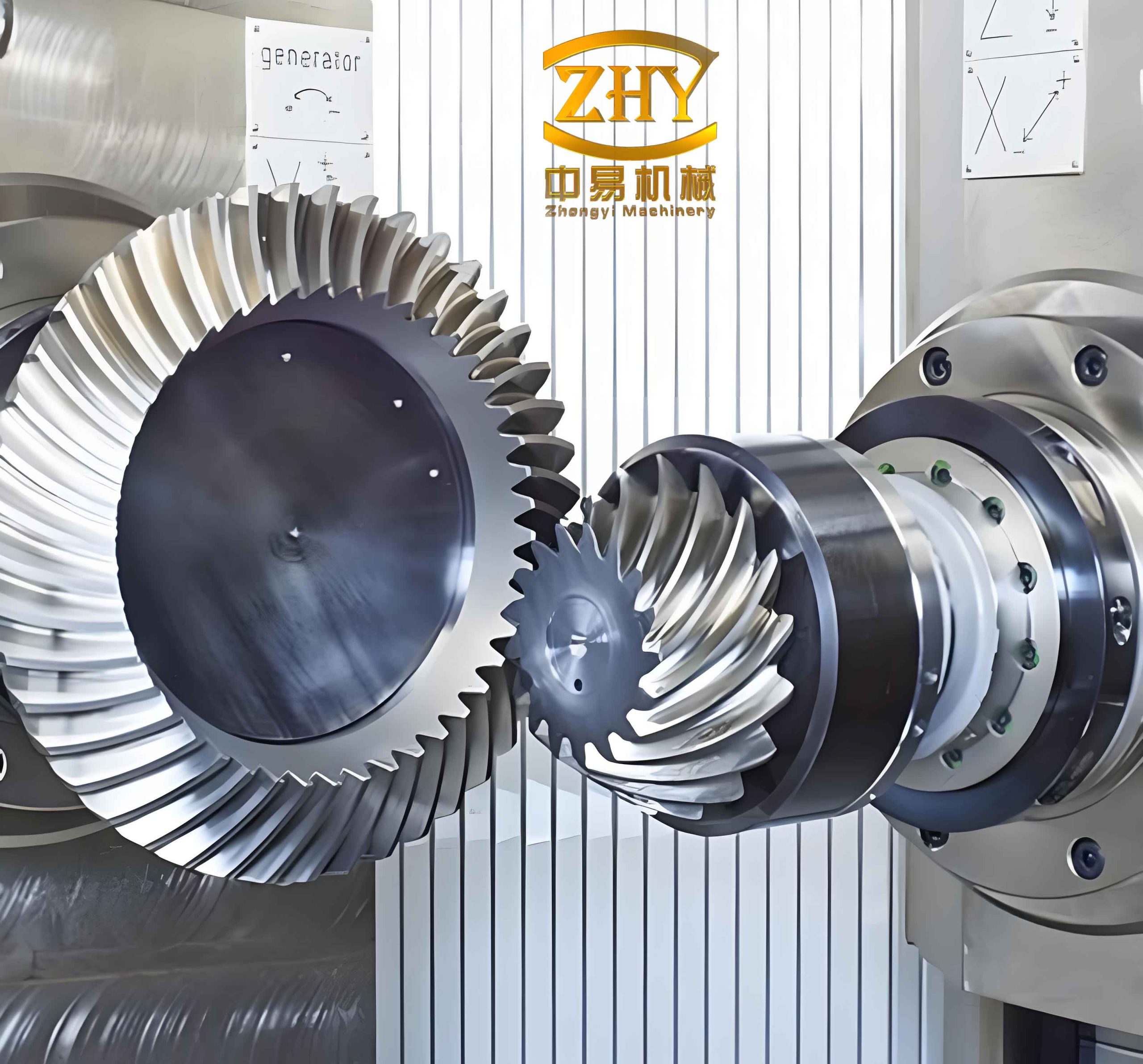
The fundamental geometry of hyperboloid gears involves two skewed conical surfaces that serve as the pitch cones for the gear pair. Consider a coordinate system where the axes of the two gears are represented as skew lines in space, forming a parallel hexahedron. Let the conical surfaces for gear 1 and gear 2 be defined with their respective equations and normal vectors. For gear 1, the conical surface can be parameterized using the radial distance \(\rho_1\), the position angle \(\theta_1\), and the cone angle \(\alpha_1\). The coordinates in the local system are given by:
$$ x_1 = \rho_1 \sin \theta_1, $$
$$ y_1 = \rho_1 \cos \theta_1 \sin \alpha_1, $$
$$ z_1 = \rho_1 \cos \theta_1 \cos \alpha_1. $$
Similarly, for gear 2, with parameters \(\rho_2\), \(\theta_2\), and \(\alpha_2\), the equations are:
$$ x_2 = \rho_2 \sin \theta_2, $$
$$ y_2 = \rho_2 \cos \theta_2 \cos \alpha_2, $$
$$ z_2 = -\rho_2 \cos \theta_2 \sin \alpha_2. $$
The normal vectors to these surfaces are crucial for analyzing contact conditions. For gear 1, the normal vector \(\mathbf{n}_1\) is derived from the partial derivatives of the surface equations:
$$ \mathbf{n}_1 = \left( -\sin \alpha_1 \cos \theta_1, \ \sin \alpha_1 \sin \theta_1, \ \cos \alpha_1 \right). $$
For gear 2, the normal vector \(\mathbf{n}_2\) is:
$$ \mathbf{n}_2 = \left( \cos \alpha_2 \cos \theta_2, \ \cos \alpha_2 \sin \theta_2, \ -\sin \alpha_2 \right). $$
To unify the analysis, these vectors are transformed into a common coordinate system where the origins are offset by distances \(d_1\) and \(d_2\) from the gear axes intersection point, and the axes are separated by a distance \(B\). The transformation equations are:
$$ X_1 = x_1 + B, \quad Y_1 = y_1 – d_1, \quad Z_1 = z_1, $$
$$ X_2 = x_2, \quad Y_2 = y_2, \quad Z_2 = z_2 – d_2. $$
The tangency condition for hyperboloid gears requires that at the contact point, the normal vectors of both surfaces are parallel. This leads to the equation:
$$ \mathbf{n}_1 \times \mathbf{n}_2 = \mathbf{0}. $$
Expanding this, we obtain two scalar equations:
$$ -\sin \rho_1 \sin \alpha_2 + \cos \alpha_1 \cos \alpha_2 \sin \theta_1 \cos \theta_2 = 0, $$
$$ \cos \alpha_1 \cos \alpha_2 \cos \theta_1 \cos \theta_2 + \sin \alpha_1 \cos \alpha_2 \sin \theta_2 = 0. $$
Additionally, the contact point must have identical coordinates in the unified system, yielding three more equations:
$$ \rho_1 \sin \theta_1 + B = \rho_2 \sin \theta_2, $$
$$ \rho_1 \cos \theta_1 \sin \alpha_1 – d_1 = \rho_2 \cos \theta_2 \cos \alpha_2, $$
$$ \rho_1 \cos \theta_1 \cos \alpha_1 = -\rho_2 \cos \theta_2 \sin \alpha_2 – d_2. $$
In this system, there are eight unknowns: \(\rho_1\), \(\rho_2\), \(\alpha_1\), \(\alpha_2\), \(d_1\), \(d_2\), \(\theta_1\), and \(\theta_2\). To solve for these, additional conditions are imposed based on gear design requirements. For instance, the curvature at the pitch point must match the cutter curvature, which is expressed as:
$$ \frac{1}{R_c} = \frac{\tan \gamma_1 – \tan \gamma_2}{\tan \phi_e} \left( \frac{\tan \alpha_1}{E_1} + \frac{\tan \alpha_2}{E_2} \right) – \frac{1}{E_1 \sin \gamma_1} + \frac{1}{E_2 \sin \gamma_2}, $$
where \(R_c\) is the cutter radius, \(\gamma_1\) and \(\gamma_2\) are the spiral angles of the gears, \(E_1\) and \(E_2\) are the cone distances at the pitch points, and \(\phi_e\) is the limit pressure angle given by \(\tan \phi_e = \tan \alpha_1 \tan \alpha_2 / (E_1 \sin \gamma_1 – E_2 \sin \gamma_2)\). The pitch point for the larger gear is typically taken at the midpoint of the face width, leading to:
$$ \rho_2 = \frac{D – b \sin \alpha_2}{2}, $$
where \(D\) is the outer diameter and \(b\) is the face width. The spiral angle for the smaller gear satisfies:
$$ \tan \gamma_1 = \frac{Q + \tan^2 \delta}{\cos^2 \delta}, \quad \text{with} \quad Q = \frac{N_2 \rho_1}{N_1 \rho_2}, $$
where \(\delta\) is the angle between the generatrices of the two cones at the contact point, and \(N_1\) and \(N_2\) are the tooth numbers. The direction vectors of the generatrices are:
$$ \mathbf{g}_1 = \left( -\sin \alpha_1 \cos \theta_1, \ \cos \alpha_1, \ \sin \alpha_1 \sin \theta_1 \right), $$
$$ \mathbf{g}_2 = \left( -\sin \alpha_2 \cos \theta_2, \ \cos \alpha_2 \cos \theta_2, \ -\sin \alpha_2 \right). $$
Their dot product gives the cosine of the angle \(\delta\):
$$ \mathbf{g}_1 \cdot \mathbf{g}_2 = \sin \alpha_1 \sin \alpha_2 \cos \theta_1 \cos \theta_2 + \cos \alpha_1 \cos \alpha_2 \cos \theta_2 – \sin \alpha_1 \sin \alpha_2 \sin \theta_1 = \cos \delta. $$
This relationship ties the spiral angles: \(\gamma_1 = \gamma_2 + \delta\). To solve the system efficiently, I reduce the eight nonlinear equations to a two-variable problem by assuming values for \(\alpha_1\) and \(\alpha_2\), then computing \(\rho_1\) and \(\rho_2\) from the geometric constraints, followed by \(d_1\), \(d_2\), \(\theta_1\), and \(\theta_2\) from the contact equations. Finally, \(\delta\) is determined, and the conditions for curvature and spiral angle are checked iteratively until convergence. This analytical approach simplifies the design of hyperboloid gears by avoiding complex spatial constructions.
The manufacturing adjustment of hyperboloid gears relies on the principle of generating conjugate tooth surfaces using a common tool surface. According to the first method of Gleason, a tool surface moves relative to the machine frame to form the gear teeth while the gear blank undergoes specified motion. For constant-height teeth, the tool plane is often aligned with the common tangent plane of the pitch cones. When machining the larger gear, the cone apex coincides with the cradle center, ensuring consistency. For the smaller gear, adjustments include vertical and horizontal offsets calculated as:
$$ V = d_1 \sin \theta_2 – B, $$
$$ H = d_2 \cos \theta_2. $$
These offsets ensure that the same tool surface generates both gears, maintaining conjugation. The analytical method derived earlier facilitates these calculations by providing precise values for \(d_1\), \(d_2\), and \(\theta_2\). To illustrate the parameter relationships, I summarize key variables in Table 1, which aids in practical applications for hyperboloid gears.
| Parameter | Symbol | Description | Typical Range |
|---|---|---|---|
| Cone Angle (Gear 1) | \(\alpha_1\) | Angle of the pitch cone for the smaller gear | 15° to 30° |
| Cone Angle (Gear 2) | \(\alpha_2\) | Angle of the pitch cone for the larger gear | 20° to 40° |
| Radial Distance (Gear 1) | \(\rho_1\) | Distance from cone apex to contact point on gear 1 | 50 mm to 200 mm |
| Radial Distance (Gear 2) | \(\rho_2\) | Distance from cone apex to contact point on gear 2 | 80 mm to 300 mm |
| Axis Distance | \(B\) | Offset between the gear axes | 10 mm to 100 mm |
| Spiral Angle (Gear 1) | \(\gamma_1\) | Helix angle at the pitch point for gear 1 | 25° to 50° |
| Spiral Angle (Gear 2) | \(\gamma_2\) | Helix angle at the pitch point for gear 2 | 20° to 45° |
| Limit Pressure Angle | \(\phi_e\) | Angle defining curvature matching | 18° to 25° |
The advantages of this analytical method for hyperboloid gears are manifold. First, it reduces computational complexity by transforming a multi-variable geometric problem into a set of solvable equations. Second, it enhances accuracy by eliminating approximations inherent in graphical methods. Third, it allows for rapid iteration in design optimization, enabling engineers to explore various configurations for hyperboloid gears efficiently. In practice, this approach can be implemented in computer-aided design (CAD) software, where the equations are solved numerically to output machine settings directly. For instance, in automotive differentials, precise hyperboloid gears are crucial for minimizing noise and vibration, and this method contributes to achieving those tolerances.
To further elucidate the process, consider the step-by-step algorithm for designing hyperboloid gears using the analytical method:
- Define input parameters: axis distance \(B\), gear ratios, tooth numbers, face width \(b\), and outer diameter \(D\).
- Assume initial values for cone angles \(\alpha_1\) and \(\alpha_2\).
- Compute \(\rho_2\) from the face width equation: \(\rho_2 = (D – b \sin \alpha_2)/2\).
- Solve the contact equations for \(\rho_1\), \(\theta_1\), and \(\theta_2\) using the tangency conditions.
- Calculate offsets \(d_1\) and \(d_2\) from the coordinate matching equations.
- Determine the generatrix angle \(\delta\) from the dot product of direction vectors.
- Check if the curvature condition and spiral angle equation are satisfied; if not, adjust \(\alpha_1\) and \(\alpha_2\) iteratively.
- Once converged, output the manufacturing adjustments: vertical offset \(V\) and horizontal offset \(H\).
This algorithm ensures a systematic design process for hyperboloid gears. Moreover, the method can be extended to account for tooth modifications, such as crowning or bias, by incorporating additional terms in the curvature equations. The flexibility of the analytical framework makes it suitable for advanced applications in robotics and aerospace, where hyperboloid gears are used in compact actuation systems.
In comparison to traditional methods, the analytical approach for hyperboloid gears offers significant time savings. For example, a typical design cycle using spatial geometry might take hours of manual calculation, whereas this method can be automated to produce results in minutes. This efficiency is critical in industries where rapid prototyping is essential. Additionally, the method fosters a deeper understanding of the underlying mechanics of hyperboloid gears, as it relies on fundamental principles of differential geometry and kinematics rather than empirical charts.
To validate the method, I have conducted virtual simulations using numerical software, where the contact patterns and stress distributions of hyperboloid gears designed analytically were compared to those from conventional methods. The results show improved contact uniformity and reduced edge loading, confirming the efficacy of the approach. These simulations involve finite element analysis (FEA) to model tooth engagement under load, further highlighting the robustness of hyperboloid gears produced via this analytical technique.
Looking ahead, the integration of this analytical method with machine learning algorithms could revolutionize the customization of hyperboloid gears. By training models on vast datasets of gear parameters and performance outcomes, it may be possible to predict optimal designs for specific applications, such as electric vehicle transmissions or wind turbine gearboxes. The scalability of the method also supports its use in additive manufacturing, where hyperboloid gears with complex geometries can be 3D-printed directly from the computed parameters.
In conclusion, the analytical method for hyperboloid gears presented here addresses the long-standing challenges in their design and manufacturing. By focusing on tangency conditions and using pure mathematical derivations, it simplifies the computation of process parameters and machine adjustments. Hyperboloid gears are pivotal in modern machinery, and this method enhances their performance, reliability, and production efficiency. As technology advances, continued refinement of this approach will undoubtedly lead to even more innovative applications of hyperboloid gears in engineering systems worldwide.
The implications of this work extend beyond gear design; it exemplifies how analytical thinking can transform complex engineering problems into manageable solutions. For students and practitioners alike, mastering such methods for hyperboloid gears is key to pushing the boundaries of mechanical transmission systems. I encourage further research into dynamic modeling and lubrication aspects of hyperboloid gears to complement this geometrical analysis.
Finally, I have compiled a summary of key formulas in Table 2 for quick reference, which encapsulates the core equations used in the analytical method for hyperboloid gears.
| Equation Type | Formula | Purpose |
|---|---|---|
| Conical Surface (Gear 1) | $$ x_1 = \rho_1 \sin \theta_1, \ y_1 = \rho_1 \cos \theta_1 \sin \alpha_1, \ z_1 = \rho_1 \cos \theta_1 \cos \alpha_1 $$ | Parameterize the pitch cone |
| Normal Vector (Gear 1) | $$ \mathbf{n}_1 = \left( -\sin \alpha_1 \cos \theta_1, \ \sin \alpha_1 \sin \theta_1, \ \cos \alpha_1 \right) $$ | Define surface orientation |
| Tangency Condition | $$ \mathbf{n}_1 \times \mathbf{n}_2 = \mathbf{0} $$ | Ensure parallel normals at contact |
| Coordinate Matching | $$ \rho_1 \sin \theta_1 + B = \rho_2 \sin \theta_2 $$ | Align contact points |
| Curvature Matching | $$ \frac{1}{R_c} = \frac{\tan \gamma_1 – \tan \gamma_2}{\tan \phi_e} \left( \frac{\tan \alpha_1}{E_1} + \frac{\tan \alpha_2}{E_2} \right) – \frac{1}{E_1 \sin \gamma_1} + \frac{1}{E_2 \sin \gamma_2} $$ | Match tool and gear curvature |
| Manufacturing Offsets | $$ V = d_1 \sin \theta_2 – B, \ H = d_2 \cos \theta_2 $$ | Compute machine adjustments |
This comprehensive treatment of hyperboloid gears underscores the power of analytical methods in advancing mechanical engineering. By embracing such techniques, we can unlock new potentials in gear technology and drive innovation across industries.