
In the realm of automotive powertrain systems, the final drive assembly is paramount for torque transmission and speed reduction. Among its core components, hyperboloidal gears are extensively employed due to their superior load-bearing capacity and favorable Noise, Vibration, and Harshness (NVH) characteristics. The efficient and reliable operation of these gears hinges on a critical yet often nuanced design parameter: the tooth side clearance, or backlash.
The fundamental purpose of introducing clearance between the non-working flanks of meshing hyperboloidal gears is twofold. Primarily, it ensures the formation of a lubricant film between the contacting tooth surfaces. This film is indispensable for mitigating friction, dissipating heat, and preventing scoring or seizure that could lead to premature gear failure. Secondly, the clearance accommodates thermal expansion of the gear set during operation. Without sufficient allowance, thermal growth could eliminate the clearance, leading to binding, excessive load, and catastrophic failure. However, this clearance is a double-edged sword. While its absence is detrimental, excessive backlash introduces discrete impacts at the tooth meshing point during torque reversals or load variations, significantly degrading the NVH performance of the driveline. Therefore, determining an optimal, scientifically-grounded tooth side clearance range is a central challenge in the design and manufacture of hyperboloidal gear sets. This study synthesizes methodologies from theoretical forward design, reverse engineering based on manufacturing capabilities, empirical quality data, and considerations of load-induced and thermal deformation to establish a robust design framework for this parameter.
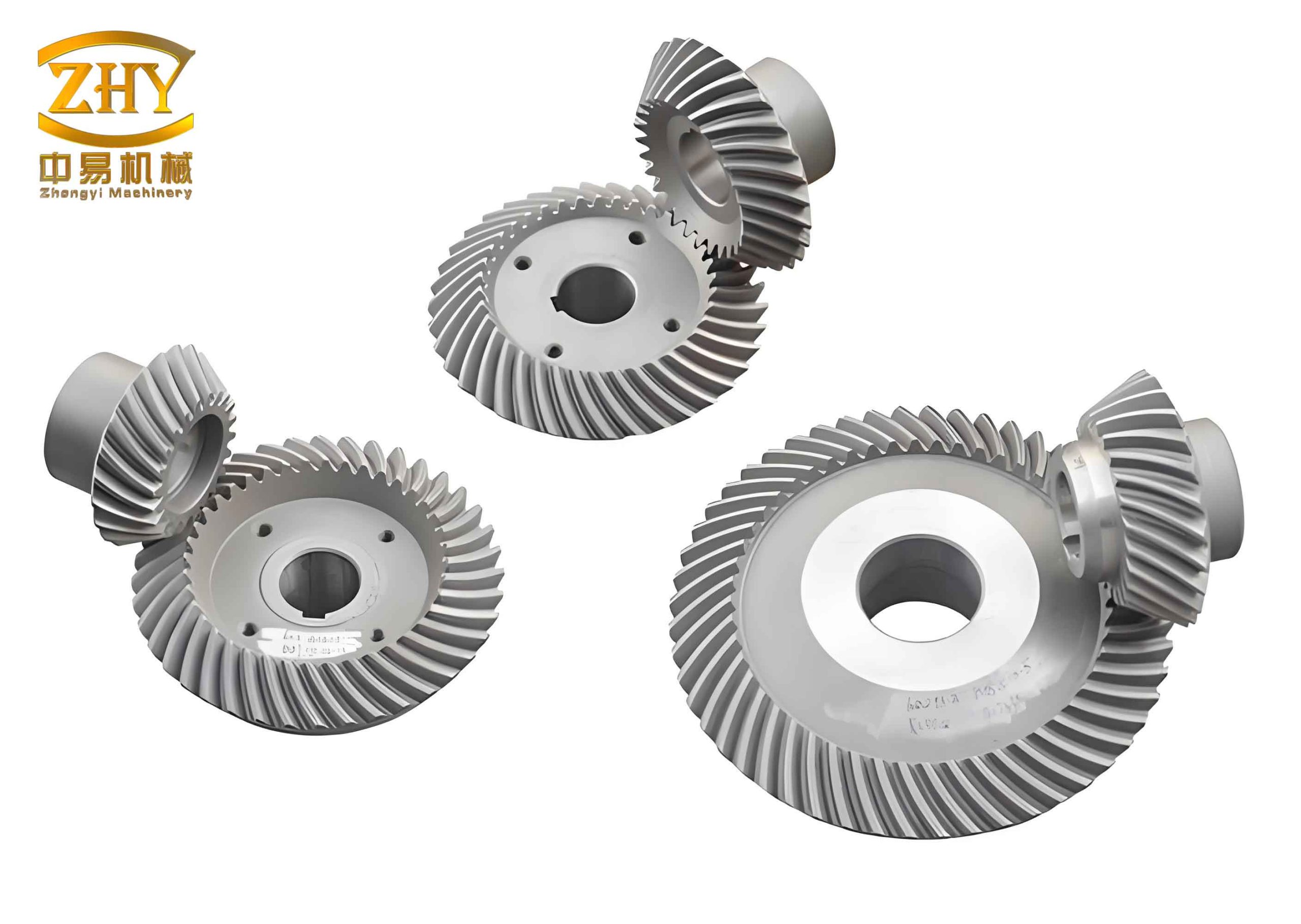
The theoretical design phase serves as the foundation. Utilizing specialized gear design software, such as the Gleason C-AGE system, the nominal tooth side clearance is calculated based on the gear geometry, module, and intended application. For a typical automotive final drive hyperboloidal gear set, this forward design often yields a recommended clearance range. For instance, a common output from such software might be a design backlash of:
$$ BL_{design} = 0.127 \text{ mm to } 0.1778 \text{ mm} $$
This range aligns with established empirical selection tables that correlate clearance with gear pitch diameter. The following table provides generalized guidelines:
| Pitch Diameter Range (mm) | Minimum Backlash (mm) | Maximum Backlash (mm) |
|---|---|---|
| >127 to 152.4 | 0.13 | 0.18 |
| >152.4 to 203.2 | 0.10 | 0.15 |
| >203.2 to 254.0 | 0.08 | 0.13 |
While theoretical design provides a target, the real-world achievable clearance is governed by manufacturing precision. Gear quality is standardized, often targeting Grade 7 per standards like GB/T 11365 or AGMA 2005. The single most significant manufacturing factor affecting the instantaneous backlash in an assembly with fixed mounting distance is the individual pitch error of the pinion and gear. The pitch deviation ($F_p$) is the difference between the actual and theoretical pitch. For a given grade, maximum permissible errors are defined. For Grade 7 hyperboloidal gears, typical values are:
| Gear | Grade 7 Pitch Error $F_p$ (µm) |
|---|---|
| Pinion (Drive) | 45 |
| Gear (Driven) | 63 |
In a worst-case scenario (extreme value analysis), the cumulative effect of these errors on backlash variation can be estimated. If one gear has its maximum positive pitch error and its mate has the maximum negative error (or vice versa), the total variation ($\Delta BL_{manufacturing}$) from the nominal setting is the sum of the individual pitch errors:
$$ \Delta BL_{manufacturing} = F_{p(pinion)} + F_{p(gear)} = 45 \mu m + 63 \mu m = 108 \mu m = 0.108 \text{ mm} $$
Thus, even if the assembly is adjusted to a nominal midpoint of the design range (e.g., $BL_{mid} = 0.155$ mm), the measured backlash at different tooth engagements could theoretically vary between:
$$ BL_{min(theoretical)} = BL_{mid} – \Delta BL_{manufacturing} = 0.155 – 0.108 = 0.047 \text{ mm} $$
$$ BL_{max(theoretical)} = BL_{mid} + \Delta BL_{manufacturing} = 0.155 + 0.108 = 0.263 \text{ mm} $$
This highlights a crucial point: the inherent variability in manufacturing precision dictates a functional tolerance band for backlash that is wider than the designer’s initial intent. Furthermore, the meshing relationship of hyperboloidal gears, especially with non-integer ratio teeth, means that measuring backlash at the same index position after rotation involves different tooth pairs, each with its own unique micro-geometry errors, explaining the observed variation in successive measurements.
Empirical data from production assembly and testing validates this theoretical manufacturing spread. Measurements taken on 50 final drive assemblies, both post-assembly and post-run-in test, show a practical range of backlash values. A subset of this data is summarized below:
| Unit ID | State | Position 1 (mm) | Position 2 (mm) | Position 3 (mm) | Position 4 (mm) |
|---|---|---|---|---|---|
| 1 | Pre-test | 0.14 | 0.15 | 0.13 | 0.14 |
| Post-test | 0.16 | 0.16 | 0.15 | 0.17 | |
| 2 | Pre-test | 0.12 | 0.12 | 0.11 | 0.13 |
| Post-test | 0.15 | 0.13 | 0.13 | 0.16 | |
| 3 | Pre-test | 0.13 | 0.14 | 0.18 | 0.17 |
| Post-test | 0.17 | 0.16 | 0.20 | 0.18 |
The observed range of approximately 0.07 mm to 0.21 mm falls within the broader theoretical manufacturing limits, confirming the analysis. The slight increase post-test can often be attributed to initial seating of bearings and wear-in of gear micro-roughness.
A critical, non-manufacturing factor that sets the absolute lower bound for assembly backlash is the deformation of hyperboloidal gears under load and temperature. During operation, gears experience elastic deflection due to transmitted torque and significant thermal expansion. The working flank is subject to both load deformation and thermal growth, while the non-working flank primarily experiences thermal expansion. Neglecting this combined deformation risks designing an assembly clearance that becomes zero or negative (interference) in service, leading to high contact stress, oil film collapse, and noise.
Load-induced separation can be estimated from recommended “separation factor” values, often around 0.00635 mm for automotive hyperboloidal gears. Thermal expansion is calculated using the coefficient of linear thermal expansion for steel ($\alpha \approx 11 \times 10^{-6} /^\circ C$) over a typical operating temperature rise ($\Delta T$). For a temperature range from ambient (20°C) to an operating temperature of 70-150°C, the expansion per flank is significant. Considering a conservative temperature rise of 80°C (to 100°C) for the gear bulk, the thermal growth $\delta_{thermal}$ for a characteristic dimension is:
$$ \delta_{thermal} = \alpha \cdot L \cdot \Delta T $$
Where $L$ is a representative tooth thickness or related dimension. For estimation, a nominal tooth thickness $L$ in the order of 10-20 mm is considered. For $L=15$ mm and $\Delta T=80^\circ C$:
$$ \delta_{thermal} = 11 \times 10^{-6} \cdot 15 \cdot 80 = 0.0132 \text{ mm} $$
More severe operating conditions (e.g., heavy towing) can lead to higher temperatures and greater expansion. Therefore, the total effective reduction in clearance on one side of the tooth due to deformation can be approximated as the sum of load separation and thermal expansion. Since both flanks (driving and coast) expand, the total minimum clearance required to avoid binding ($BL_{min\_required}$) is roughly twice the thermal expansion plus the load separation allowance:
$$ BL_{min\_required} \approx 2 \cdot \delta_{thermal} + \delta_{load} $$
Using the values above:
$$ BL_{min\_required} \approx 2 \cdot (0.0132 \text{ to } 0.03) + 0.00635 = 0.03275 \text{ to } 0.06635 \text{ mm} $$
A more stringent check ensures the non-working flank does not interfere during meshing entry, suggesting the required assembly clearance should safely exceed this sum. A practical lower limit derived from experience and analysis is often higher, in the range of **0.10 mm to 0.11 mm**.
Synthesizing all constraints, the final specification for assembly tooth side clearance for hyperboloidal gears is determined through a confluence of methodologies:
- Theoretical Design Target: 0.127 – 0.1778 mm.
- Manufacturing Capability (Grade 7): Induces a variation of ±0.108 mm around any set nominal value.
- Empirical Production Data: Shows a realized range of 0.07 – 0.21 mm.
- Operational Deformation Limit: Dictates an absolute minimum above approximately 0.107 mm to prevent negative clearance.
The intersection of these domains yields a robust, manufacturable, and functionally safe specification. An assembly clearance range of **0.11 mm to 0.20 mm** satisfies all criteria. This range accommodates the cumulative tolerances of all related components (gears, bearings, housing), provides a safety margin against thermal binding, and remains within the bounds of typical manufacturing process capability for Grade 7 hyperboloidal gears. Specifying an unnecessarily narrow range (e.g., 0.13-0.14 mm) would lead to high scrap or rework rates without providing a functional benefit, while a range that ignores the thermal lower bound risks field failures.
The influence of tooth side clearance on the NVH performance of hyperboloidal gears is profound and is intrinsically linked to the concept of transmission error (TE). TE is the deviation of the actual position of the driven gear from its theoretical position relative to the driver, and it is the primary excitation source for gear whine noise. In an ideal, perfectly conjugate gear pair with zero errors and zero clearance, TE would be zero. In practice, gears are manufactured with a deliberate “mismatch” or localized contact pattern to accommodate misalignments and ensure stable contact under load. The tooth side clearance is a key element of this mismatch topology.
An optimized clearance works in concert with the prescribed tooth surface modifications (e.g., tip and root relief, lead crowning) to manage the progression of mesh stiffness and minimize the amplitude of transmission error across the entire path of contact. Insufficient clearance, as discussed, leads to a high risk of interference and a sudden, sharp increase in TE. Excessive clearance allows for momentary loss of contact during load reversals, resulting in impactive events that excite structural resonances, manifesting as clunk or rattle. The relationship between normalized backlash ($b^* = b / m_n$, where $b$ is backlash and $m_n$ is normal module) and dynamic factor can be conceptually represented in design charts, emphasizing the existence of an optimal zone. Therefore, the specified backlash range is not merely an assembly tolerance but a critical design variable for acoustic performance. Its control, along with contact pattern optimization, is essential for achieving the renowned quiet operation of well-designed hyperboloidal gear sets.
In conclusion, the design of tooth side clearance for hyperboloidal gears in final drive assemblies is a multidisciplinary exercise that balances tribological necessity, manufacturing reality, and acoustic performance. A purely theoretical forward design is insufficient. It must be tempered by a reverse analysis of process-induced variation, grounded by empirical quality data, and bounded by the absolute physical limits imposed by operational deformations. The methodology outlined herein—integrating forward design software outputs, statistical tolerance analysis based on gear grade, validation through production measurement, and thermodynamic/elastic deformation modeling—provides a comprehensive and scientific framework for defining this critical parameter. By adopting this synthesized approach, engineers can specify backlash ranges that ensure reliability, maximize manufacturing yield, and contribute to the superior NVH characteristics expected from modern automotive drivelines employing hyperboloidal gears. This systematic process also establishes a clear basis for continuous improvement initiatives aimed at reducing backlash-related non-conformities and refining gear set performance.