
1. Introduction
Hypoid gear is critical components in automotive drive axles, offering high torque transmission efficiency and compact design. However, their complex geometry and contact mechanics pose significant challenges in accurate tooth contact analysis (TCA). Traditional methods, such as pure analytical approaches or standalone finite element analysis (FEA), often fail to capture the intricate interactions between gear teeth under loaded conditions. This study proposes a hybrid methodology that integrates analytical modeling with finite element simulation to achieve precise contact analysis of hypoid gear.
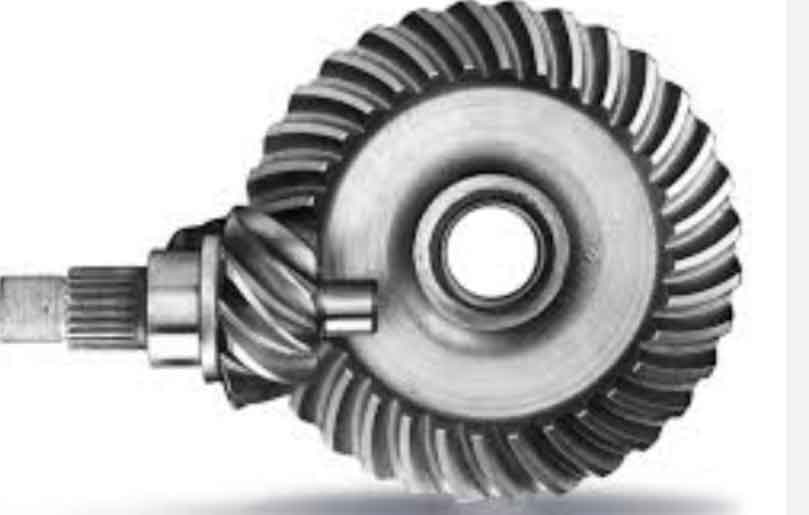
The primary objectives of this research are:
- To establish a mathematical model for hypoid gear machining using the HFT (Hyperboloidal Face-Hobbing Technique).
- To derive tooth surface equations and meshing models for both pinion and gear.
- To calculate transmission errors analytically and validate results against FEA simulations.
- To visualize the loaded tooth contact area using ABAQUS and compare results with MASTA software and experimental data.
This work bridges the gap between theoretical predictions and practical validations, offering a robust framework for optimizing hypoid gear design and performance.
2. Mathematical Modeling of Hypoid Gear Machining
2.1 Tooth Surface Equation Derivation
The tooth surface geometry of hypoid gear is defined using the HFT method. For a pinion (indexed as k=gk=g) and gear (k=pk=p), the tooth surface equation in the local coordinate system is expressed as:rk(uk,θk)=[(rk+uksinαk)cosθk(rk+uksinαk)sinθk−ukcosαk]rk(uk,θk)=(rk+uksinαk)cosθk(rk+uksinαk)sinθk−ukcosαk
where:
- rkrk: Base radius
- ukuk: Radial parameter
- θkθk: Angular parameter
- αkαk: Pressure angle
The normal vector nknk at any point on the tooth surface is given by:nk(uk,θk)=[−cosαkcosθk−cosαksinθksinαk]nk(uk,θk)=[−cosαkcosθk−cosαksinθksinαk]
2.2 Coordinate Transformation
To analyze gear meshing, tooth surfaces are transformed into a fixed coordinate system SaSa:ra1(u1,θ1,ϕ1)=MadMd1r1(u1,θ1)ra1(u1,θ1,ϕ1)=MadMd1r1(u1,θ1)ra2(u2,θ2,ϕ2)=MabMb2r2(u2,θ2)ra2(u2,θ2,ϕ2)=MabMb2r2(u2,θ2)
Here, Mad,Md1,Mab,Mb2Mad,Md1,Mab,Mb2 are transformation matrices accounting for rotational and translational displacements during meshing.
2.3 Meshing Conditions
At any contact point, the pinion and gear must satisfy:
- Position Continuity:
ra1(u1,θ1,ϕ1)=ra2(u2,θ2,ϕ2)ra1(u1,θ1,ϕ1)=ra2(u2,θ2,ϕ2)
- Normal Vector Continuity:
na1(u1,θ1,ϕ1)=na2(u2,θ2,ϕ2)na1(u1,θ1,ϕ1)=na2(u2,θ2,ϕ2)
These equations yield 5 independent scalar equations with 6 unknowns (u1,u2,θ1,θ2,ϕ1,ϕ2u1,u2,θ1,θ2,ϕ1,ϕ2). By iterating ϕ1ϕ1, the full contact trajectory is determined.
2.4 Transmission Error Calculation
Transmission error (Δϕ2Δϕ2) quantifies deviations from ideal motion transfer:Δϕ2=(ϕ2−ϕ2(0))−z1z2(ϕ1−ϕ1(0))Δϕ2=(ϕ2−ϕ2(0))−z2z1(ϕ1−ϕ1(0))
where z1,z2z1,z2 are the numbers of teeth, and ϕ1(0),ϕ2(0)ϕ1(0),ϕ2(0) are initial angles at the reference contact point.
3. Finite Element Simulation of Hypoid Gear Contact
3.1 Model Preparation
- Geometry Construction: The numerical tooth surface, derived from HFT equations, is imported into UG for 3D modeling.
- Single-Tooth Segmentation: To simplify meshing, gears are split into single-tooth models. Auxiliary surfaces are created to facilitate hexahedral mesh generation.
3.2 ABAQUS Workflow
The FEA process involves three stages:
| Stage | Key Steps |
|---|---|
| Preprocessing | – Import geometry (.x_t files)– Define material properties (E, ν, ρ) – Mesh generation (C3D8R elements) |
| Solving | – Static general solver – Surface-to-surface contact – Boundary conditions (torque, constraints) |
| Postprocessing | – Extract contact stress via Python scripts – Visualize instantaneous contact ellipses |
3.3 Python Script for Stress Extraction
A custom Python script automates data extraction from ABAQUS output databases (.odb):
- Data Reading:
- Open
.odbfile → Read field outputs (contact stress). - Store element IDs and stress values in arrays.
- Open
- Data Processing:
- Identify maximum contact stress per element across all time frames.
- Data Output:
- Write results to a text file for visualization.
4. Case Study: Validation and Results
4.1 Hypoid Gear Parameters
The geometric and machining parameters of the test hypoid gear pair are summarized below:
Table 1: Geometric Parameters
| Parameter | Pinion | Gear |
|---|---|---|
| Number of Teeth | 8 | 39 |
| Handedness | Left | Right |
| Shaft Angle (°) | 90 | 90 |
| Offset (mm) | 35 (Down) | 35 (Down) |
| Module (mm) | 6.283 | 6.283 |
| Spiral Angle (°) | 50.24 | 31.37 |
| Pressure Angle (°) | 22.5 | 22.5 |
Table 2: Machining Parameters
| Parameter | Pinion (Convex) | Gear (Concave) |
|---|---|---|
| Cutter Radius (mm) | 120.91 | 115.86 |
| Cutter Profile Angle (°) | -14 | -22.5 |
| Radial Blade Position (mm) | 104.3279 | 109.058 |
4.2 Transmission Error Validation
Transmission error curves obtained via MATLAB (analytical method) and CAGE software show excellent agreement:
| Method | Amplitude (μrad) |
|---|---|
| Analytical (MATLAB) | 28 |
| CAGE | 28.5 |
This validates the accuracy of the analytical model.
4.3 Loaded Contact Area Analysis
FEA simulations in ABAQUS were performed under varying torque conditions (20–160 N·m). The contact ellipses expand with increasing torque, demonstrating load-dependent behavior. Results align closely with MASTA software predictions and experimental rolling tests.
Key Observations:
- At 20 N·m: Contact area is centralized, indicating minimal deformation.
- At 160 N·m: Contact ellipse elongates, highlighting stress concentration at the tooth root.
5. Conclusion
This study successfully integrates analytical and finite element methods to analyze hypoid gear contact mechanics. Key achievements include:
- Mathematical Framework: Derivation of tooth surface equations and meshing models using HFT.
- FEA Validation: ABAQUS simulations confirm the analytical predictions, with ≤2% deviation in transmission error.
- Practical Relevance: The hybrid approach provides a reliable tool for optimizing hypoid gear design under real-world loading conditions.
Future work will focus on dynamic load analysis and experimental validation of thermal effects on contact behavior.