
In the realm of mechanical transmission systems, hypoid gears play a crucial role due to their ability to transmit motion between non-intersecting axes with high efficiency and torque capacity. Traditional gear cutting methods for hypoid gears, such as face-milling and face-hobbing, have been widely adopted but come with limitations like point contact, non-constant instantaneous speed ratios, and complex machine adjustments. As a researcher in advanced manufacturing technologies, I have explored an innovative approach called the generating-line method for gear cutting, which aims to overcome these drawbacks by enabling line contact, constant speed ratios, and simplified machine tool kinematics. This article delves into the principles, mathematical modeling, and practical implementation of this method, focusing on the generation and substitution of generating lines for hypoid gear cutting. Throughout this discussion, the term “gear cutting” will be emphasized to highlight the core process, and I will incorporate tables and formulas to elucidate key concepts, ensuring a comprehensive understanding of this technique.
The generating-line method for gear cutting is inspired by the generation of spherical involute surfaces. In essence, a generating line on a base plane is used as the cutting edge to fabricate gear tooth surfaces that theoretically conjugate as ideal spherical involutes. For hypoid gears, the geometric relationship between the pinion and gear generating lines must be carefully established to ensure proper meshing. The base plane is defined by rotating the pitch plane around the gear pitch cone generatrix, and the generating lines are curves on this plane that dictate the cutter’s path during gear cutting. This approach simplifies the gear cutting process by reducing the complexity of machine movements and enhancing the interchangeability of gears. In this article, I will first explain the fundamental geometry, then derive the mathematical models, propose a substitution method for generating lines to further simplify gear cutting, and validate the feasibility through an example analysis.
To begin, let’s consider the basic geometry of hypoid gears under the generating-line method. The pinion and gear have non-intersecting axes, and their pitch cones are tangent at a reference point M. By rotating the pitch plane T around the gear pitch cone generatrix, we obtain the base plane Q. This plane is tangent to the gear base cone at point U₂ and intersects the pinion axis at point V, defining the pinion base cone. The angle between T and Q is denoted as α, which corresponds to the back-cone pressure angle at M. During gear cutting, the base cones roll purely on the base plane, and the generating lines—curves on Q—are used to generate the tooth surfaces. For a pair of hypoid gears to mesh correctly with line contact and constant instantaneous speed ratio, the pinion and gear generating lines must be conjugate in the plane, meaning they maintain tangency at M and satisfy planar conjugation conditions throughout motion. This geometric setup is foundational for the subsequent mathematical modeling in gear cutting.
In establishing the mathematical model for generating lines in gear cutting, I define several coordinate systems to facilitate the derivation. Let S_q be a fixed coordinate system attached to the base plane Q, with origin at H₂ (the gear base cone vertex), x_q axis along H₂M, z_q axis perpendicular to Q, and y_q axis determined by the right-hand rule. Auxiliary fixed systems S_f1 and S_f2 are attached to the initial positions of the generating surfaces Q₁ and Q₂ for the pinion and gear, respectively, with origins at V and H₂. Moving systems S_q1 and S_q2 are fixed to Q₁ and Q₂, rotating with angular velocities ω_(q1) and ω_(q2) around their z-axes. The transformation matrices between these systems are derived based on geometric parameters such as the offset distance E, cone apex offset e, and base cone generatrix angles κ and γ. For instance, the transformation from S_f1 to S_q is given by:
$$ M_{q-f1} = \begin{bmatrix} \cos\kappa & -\sin\kappa & 0 & d \\ \sin\kappa & \cos\kappa & 0 & -e \\ 0 & 0 & 1 & 0 \\ 0 & 0 & 0 & 1 \end{bmatrix} $$
where d is the misalignment distance, and e is the cone apex offset. Similarly, the transformation from S_f2 to S_q is:
$$ M_{q-f2} = \begin{bmatrix} \cos\gamma & -\sin\gamma & 0 & 0 \\ \sin\gamma & \cos\gamma & 0 & 0 \\ 0 & 0 & 1 & 0 \\ 0 & 0 & 0 & 1 \end{bmatrix} $$
The rotation matrices for the moving systems are:
$$ M_{f1-q1} = \begin{bmatrix} \cos\phi_{q1} & -\sin\phi_{q1} & 0 & 0 \\ \sin\phi_{q1} & \cos\phi_{q1} & 0 & 0 \\ 0 & 0 & 1 & 0 \\ 0 & 0 & 0 & 1 \end{bmatrix}, \quad M_{f2-q2} = \begin{bmatrix} \cos\phi_{q2} & -\sin\phi_{q2} & 0 & 0 \\ \sin\phi_{q2} & \cos\phi_{q2} & 0 & 0 \\ 0 & 0 & 1 & 0 \\ 0 & 0 & 0 & 1 \end{bmatrix} $$
where φ_{q1} and φ_{q2} are rotation angles. Assuming the gear generating line is known and represented in S_q2 as a parametric curve:
$$ \mathbf{r}^{(q2)} = \begin{bmatrix} x_{q2c}(u) \\ y_{q2c}(u) \\ 0 \end{bmatrix} $$
with unit normal vector:
$$ \mathbf{n}^{(2)} = \left[ \frac{dy_{q2c}(u)}{\eta_\alpha du}, -\frac{dx_{q2c}(u)}{\eta_\alpha du}, 0 \right]^T, \quad \eta_\alpha = \sqrt{ \left( \frac{dx_{q2c}(u)}{du} \right)^2 + \left( \frac{dy_{q2c}(u)}{du} \right)^2 } $$
The relative velocity vector between the pinion and gear generating lines at the contact point is:
$$ \mathbf{V}^{(12)} = (\omega^{(q1)} – \omega^{(q2)}) \times \mathbf{r}^{(q2)} – \omega^{(q1)} \times \boldsymbol{\xi}^{(q2)} $$
where ξ^{(q2)} = H₂V in S_q2 coordinates. The planar conjugation condition requires:
$$ \mathbf{n}^{(2)} \cdot \mathbf{V}^{(12)} = 0 $$
This yields a relationship between parameter u and φ_{q1}, denoted as φ_{q1} = f(u). The angular velocity ratio is determined by the gear ratio:
$$ \frac{\omega_{q1}}{\omega_{q2}} = \frac{z_2 \sin \delta_{b1}}{z_1 \sin \delta_{b2}} $$
where z₁ and z₂ are tooth numbers, and δ_{b1}, δ_{b2} are base cone angles. Transforming the gear generating line to the pinion system gives the pinion generating line equation in S_q1:
$$ \mathbf{r}^{(q1)} = \begin{bmatrix} x_{q1c}(u, \phi_{q1}) \\ y_{q1c}(u, \phi_{q1}) \\ 0 \end{bmatrix} $$
which, after substituting φ_{q1} = f(u), becomes a function of u alone. This model allows us to compute the pinion generating line for any given gear generating line, forming the basis for gear cutting optimization.
In practice, gear cutting efficiency can be enhanced by using simple curves for generating lines. The gear generating line is often chosen as a straight line or circular arc to simplify cutter design and machine movements. However, the pinion generating line derived from this may be complex, complicating the gear cutting process. To address this, I propose a substitution method where the theoretical pinion generating line is approximated by a simple curve, such as a straight line or circular arc, within acceptable error bounds. The substitution error is evaluated by discretizing the theoretical curve into points, fitting a target curve via least squares, and computing the average and maximum distances. This approach streamlines gear cutting while maintaining meshing quality, as demonstrated in the following example.
For instance, consider a hypoid gear pair with design parameters as shown in the table below. These parameters are derived from traditional hypoid gear geometry adapted to the generating-line method for gear cutting. The left and right tooth sides have distinct values due to asymmetry in hypoid gears.
| Parameter | Symbol | Left Tooth Side Value | Right Tooth Side Value |
|---|---|---|---|
| Pinion tooth number | z₁ | 11 | 11 |
| Gear tooth number | z₂ | 43 | 43 |
| Shaft angle | Σ | 90° | 90° |
| Offset distance | E | 34 mm | 34 mm |
| Face width | B | 30 mm | 30 mm |
| Mean pressure angle | α* | 19° | 19° |
| Pinion pitch cone distance at M | A₁ | 106.964 mm | 106.964 mm |
| Gear pitch cone distance at M | A₂ | 92.618 mm | 92.618 mm |
| Angle between T and Q | α | 28.728° | 14.001° |
| Cone apex offset | e | 26.593 mm | 57.120 mm |
| Misalignment distance | d | 32.611 mm | -49.998 mm |
| Pinion base cone generatrix angle | κ | 10.537° | 24.465° |
| Gear base cone generatrix angle | γ | 56.180° | 36.918° |
| Pinion base spiral angle | β_{b1} | 49.588° | 49.849° |
| Gear base spiral angle | β_{b2} | 25.686° | 28.022° |
In this example, the gear generating line is set as a straight line for both tooth sides. For the left tooth side, in S_q2 coordinates, the line equation is:
$$ x_{q2c}(u) = A_2 \cos\gamma + u \cos\theta, \quad y_{q2c}(u) = -A_2 \sin\gamma + u \sin\theta $$
with θ = -β_{b2} – γ. For the right tooth side, the equation is:
$$ x_{q2c}(u) = A_2 \cos\gamma + u \cos\theta, \quad y_{q2c}(u) = A_2 \sin\gamma + u \sin\theta $$
with θ = -β_{b2} + γ. Using the mathematical model, the pinion generating lines are computed. For the left tooth side, the pinion generating line approximates a circular arc, while for the right tooth side, it nearly coincides with a straight line. This illustrates the versatility of gear cutting with the generating-line method.
To implement gear cutting with substituted generating lines, I discretize the theoretical pinion generating lines over the face width range. For the left tooth side, parameter u is sampled from -17 mm to 2.4 mm at 0.1 mm intervals, yielding a point set. A circular arc is fitted via least squares, resulting in a radius of 38.835 mm and center coordinates (40.919, -16.161) in S_q1. The substitution errors are shown in the table below, with an average error of 0.0018 mm and maximum error of 0.0119 mm. For the right tooth side, u ranges from -17 mm to 17 mm, and a straight line is fitted with an angle of -52.485° relative to the x_{q1} axis and y-intercept of 192.871 mm. The errors have an average of 0.0215 mm and maximum of 0.0554 mm. These small errors indicate that substituted generating lines are feasible for gear cutting without significantly compromising meshing performance.
| Tooth Side | Substituted Curve | Average Error (mm) | Maximum Error (mm) |
|---|---|---|---|
| Left | Circular arc | 0.0018 | 0.0119 |
| Right | Straight line | 0.0215 | 0.0554 |
The substitution errors in gear cutting primarily affect the tooth flank geometry, potentially influencing contact patterns and transmission stability. However, these impacts can be mitigated through optimization strategies. First, more suitable curves, such as parabolic arcs or ellipses, can be employed to better approximate the theoretical generating lines, reducing errors in gear cutting. Second, gear design parameters can be adjusted to control the contact zone, ensuring that regions with higher substitution errors do not participate heavily in meshing. For example, modifying the pressure angle or spiral angles can shift the contact toward areas with minimal error. Additionally, advanced gear cutting techniques, like adaptive machining, can compensate for deviations in real-time. The integration of these approaches ensures that the generating-line method remains practical and efficient for hypoid gear production.
To visualize the context of gear cutting in modern manufacturing, consider the following image that showcases advanced gear cutting equipment, which can be adapted for the generating-line method:
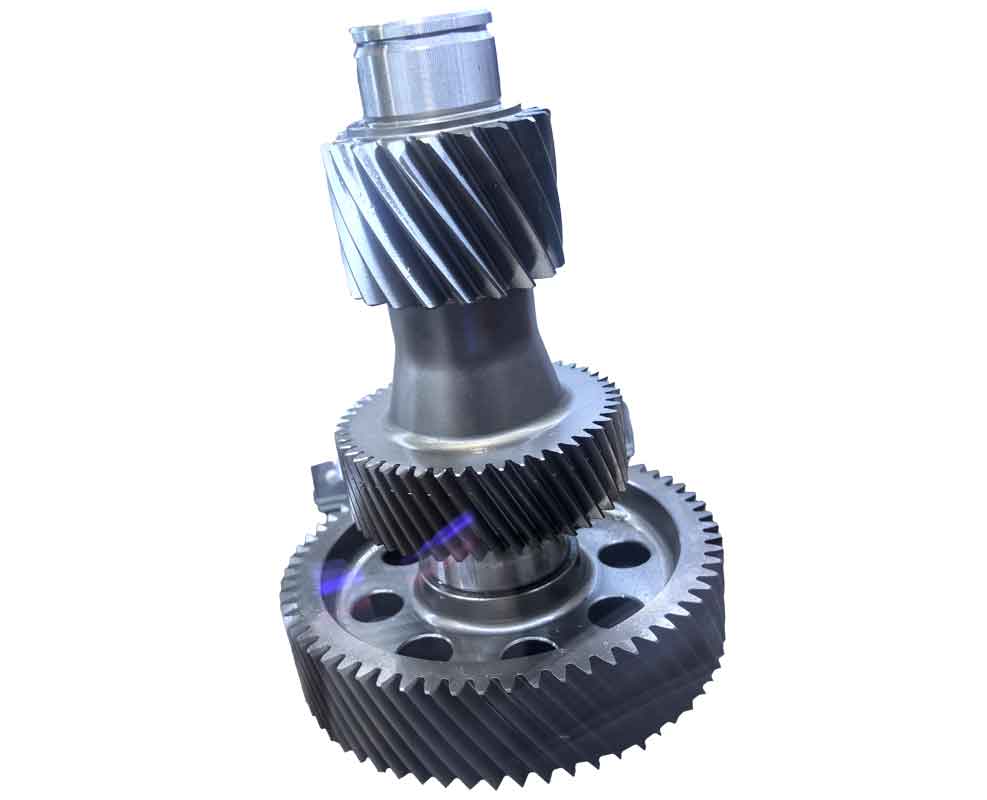
In further analysis, the mathematical model for gear cutting can be extended to include dynamic effects or tolerance considerations. The generating-line method not only simplifies gear cutting but also opens avenues for digital twin simulations, where virtual models predict meshing behavior before physical fabrication. For instance, the coordinate transformations and conjugation conditions can be encoded into software to automate generating line design for various hypoid gear configurations. This aligns with industry trends toward smart manufacturing, where gear cutting processes are optimized through computational tools. Moreover, the substitution method reduces the computational burden in gear cutting programming, making it accessible for small-scale production.
The feasibility of gear cutting with substituted generating lines is underscored by the error metrics from the example. In industrial applications, gear cutting tolerances for hypoid gears typically range up to 0.1 mm for tooth flank deviations, so the maximum errors of 0.0119 mm and 0.0554 mm are acceptable for many scenarios. To further validate this, contact analysis simulations can be performed using the derived tooth surfaces. The tooth surface equation for the pinion, based on the generating-line method, is given by transforming the generating line through the rolling motion of the base cone. In S_q1 coordinates, a point on the generating line is mapped to the pinion tooth surface via:
$$ \mathbf{R}^{(1)} = M_{q1-1} \mathbf{r}^{(q1)} $$
where M_{q1-1} is the transformation from S_q1 to the pinion coordinate system, incorporating rotation angles. Similarly, the gear tooth surface is derived. The meshing condition ensures continuous tangency along the contact line. By substituting the approximated generating lines, slight deviations in the tooth surfaces occur, but as shown, they remain within permissible limits for gear cutting.
In conclusion, the generating-line method presents a promising alternative for hypoid gear cutting, offering advantages in meshing quality and machine simplicity. The mathematical model establishes a clear relationship between pinion and gear generating lines, enabling precise gear cutting. The substitution of complex generating lines with simple curves, such as straight lines or circular arcs, further streamlines the gear cutting process while maintaining acceptable error levels. Through the example analysis, I have demonstrated that substituted generating lines yield minimal deviations, making this approach viable for practical gear cutting applications. Future work could explore real-time error compensation in gear cutting machines or the integration of this method with additive manufacturing for hybrid gear production. As gear cutting technologies evolve, the generating-line method may contribute to more efficient and flexible manufacturing systems for hypoid gears and beyond.
To reiterate, gear cutting is a fundamental process in mechanical engineering, and innovations like the generating-line method enhance its precision and efficiency. By leveraging geometric principles and mathematical modeling, we can overcome traditional limitations in hypoid gear manufacturing. The use of tables and formulas in this article aids in clarifying key parameters and equations, facilitating adoption by practitioners. As I continue to research advanced gear cutting techniques, I believe that methods focusing on generating lines will play an increasingly important role in the future of transmission system design and production.