
The manufacturing of hypoid gears represents one of the most complex challenges in gear technology. As a crucial component in differentials of automobiles and heavy machinery, their non-intersecting, offset axes enable compact and high-torque drivetrains. The core of their design and fabrication lies in the precise definition and relative positioning of two hyperboloidal pitch cones—or more accurately, their approximating conical surfaces—that must maintain a specific tangency condition along a chosen contact path. This article, from my perspective as someone deeply involved in gear geometry and manufacturing analysis, delves into a pure analytical method for determining the critical machine setup parameters. I will demonstrate how a traditionally complex 8-variable nonlinear system can be systematically reduced to a manageable 2-variable problem, thereby simplifying the adjustment calculation process for machining hypoid gear sets.
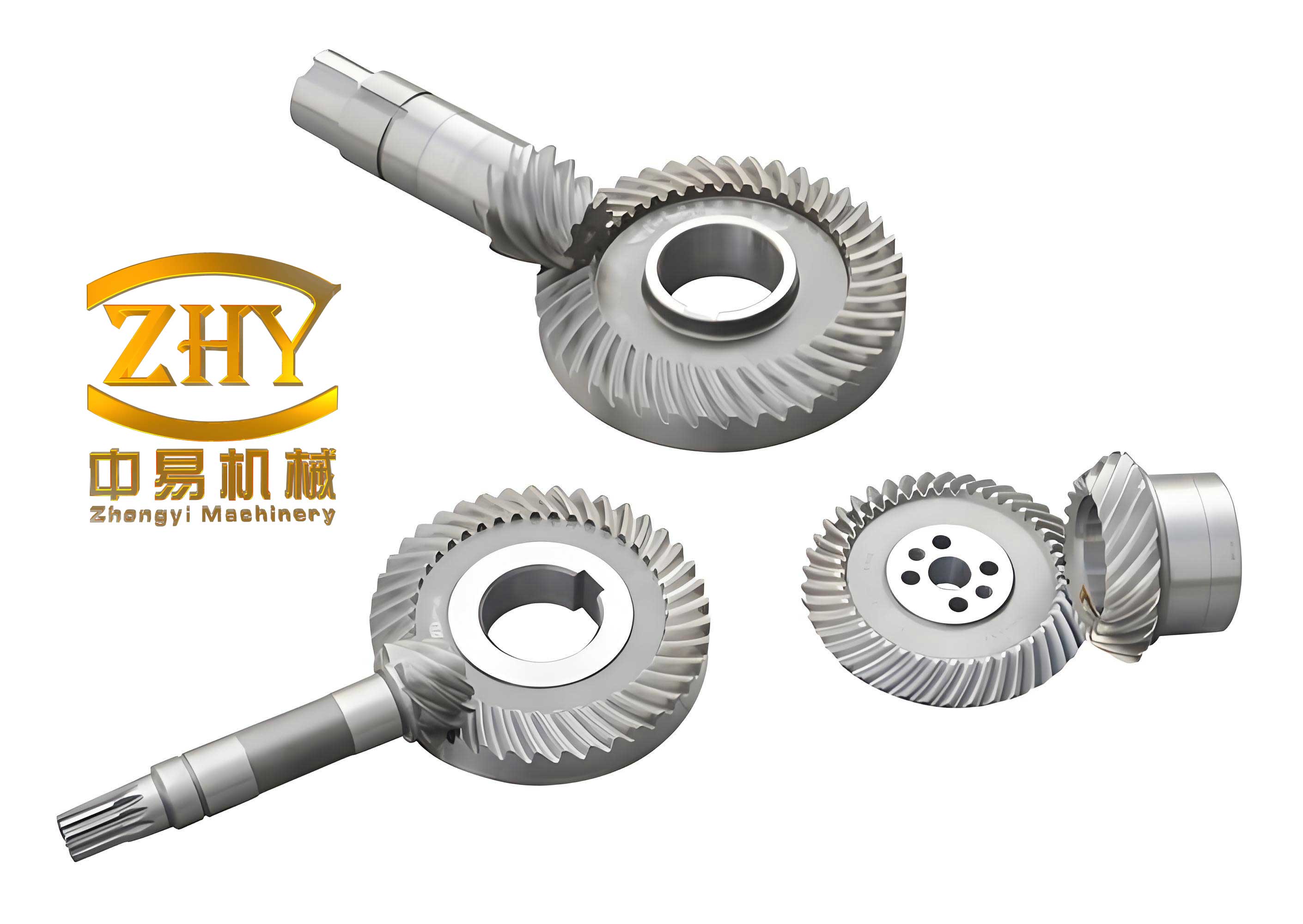
The fundamental geometry of a hypoid gear pair can be conceptualized using two skew axes, which form two non-intersecting lines in space. The pitch surfaces are typically approximated by two cones with their apexes offset from the point of shortest distance between the axes. Establishing the correct tangency condition between these conical surfaces is paramount for proper meshing and load distribution. Traditional methods, as documented in various literature, heavily rely on spatial, graphical vector analysis. While conceptually sound, this approach involves numerous interdependent variables, leading to complex equation systems that are difficult to formulate and solve directly for machine settings. My goal here is to circumvent these graphical complexities by employing a rigorous, purely analytical derivation based on coordinate transformations and contact mechanics.
Let us define the fundamental coordinate systems and geometry. Consider two cones representing the pitch surfaces of the pinion (gear 1) and the gear (gear 2). Their own coordinate systems, \( X^{(1)}Y^{(1)}Z^{(1)} \) for the pinion and \( X^{(2)}Y^{(2)}Z^{(2)} \) for the gear, are defined with origins at their respective cone apexes, \( O_1 \) and \( O_2 \). The Z-axes are aligned with the cone axes of rotation.
The surface of the pinion cone in its local system can be parameterized by the radial distance \( r_1 \) along a generatrix and the position angle \( \theta_1 \):
$$ x_1^{(1)} = r_1 \cos\theta_1, \quad y_1^{(1)} = r_1 \cot\gamma_1, \quad z_1^{(1)} = r_1 \sin\theta_1 $$
where \( \gamma_1 \) is the cone angle of the pinion (complementary to the pitch angle).
Similarly, the surface of the gear cone is parameterized as:
$$ x_2^{(2)} = r_2 \cos\theta_2, \quad y_2^{(2)} = r_2 \sin\theta_2, \quad z_2^{(2)} = -r_2 \cot\gamma_2 $$
where \( \gamma_2 \) is the gear cone angle.
The unit normal vectors on these conical surfaces are derived from the cross product of the partial derivatives with respect to the parameters. They are:
$$ \mathbf{n}_1^{(1)} = (\cos\gamma_1 \cos\theta_1, -\sin\gamma_1, \cos\gamma_1 \sin\theta_1) $$
$$ \mathbf{n}_2^{(2)} = (\cos\gamma_2 \cos\theta_2, \cos\gamma_2 \sin\theta_2, \sin\gamma_2) $$
It is crucial to note the sign conventions, which ensure the normals point outward from the material.
Now, we introduce the global machine coordinate system \( X^{(0)}Y^{(0)}Z^{(0)} \). The pinion and gear axes are skew. Let \( E \) be the offset (the shortest distance between the two axes). Let \( e_1 \) and \( e_2 \) be the distances from the respective cone apexes \( O_1 \) and \( O_2 \) to the point where the common perpendicular connecting the two axes intersects each axis (the “cross point”). The transformations to the global system are:
$$ x_1^{(0)} = x_1^{(1)} + E, \quad y_1^{(0)} = y_1^{(1)} – e_1, \quad z_1^{(0)} = z_1^{(1)} $$
$$ x_2^{(0)} = x_2^{(2)}, \quad y_2^{(0)} = y_2^{(2)}, \quad z_2^{(0)} = z_2^{(2)} – e_2 $$
The condition for the two conical surfaces to be in tangency at a point requires: 1) The points are coincident in the global system, and 2) Their surface normal vectors at that point are parallel (or anti-parallel, depending on the chosen direction). The coincidence condition yields three equations:
$$ r_1 \cos\theta_1 + E = r_2 \cos\theta_2 \tag{C1} $$
$$ r_1 \cot\gamma_1 – e_1 = r_2 \sin\theta_2 \tag{C2} $$
$$ r_1 \sin\theta_1 = -r_2 \cot\gamma_2 – e_2 \tag{C3} $$
The parallelism condition of the normals, \( \mathbf{n}_1^{(0)} \parallel \mathbf{n}_2^{(0)} \), provides two independent scalar equations (since the vectors are unit length). Given that the normals in their local systems transform as free vectors (translation doesn’t affect them), we have \( \mathbf{n}_1^{(0)} = \mathbf{n}_1^{(1)} \) and \( \mathbf{n}_2^{(0)} = \mathbf{n}_2^{(2)} \). Their cross product must be zero. Equivalently, the ratios of their corresponding components must be equal. This leads to:
$$ -\sin\gamma_1 \sin\gamma_2 = \cos\gamma_2 \cos\gamma_1 \sin\theta_1 \sin\theta_2 \tag{N1} $$
$$ \cos\gamma_1 \cos\gamma_2 \cos\theta_1 \sin\theta_2 = -\sin\gamma_1 \cos\gamma_2 \cos\theta_2 \tag{N2} $$
(A third equation derived from the components is typically dependent on these two).
At this stage, we have five equations (C1, C2, C3, N1, N2) involving eight primary unknowns related to the geometry and contact point: \( r_1, r_2, \gamma_1, \gamma_2, e_1, e_2, \theta_1, \theta_2 \). The offset \( E \) is a given design parameter. To solve this system, we must introduce additional conditions derived from the specific manufacturing process and desired gear performance.
The manufacturing of hypoid gears is typically done using a face-milling or face-hobbing process with a circular cutting tool (cutter head). According to the theory of gearing (Oliver’s first principle), two conjugate gear surfaces can be generated by the same tool surface (the generating surface) performing different rolling motions relative to the blank. A key requirement is that the normal curvature of the gear pitch surface at the design point in the direction perpendicular to the contact line must match the curvature of the cutter head, which is defined by its point radius \( r_c \). This provides another equation:
$$ r_c = \frac{\tan\psi_1 – \tan\psi_2}{\pm \tan\phi_0 \left( \frac{\tan\psi_1}{L_1 \tan\gamma_1} + \frac{\tan\psi_2}{L_2 \tan\gamma_2} \right) + \left( \frac{1}{L_1 \cos\psi_1} – \frac{1}{L_2 \cos\psi_2} \right)} \tag{K} $$
where:
- \( \psi_1, \psi_2 \) are the spiral angles of the pinion and gear, respectively, at the mean point.
- \( L_1, L_2 \) are the cone distances (mean pitch radii divided by sine of cone angle) for pinion and gear.
- \( \phi_0 \) is the so-called “limit pressure angle,” calculated as:
$$ \tan\phi_0 = \frac{\tan\gamma_1 \tan\gamma_2 (L_1 \sin\psi_1 – L_2 \sin\psi_2)}{L_1 \tan\gamma_1 + L_2 \tan\gamma_2} $$
Furthermore, we typically fix the mean point of the gear tooth. For the larger gear, the mean point is often chosen at the midpoint of the face width \( F \). If the gear’s outer diameter is \( D \), the mean cone distance \( r_2 \) is:
$$ r_2 = \frac{D – F \sin\gamma_2}{2} \tag{F1} $$
This serves as a practical constraint.
The spiral angles of the two members are not independent. Their relationship stems from the geometry of the contact line direction on each surface. The direction vectors of the generating lines (generatrices) at the contact point in the global system are:
$$ \mathbf{t}_1^{(0)} = (\sin\gamma_1 \cos\theta_1, \cos\gamma_1, \sin\gamma_1 \sin\theta_1) $$
$$ \mathbf{t}_2^{(0)} = (\sin\gamma_2 \cos\theta_2, \sin\gamma_2 \sin\theta_2, -\cos\gamma_2) $$
The angle \( \varepsilon’ \) between these two generatrices is given by their dot product:
$$ \mathbf{t}_1^{(0)} \cdot \mathbf{t}_2^{(0)} = \cos\varepsilon’ \tag{G} $$
For a hypoid gear pair with a constant tooth depth (so-called “height-wise” or “uniform depth” teeth), which simplifies tooling, the spiral angles are related by:
$$ \psi_1 = \psi_2 + \varepsilon’ \tag{S1} $$
Additionally, a kinematic relation exists based on the velocity ratio and geometry at the contact point:
$$ \tan\psi_1 = \frac{k – \cos\varepsilon’}{\sin\varepsilon’}, \quad \text{where } k = \frac{N_2 r_1}{N_1 r_2} \tag{S2} $$
Here, \( N_1 \) and \( N_2 \) are the numbers of teeth on the pinion and gear, respectively.
We now have a complete, albeit complex, system. The conventional approach of solving these equations simultaneously for all eight unknowns is computationally intensive. The analytical reduction method I propose streamlines this process significantly. The key insight is to treat \( \gamma_1 \) and \( \gamma_2 \) as the primary independent variables in an iterative solution loop. The step-by-step reduction is as follows:
- Start with initial guess values for the cone angles \( \gamma_1 \) and \( \gamma_2 \).
- Calculate the mean gear radius \( r_2 \) from the fixed gear geometry using Equation (F1).
- Solve the contact point coincidence and normal parallelism equations (C1, N1, N2, etc.) to determine the corresponding \( r_1, \theta_1, \theta_2 \). This involves manipulating equations (N1) and (N2) to express \( \theta_1 \) and \( \theta_2 \) in terms of \( \gamma_1 \) and \( \gamma_2 \), and then using (C1) to find \( r_1 \) and \( r_2 \). From (N2), we can get:
$$ \tan\theta_2 = -\frac{\sin\gamma_1 \cos\theta_2}{\cos\gamma_1 \cos\theta_1} \quad \Rightarrow \quad \cos\theta_1 \sin\theta_2 = -\tan\gamma_1 \cos\theta_2 $$
This can be combined with (N1) to solve for the angles. - Once \( r_1, r_2, \theta_1, \theta_2 \) are known for the guessed \( \gamma_1, \gamma_2 \), calculate the offset distances \( e_1 \) and \( e_2 \) from Equations (C2) and (C3).
- Using the geometry from steps 2-4, compute the cone distances \( L_1 = r_1 / \sin\gamma_1 \) and \( L_2 = r_2 / \sin\gamma_2 \).
- Calculate the angle \( \varepsilon’ \) between the generatrices using Equation (G).
- Determine the spiral angles. Often, the gear spiral angle \( \psi_2 \) is chosen based on design requirements (e.g., for balanced bearing loads). Then, \( \psi_1 \) is given by \( \psi_1 = \psi_2 + \varepsilon’ \). Alternatively, use the kinematic relation (S2) for consistency check.
- Compute the limit pressure angle \( \phi_0 \) and then the required cutter point radius \( r_c \) from the curvature equation (K).
- Compare the calculated \( r_c \) with the available or desired cutter radius \( r_{c0} \). Also, check if the calculated spiral angle \( \psi_1 \) matches the design target \( \psi_{10} \).
- The differences \( \Delta r_c = r_c – r_{c0} \) and \( \Delta \psi_1 = \psi_1 – \psi_{10} \) become the residuals. The original 8-variable problem is now reduced to finding the roots \( (\gamma_1, \gamma_2) \) that zero these two residuals. This is a standard 2-dimensional root-finding problem (e.g., using the Newton-Raphson method).
The following table summarizes the core equations and their role in the reduction algorithm:
| Equation Purpose | Mathematical Form | Role in Reduction |
|---|---|---|
| Contact Point Coincidence (x) | $$ r_1 \cos\theta_1 + E = r_2 \cos\theta_2 $$ | Links radial and angular parameters after \( \gamma_1, \gamma_2 \) are assumed. |
| Contact Point Coincidence (y) | $$ r_1 \cot\gamma_1 – e_1 = r_2 \sin\theta_2 $$ | Used to calculate \( e_1 \) after other variables are found. |
| Contact Point Coincidence (z) | $$ r_1 \sin\theta_1 = -r_2 \cot\gamma_2 – e_2 $$ | Used to calculate \( e_2 \) after other variables are found. |
| Normal Parallelism (1) | $$ -\sin\gamma_1 \sin\gamma_2 = \cos\gamma_1 \cos\gamma_2 \sin\theta_1 \sin\theta_2 $$ | Core relation to solve for \( \theta_1, \theta_2 \) given \( \gamma_1, \gamma_2 \). |
| Normal Parallelism (2) | $$ \cos\gamma_1 \cos\theta_1 \sin\theta_2 = -\sin\gamma_1 \cos\theta_2 $$ | Core relation to solve for \( \theta_1, \theta_2 \) given \( \gamma_1, \gamma_2 \). |
| Gear Mean Point | $$ r_2 = (D – F \sin\gamma_2)/2 $$ | Provides fixed value for \( r_2 \) once \( \gamma_2 \) is assumed. |
| Generatrix Angle | $$ \mathbf{t}_1 \cdot \mathbf{t}_2 = \cos\varepsilon’ $$ | Calculates \( \varepsilon’ \) from solved geometry. |
| Spiral Angle Relation | $$ \psi_1 = \psi_2 + \varepsilon’ $$ | Provides target \( \psi_1 \) for comparison. |
| Curvature Match (Cutter Radius) | $$ r_c = f(\gamma_1, \gamma_2, \psi_1, \psi_2, L_1, L_2) $$ | Provides target \( r_c \) for comparison. |
Once the correct geometrical parameters (\( \gamma_1, \gamma_2, e_1, e_2, r_1, \theta_1, etc. \)) are determined through the above iterative procedure, they must be translated into actual machine settings. For hypoid gear generators, the most common setup is based on the “fixed-setting” or “Formate” method for the gear and a complementary generated method for the pinion, or a full generated method for both. A fundamental concept is using a common generating surface (the cradle with the cutter head) to produce both members. Often, for uniform depth teeth, the common generating plane is chosen as the plane containing the two cone apexes and the mean contact point.
When cutting the gear, the gear cone apex \( O_2 \) is usually made coincident with the cradle center (the center of the generating gear in the machine). When subsequently cutting the pinion, the same cradle (and thus the same imaginary generating gear) is used, but its position relative to the pinion blank is changed to account for the different pinion cone geometry. The necessary machine adjustments—vertical wheel offset (V), horizontal wheel offset (H), and machine root angle—can be derived from the solved geometry.
A simplified expression for the required offset of the pinion relative to the generating cradle position, based on the common generating plane concept, involves the solved parameters \( L_1, L_2, \) and \( \varepsilon’ \). One component can be expressed as a function of the cone distances and the generatrix angle. While the exact formulas are machine-specific, the principle is that the analytical solution provides all necessary vectors and points in space (\( O_1, O_2 \), contact point \( M \), surface normals) to unambiguously calculate the required translational and rotational offsets to position the pinion blank correctly relative to the tool.
In conclusion, the manufacturing of hypoid gears is a sophisticated process where the bridge between design geometry and physical part is built upon precise machine adjustments. The analytical reduction method I have presented transforms the traditionally daunting problem of calculating these adjustments—modeled as finding the tangency condition between two skew cones—into a tractable two-variable numerical root-finding exercise. By strategically assuming the cone angles as primary variables and systematically solving for all other dependent parameters (contact point location, offsets, spiral angles, and required cutter curvature), we effectively reduce an 8-variable nonlinear system to a 2-variable one. This method offers clarity, computational efficiency, and a deeper understanding of the geometric interdependencies within a hypoid gear pair. The final machine settings, derived from this solved geometry, enable the successful generation of a functional hypoid gear set that meets stringent meshing and performance criteria. This analytical framework, therefore, serves as a powerful tool for engineers and technicians involved in the development and production of these essential mechanical components.