
In my extensive experience with automotive drivetrain systems, hypoid gears stand out as a critical component, especially in rear axle drives for vehicles requiring high torque and smooth operation. The unique geometry of hypoid gears, characterized by an offset between the pinion and gear axes, allows for higher gear ratios and improved strength compared to conventional spiral bevel gears. This offset, often denoted as “E” in technical literature, is a fundamental parameter that dictates the meshing performance and load capacity of the gear set. Throughout this article, I will delve into the intricacies of hypoid gears, focusing on the challenges and solutions associated with their refurbishment, particularly the precise measurement of the pinion offset. The keyword “hypoid gears” will be frequently emphasized to underscore its centrality in drivetrain engineering.
Hypoid gears are widely used in automotive applications, such as differentials, where their ability to transmit power between non-intersecting shafts at right angles is invaluable. The offset design not only reduces the pinion shaft diameter, allowing for lower vehicle floors, but also increases the contact ratio, leading to quieter and more durable operation. However, when hypoid gears fail due to wear, pitting, or other fatigue-related issues, refurbishment becomes necessary. A key step in this process is accurately determining the original pinion offset, as any error can result in poorly meshing gears, reduced load capacity, or even premature failure. This measurement is notoriously difficult, especially when dealing with worn or报废 gear pairs where the original geometry may be obscured.
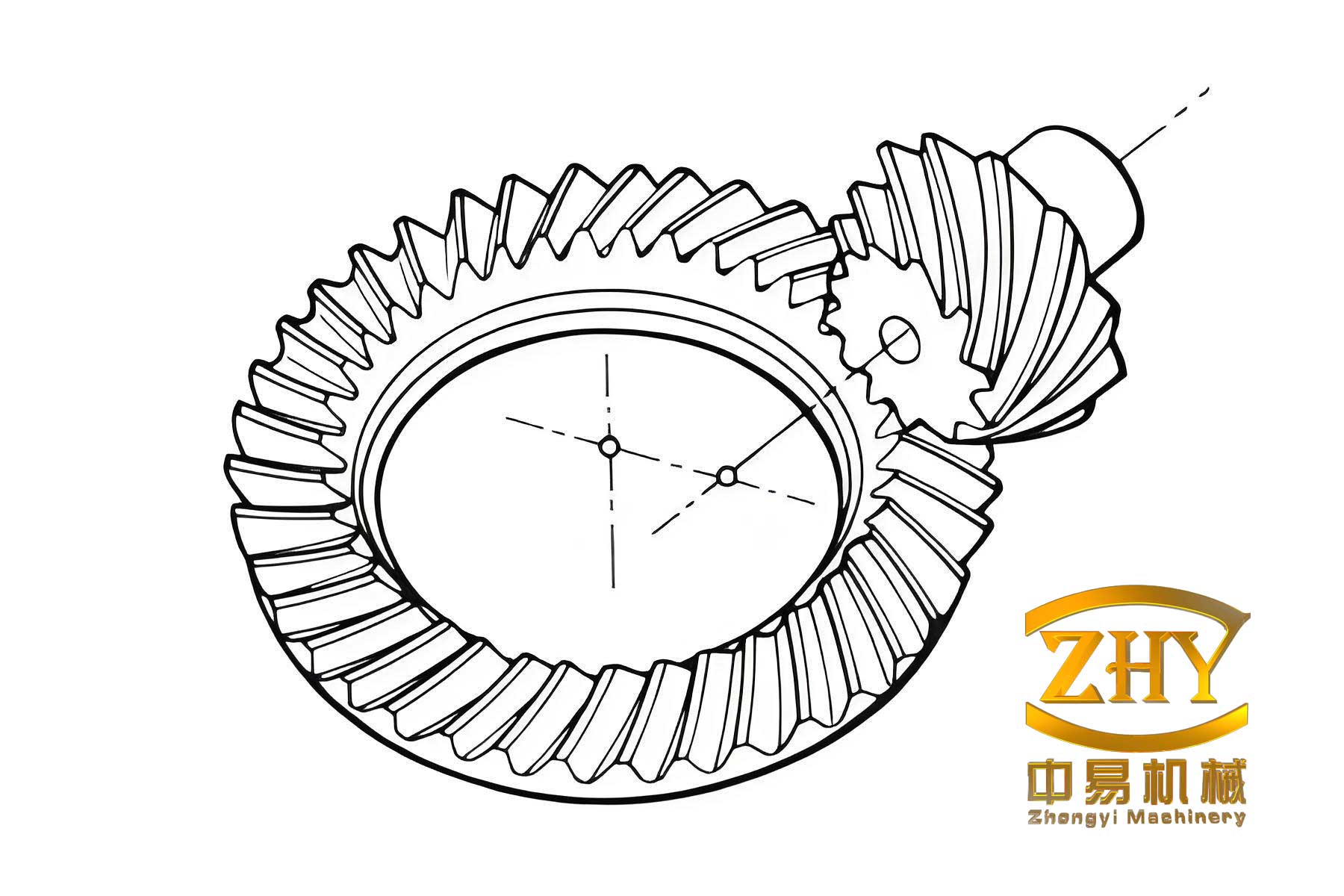
Traditional methods for measuring the offset in hypoid gears often rely on inspecting the housing bore or using specialized fixtures, but these approaches can be imprecise or impractical for field repairs. In my work, I have developed and refined a novel measurement technique that overcomes these limitations. This method utilizes custom-made gauge components and simple tools like vernier calipers to achieve high accuracy. The core idea involves creating two reference pieces that fit into the bearing seat holes of the gear and pinion assemblies, respectively, allowing for direct measurement of the spatial relationship between their axes.
The first component, which I refer to as the “gear-side gauge,” is designed to be inserted into the bearing seat holes on the differential gear side. It consists of cylindrical sections with diameters matching the nominal bore sizes of the housing. The critical dimensions here are the diameters $D_1$ and $D_2$, which correspond to the bearing seat holes near the hypoid gear. These diameters should be manufactured with tight tolerances, typically within H7 or similar fit classes, to ensure a snug yet removable fit. The length $L_1$ of this gauge is set to span the distance between the inner faces of the bearing seats, ensuring proper alignment. The second component, the “pinion-side gauge,” is similarly crafted to fit into the pinion bearing seat holes. Its diameters $d_1$ and $d_2$ are matched to the pinion bearing outer races, while a protruding section $d_3$ extends beyond the gear axis to facilitate measurement. Both gauges must be machined in a single setup to guarantee concentricity of their cylindrical sections, minimizing errors.
To measure the offset $E$ of the hypoid gears, I follow a systematic procedure. First, I install the gear-side gauge into the differential housing bore, ensuring it sits flush against the bearing seats. Next, I place the pinion-side gauge into the pinion bearing seat holes and secure it. Using a vernier caliper, I then measure the distance $M$ between the outer surfaces of the gauges at the point where the pinion and gear axes would intersect if extended. This measurement must be taken carefully, with the caliper aligned perpendicular to the axes to avoid parallax errors. The actual diameters of the gauges at the measurement location, denoted as $D_{actual}$ and $d_{actual}$, are previously determined using a micrometer for high precision. The offset $E$ is calculated using the following formula:
$$E = M – \frac{D_{actual} + d_{actual}}{2}$$
This equation derives from the geometric relationship where $M$ represents the center distance between the gauge surfaces, and subtracting the average radii yields the axial offset between the pinion and gear axes. The accuracy of this method hinges on precise manufacturing and measurement of the gauge diameters, as errors here propagate directly into the offset calculation. In practice, I have found that this approach yields errors within $\pm 0.05\, \text{mm}$, which is sufficient for most hypoid gear refurbishment applications.
To illustrate the gauge dimensions and tolerances, I summarize them in the table below. This table serves as a quick reference for engineers implementing this measurement technique for hypoid gears.
| Gauge Component | Dimension | Nominal Value (mm) | Tolerance | Purpose |
|---|---|---|---|---|
| Gear-Side Gauge | $D_1$ | Equal to bore diameter | H7 fit | Fits into gear bearing seat |
| $D_2$ | Equal to bore diameter | H7 fit | Fits into gear bearing seat | |
| $L_1$ | Distance between seat inner faces | ±0.02 mm | Ensures proper span | |
| Pinion-Side Gauge | $d_1$ | Equal to bearing outer race | h6 fit | Fits into pinion bearing seat |
| $d_2$ | Equal to bearing outer race | h6 fit | Fits into pinion bearing seat | |
| $d_3$ | 30 (example) | Not critical | Extension for measurement | |
| Concentricity | All diameters | — | < 0.01 mm TIR | Minimizes alignment errors |
Applying this method to hypoid gears in a real-world scenario, such as the drivetrain of an off-road vehicle, I measured an offset of approximately 30 mm. This value was used in the refurbishment design to manufacture new hypoid gears, which subsequently performed flawlessly in service, demonstrating the method’s reliability. The success hinges on the fact that the gauges bypass the worn gear teeth, directly referencing the housing geometry, which remains intact even after gear failure. This is crucial because attempting to measure offset from报废 hypoid gears often leads to inaccuracies due to tooth wear or damage.
Beyond measurement, understanding the design principles of hypoid gears is essential for effective refurbishment. The offset $E$ influences several key parameters, such as the spiral angle $\beta$, pressure angle $\alpha$, and gear ratio $i$. These parameters are interrelated through complex equations that govern the meshing behavior. For instance, the relationship between offset and gear tooth geometry can be expressed using the following formula, which approximates the condition for proper conjugation:
$$E = R_m \cdot \sin(\beta) \cdot \left(1 – \frac{1}{i}\right)$$
where $R_m$ is the mean cone distance of the gear, $\beta$ is the spiral angle, and $i$ is the gear ratio. This highlights how variations in offset affect tooth contact patterns and load distribution. In refurbishment, even small deviations from the original offset can alter these patterns, leading to localized stress concentrations and reduced fatigue life. Therefore, precise measurement is not merely a procedural step but a critical factor in ensuring the longevity of hypoid gears.
Another aspect worth considering is the manufacturing tolerances for hypoid gears. During production, factors like tooth profile modifications, heat treatment distortions, and assembly misalignments can introduce errors. The table below summarizes common tolerance ranges for key parameters in hypoid gears, based on industry standards. These tolerances must be accounted for when setting acceptable limits for offset measurement during refurbishment.
| Parameter | Symbol | Typical Tolerance | Impact on Performance |
|---|---|---|---|
| Pinion Offset | $E$ | ±0.05 mm to ±0.1 mm | Affects contact pattern and noise |
| Spiral Angle | $\beta$ | ±5 arc minutes | Influences smoothness of engagement |
| Pressure Angle | $\alpha$ | ±3 arc minutes | Affects tooth strength and wear |
| Gear Ratio | $i$ | ±0.5% | Determines speed and torque output |
| Tooth Thickness | $s_n$ | ±0.02 mm | Impacts backlash and load capacity |
In addition to offset measurement, the refurbishment process for hypoid gears often involves other steps, such as tooth grinding, bearing replacement, and shimming adjustments. These steps are interdependent; for example, an inaccurate offset measurement might necessitate excessive shimming, which could misalign the bearings and cause premature failure. Thus, a holistic approach is required, where measurement accuracy underpins all subsequent actions. My method, by providing a reliable offset value, serves as a foundation for such an approach, ensuring that refurbished hypoid gears meet or exceed original performance specifications.
The importance of hypoid gears extends beyond automotive applications to industries like aerospace, marine, and heavy machinery, where high-power, compact drivetrains are needed. In all these contexts, the offset parameter plays a pivotal role. For instance, in electric vehicle drivetrains, hypoid gears are increasingly used for their efficiency and noise reduction capabilities, making precise offset measurement even more critical for optimizing energy consumption. As a design engineer, I have observed that advancements in materials, such as case-hardened steels or composite coatings, can further enhance the durability of hypoid gears, but only if geometric accuracy is maintained during refurbishment.
To elaborate on the measurement technique, let’s consider the mathematical derivation in more detail. The offset $E$ is essentially the perpendicular distance between the pinion and gear axes. In a coordinate system where the gear axis is along the Z-direction and the pinion axis is offset in the X-direction, the relationship can be modeled using transformation matrices. For hypoid gears, the meshing equation involves complex conjugate surfaces, but for offset measurement, a simplified 2D projection suffices. Assuming the gauges are concentric with the bearing seats, the measured distance $M$ relates to the radii $r_G = D_{actual}/2$ and $r_P = d_{actual}/2$ as follows:
$$M = E + r_G + r_P$$
Rearranging gives $E = M – (r_G + r_P)$, which is equivalent to the earlier formula. This linear relationship holds as long as the gauges are properly aligned. In practice, I recommend taking multiple measurements at different angular positions to average out any minor misalignments, further improving accuracy for hypoid gears.
Furthermore, the design of the gauges can be optimized based on the specific hypoid gear set. For example, in hypoid gears with large offsets, the pinion-side gauge may need a longer extension $d_3$ to clear the gear housing. Material selection is also important; I typically use carbon steel for its stability and wear resistance, but in corrosive environments, stainless steel might be preferable. The gauges should be calibrated periodically against master rings to ensure dimensional integrity, especially if used frequently for hypoid gear refurbishment.
In terms of economic impact, accurate refurbishment of hypoid gears can lead to significant cost savings compared to full replacements. For a fleet of vehicles, the ability to reliably measure offset and restore drivetrain components extends service life and reduces downtime. This is particularly relevant for heavy-duty applications, such as trucks or agricultural machinery, where hypoid gears are subjected to harsh operating conditions. My measurement method, being low-cost and tool-based, is accessible to small workshops, democratizing the repair process for hypoid gears.
Looking at broader trends, the evolution of hypoid gear technology is intertwined with advancements in metrology. Modern coordinate measuring machines (CMMs) can digitally scan gear teeth and compute offsets, but they require expensive equipment and skilled operators. In contrast, my method offers a pragmatic, on-site solution that does not compromise on accuracy. For hypoid gears in remote or resource-limited settings, this is invaluable. Additionally, simulation tools like finite element analysis (FEA) can model the stress distribution in hypoid gears based on offset values, guiding design improvements. The formula for contact stress $\sigma_H$ in hypoid gears, derived from Hertzian theory, illustrates this:
$$\sigma_H = \sqrt{\frac{F_n}{\pi \cdot b \cdot \rho_{rel}} \cdot \frac{E^*}{2}}$$
where $F_n$ is the normal load, $b$ is the face width, $\rho_{rel}$ is the relative curvature radius, and $E^*$ is the equivalent elastic modulus. The offset $E$ influences $\rho_{rel}$ through the gear geometry, so an accurate measurement directly feeds into stress predictions, enabling proactive maintenance schedules for hypoid gears.
In conclusion, the measurement of pinion offset is a cornerstone of hypoid gear refurbishment, and my developed method provides a robust, accurate, and practical approach. By leveraging simple gauges and fundamental geometry, it addresses a common pain point in drivetrain repair. Hypoid gears, with their unique offset design, will continue to be vital in mechanical power transmission, and ensuring their precise refurbishment through techniques like this supports sustainable engineering practices. As I reflect on my experiences, I am convinced that attention to such details not only enhances performance but also fosters innovation in the field of hypoid gears. For anyone working with these components, I encourage adopting this measurement protocol to achieve reliable results and extend the life of critical drivetrain systems.
To further enrich the discussion, I can explore additional facets of hypoid gears, such as their historical development, comparative analysis with other gear types, or future directions like additive manufacturing. However, the core message remains: accurate offset measurement is non-negotiable for successful hypoid gear refurbishment, and the method described here stands as a testament to engineering ingenuity. Whether for automotive, industrial, or emerging applications, hypoid gears demand precision, and this technique delivers it with elegance and efficiency.