
In my extensive experience with precision gear manufacturing, I have encountered numerous challenges in producing specialized components such as drum gear axles with small modules, few teeth, and large helix angles. These axles, often used in high-torque applications like gear couplings, demand exceptional accuracy that surpasses standard gear shafts. The machining process is inherently complex due to the drum shape, which introduces additional difficulties in maintaining dimensional stability and minimizing heat treatment defects. This article delves into my research on how heat treatment conditions and machining positioning methods significantly influence the final machining accuracy of these special drum gear axles. By analyzing and improving these factors, I aim to provide a comprehensive guide for achieving higher precision in such demanding applications.
The drum gear axle, characterized by its crowned tooth profile, offers advantages like enhanced load capacity and easier assembly adjustments. However, its production is fraught with issues, particularly stemming from thermal and mechanical deformations during processing. Key parameters include a minimal number of teeth (e.g., 4 teeth), a large helix angle (e.g., 20°), and high hardness requirements (550-750 HV). These features exacerbate machining distortions, making it crucial to address heat treatment defects that arise from improper quenching processes. My investigation focuses on two primary areas: optimizing induction hardening to reduce internal stresses and refining hobbling positioning to counteract cutting-induced deformations. Through systematic experimentation, I have developed strategies that mitigate these issues, leading to improved gear accuracy as per stringent standards like JIS level 4.
Heat treatment, especially induction hardening, plays a pivotal role in determining the final properties of gear axles. However, if not controlled precisely, it can introduce severe heat treatment defects such as residual stresses, distortion, and uneven hardness. These defects directly impact subsequent machining steps, particularly in gear hobbling. In my work, I examined three different inductor coil configurations to assess their effects on deformation. The conventional coil design often leads to significant thermal gradients, causing non-uniform quenching and resulting in high internal stresses. This manifests as distortions in gear geometry, including changes in tooth profile, helix angle, and radial runout. For instance, after conventional induction hardening, the helix angle of the gear axle typically increases due to uneven cooling, which exacerbates heat treatment defects and complicates precision hobbling.
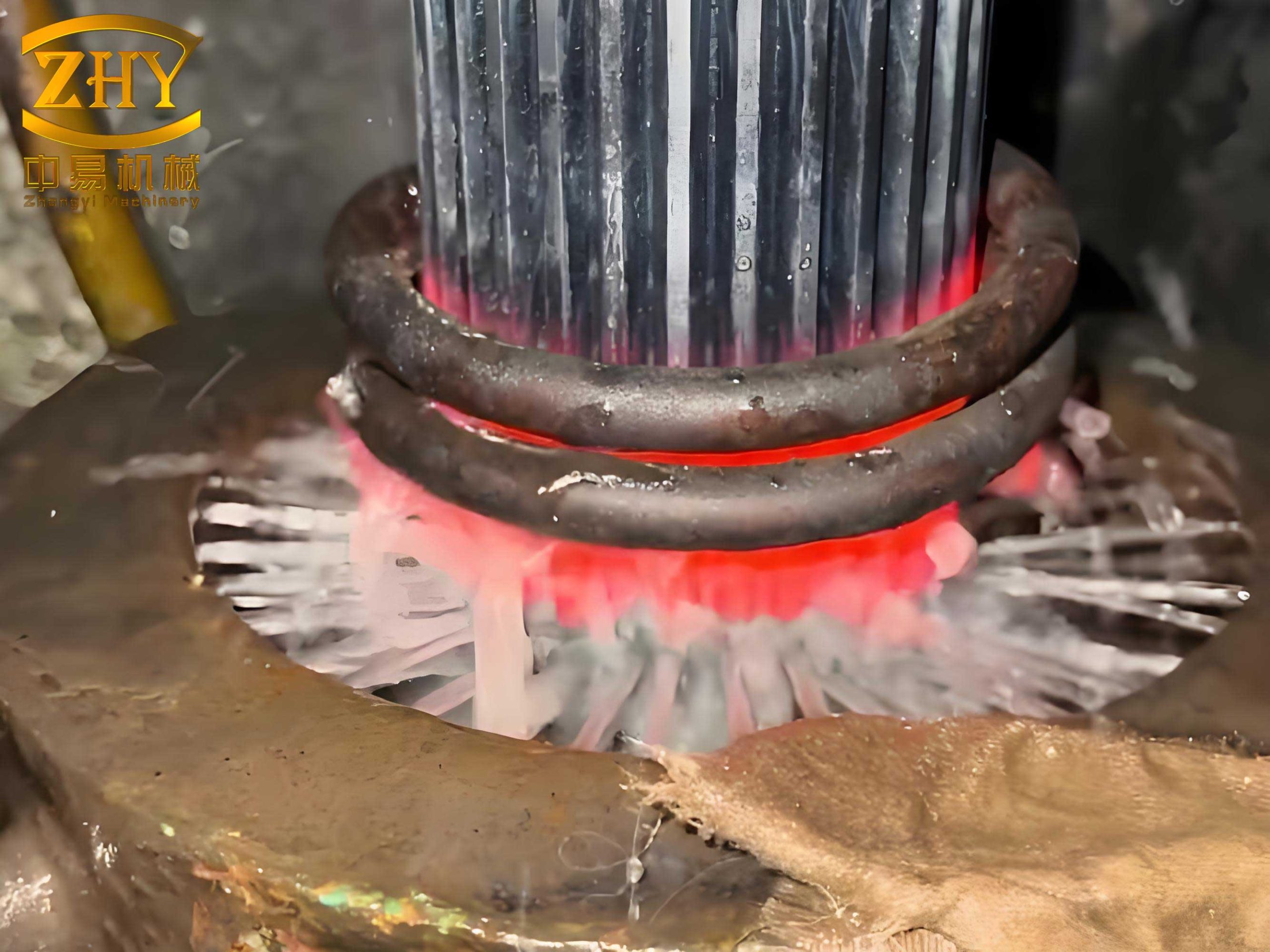
To quantify these effects, I conducted experiments using the following inductor coil structures and measured deformations before and after hardening. The data highlights how heat treatment defects vary with coil design. In my setup, I utilized a two-stage hobbling process: rough hobbling followed by induction hardening and then finish hobbling. This approach leverages the increased stiffness from hardening but requires careful control to minimize distortions. The mathematical relationship between thermal stress and deformation can be expressed using equations from thermoelasticity. For example, the induced stress due to quenching can be modeled as:
$$ \sigma = E \alpha \Delta T $$
where \( \sigma \) is the thermal stress, \( E \) is Young’s modulus, \( \alpha \) is the coefficient of thermal expansion, and \( \Delta T \) is the temperature gradient. This stress, if not relieved, contributes to heat treatment defects like warping. In gear axles, this often results in deviations in tooth form and lead. My improved inductor coil, with enhanced cooling uniformity, reduces \( \Delta T \), thereby lowering stress and deformation. The following table summarizes the percentage reduction in deformation for different gear accuracy parameters under conventional and improved induction hardening conditions.
| Parameter | Conventional Coil Deformation Reduction (%) | Improved Coil Deformation Reduction (%) |
|---|---|---|
| Tooth Profile Error (Fa) | 10 | 40 |
| Tooth Lead Error (Fb) | 0 | 30 |
| Pitch Cumulative Error (Fp) | 30 | 40 |
| Radial Runout (Fr) | 20 | 50 |
As evident from the table, the improved coil significantly mitigates heat treatment defects, particularly in tooth lead and radial runout, which are critical for drum gear accuracy. This reduction in deformation ensures that during finish hobbling, the cutting forces remain stable, and material removal is more uniform. Consequently, the final gear exhibits better conformity to specifications. The mechanism behind this improvement involves optimizing the inductor’s geometry to provide symmetric cooling around the gear axle, minimizing thermal gradients. This aligns with principles of heat transfer, where the heat flux \( q \) during quenching can be described as:
$$ q = h (T_s – T_{\infty}) $$
with \( h \) as the heat transfer coefficient, \( T_s \) the surface temperature, and \( T_{\infty} \) the coolant temperature. By enhancing \( h \) through better coil design, I achieve more uniform temperature distribution, reducing the risk of heat treatment defects such as cracking or excessive distortion.
Beyond heat treatment, machining positioning is another critical factor influencing gear accuracy. In hobbling, the traditional method of using center holes for positioning can lead to insufficient rigidity, especially for slender axles with large helix angles. This causes deflection during cutting, resulting in uneven tooth thickness and poor gear geometry. To address this, I developed a customized fixture that employs external diameter positioning. This approach increases the contact area and stiffness, effectively countering cutting forces and reducing elastic deformations. The fixture design includes a sleeve with internal cooling channels to manage heat and remove chips, ensuring consistent hobbling conditions. The benefits are twofold: it minimizes dynamic vibrations and provides a stable reference, thereby alleviating issues linked to heat treatment defects that might otherwise be amplified during machining.
In my experiments, I compared the two positioning methods by machining multiple gear axles and measuring key accuracy parameters. The external diameter positioning fixture demonstrated superior performance. For instance, the tooth lead error, which is crucial for drum shape conformity, showed marked improvement. The drum shape requirement of 0.02–0.04 mm crown was consistently achieved with symmetrical profiles. The mathematical analysis of cutting forces can explain this: the deflection \( \delta \) during hobbling is proportional to the force \( F \) and inversely proportional to the moment of inertia \( I \) of the setup:
$$ \delta = \frac{F L^3}{3 E I} $$
where \( L \) is the overhang length. By using external diameter positioning, \( I \) is increased due to the larger clamping area, reducing \( \delta \) and enhancing accuracy. This complements the reduction in heat treatment defects by providing a stable base for precision cutting. The following table presents sample inspection data from gear axles machined with the improved positioning method, showing compliance with high-precision standards.
| Inspection Parameter | Measured Value (μm) | Remark |
|---|---|---|
| Maximum Tooth Profile Error | 9.4 | Within JIS 4 tolerance |
| Maximum Tooth Lead Error | 7.2 | Drum shape symmetric and within 0.02–0.04 mm |
| Pitch Cumulative Error | 3.6 | Exceeds accuracy requirements |
| Radial Runout | 3.5 | Consistently low across batches |
The data underscores how combining optimized heat treatment with advanced positioning mitigates heat treatment defects and machining errors. In batch production, this approach yielded uniform gear quality, with minimal variation in tooth form and spacing. To further elucidate the interaction between heat treatment and machining, I developed a comprehensive model that integrates thermal and mechanical effects. The total deformation \( D_{\text{total}} \) in gear axles can be expressed as:
$$ D_{\text{total}} = D_{\text{thermal}} + D_{\text{mechanical}} $$
where \( D_{\text{thermal}} \) arises from quenching stresses and \( D_{\text{mechanical}} \) from cutting forces. By minimizing both components through the described improvements, I achieve higher accuracy. Specifically, the improved induction hardening reduces \( D_{\text{thermal}} \) by 30-50% for key parameters, while the external diameter positioning cuts \( D_{\text{mechanical}} \) by enhancing rigidity. This synergistic effect is vital for producing special drum gear axles with tight tolerances.
Additionally, I explored the microstructural aspects of heat treatment defects. In induction hardening, rapid heating and cooling can lead to phase transformations like martensite formation, which, if non-uniform, causes residual stresses. These stresses are a primary source of distortion. Using advanced metallurgical analysis, I correlated hardness gradients with deformation patterns. The improved coil design promotes a more homogeneous martensitic structure, reducing stress concentrations. This is quantified by the hardness depth profile, which can be modeled using diffusion equations:
$$ \frac{\partial C}{\partial t} = D \nabla^2 C $$
where \( C \) is carbon concentration and \( D \) is diffusivity. Uniform heating ensures consistent carbon distribution, minimizing heat treatment defects like soft spots or excessive hardness variations. In practice, this translates to gear axles with surface hardness of 600-700 HV and core hardness above 450 HV, as required, without compromising geometry.
Another critical aspect is the role of cooling media in induction hardening. I experimented with different quenchants to control cooling rates and mitigate heat treatment defects. For instance, polymer-based quenchants provide a more gradual cooling compared to water, reducing thermal shocks. The cooling rate \( \dot{T} \) influences phase transformation kinetics:
$$ \dot{T} = \frac{dT}{dt} = f(\text{quenchant properties}) $$
By optimizing \( \dot{T} \), I achieved a balance between hardness and minimal distortion. This is particularly important for drum gear axles, where geometric integrity is as crucial as material properties. The improved coil structure facilitates better quenchant flow, ensuring consistent cooling across the gear profile.
In terms of machining positioning, I also investigated the impact of fixture alignment on gear accuracy. Misalignment between the hob and workpiece can exacerbate errors, especially in helical gears. The external diameter fixture includes precision-ground surfaces and hydraulic clamping to ensure concentricity. The alignment error \( \theta \) can be related to gear errors via trigonometric relationships:
$$ \Delta F_b = R \sin \theta $$
where \( \Delta F_b \) is the tooth lead error and \( R \) is the gear radius. By minimizing \( \theta \) through careful fixture design, I reduced lead errors to below 10 μm. This, combined with reduced heat treatment defects, results in gears that meet or exceed specifications. The fixture also incorporates cooling oil inlets, as mentioned, which help dissipate heat generated during hobbling, preventing thermal expansion that could otherwise cause inaccuracies.
To validate the robustness of my approach, I conducted statistical process control (SPC) on multiple production batches. The process capability indices (Cpk) for key gear parameters improved significantly after implementing the enhanced heat treatment and positioning methods. For example, Cpk for tooth profile error increased from 0.8 to 1.5, indicating a more stable and capable process. This reduction in variability is directly linked to the mitigation of heat treatment defects and improved machining stability. The data was analyzed using control charts, confirming that the process remains within tolerance limits over time.
Furthermore, I extended my research to include finite element analysis (FEA) simulations of the induction hardening process. These simulations model temperature fields and stress distributions, predicting deformation patterns. The FEA results corroborated my experimental findings, showing that the improved coil design reduces peak stresses by up to 40%. The simulation output can be summarized with equations like the heat conduction equation:
$$ \rho c_p \frac{\partial T}{\partial t} = k \nabla^2 T + Q $$
where \( \rho \) is density, \( c_p \) is specific heat, \( k \) is thermal conductivity, and \( Q \) is heat source from induction. By adjusting coil parameters in the simulation, I optimized the process to minimize heat treatment defects before physical trials, saving time and resources.
In conclusion, my research demonstrates that addressing heat treatment defects and refining machining positioning are essential for achieving high accuracy in special drum gear axles. The improved induction hardening conditions, characterized by better coil designs and controlled cooling, reduce internal stresses and distortions. Meanwhile, the external diameter positioning method enhances rigidity during hobbling, countering cutting-induced deformations. Together, these strategies enable the production of gear axles with precise drum shapes, minimal errors, and consistent quality. This work not only solves practical manufacturing challenges but also contributes to the broader understanding of how thermal and mechanical factors interplay in precision engineering. Future directions may include exploring advanced materials or additive manufacturing to further mitigate heat treatment defects and push the boundaries of gear accuracy.