
Abstract
In high-speed aeronautical transmission systems, spiral bevel gear is critical components that operate under extreme conditions, including rotational speeds exceeding 10,000 rpm and contact pressures above 1 GPa. Ensuring reliable lubrication and thermal management is paramount to mitigating risks of gear scuffing, pitting, and thermal deformation. This study investigates the influence of linear velocity (40–160 m/s) on oil jet lubrication flow fields, windage losses, and temperature distributions in spiral bevel gear using a validated thermal-fluid coupling model. Key findings reveal that increasing linear velocity leads to significant oil jet fragmentation, reduced lubrication efficiency, exponential growth in windage losses, and elevated gear temperatures. These insights provide critical guidelines for optimizing high-speed spiral bevel gear design in aerospace applications.
Introduction
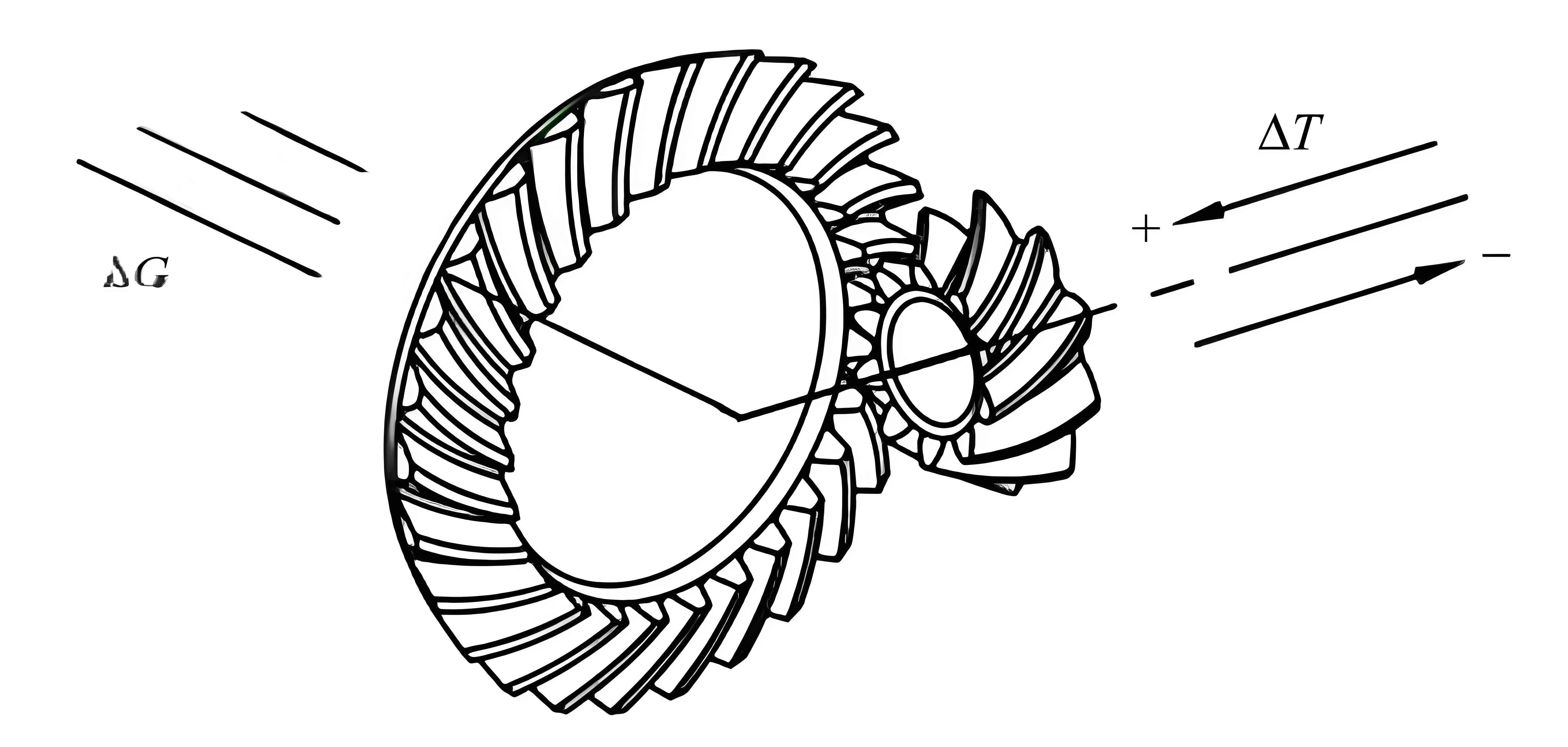
Spiral bevel gear is widely adopted in aircraft engines and helicopter transmissions due to their high load-carrying capacity and stability. However, under extreme operating conditions, inadequate lubrication and excessive heat generation pose severe challenges. Traditional empirical lubrication models, such as Anderson-Loewenthal and Niemann formulas, often neglect the dynamic effects of high-speed rotations on oil jet behavior, leading to suboptimal designs.
This study addresses these gaps by developing a computational fluid dynamics (CFD)-based thermal-fluid coupling model to analyze the interplay between linear velocity, lubrication efficiency, and thermal performance in spiral bevel gear. By simulating gear rotations up to 160 m/s, we quantify the degradation of lubrication, the dominance of windage losses, and the resultant thermal stresses.
Methodology
1. CFD Model Setup
A finite volume-based thermal-fluid coupling model was constructed to simulate the oil jet lubrication and heat transfer in spiral bevel gear. Key components include:
- Fluid Domain: A 3D geometry replicating the gearbox environment, with mesh refinement near the oil jet nozzle and gear surfaces (Figure 1).
- Multiphase Flow: The Volume of Fluid (VOF) model was employed to track air-oil interactions, with air as the primary phase and ISO VG 4106 oil as the secondary phase.
- Turbulence Modeling: The RNG k-ε model was selected for its accuracy in capturing high-speed rotational flows and vortices.
- Dynamic Mesh: A remeshing algorithm ensured mesh quality during gear rotation.
Table 1: Material Properties of ISO VG 4106 Oil at 140°C
| Parameter | Value |
|---|---|
| Density (kg/m³) | 682.79 |
| Dynamic Viscosity (mPa·s) | 2.6 |
| Thermal Conductivity (W/m·K) | 0.1331 |
| Specific Heat (J/kg·°C) | 2280 |
2. Heat Source Calculation
Heat generation in spiral bevel gear arises from two primary sources:
- Meshing Friction Losses:Pfriction=f⋅Fn‾⋅vs‾/1000Pfriction=f⋅Fn⋅vs/1000where ff is the friction coefficient, Fn‾Fn is the average normal load (N), and vs‾vs is the sliding velocity (m/s).
- Windage Losses:Pwindage=2.82×10−7⋅(1+4600bmmtz1)⋅n12.8⋅(mmtz12000)4.6⋅(0.028μ0+0.019)0.2Pwindage=2.82×10−7⋅(1+mmtz14600b)⋅n12.8⋅(2000mmtz1)4.6⋅(0.028μ0+0.019)0.2where bb is face width (mm), mmtmmt is transverse module, z1z1 is tooth count, and μ0μ0 is fluid viscosity (mPa·s).
3. Thermal Boundary Conditions
Convective heat transfer coefficients extracted from the fluid domain were applied to gear surfaces. Radiation effects were neglected due to moderate operating temperatures.
Results and Discussion
1. Lubrication Efficiency Degradation
Increasing linear velocity disrupts oil jet stability, leading to insufficient lubrication at the gear meshing zone.
Table 2: Oil Volume Fraction at Different Linear Velocities
| Linear Velocity (m/s) | Oil Volume Fraction | Reduction (%) |
|---|---|---|
| 40 | 0.01275 | – |
| 160 | 0.002085 | 83.5 |
At 120 m/s, the oil-air ratio drops below critical thresholds, causing “dry zones” on tooth surfaces (Figure 2). This phenomenon correlates with a sharp decline in convective heat transfer coefficients beyond 120 m/s, exacerbating thermal risks.
2. Windage Loss Dominance
Windage losses grow exponentially with velocity, surpassing meshing friction losses at 80 m/s. At 160 m/s, windage accounts for over 80% of total power loss.
Table 3: Power Loss Distribution at 160 m/s
| Loss Type | Contribution (%) |
|---|---|
| Windage | 80.2 |
| Meshing Friction | 19.8 |
Figure 3 illustrates the near-exponential trend of windage loss, aligning with experimental data from NASA and empirical models.
3. Thermal Performance
Rising linear velocity elevates gear temperatures and thermal gradients. At 160 m/s, the maximum temperature reaches 293.7°C, a 73% increase from 40 m/s.
Table 4: Temperature Rise in Spiral Bevel Gear
| Linear Velocity (m/s) | Max Temp (°C) | Min Temp (°C) | ΔT (°C) |
|---|---|---|---|
| 40 | 169.7 | 120.3 | 49.4 |
| 160 | 293.7 | 190.1 | 103.6 |
Thermal gradients induce uneven expansion, increasing misalignment risks and accelerating wear mechanisms like scuffing.
Conclusion
This study establishes a robust framework for analyzing high-speed spiral bevel gear under oil jet lubrication. Key takeaways include:
- Lubrication Failure: Linear velocities above 120 m/s cause severe oil jet fragmentation, reducing lubrication efficiency by 83.5%.
- Windage Dominance: Beyond 80 m/s, windage losses dominate power dissipation, necessitating aerodynamic optimizations like streamlined shrouds.
- Thermal Risks: Temperature rises up to 293.7°C and thermal gradients exceeding 100°C highlight the need for advanced cooling strategies.
These findings underscore the importance of integrating CFD-based thermal-fluid analyses into the design of high-reliability spiral bevel gear for aerospace applications.