
In the field of precision engineering, the high-precision manufacturing of spiral bevel gears is fundamental to achieving superior performance characteristics such as high speed, low noise, and minimal vibration. As a researcher focused on gear dynamics and manufacturing accuracy, I have extensively studied how errors in machine tool adjustment parameters influence the tooth surface form errors of spiral bevel gears. This article delves into the mathematical modeling, discrete analysis, and computational methods used to assess these impacts, providing insights that can guide error compensation strategies and enhance manufacturing quality. The complexity of spiral bevel gears lies in their spatial local conjugate point-contact design, where the tooth surface geometry is determined by the relative positions and motions between the gear blank and the cutting tool. Understanding the sensitivity of tooth surface errors to various adjustment parameters is crucial for optimizing the machining process of spiral bevel gears.
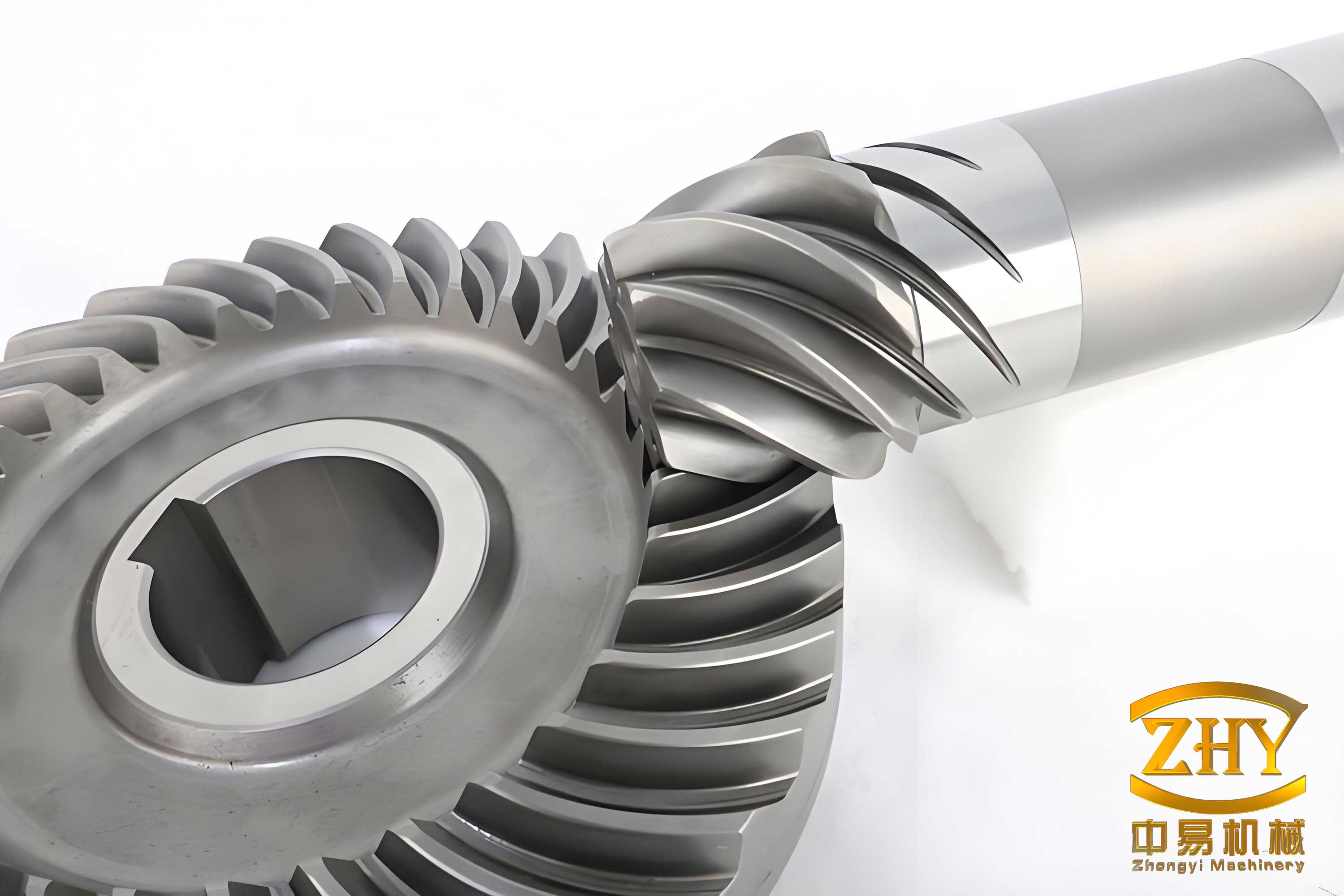
To begin, the tooth surface of spiral bevel gears is derived from a kinematic model that accounts for the interaction between the cutter and the gear blank. Let the cutter cone apex be denoted as point O, and the gear blank cone apex as point O’. For any point M on the cutter’s conical cutting surface, the normal vector is represented as \(\mathbf{n}\), and the unit vector along the generatrix direction as \(\mathbf{t}\). Using vector operations, the motion vector equation \(\mathbf{r}\) for point M relative to O is established, along with the vector equation \(\mathbf{r}_c\) for point M relative to O’. The cutting surface defined by \(\mathbf{r}\) is a motion surface parameterized by the cradle angle \(q\), and the manufactured tooth surface is the conjugate surface of this cutting surface. Through the engagement equation, the cradle angle \(q\), cutter phase angle \(\theta\), and workpiece rotation angle \(\phi\) at which point M contacts the conjugate point on the gear tooth can be determined. Consequently, the position vector \(\mathbf{r}_w\) and normal vector \(\mathbf{n}_w\) of that point on the tooth surface in the workpiece’s initial position, relative to O’, are given by:
$$ \mathbf{r}_w = (\mathbf{p} \cdot \mathbf{r}_c) \mathbf{p} + \cos\phi (\mathbf{p} \times \mathbf{r}_c) \times \mathbf{p} + \sin\phi (\mathbf{p} \times \mathbf{r}_c) $$
$$ \mathbf{n}_w = (\mathbf{p} \cdot \mathbf{n}) \mathbf{p} + \cos\phi (\mathbf{p} \times \mathbf{n}) \times \mathbf{p} + \sin\phi (\mathbf{p} \times \mathbf{n}) $$
Here, \(\mathbf{p}\) is the position vector of the gear axis. These equations form the basis for simulating the theoretical tooth surface of spiral bevel gears, enabling precise analysis of deviations caused by machining inaccuracies. The mathematical model highlights the intricate dependencies on adjustment parameters, which are pivotal in controlling the quality of spiral bevel gears.
To quantify tooth surface form errors, the tooth surface is discretized into a grid of points. Typically, along the tooth length direction, 9 columns are selected, and along the tooth height direction, 5 rows are chosen, resulting in 45 discrete points. This discretization allows for a detailed evaluation of errors across the entire surface of spiral bevel gears. In the axial cross-section, the coordinates of these discrete points \((x(i,j), y(i,j))\) are calculated relative to a design reference point, such as the crossing point O1, where \(i = 1, 2, \ldots, 9\) and \(j = 1, 2, \ldots, 5\). For a point M on the tooth surface, the distance to the gear axis \(\mathbf{p}\) (i.e., the X-axis in the axial plane) is \(y\), and the distance along the gear axis to the design crossing point is \(x\). These are expressed as:
$$ y = | \mathbf{r}_w \times \mathbf{p} | $$
$$ x = – \mathbf{r}_w \cdot \mathbf{p} $$
Since \(x\) and \(y\) are functions of \(q\) and \(\theta\), given specific values of \(q\) and \(\theta\), \(x\) and \(y\) can be computed. Conversely, for given discrete point coordinates \((x(i,j), y(i,j))\), a binary iteration method is employed to solve for the corresponding \(q\) and \(\theta\). Subsequently, the position vector \(\mathbf{r}_w(i,j)\) and normal vector \(\mathbf{n}_w(i,j)\) at these points can be derived using the earlier equations. This discretization approach is essential for analyzing localized errors on spiral bevel gears, facilitating a comprehensive assessment of manufacturing tolerances.
The calculation of tooth surface form errors involves comparing the theoretical tooth surface with an error-affected surface. Using the machine tool adjustment parameters and cutter parameters from gear cutting computations, the theoretical position vectors \(\mathbf{r}_w(i,j)\) and normal vectors \(\mathbf{n}_w(i,j)\) for the discrete points are obtained. Similarly, when a set of adjustment parameters with introduced errors is applied, the corresponding vectors \(\mathbf{r}”_w(i,j)\) and \(\mathbf{n}”_w(i,j)\) for the error surface are determined. To align the surfaces for comparison, the midpoint of the tooth surface, corresponding to discrete point \((x(5,3), y(5,3))\), is used as a reference. The angle \(\gamma\) between \(\mathbf{r}_w(5,3)\) and \(\mathbf{r}”_w(5,3)\) is computed, and the theoretical vectors are rotated around the gear axis \(\mathbf{p}\) by \(\gamma\) to yield adjusted vectors \(\mathbf{r}’_w(i,j)\) and \(\mathbf{n}’_w(i,j)\). This ensures that the theoretical and error surfaces coincide at the midpoint. The tooth surface form error \(e(i,j)\) in the direction of the normal vector \(\mathbf{n}’_w(i,j)\) is then calculated as:
$$ e(i,j) = [\mathbf{r}’_w(i,j) – \mathbf{r}”_w(i,j)] \cdot \mathbf{n}’_w(i,j) $$
The total error \(\Delta k\) is defined as the sum of squared errors across all discrete points:
$$ \Delta k = \sum_{i=1}^{9} \sum_{j=1}^{5} e^2(i,j) $$
To evaluate the influence of individual machine tool adjustment parameter errors, a perturbation analysis is conducted. For a parameter with a nominal value, a small change \(\Delta m\) is introduced, leading to errors \(e(i,j)\) at each discrete point. The influence coefficient \(\zeta\) for that parameter is defined as the ratio of the total error change to the perturbation:
$$ \zeta = \Delta k / \Delta m $$
This coefficient quantifies the sensitivity of tooth surface form errors in spiral bevel gears to specific adjustment parameters, providing a metric for prioritizing error control during machining.
For a practical illustration, consider the convex side of a large spiral bevel gear pair. The geometric parameters of the spiral bevel gears and the machine tool adjustment parameters for the large gear are summarized in the following tables. These parameters serve as a basis for analyzing how errors propagate in the manufacturing of spiral bevel gears.
| Parameter | Large Gear | Small Gear |
|---|---|---|
| Hand of Spiral | Right | Left |
| Module (mm) | 8.22 | 8.22 |
| Number of Teeth | 46 | 15 |
| Pressure Angle (°) | 20 | 20 |
| Spiral Angle at Pitch Point (°) | 35 | 35 |
| Pitch Cone Distance (mm) | 170.283 | 170.283 |
| Pitch Angle (°) | 71.939 | 71.939 |
| Dedendum (mm) | 11.4 | 5.67 |
| Addendum (mm) | 4.12 | 9.85 |
| Parameter | Value |
|---|---|
| Workpiece Installation Angle (°) | 68.66 |
| Cutter Radius (mm) | 152.40 |
| Inside Blade Profile Angle (°) | 22 |
| Horizontal Wheel Position (mm) | 0 |
| Vertical Wheel Position (mm) | 0 |
| Bed Position (mm) | 0 |
| Cutter Position Polar Angle (°) | 56.42 |
| Radial Cutter Position (mm) | 149.83 |
| Ratio of Roll | 0.950 |
To assess the impact of adjustment parameter errors on tooth surface form errors in spiral bevel gears, each parameter is perturbed by a small amount \(\Delta m\), as listed below. The resulting tooth surface errors at the 45 discrete points are measured using a coordinate measuring machine, and the total error \(\Delta k\) is computed. The influence coefficients \(\zeta\) are then derived, revealing the relative significance of each parameter in affecting the accuracy of spiral bevel gears.
| Adjustment Parameter | Perturbation \(\Delta m\) | Influence Coefficient \(\zeta\) |
|---|---|---|
| Workpiece Installation Angle (°) | +0.1 | 48.322 |
| Cutter Radius (mm) | +0.01 | 0.934 |
| Inside Blade Profile Angle (°) | +0.1 | 38.226 |
| Horizontal Wheel Position (mm) | +0.01 | 1.143 |
| Vertical Wheel Position (mm) | +0.01 | 0.386 |
| Bed Position (mm) | +0.01 | 6.554 |
| Cutter Position Polar Angle (°) | +0.1 | 12.542 |
| Radial Cutter Position (mm) | +0.01 | 3.181 |
| Ratio of Roll | +0.01 | 86.673 |
The influence coefficients indicate that the ratio of roll, inside blade profile angle, and workpiece installation angle have the most substantial impact on tooth surface form errors in spiral bevel gears, with the ratio of roll being the most sensitive. However, these coefficients only provide an overall measure of influence and do not detail how errors manifest across specific regions of the tooth surface. To gain deeper insights, the discrete points are grouped along the tooth length direction into 5 columns, each containing 9 points, and error values are fitted using spline curves. This allows for an analysis of error trends and their implications for meshing performance in spiral bevel gears. For brevity, I focus on the parameters with high influence coefficients: workpiece installation angle, inside blade profile angle, and ratio of roll.
Starting with the workpiece installation angle error, the fitted error curves across discrete points show that at the small end of the tooth, the addendum region experiences significant errors, approaching 0.02 mm, while the dedendum region has near-zero errors. At the large end, the addendum error is positive at about 0.014 mm, and the dedendum error is negative at approximately 0.005 mm. Along the pitch line, the error is nearly zero at the large end but around 0.008 mm at the small end. Tooth contact analysis (TCA) for spiral bevel gears reveals that such errors cause the contact area to shift toward the dedendum at the large end. This shift increases gear meshing strength but reduces the contact ratio, leading to greater impact during meshing and elevated vibration levels. Thus, installation angle errors in spiral bevel gears can alter meshing dynamics, emphasizing the need for precise control during machining.
Regarding the inside blade profile angle error, the fitted curves indicate that the addendum at the large end and the dedendum at the small end are most affected, with errors of about +0.007 mm and -0.013 mm, respectively. Conversely, the dedendum at the large end and the addendum at the small end show smaller errors, around -0.006 mm and +0.005 mm. The pitch line remains largely unaffected, with errors close to zero at the large end and -0.002 mm at the small end. TCA for spiral bevel gears demonstrates that this error shifts the contact area toward the addendum at the small end, reducing meshing strength and potentially causing tooth breakage. Additionally, the contact ratio decreases, resulting in increased impact and vibration during operation. Therefore, inside blade profile angle errors in spiral bevel gears can compromise durability and smoothness, highlighting the importance of accurate tool geometry.
The ratio of roll error exhibits the most pronounced effect on tooth surface form errors in spiral bevel gears. The fitted curves show substantial errors at the dedendum of the large end and the addendum of the small end, with values of -0.069 mm and +0.038 mm, respectively. Errors at the addendum of the large end and dedendum of the small end are relatively smaller, at -0.031 mm and +0.022 mm. TCA for spiral bevel gears indicates that this error causes the contact area to spread toward the edges, creating a non-contact zone in the central region. While this may increase the contact ratio and improve impact resistance, it accelerates tooth wear and hastens failure mechanisms. Consequently, ratio of roll errors in spiral bevel gears can lead to uneven load distribution and reduced service life, underscoring the criticality of maintaining precise roll settings during manufacturing.
To further elucidate these effects, consider the mathematical relationships involved. The total error \(\Delta k\) can be expressed as a function of the perturbation \(\Delta m\) for each parameter. For instance, if we denote the error vector for all discrete points as \(\mathbf{e} = [e(1,1), e(1,2), \ldots, e(9,5)]^T\), and the sensitivity matrix as \(\mathbf{S}\) relating parameter changes to errors, then:
$$ \Delta k = \mathbf{e}^T \mathbf{e} $$
And for a small change \(\Delta m\) in a parameter, the first-order approximation gives:
$$ \Delta k \approx \left( \frac{\partial \mathbf{e}}{\partial m} \Delta m \right)^T \left( \frac{\partial \mathbf{e}}{\partial m} \Delta m \right) = \Delta m^2 \left\| \frac{\partial \mathbf{e}}{\partial m} \right\|^2 $$
Thus, the influence coefficient \(\zeta\) is proportional to the squared norm of the error sensitivity vector:
$$ \zeta = \frac{\Delta k}{\Delta m} \approx \Delta m \left\| \frac{\partial \mathbf{e}}{\partial m} \right\|^2 $$
This formulation helps in understanding why certain parameters, like the ratio of roll, have high influence coefficients—their error sensitivity vectors have large magnitudes due to the kinematic couplings in spiral bevel gear generation. Additionally, the tooth surface geometry of spiral bevel gears can be described using differential geometry principles. The principal curvatures and directions on the tooth surface affect how errors propagate. If \(\kappa_1\) and \(\kappa_2\) are the principal curvatures, and \(\mathbf{d}_1\) and \(\mathbf{d}_2\) are the corresponding directions, the surface error \(e\) at a point can be related to the parameter-induced deviations \(\delta x, \delta y, \delta z\) in local coordinates:
$$ e \approx \delta z + \frac{1}{2} (\kappa_1 \delta x^2 + \kappa_2 \delta y^2) $$
This quadratic approximation shows that errors are amplified in regions of high curvature, which is common in the root and tip areas of spiral bevel gears. Moreover, the meshing of spiral bevel gears involves complex conjugate actions. The transmission error \(\Delta \phi\) between gears, defined as the deviation from ideal motion, can be linked to tooth surface errors through the following integral over the contact path:
$$ \Delta \phi = \int_{C} \frac{\partial e}{\partial s} ds $$
where \(C\) is the contact line and \(s\) is the arc length. This relationship underscores how localized form errors in spiral bevel gears accumulate to affect dynamic performance, such as noise and vibration. In practice, compensation techniques are employed to mitigate these errors. For example, based on the influence coefficients, one can adjust the machine tool settings iteratively. If the desired tooth surface is defined by vector \(\mathbf{r}_d\), and the current machined surface is \(\mathbf{r}_m\), the correction \(\Delta \mathbf{m}\) to the adjustment parameters can be estimated using the pseudo-inverse of the sensitivity matrix \(\mathbf{J}\):
$$ \Delta \mathbf{m} = \mathbf{J}^+ (\mathbf{r}_d – \mathbf{r}_m) $$
where \(\mathbf{J}\) is the Jacobian matrix with entries \(\partial \mathbf{r}_m / \partial m_i\) for each parameter \(m_i\). This approach enables targeted error reduction in spiral bevel gears, enhancing manufacturing precision. Furthermore, statistical analysis of production data for spiral bevel gears can reveal trends in parameter drift. Suppose we have \(N\) samples of manufactured gears, with measured errors \(\mathbf{e}_k\) and parameter deviations \(\Delta \mathbf{m}_k\). A multivariate regression model can be fitted:
$$ \mathbf{e} = \mathbf{A} \Delta \mathbf{m} + \boldsymbol{\epsilon} $$
where \(\mathbf{A}\) is the coefficient matrix and \(\boldsymbol{\epsilon}\) is the residual error. This model aids in predicting error magnitudes and optimizing tolerance allocations for spiral bevel gears. The thermal and elastic deformations during machining also play a role. The cutting force \(\mathbf{F}\) induces deflections \(\boldsymbol{\delta}\) in the machine-tool-workpiece system, which can be modeled as:
$$ \boldsymbol{\delta} = \mathbf{K}^{-1} \mathbf{F} $$
with \(\mathbf{K}\) being the stiffness matrix. These deflections contribute to tooth surface errors in spiral bevel gears, especially in high-speed machining where forces vary dynamically. Thus, a holistic approach considering both kinematic and dynamic factors is essential for achieving high accuracy in spiral bevel gears. In summary, the study of machine tool adjustment parameter errors provides a foundation for improving the manufacturing quality of spiral bevel gears. By leveraging mathematical models, discrete analysis, and computational tools, we can quantify error influences, predict meshing behavior, and implement effective compensation strategies. The insights gained here are applicable to various types of spiral bevel gears, including those used in automotive, aerospace, and industrial applications, where precision and reliability are paramount.
In conclusion, the research on tooth surface errors caused by machine tool adjustment parameters in spiral bevel gears offers valuable guidelines for precision manufacturing. The defined influence coefficients help prioritize error control, with the ratio of roll, inside blade profile angle, and workpiece installation angle being critical factors. Through discrete point analysis and curve fitting, we can visualize error distributions and understand their effects on meshing contact areas, which may shift or distort, impacting gear performance. These findings support the development of error compensation techniques, such as real-time adjustments or post-process corrections, to enhance the accuracy and longevity of spiral bevel gears. Future work could explore advanced sensing technologies and adaptive control systems to further minimize errors in the production of spiral bevel gears, ensuring they meet the demanding requirements of modern engineering applications.