
The reliable and quiet operation of gear transmissions is paramount in high-performance applications such as wind turbine gearboxes, aerospace systems, and precision machinery. Among various gear types, helical gears are widely favored due to their smoother engagement, higher load capacity, and reduced noise compared to spur gears. However, their performance is highly sensitive to deviations from ideal assembly and operating conditions. In practical applications, components like shafts, bearings, and housings undergo elastic deformations under load, and manufacturing tolerances are inevitable. These factors collectively lead to mesh misalignment, where the gear teeth do not engage along their theoretically perfect conjugate surfaces. This misalignment significantly degrades the meshing characteristics, leading to non-uniform load distribution, increased vibration, and elevated noise levels, ultimately compromising the system’s reliability and lifespan. Therefore, a comprehensive understanding of the influence of mesh misalignment on both the static and dynamic behavior of helical gear pairs is crucial. Furthermore, developing effective countermeasures, primarily through strategic tooth micro-modifications, is essential for optimizing performance. This article delves into a detailed analysis of these effects, presents a dynamic modeling approach that incorporates misalignment, and proposes and validates a combined tooth modification strategy to mitigate the adverse consequences.
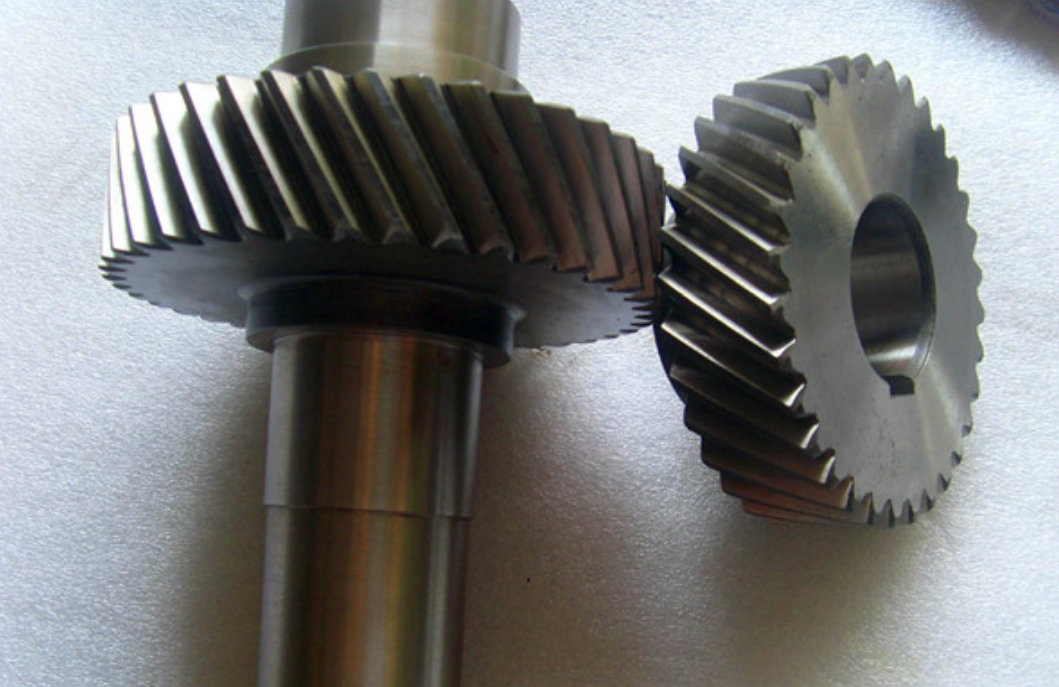
The fundamental geometry of a helical gear involves a cylindrical base with teeth cut at a specific helix angle. This angle introduces a gradual contact line that sweeps across the face width during engagement, which is the source of its smooth operation. The ideal meshing condition assumes perfect parallelism of the gear axes, zero assembly errors, and rigid supporting structures. The contact pattern under this ideal condition is uniform across the full face width and along the active profile. The transmitted load is evenly shared among the contact lines, and the kinematic error, or static transmission error (STE), is minimal and periodic. However, this ideal state is never achieved in real-world helical gear assemblies. The primary consequence of real-world imperfections is mesh misalignment, which can be decomposed into several types as summarized in the table below.
| Type of Misalignment | Description | Primary Causes |
|---|---|---|
| Parallel (Offset) Misalignment | Displacement of the gear axes parallel to each other in the axial direction. | Assembly errors, housing bore misalignment, bearing clearances. |
| Angular (Tilt) Misalignment | Non-parallelism of the gear axes, causing a tilt angle. | Shaft deflection under load, manufacturing inaccuracies in bearing seats. |
| Lead (Helix Angle) Error | Deviation of the actual helix angle from the theoretical design value on one or both gears. | Manufacturing errors during gear cutting or grinding. |
| Axial Misalignment (Shifting) | Axial displacement of one gear relative to its mating partner along the shaft axis. | Incorrect axial positioning during assembly, thermal expansion. |
In practice, a combination of these misalignments often occurs. The net effect is quantified as the total mesh misalignment (fma), defined as the maximum deviation along the path of contact from the ideal conjugate position. It is typically measured in micrometers (μm). A positive value often indicates a shift causing heavier loading at one end of the tooth face, while a negative value indicates the opposite. Accurately predicting this value requires sophisticated system-level analyses, such as finite element analysis (FEA) or multi-body simulation (MBS), which model the flexibility of shafts, bearings, and housings under operational loads.
Influence of Mesh Misalignment on Static Meshing Characteristics
The static meshing characteristics, primarily the load distribution and the resulting static transmission error, are the first to be adversely affected by misalignment in a helical gear pair. The analysis typically involves a loaded tooth contact analysis (LTCA) which solves for the contact pressures and deformations across the potential contact area.
Under ideal alignment, the contact force per unit length (q) is uniformly distributed. When misalignment is present, the contact pattern shifts and becomes concentrated on a reduced area. The maximum contact pressure and unit load increase dramatically, leading to a condition known as edge loading. The contact force for a slice of the tooth can be expressed based on the local approach of the teeth, which is a function of the nominal tooth deflection, manufacturing deviations, and the misalignment-induced separation:
$$ q_i = K \cdot \delta_i $$
where \( q_i \) is the load intensity at discrete segment \( i \), \( K \) is the mesh stiffness per unit length (which varies along the path of contact), and \( \delta_i \) is the total composite deformation at that segment, given by:
$$ \delta_i = \delta_{b,i} + \delta_{m,i} + \delta_{c,i} – e_i $$
Here, \( \delta_{b,i} \) is the bending and shear deflection, \( \delta_{m,i} \) is the contact (Hertzian) deformation, \( \delta_{c,i} \) is the foundation deflection of the gear body, and \( e_i \) is the geometric separation due to profile modifications and misalignment. The misalignment term directly influences \( e_i \), causing it to vary linearly or non-linearly across the face width, breaking the uniform load distribution.
The static transmission error (STE) is defined as the difference between the actual angular position of the driven gear and the position it would occupy if the gears were perfectly conjugate and rigid. It is a primary excitation source for gear vibration and noise. The STE for a helical gear pair under load is calculated as:
$$ \epsilon(\theta) = \frac{\sum_{j=1}^{N_c} q_j(\theta) \cdot \Delta_j}{K_m} $$
where \( \epsilon(\theta) \) is the STE at pinion rotation angle \( \theta \), \( N_c \) is the number of discrete contact lines, \( q_j \) is the load on the j-th contact line, \( \Delta_j \) is the composite tooth error (including modifications and misalignment) at that line, and \( K_m \) is the average mesh stiffness. Misalignment increases the peak-to-peak fluctuation of \( \epsilon(\theta) \) by altering the load distribution \( q_j \) and the effective composite error \( \Delta_j \). A larger STE variation implies a stronger vibratory excitation within the helical gear system.
Dynamic Modeling of Helical Gears with Mesh Misalignment
To fully capture the impact on noise and vibration, a dynamic analysis is indispensable. A lumped-parameter model is often employed, where the gears are represented by masses and moments of inertia, the mesh by a non-linear time-varying stiffness, and the supports by damping and stiffness elements. A six-degree-of-freedom model per gear (translations in x, y, z and rotations about these axes) coupled through the mesh interface can capture complex motions including torsional, translational, and tilting vibrations.
The equations of motion for a helical gear pair system can be written in matrix form as:
$$ \mathbf{M}\ddot{\mathbf{x}} + \mathbf{C}\dot{\mathbf{x}} + \mathbf{K}(t)\mathbf{x} = \mathbf{F}(t) + \mathbf{F}_{m}(t) $$
where \( \mathbf{M} \), \( \mathbf{C} \), and \( \mathbf{K}(t) \) are the mass, damping, and time-varying stiffness matrices, respectively. \( \mathbf{x} \) is the displacement vector containing all degrees of freedom. \( \mathbf{F}(t) \) represents external forces and torques, and \( \mathbf{F}_{m}(t) \) is the internal excitation vector due to transmission error and friction.
The critical element here is the time-varying mesh stiffness \( k_m(t) \). For a helical gear, it is periodic with the gear mesh frequency. Misalignment modifies this stiffness function by effectively reducing the total contact length during part of the mesh cycle, causing sharper variations. Furthermore, the primary excitation, the dynamic transmission error (DTE), is directly related to the static transmission error influenced by misalignment:
$$ DTE(t) = \epsilon(t) + \delta_{dyn}(t) $$
where \( \delta_{dyn}(t) \) is the additional dynamic deflection due to system inertia. The spectrum of the DTE or the dynamic mesh force reveals excitation at the mesh frequency and its harmonics. Misalignment, by increasing the fluctuation in \( \epsilon(t) \), amplifies these excitations, particularly at lower harmonics. The dynamic response shows resonance peaks when these excitation frequencies coincide with the system’s natural frequencies, such as those associated with torsional modes, axial translational modes, or rocking modes of the helical gear pair.
Tooth Micro-Geometry Modification as a Corrective Strategy
Given the detrimental effects of misalignment, intentional tooth modifications, commonly referred to as micro-geometry or profile and lead crowning, are applied to compensate for these errors and improve load distribution. The goal is to pre-shape the tooth surfaces so that under load and with anticipated misalignment, the contact pattern becomes uniform and edge loading is avoided. For helical gears, two main types of modifications are most relevant:
1. Profile Modification: This involves altering the tooth profile (in the cross-section perpendicular to the axis) from the ideal involute. Tip and root relief are common to avoid edge contact at the beginning and end of engagement. A more comprehensive approach is profile crowning (or barreling), which gives a slight convex shape to the profile, making the center of the tooth profile slightly higher than the edges.
2. Lead (Longitudinal) Modification: This involves altering the tooth surface along the face width (lead direction). The most common type is lead crowning, which gives a convex shape to the tooth flank along its length. This is specifically designed to accommodate misalignment and shaft deflection. Additionally, lead slope modification (or helix angle correction) can be applied to intentionally create a linear taper across the face width to directly counteract a known, constant misalignment.
The optimal modification amount is not arbitrary. It is typically designed to compensate for the combined static deflections of the system and the anticipated misalignment. A common design principle is to make the crowning amount (Ca) equal to or slightly greater than the expected total composite displacement at the tooth. For a helical gear pair, the lead crowning amount to compensate for parallel misalignment (fma) and bending deflection (δb) can be estimated as:
$$ C_a \approx f_{ma} + \delta_b $$
Similarly, a lead slope modification (Δβ) can be applied to directly negate a measured angular misalignment. The relationship between slope modification (in length units at the ends of the face width) and the misalignment is often direct: the slope amount S is set to be equal and opposite to the misalignment value fma.
| Target Issue | Modification Type | Purpose & Typical Magnitude |
|---|---|---|
| Parallel Misalignment & Shaft Deflection | Lead Crowning | Creates a convex tooth surface to center the load. Magnitude is typically 10-50 μm, matched to calculated deflection. |
| Constant Angular Misalignment | Lead Slope (Helix Angle Correction) | Introduces a linear taper across the face width. Slope magnitude (difference in end heights) is set equal to the misalignment (e.g., 30 μm). |
| Mesh Entry/Exit Impact | Tip and Root Relief | Removes material near the tip and root to smooth engagement. Relief amount is usually small (5-20 μm). |
| General Load Localization | Profile Crowning | Creates a slightly convex profile to accommodate alignment errors in the profile plane. Magnitude is typically smaller than lead crowning. |
Case Study: Analysis of a Wind Turbine Gearbox Helical Gear Stage
To illustrate the concepts, let’s consider a case study based on an intermediate parallel-axis helical gear pair from a multi-megawatt wind turbine gearbox. The basic parameters are: Module mn = 8.25 mm, Helix Angle β = 14°, Number of Teeth (Pinion/Wheel) z1/z2 = 23/82, Face Width (Pinion/Wheel) b1/b2 = 185 mm / 170 mm. A system-level flexible multibody dynamics analysis of the complete gearbox, considering shaft flexibilities and bearing clearances, predicted a constant mesh misalignment for this stage of fma = -44 μm (indicating load shift towards one end).
Static Analysis Results (Without vs. With Misalignment):
A. Load Distribution: Under ideal alignment, the contact pattern was uniform with a maximum unit load qmax, ideal ≈ 767 N/mm. When the calculated misalignment of -44 μm was introduced, severe edge loading occurred. The load shifted dramatically, with the unit load at the heavily loaded end rising to qmax, misaligned ≈ 1192 N/mm—an increase of over 55%. The lightly loaded end carried only a fraction of the load.
B. Static Transmission Error: The peak-to-peak variation of the STE increased from Δεideal ≈ 4.73 μm to Δεmisaligned ≈ 5.33 μm, an increase of about 12.7%. This confirms that the misalignment introduces additional kinematic excitation.
Dynamic Analysis Results:
A frequency-domain dynamic analysis of the helical gear pair model, incorporating the time-varying mesh stiffness and the misalignment-influenced STE as excitation, was performed. The dynamic mesh force spectrum showed dominant peaks at the mesh frequency and its harmonics. Notably, the first-order harmonic (at the mesh frequency) exhibited significant amplification at specific lower frequencies (e.g., 232 Hz, 444 Hz, 804 Hz). These frequencies were identified as system natural modes related to the axial translation, axial translation-torsion coupling, and radial rocking motions of the helical gear pair, respectively. The dynamic transmission error also showed a strong first harmonic component, indicating a potent source for vibration and noise generation in this helical gear stage.
Application and Validation of a Combined Modification Strategy
To rectify the issues caused by the -44 μm misalignment, a combined modification on the pinion (the smaller, more cost-effective gear to modify) was designed:
- Lead Crowning (Ca): To accommodate general system deflections and centralize the contact. Based on elastic deflection calculations, a value of Ca = 59 μm was chosen.
- Lead Slope Modification (S): To directly counteract the specific -44 μm parallel misalignment. A slope of S = +44 μm was applied (positive slope to offset the negative misalignment).
Results After Modification:
The loaded tooth contact analysis was repeated with the modified pinion tooth surface. The results demonstrated a remarkable improvement:
- Load Distribution: The edge loading was completely eliminated. The contact pattern became centered and uniform across the face width of the helical gear. The maximum unit load was reduced to qmax, modified ≈ 1095 N/mm, representing an 8.2% reduction from the severe misaligned case and a much healthier distribution.
- Static Transmission Error: The fluctuation was drastically reduced. The peak-to-peak STE variation dropped to Δεmodified ≈ 0.31 μm. This is a reduction of approximately 94% compared to the misaligned case and over 93% compared to even the nominal “ideal” aligned case (which still had some inherent fluctuation). This dramatic smoothing of the primary excitation source directly leads to lower dynamic forces.
Subsequent dynamic simulation of the modified helical gear pair confirmed the improvement. The amplitude of the dynamic mesh force at the key excitation frequencies, particularly the first harmonic component near the system resonances, was significantly attenuated. This translates directly into lower vibration levels and reduced noise emission from the gearbox, enhancing its operational reliability and longevity.
Conclusion
Mesh misalignment is an inevitable reality in the operation of helical gear pairs within complex mechanical systems. Its impact on both static characteristics—manifesting as detrimental edge loading and increased static transmission error fluctuation—and dynamic behavior—exciting system resonances and amplifying vibration and noise—is profound and cannot be neglected in high-performance design. Accurate system-level modeling to predict the magnitude and type of misalignment is the essential first step. Following this, intentional micro-geometry tooth modifications serve as a highly effective corrective measure. As demonstrated, a strategy combining lead crowning to manage general deflections and lead slope modification to target specific, quantifiable misalignment can successfully restore uniform load distribution and dramatically reduce transmission error excitation. For critical applications like wind turbines, employing such a comprehensive approach—from system analysis predicting misalignment in the helical gear pair to the design and application of targeted modifications—is fundamental to achieving the required levels of durability, efficiency, and quiet operation. The interplay between misalignment anticipation and compensatory geometric design remains a cornerstone of modern, reliable helical gear engineering.