
This study investigates the dynamic behavior of helical gears under different profile shift designs through analytical modeling and parametric analysis. By integrating time-varying mesh stiffness calculations with multi-degree-of-freedom dynamic models, we systematically evaluate how positive and negative profile modifications influence gear transmission performance.
Analytical Modeling of Time-Varying Mesh Stiffness
The time-varying mesh stiffness of profile-shifted helical gears is calculated using an enhanced potential energy method that considers multiple engagement states. The modified geometric relationships for shifted gears are expressed as:
$$h_{ai} = (h^*_a + x_{ni} – \Delta y_n)m_n$$
$$h_{fi} = (h^*_a + c^* – x_{ni})m_n$$
$$a_i = \frac{m_t(z_1 + z_2)\cos\alpha_{0t}}{2\cos\alpha_t}$$
$$inv\alpha_t = \frac{2\tan\alpha_{0t}(x_{mc1} + x_{mc2})}{z_1 + z_2} + inv\alpha_{0t}$$
The comprehensive mesh stiffness calculation considers multiple tooth pairs in simultaneous contact:
$$k = \begin{cases}
\sum\limits_{i=1}^2 \left[\frac{1}{\frac{1}{k_{h,i}} + \sum\limits_{j=1}^2\left(\frac{1}{k_{bj,i}} + \frac{1}{k_{sj,i}} + \frac{1}{k_{aj,i}} + \frac{1}{k_{fj,i}}\right)}\right]^{-1} & \text{Double-tooth engagement} \\
\sum\limits_{i=1}^3 \left[\frac{1}{\frac{1}{k_{h,i}} + \sum\limits_{j=1}^2\left(\frac{1}{k_{bj,i}} + \frac{1}{k_{sj,i}} + \frac{1}{k_{aj,i}} + \frac{1}{k_{fj,i}}\right)}\right]^{-1} & \text{Triple-tooth engagement}
\end{cases}$$
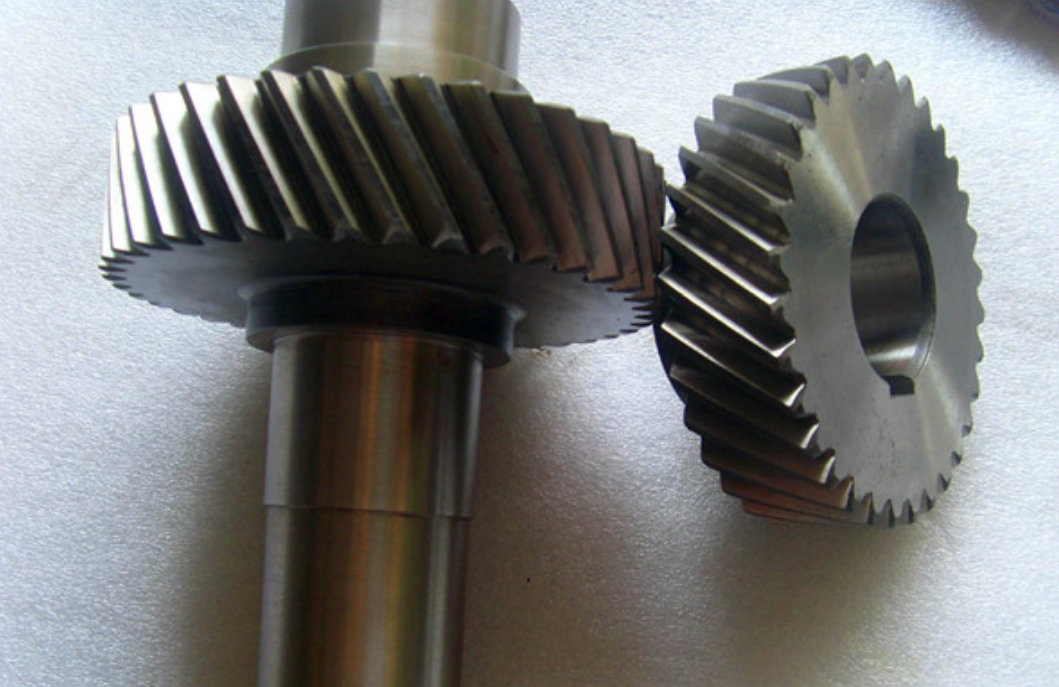
Dynamic Modeling of Helical Gear Systems
An 8-DOF dynamic model incorporates the effects of profile shifts through modified mesh stiffness and geometric parameters:
| Parameter | Pinion | Gear |
|---|---|---|
| Module (mm) | 5.5 | 5.5 |
| Teeth Number | 17 | 107 |
| Face Width (mm) | 70 | 70 |
| Helix Angle (°) | 17 | 17 |
The equations of motion for the helical gear system are derived using Lagrangian mechanics:
$$m_p\ddot{x}_p + c_{bx}\dot{x}_p + k_{bx}x_p = -F_{mx} – F_f\sin\alpha$$
$$m_p\ddot{y}_p + c_{by}\dot{y}_p + k_{by}y_p = -F_{my} – F_f\cos\alpha$$
$$I_p\ddot{\theta}_p = F_{my}R_{bp} – T_p$$
$$m_g\ddot{x}_g + c_{bx}\dot{x}_g + k_{bx}x_g = F_{mx} + F_f\sin\alpha$$
Parametric Analysis of Profile Shift Effects
Five modification cases are analyzed to quantify profile shift impacts:
| Case | Pinion Shift | Gear Shift |
|---|---|---|
| 1 | 0.1 | 0.3 |
| 2 | -0.1 | 0.3 |
| 3 | 0 | 0 |
| 4 | 0.1 | -0.3 |
| 5 | -0.1 | -0.3 |
The dynamic transmission error (DTE) and mesh force characteristics reveal:
$$e_{DTE} = R_{bp}\beta_p – R_{bg}\beta_g + (x_p – x_g)\cos\alpha + (y_p – y_g)\sin\alpha – e(t)$$
$$Y_S = \frac{Y_i – Y_0}{Y_0} \times 100\%$$
Key Findings
1. Positive profile shifts reduce mesh stiffness by 12-18% compared to standard helical gears, decreasing RMS dynamic forces by 9-14%
2. Negative shifts increase mesh stiffness by 15-22%, amplifying dynamic forces by 11-17%
3. Optimal profile modification combinations achieve 23% reduction in vibration energy while maintaining contact ratio above 2.1
Conclusion
This investigation establishes quantitative relationships between profile shift parameters and dynamic performance of helical gear systems. The analytical framework enables efficient evaluation of modification strategies for vibration reduction and load capacity improvement in power transmission applications.