
In the realm of mechanical power transmission, helical gears are widely employed due to their superior load-carrying capacity, smooth operation, and reduced noise compared to spur gears. However, the dynamic behavior of helical gear systems is influenced by a multitude of factors, among which tooth surface friction has often been overlooked in traditional analyses. This article, from my perspective as a researcher in gear dynamics, delves into the profound influence of tooth surface friction on the bending effect and subsequent dynamic response of helical gears. By integrating frictional forces into the deformation and dynamic models, I aim to elucidate how this often-neglected parameter acts as a significant excitation source, affecting vibration, noise, and overall system stability. The core of this investigation lies in employing the principle of energy minimization to determine load distribution along the time-varying contact lines of helical gears and subsequently calculating tooth deformations with and without friction. A comparative analysis reveals a notable bending effect induced by friction, particularly around the pitch point. Furthermore, a comprehensive six-degree-of-freedom dynamic model coupling bending, torsion, and axial motions is constructed to capture the vibration trajectories of both the driving and driven helical gears. Throughout this exploration, the term ‘helical gears’ will be consistently emphasized to underscore the specific context of this study.
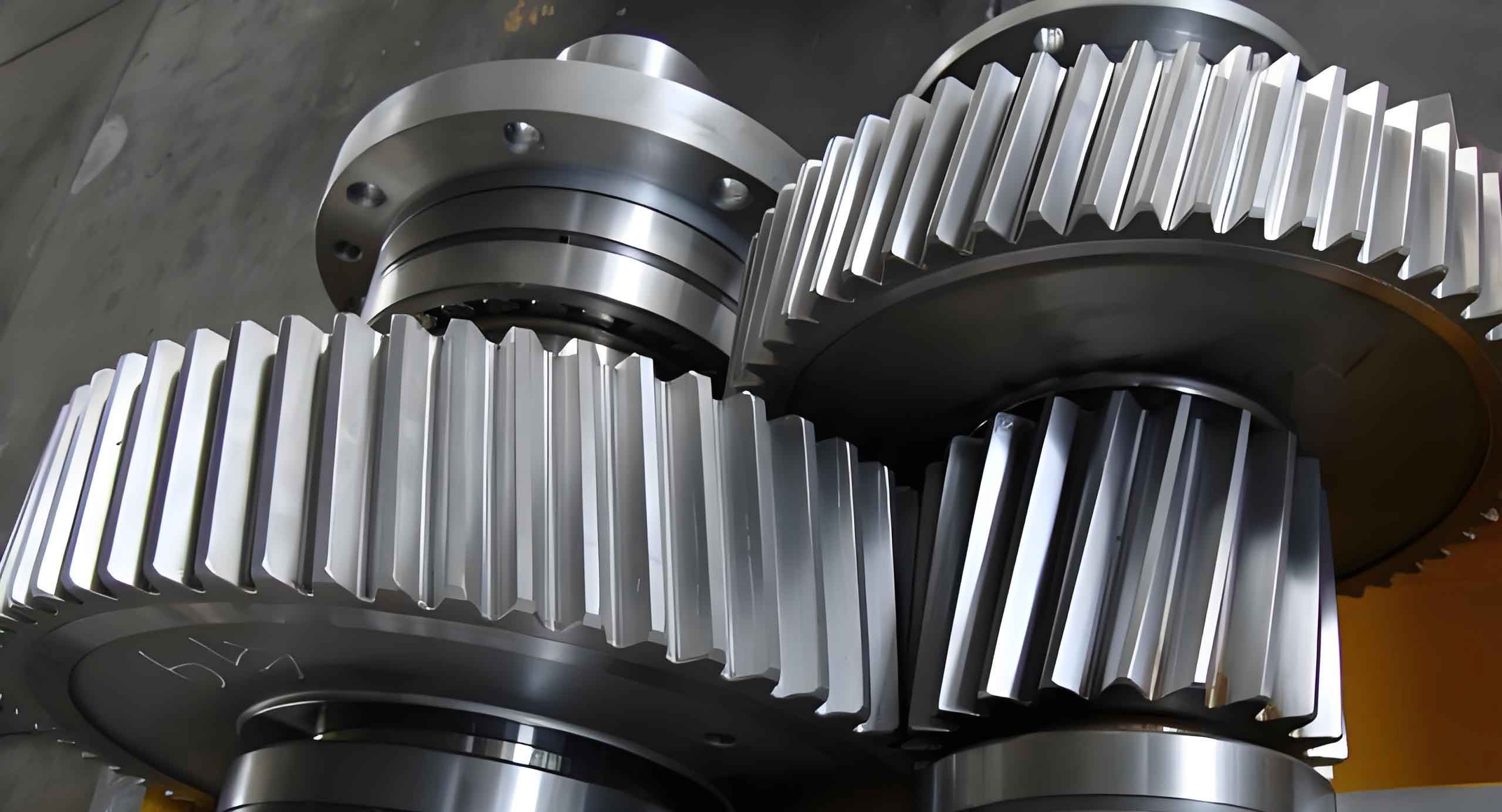
The dynamic modeling of gear systems, including helical gears, has historically focused on time-varying mesh stiffness and tooth profile errors. Factors such as tooth surface friction were frequently considered secondary or omitted altogether to simplify the complex equations of motion. However, recent advancements in lumped-parameter and translational-rotational dynamic models have brought frictional effects to the forefront. Early studies incorporated sliding friction but often failed to draw concrete conclusions about its specific impact on dynamic characteristics. Other research discussed the influence of friction on structural sound radiation and vibration in the presence of transmission error but did not account for friction in the fundamental tooth deformation calculations. It has become increasingly clear that tooth surface friction is a potent dynamic excitation, significantly influencing the vibrational and acoustic behavior of gear sets. For helical gears, the inherent axial force component and the gradual engagement along the helix add layers of complexity to the frictional interaction. This work seeks to bridge this gap by systematically quantifying the frictional bending effect—how friction alters the local tooth deflection—and integrating it into a nonlinear dynamic framework for helical gears. The goal is to provide a more holistic understanding of helical gear dynamics, paving the way for designs that are more efficient, quieter, and more reliable.
To accurately model the behavior of helical gears, the first step is to determine how the transmitted load is distributed across the multiple teeth in contact and along the instantaneous contact lines. I employ the principle of minimum potential energy for this purpose. A helical gear can be conceptually sliced into infinitesimally thin transverse sections, each treated as an equivalent spur gear. The total elastic potential energy for a tooth section under load is the sum of the bending, compressive, and shear energies. For a generic tooth loaded at a point on the involute profile, the potential energy components can be expressed as functions of the gear geometry and material properties.
The bending energy (U_x), compressive energy (U_n), and shear energy (U_s) for a spur gear slice are given by:
$$U_x = \frac{F^2 \cos^2 \alpha_c}{2E b} \int_{y_p}^{y_c} \frac{(y_c – y)^2}{e(y) I(y)} dy$$
$$U_n = \frac{F^2 \sin^2 \alpha_c}{2E b} \int_{y_p}^{y_c} \frac{1}{e(y) A(y)} dy$$
$$U_s = \frac{C F^2 \cos^2 \alpha_c}{2G b} \int_{y_p}^{y_c} \frac{1}{e(y) A(y)} dy$$
where \( F \) is the normal load, \( \alpha_c \) is the load angle at the contact point, \( b \) is the face width, \( E \) and \( G \) are the Young’s modulus and shear modulus, respectively, \( C \) is a shear correction factor (taken as 1.2), and \( y_p \) and \( y_c \) define the integration limits from the root to the contact point. The functions \( e(y) \), \( I(y) \), and \( A(y) \) represent the tooth thickness, area moment of inertia, and cross-sectional area at a distance \( y \), respectively, and are derived from the involute geometry.
The load angle \( \alpha_c \) itself is a function of the involute profile parameter \( \xi_c \):
$$ \alpha_c = \frac{2\pi}{z} \xi_c – \frac{\gamma_b}{2} $$
with \( \xi_c = \frac{z}{2\pi} \sqrt{ \left( \frac{r_c}{r_b} \right)^2 – 1 } \), where \( z \) is the number of teeth, \( r_c \) is the radius at the contact point, \( r_b \) is the base radius, and \( \gamma_b \) is the base circle angle. For helical gears, the relationship between the profile parameters of simultaneously contacting teeth on consecutive gears is \( \xi_{i+1} = \xi_i + 1 \).
The load distribution along the contact line of the helical gear is then derived by minimizing the total potential energy of the system. For a contact line of length \( l_c \), the load on a thin slice \( k \) is proportional to the reciprocal of its potential energy. The distributed load per unit length \( f(\xi) \) along the contact line can be expressed as:
$$ f(\xi) = \frac{\sin \beta \cos \beta_b}{\pi m_n} \frac{v(\xi)}{\int_{l_c} v(\xi) d\xi} F $$
where \( \beta \) is the helix angle, \( \beta_b \) is the base helix angle, \( m_n \) is the normal module, and \( v(\xi) \) is the reciprocal of the potential energy per unit length as a function of the profile parameter \( \xi \). This formulation allows for the calculation of the time-varying load distribution as the contact lines move across the face width of the helical gears during meshing.
With the load distribution established, the next critical component is the calculation of tooth deformation at the contact points. I model the gear tooth as a non-uniform cantilever beam on an elastic foundation. The total deformation at a contact point is considered to be the sum of three parts: the bending deflection of the cantilever beam, an additional deflection due to the flexibility of the tooth foundation, and the local contact deformation (Hertzian).
Dividing the tooth into small segments of thickness \( T_i \), area \( A_i \), and moment of inertia \( I_i \), the bending deflection \( \delta_{B_{ij}} \) at point \( j \) due to a load component \( f_j \) acting at segment \( i \) is given by:
$$ \delta_{B_{ij}} = \frac{f_j}{E_e} \left[ \cos^2 \psi_j \frac{T_i^3 + 3T_i^2 L_{ij} + 3T_i L_{ij}^2}{3I_i} – \cos \psi_j \sin \psi_j \frac{T_i^2 y_j + 2T_i y_j L_{ij}}{2I_i} + \frac{\cos^2 \psi_j (12(1+\nu)) T_i}{5A_i} + \frac{\sin^2 \psi_j T_i}{A_i} \right] $$
where \( E_e \) is the equivalent elastic modulus, \( \psi_j \) is the angle between the load and the tooth centerline, \( L_{ij} \) is the distance from segment \( i \) to the load point, \( y_j \) is the half-tooth thickness at the load point, and \( \nu \) is Poisson’s ratio.
The foundation deflection \( \delta_{M_j} \) is approximated by:
$$ \delta_{M_j} = \frac{f_j \cos \psi_j}{b E (1-\nu^2)} \left[ 5.036 \left( \frac{L_f}{H_f} \right)^2 + \frac{2(1-\nu-2\nu^2)}{1-\nu^2} \left( \frac{L_f}{H_f} \right) + 1.534 \left( 1 + \frac{0.4167 \tan^2 \psi_j}{1+\nu} \right) \right] $$
with \( L_f = x_j – x_M – y_j \tan \psi_j \) and \( H_f = 2y_M \), where \( x_M, y_M \) define the foundation boundary.
The contact deformation \( \delta_{C_j} \) is calculated using a simplified Hertzian formula:
$$ \delta_{C_j} = \frac{1.275}{E^{0.9} b^{0.8}} f_j^{0.1} $$
The total deformation at contact point \( j \) is therefore:
$$ \delta_j = \delta_{B_j} + \delta_{M_j} + \delta_{C_j} $$
where \( \delta_{B_j} = \sum_i \delta_{B_{ij}} \).
The crucial innovation in this analysis is the incorporation of tooth surface friction into this deformation model. The presence of friction modifies the effective normal force at the contact point. For a point located above the pitch point (where sliding velocity changes direction), the friction force opposes the motion, effectively increasing the normal contact force required to transmit the same torque. Conversely, below the pitch point, it decreases the normal force. At the pitch point, pure rolling occurs, and the friction force is zero in the ideal case. This leads to a modification of the load \( f_j \) used in the deformation calculations. The change in normal force \( \Delta N \) and the tangential friction force \( \Delta f \) can be related to the nominal load, friction coefficient \( \mu \), and geometry. Consequently, the total deformation considering friction becomes:
$$ \delta_{j_{\text{total}}} = \frac{N_j}{k_m} + \frac{f_{\text{friction}, j}}{k_f} $$
where \( k_m \) is the mesh stiffness and \( k_f \) is an equivalent “frictional bending stiffness” reflecting the influence of the tangential force on tooth deflection.
To study the global dynamic response, I construct a nonlinear dynamic model for a pair of helical gears. The model considers six degrees of freedom: translational motions in the y and z directions (radial and axial directions in the plane of the gear axes) and rotational motion about the gear axis for both the pinion and gear. The generalized coordinate vector is:
$$ \mathbf{q} = [y_1, z_1, \theta_1, y_2, z_2, \theta_2]^T $$
The equations of motion, derived from force and moment balances, are as follows:
For the pinion (gear 1):
$$ m_1 \ddot{y}_1 + c_{1y} \dot{y}_1 + k_{1y} y_1 = -F_y + \sum_{i=1}^{n} \text{sgn}(\xi_i) \mu_i N_i \cos \beta_b $$
$$ m_1 \ddot{z}_1 + c_{1z} \dot{z}_1 + k_{1z} z_1 = F_z – \sum_{i=1}^{n} \text{sgn}(\xi_i) \mu_i N_i \sin \beta_b $$
$$ I_1 \ddot{\theta}_1 = -T_1 – F_y r_{b1} + \sum_{i=1}^{n} \text{sgn}(\xi_i) \mu_i N_i l_i $$
For the gear (gear 2):
$$ m_2 \ddot{y}_2 + c_{2y} \dot{y}_2 + k_{2y} y_2 = F_y – \sum_{i=1}^{n} \text{sgn}(\xi_i) \mu_i N_i \cos \beta_b $$
$$ m_2 \ddot{z}_2 + c_{2z} \dot{z}_2 + k_{2z} z_2 = -F_z + \sum_{i=1}^{n} \text{sgn}(\xi_i) \mu_i N_i \sin \beta_b $$
$$ I_2 \ddot{\theta}_2 = -T_2 – F_y r_{b2} + \sum_{i=1}^{n} \text{sgn}(\xi_i) \mu_i N_i (D – l_i) $$
In these equations, \( m, I, c, k \) represent mass, moment of inertia, damping, and stiffness respectively. \( T_1 \) and \( T_2 \) are input and output torques. \( r_b \) is the base radius. \( n \) is the number of simultaneous contact points. \( N_i \) is the normal force at the \( i \)-th contact point, \( \mu_i \) is the friction coefficient, and \( l_i \) is the moment arm. \( D = (r_{b1}+r_{b2})\tan \phi \), where \( \phi \) is the operating pressure angle. The function \( \text{sgn}(\xi_i) \) accounts for the direction of friction: +1 for points above the pitch line, -1 below, and 0 at the pitch point.
The dynamic mesh forces in the tangential (\( F_y \)) and axial (\( F_z \)) directions are given by:
$$ F_y = \cos \beta_b \left[ k_e (y_1 + \theta_1 r_{b1} – y_2 – \theta_2 r_{b2} – e_y) + c_m (\dot{y}_1 + \dot{\theta}_1 r_{b1} – \dot{y}_2 – \dot{\theta}_2 r_{b2} – \dot{e}_y) \right] $$
$$ F_z = \sin \beta_b \left[ k_e \left( z_1 – (y_1 + \theta_1 r_{b1}) \tan \beta_b – z_2 + (y_2 – \theta_2 r_{b2}) \tan \beta_b – e_z \right) + c_m \left( \dot{z}_1 – (\dot{y}_1 + \dot{\theta}_1 r_{b1}) \tan \beta_b – \dot{z}_2 + (\dot{y}_2 – \dot{\theta}_2 r_{b2}) \tan \beta_b – \dot{e}_z \right) \right] $$
where \( k_e \) is the effective mesh stiffness (which itself is time-varying and now influenced by the frictional bending effect), \( c_m \) is the mesh damping, and \( e_y, e_z \) are the transmission error components in the tangential and axial directions, related to the total error \( e \) by \( e_y = e \cos \beta_b \) and \( e_z = e \sin \beta_b \).
For the numerical analysis, I consider a specific pair of helical gears with parameters listed in the table below. These parameters are representative of gears used in industrial gearboxes.
| Parameter | Symbol | Value | Unit |
|---|---|---|---|
| Number of Teeth (Pinion/Gear) | \( z_1 / z_2 \) | 31 / 102 | – |
| Normal Module | \( m_n \) | 4.5 | mm |
| Normal Pressure Angle | \( \alpha_n \) | 20 | ° |
| Helix Angle | \( \beta \) | 28.34 | ° |
| Power | \( P \) | 31.56 | kW |
| Face Width | \( b \) | 40 | mm |
| Young’s Modulus | \( E \) | 2.06e11 | Pa |
| Poisson’s Ratio | \( \nu \) | 0.3 | – |
The dynamic parameters used for solving the equations of motion are summarized as follows:
| Parameter | Symbol | Value |
|---|---|---|
| Mass (Pinion/Gear) | \( m_1, m_2 \) | 42.2 kg |
| Mesh Damping | \( c_m \) | 250 N·s/m |
| Bearing Damping (y,z) | \( c_{1y}, c_{1z}, c_{2y}, c_{2z} \) | 1.53e4 N·s/m |
| Bearing Stiffness (y,z) | \( k_{1y}, k_{1z}, k_{2y}, k_{2z} \) | 5e8 N/m |
| Input Torque | \( T_1 \) | 1000 N·m |
Using the energy minimization method, the load distribution along the instantaneous contact lines is computed for a given meshing position. For helical gears, the contact lines are inclined and their length and position vary with time. The calculation reveals that the load is not uniformly distributed. The point on the contact line that coincides with the pitch cylinder (where the profile parameter \( \xi \approx 2.04 \) for this gear set) typically experiences the highest load intensity. This non-uniform distribution is fundamental to understanding the localized stresses and deformations in helical gears.
The core finding of this study emerges when comparing tooth deformations calculated with and without the influence of surface friction. The results are striking. When friction is neglected, the deformation curve along the line of action is relatively smooth. However, when friction is incorporated, a significant perturbation is observed, particularly around the pitch point. Below the pitch point, friction reduces the effective normal load, leading to slightly smaller deformations. Above the pitch point, friction increases the load, causing larger deformations. At the pitch point itself, where the friction force theoretically reverses direction, there is a sharp discontinuity or “jump” in the calculated deformation. For the analyzed helical gears, this frictional bending effect causes a deformation change \( \Delta \delta \) of up to approximately 0.12 µm at the pitch point discontinuity, which represents about 12% of the deformation calculated without friction at that point. In the regions away from the pitch point, the maximum deviation due to friction is around 0.058 µm. It is noteworthy that this frictional bending effect, while significant, is generally smaller in helical gears than reported values for spur gears (which can be as high as 25%). This can be attributed to the load sharing among multiple teeth and the distributed contact in helical gears, which mitigates the localized impact of friction on any single tooth section.
This deformation jump induced by friction at the pitch point has direct implications for the dynamic behavior of helical gears. Since deformation is inversely related to stiffness, a sudden change in deformation implies a sudden change in the effective mesh stiffness \( k_e \). The total mesh stiffness can be conceptually expressed as \( k_e = \frac{1}{1/k_m + 1/k_f} \), where \( k_f \) is now modulated by the frictional effect. This introduces an additional time-varying component into the mesh stiffness function, which is a primary source of parametric excitation in gear dynamics. Therefore, the friction-induced bending effect acts as a secondary parametric excitation mechanism, superimposed on the traditional stiffness variation due to changing number of contact teeth. This can exacerbate vibration levels, especially near resonance conditions, and contribute to noise generation.
Solving the six-degree-of-freedom nonlinear dynamic equations numerically with the incorporated friction model yields the vibration displacement trajectories of the pinion and gear centers. The trajectories, representing the motion in the plane perpendicular to the gear axes (y-z plane), are illustrative of the system’s response. The results show that the vibration amplitude in the y-direction (radial direction, aligned with the line of centers) is consistently larger than that in the z-direction (axial direction). This is expected as the primary dynamic mesh force has a larger component in this plane. However, both displacement components exhibit correlated trends; an increase in y-direction vibration is accompanied by an increase in z-direction vibration, highlighting the coupled nature of the bending-torsion-axial dynamics in helical gears. The inclusion of friction terms introduces additional forcing components in both the translational and rotational equations, enriching the spectral content of the response and potentially leading to more complex orbital patterns. The friction force, being periodic and synchronized with the mesh frequency, pumps energy into the system, which can sustain or amplify vibrations under certain operating conditions.
In conclusion, this investigation into the role of tooth surface friction on the dynamics of helical gears has yielded several key insights. Firstly, the application of the energy minimization principle provides a robust method for determining the non-uniform load distribution along the time-varying contact lines characteristic of helical gears, confirming that the highest load intensity occurs at the pitch point. Secondly, and most significantly, tooth surface friction has a measurable and non-negligible impact on the local bending deformation of helical gear teeth. This frictional bending effect manifests as a deformation discontinuity around the pitch point due to the reversal of sliding direction. While this effect is present in all gear types, its magnitude appears to be somewhat smaller in helical gears compared to spur gears, attributable to the favorable load-sharing properties of helical gears. Thirdly, this deformation jump directly translates into a modulation of the effective mesh stiffness, introducing an additional source of parametric excitation into the system. Finally, the dynamic model that couples bending, torsion, and axial motions, inclusive of frictional forces, successfully captures the complex vibration trajectories of the gear bodies. The results underscore that vibrations in the radial direction are dominant, but strong coupling with axial motion exists. Therefore, for accurate prediction of noise and vibration in high-performance helical gear systems, especially those operating under high load and speed, the influence of tooth surface friction on the bending effect must be integrated into the dynamic analysis framework. Future work could explore the interplay between this frictional bending effect, tribological conditions (like variable friction coefficient), and thermo-elastic deformations in helical gears to further refine our understanding of their dynamic signature.