
In modern marine propulsion systems, helical gear pairs play a critical role in speed regulation, reversing, and power transmission. These gears often operate under complex and variable working conditions, frequently subjected to impact loads, especially during ship start-stop cycles or wave-induced shocks. As a researcher focusing on gear dynamics, I have observed that understanding the dynamic behavior of helical gear pairs under such conditions is essential for ensuring reliability and optimizing design. In this study, I aim to investigate the influence of key working condition parameters, such as load torque and driving gear rotational speed, on the dynamic tooth-root stress of marine helical gears. Using explicit dynamic finite element analysis via Abaqus/Explicit, I developed a detailed simulation model to capture the transient meshing processes and stress distributions. The findings from this work are intended to provide valuable insights for the structural and strength optimization of helical gear systems in marine applications.
The dynamic performance of gears has been extensively studied through analytical methods, simulation predictions, and experimental approaches. Simulation-based techniques, particularly finite element analysis, offer a cost-effective and efficient way to handle complex contact problems, such as those encountered in gear meshing. For helical gear pairs, which involve three-dimensional contact and sliding due to their helix angle, explicit dynamic methods are well-suited for modeling impact and nonlinear behaviors. In my research, I leverage Abaqus/Explicit, a software known for its robust capabilities in simulating high nonlinearities like contact and collision. This allows me to accurately model the dynamic interactions between gear teeth under various operational scenarios, providing a deeper understanding of stress concentrations and failure mechanisms.
To begin, I established a three-dimensional geometric model of a single-stage helical gear transmission system typical in marine applications. The accuracy of the gear geometry is paramount for reliable simulation results, particularly the tooth profile and root fillet curves. I employed a virtual machining approach based on the hobbing process to generate the helical gear teeth, ensuring that the tooth surface curves are represented as piecewise nonlinear functions. This method minimizes errors in the normal line length compared to theoretical models, leading to a high-fidelity representation. The key parameters of the helical gear pair are summarized in Table 1. These parameters define the gear geometry, material properties, and rated operating conditions, which serve as the baseline for my simulations.
| Gear | Number of Teeth | Normal Module (mm) | Normal Pressure Angle (°) | Helix Angle (°) | Face Width (mm) | Elastic Modulus (GPa) | Poisson’s Ratio | Density (kg/m³) | Rated Power (kW) | Rated Speed (rpm) |
|---|---|---|---|---|---|---|---|---|---|---|
| Driving Gear | 64 | 8 | 20 | 10 | 122 | 209 | 0.3 | 7855 | 260 | 500 |
| Driven Gear | 70 | 8 | 20 | 10 | 122 | 209 | 0.3 | 7855 | 260 | – |
The finite element model was constructed using linear hexahedral elements (C3D8R) in Abaqus/Explicit, as linear elements are more effective in simulating stress waves compared to quadratic elements. To ensure high-quality meshing in the contact regions, I divided a single tooth along the helical direction into five sections, refined the mesh at the tooth root, and then replicated this to form the entire gear pair. The final model consisted of 281,566 elements and 379,648 nodes. Contact between the helical gear teeth was defined using the penalty method, with hard contact in the normal direction and finite sliding in the tangential direction, assuming a friction coefficient of 0.001. Boundary conditions and loads were applied via reference points (RP-1 and RP-2) at the geometric centers of the driving and driven gears, respectively, coupled kinematically to the gear inner surfaces. The driving gear reference point was constrained in all displacements except rotation about the z-axis, where a rotational speed ω was applied. The driven gear reference point was similarly constrained but with a load torque M applied. The loading curves for speed and torque followed a ramp-up pattern to simulate realistic operational conditions, with a total simulation time of 30 ms. Output settings were configured to capture tooth-root stress at intervals calculated as: $$ Dt = \frac{60}{N z_1 n_1} $$ where N is the number of outputs per tooth engagement (set to 10), z₁ is the number of teeth on the driving gear, and n₁ is its rotational speed. The Von-Mises stress was used as the output metric for dynamic stress analysis.
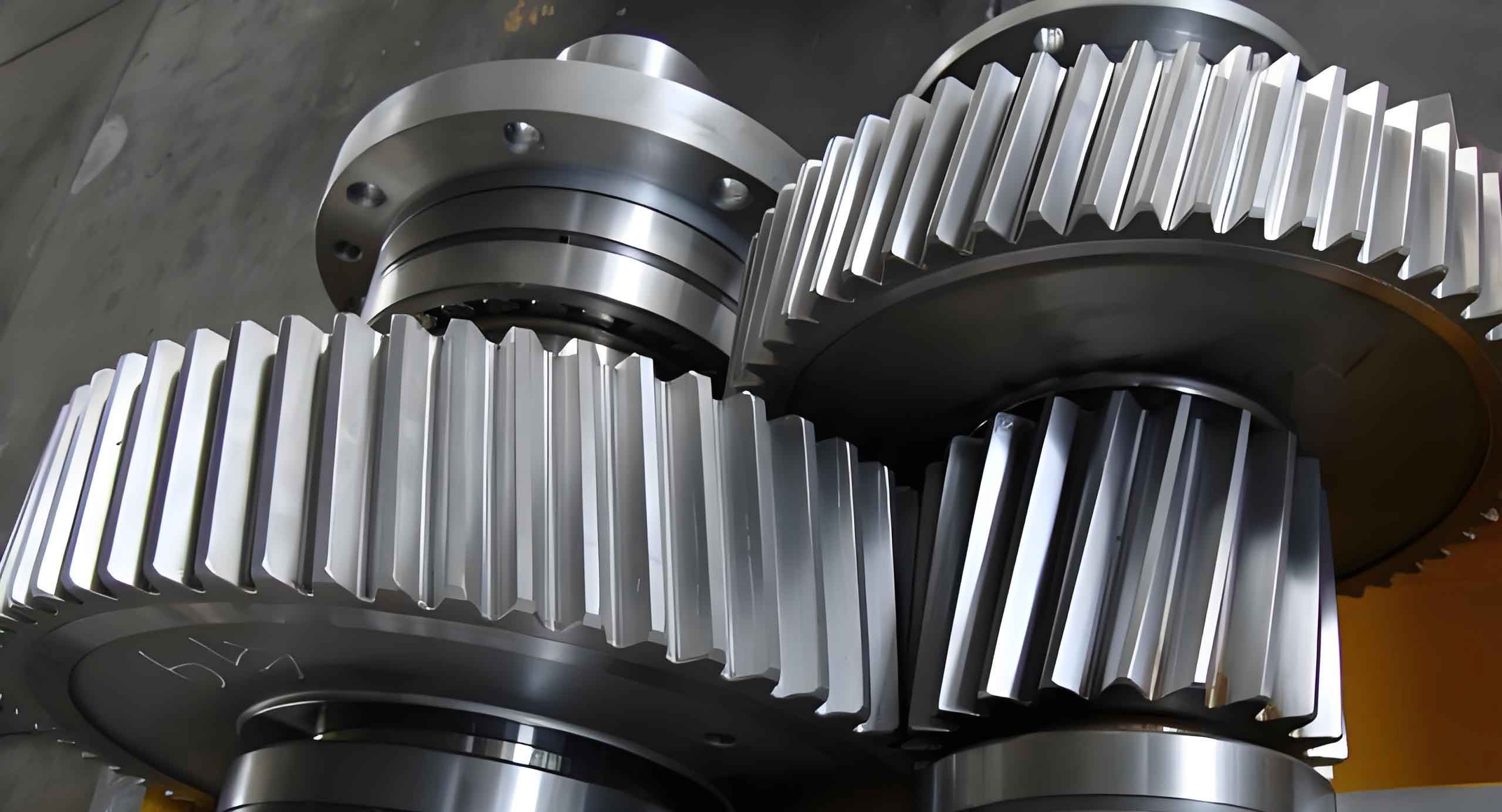
Under rated conditions, with a rotational speed of 52.36 rad/s (500 rpm) and a load torque of 5431.6 N·m, I simulated the dynamic meshing process. The results revealed detailed stress distributions on both the driving and driven helical gears at any given time. For instance, at a specific moment during engagement, the contact stress on the tooth surfaces showed varying magnitudes, with the driven gear experiencing higher maximum stress than the driving gear. This illustrates the load-sharing characteristics and stress concentrations inherent in helical gear pairs. The dynamic tooth-root stress on both the load-bearing and non-load-bearing sides of the gears exhibited similar fluctuation patterns, with maximum impact stresses appearing as pulses. Due to multiple tooth pairs engaging simultaneously in helical gears, these pulses were accompanied by smaller peaks, indicating complex dynamic interactions. To visualize these stress distributions, I include a representative image from the simulation, which highlights the meshing contact and stress contours on the helical gear teeth.
The time-history curves of dynamic tooth-root stress for the driving helical gear further demonstrate these fluctuations. On both the load-bearing and non-load-bearing sides, the stress varies cyclically with meshing frequency, and the maximum values occur during peak loading events. This behavior is critical for assessing fatigue life and potential failure points in marine helical gears. To quantify the impact of working condition parameters, I systematically varied the load torque and driving gear rotational speed within practical ranges. For load torque, I considered variations of ±20% around the rated value, while for rotational speed, I analyzed cases from 400 rpm to 600 rpm. The maximum dynamic tooth-root stress was extracted from each simulation to establish relationships with these parameters.
Regarding load torque effects, I found that the maximum dynamic stress at the tooth root increases approximately linearly with increasing torque for both gears. This linear trend can be expressed as: $$ \sigma_{\text{max}} = k_T \cdot M + c $$ where σ_max is the maximum dynamic stress, M is the load torque, k_T is the stress increase rate per unit torque, and c is a constant. The values of k_T for different gear surfaces are summarized in Table 2. Notably, the non-load-bearing side of the driving helical gear and the load-bearing side of the driven helical gear showed higher sensitivity to torque changes, indicating that these areas are more prone to stress variations under fluctuating loads. This insight is vital for designing helical gear pairs to withstand torque spikes common in marine environments, such as during sudden maneuvers or wave impacts.
| Gear Location | Average Rate (kPa/N·m) |
|---|---|
| Driving Gear Load-Bearing Side | 25.7 |
| Driving Gear Non-Load-Bearing Side | 40.2 |
| Driven Gear Load-Bearing Side | 37.5 |
| Driven Gear Non-Load-Bearing Side | 27.4 |
For rotational speed effects, the maximum dynamic tooth-root stress also exhibited a near-linear increase with increasing driving gear speed. This relationship can be modeled as: $$ \sigma_{\text{max}} = k_\omega \cdot \omega + d $$ where ω is the rotational speed, k_ω is the stress increase rate per unit speed, and d is a constant. The rates for different surfaces are provided in Table 3. Interestingly, the load-bearing side of the driving helical gear and the non-load-bearing side of the driven helical gear were more affected by speed variations. This suggests that inertial effects and meshing dynamics become more pronounced at higher speeds, leading to greater stress amplitudes on these surfaces. In marine applications, where helical gear pairs may operate across a range of speeds due to varying propulsion demands, understanding this dependency helps in optimizing gear geometry and material selection to mitigate dynamic loads.
| Gear Location | Average Rate (kPa/rpm) |
|---|---|
| Driving Gear Load-Bearing Side | 0.185745 |
| Driving Gear Non-Load-Bearing Side | 0.14518 |
| Driven Gear Load-Bearing Side | 0.09393 |
| Driven Gear Non-Load-Bearing Side | 0.19606 |
To delve deeper into the dynamics, I analyzed the underlying mechanisms driving these linear trends. For helical gear pairs, the dynamic tooth-root stress is influenced by factors such as contact ratio, sliding friction, and bending moments. The contact ratio of helical gears is higher than that of spur gears due to the helix angle, which promotes smoother load transmission but also introduces axial forces. The dynamic stress can be related to the applied torque and speed through gear dynamics equations. For instance, the bending stress at the tooth root can be approximated using the Lewis formula extended for helical gears: $$ \sigma_b = \frac{F_t}{b m_n} \cdot Y \cdot K_v $$ where F_t is the tangential force, b is the face width, m_n is the normal module, Y is the Lewis form factor, and K_v is the dynamic factor. The tangential force depends on torque as F_t = M / r, where r is the pitch radius, and the dynamic factor K_v accounts for speed-related effects such as vibrations and impacts. In my simulations, the explicit dynamic method inherently captures these effects, validating the linear relationships observed.
Moreover, the meshing stiffness of helical gear pairs varies cyclically as teeth engage and disengage, contributing to dynamic excitations. The time-varying meshing stiffness can be expressed as: $$ k_m(t) = k_0 + \sum_{i=1}^{n} A_i \sin(\omega_i t + \phi_i) $$ where k_0 is the average stiffness, and the summation represents harmonic components due to tooth spacing and errors. This stiffness variation, combined with external loads, amplifies the dynamic stress, especially at resonance frequencies. In my study, I ensured that the simulation time was sufficient to capture multiple meshing cycles, allowing for analysis of transient responses. The results indicate that for marine helical gears operating under variable conditions, dynamic stress peaks can exceed static predictions by significant margins, underscoring the need for dynamic analysis in design phases.
In discussing the implications, I consider the optimization of helical gear designs for marine applications. Based on my findings, designers can focus on reinforcing tooth-root regions that show higher stress sensitivity to torque or speed changes. For example, optimizing the fillet radius or using compressive residual stresses through shot peening could enhance fatigue resistance. Additionally, adjusting the helix angle might balance load distribution and reduce dynamic excitations. The helix angle β influences axial forces and contact patterns, with higher angles increasing smoothness but also axial thrust. A trade-off analysis could be conducted using my simulation framework to identify optimal parameters for specific operational profiles.
Furthermore, the integration of helical gear pairs into larger marine propulsion systems involves couplings with shafts, bearings, and housings. While my model focused on the gear pair alone, future work could extend to system-level dynamics to account for structural vibrations and housing interactions. This would provide a more comprehensive view of dynamic performance under shock loads, such as those from underwater explosions or heavy seas. The explicit dynamic finite element method, as applied here, is scalable to such complex models, offering a powerful tool for virtual prototyping and testing.
In conclusion, my investigation into the dynamic performance of marine helical gear pairs using explicit dynamic finite element analysis has yielded several key insights. The maximum dynamic tooth-root stress increases approximately linearly with both load torque and driving gear rotational speed, but the rates of increase vary across different tooth surfaces. These variations highlight areas of potential vulnerability that require attention in design optimization. The methodology employed, based on Abaqus/Explicit, proves effective for simulating complex gear meshing dynamics and can be adapted for other gear types or operational scenarios. For marine engineers, these results offer a reference for enhancing the reliability and efficiency of helical gear transmissions, ultimately contributing to safer and more robust marine propulsion systems. As I continue this research, I plan to explore additional factors such as misalignment, lubrication effects, and material nonlinearities to further advance the understanding of helical gear dynamics in harsh environments.
To support ongoing studies, I recommend that future simulations incorporate probabilistic loadings to account for the random nature of marine conditions, such as wave-induced torques. Additionally, experimental validation through strain gauge measurements on actual marine helical gears would strengthen the correlation with simulation results. By combining numerical and experimental approaches, the dynamic performance predictions can be refined, leading to more accurate life assessments and maintenance schedules. The helical gear, with its inherent advantages in load capacity and smooth operation, remains a critical component in marine machinery, and ongoing research into its dynamic behavior is essential for meeting the evolving demands of maritime industry.