
In mechanical transmission systems, spur gears are fundamental components due to their straightforward design and efficiency. The time-varying mesh stiffness of spur gears is a critical parameter that drives dynamic responses, leading to parametric vibrations and affecting noise, wear, and fatigue life. Accurate computation of this stiffness is essential for reliable dynamic modeling and design optimization. Traditional approaches, such as the potential energy method, often approximate the gear tooth as a cantilever beam originating from the base circle. However, this simplification can introduce significant errors when the root circle and base circle do not coincide, which is common in spur gears with varying tooth numbers. In this work, we present an enhanced energy-based methodology that models the tooth as a cantilever beam from the root circle, eliminating the need for tooth-number judgments and improving the general applicability of the method. Furthermore, we incorporate a precise transition curve model to better represent actual tooth geometry, thereby reducing calculation inaccuracies. This article details our improved method, validates it through comparative studies, and discusses its implications for spur gear dynamics.
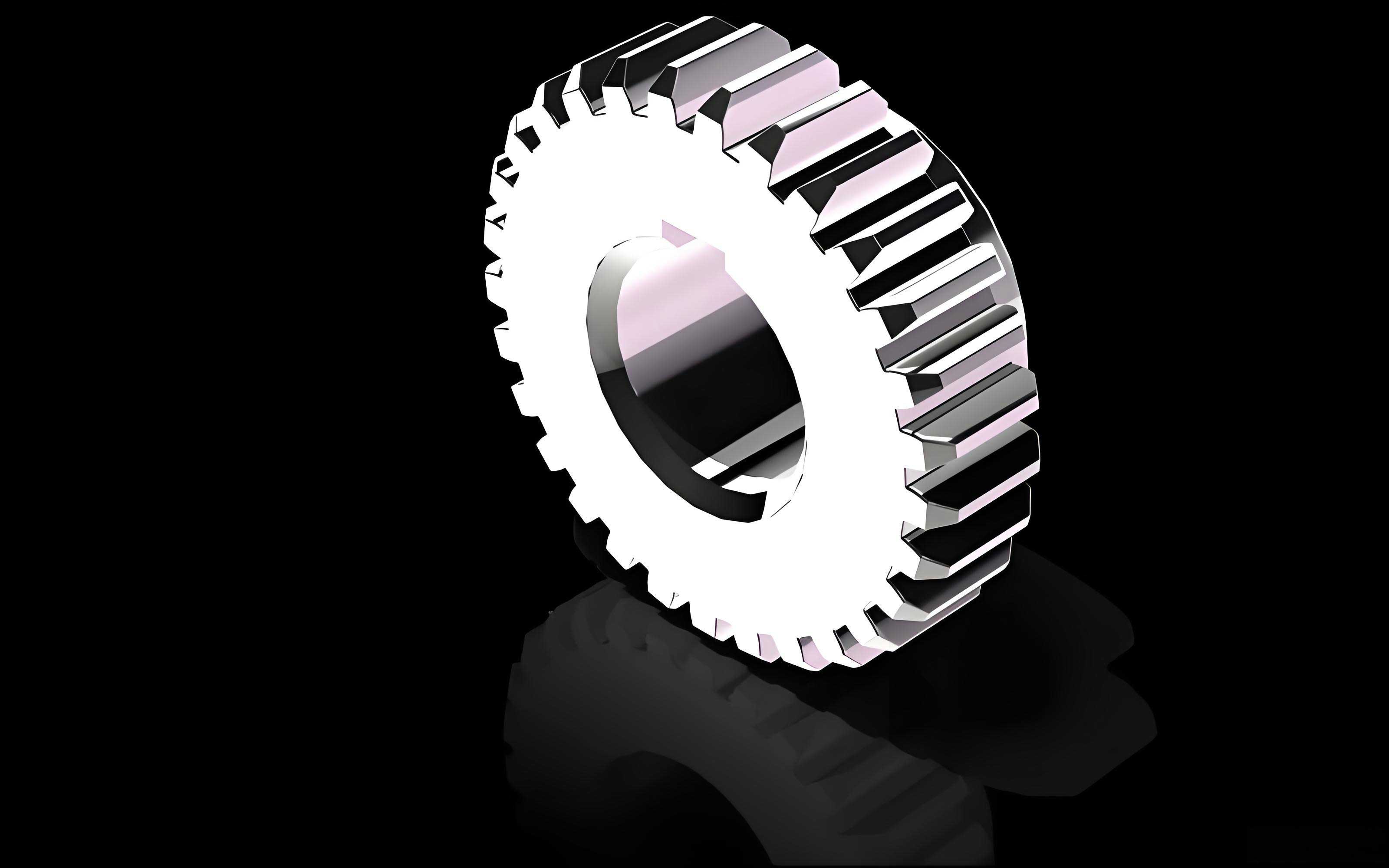
The tooth profile of a spur gear is complex, consisting of multiple segments: the tip arc, the involute profile, the transition curve, and the root arc. Precise modeling of these segments is crucial for accurate stiffness calculation. We adopt an exact formulation for the transition curve, which is the equidistant curve of an extended involute generated by a rack-type cutter with a rounded tip. This contrasts with approximate methods that use circular arcs or simplified lines, often leading to deviations in energy computations. The coordinates for the involute segment are given by:
$$x = r_i \sin \phi, \quad y = r_i \cos \phi$$
where $r_i$ is the radial distance to any point on the involute, and $\phi = \pi / (2N) – (\text{inv} \alpha_i – \text{inv} \alpha_0)$, with $N$ as the number of teeth, $\text{inv} \alpha_i$ the involute function at radius $r_i$, and $\text{inv} \alpha_0$ at the pitch circle. For the transition curve, the parametric equations are:
$$x = r \sin \omega – (a_1 / \sin \gamma + r_\rho) \cos(\gamma – \omega), \quad y = r \cos \omega – (a_1 / \sin \gamma + r_\rho) \sin(\gamma – \omega)$$
where $r$ is the pitch radius, $\omega = (a_1 / \tan \gamma + b_1) / r$, $a_1 = (h_a^* + c^*) m – r_\rho$, $r_\rho = c^* m / (1 – \sin \alpha_0)$, $b_1 = \pi m / 4 + h_a^* m \tan \alpha_0 + r_\rho \cos \alpha_0$, $m$ is the module, $h_a^*$ is the addendum coefficient, $c^*$ is the clearance coefficient, and $\gamma$ ranges from $\alpha_0$ to $\pi/2$. This accurate representation ensures that the geometry of spur gears is captured faithfully, forming the basis for stiffness derivation.
Our improved energy method decomposes the total potential energy stored in a meshing spur gear pair into several components: Hertzian contact energy, bending energy, shear energy, axial compression energy, and fillet foundation energy. Each energy component corresponds to a specific stiffness, and the overall mesh stiffness for a single tooth pair is derived from the sum of these energies. The general expression for the total potential energy $U$ is:
$$U = \frac{F^2}{2k} = U_h + U_{b1} + U_{s1} + U_{a1} + U_{f1} + U_{b2} + U_{s2} + U_{a2} + U_{f2}$$
where $F$ is the meshing force, $k$ is the total mesh stiffness, and subscripts 1 and 2 denote the driving and driven spur gears, respectively. Rearranging, we obtain the mesh stiffness as:
$$k = \frac{1}{\frac{1}{k_h} + \frac{1}{k_{b1}} + \frac{1}{k_{s1}} + \frac{1}{k_{a1}} + \frac{1}{k_{f1}} + \frac{1}{k_{b2}} + \frac{1}{k_{s2}} + \frac{1}{k_{a2}} + \frac{1}{k_{f2}}}$$
For spur gears with a contact ratio between 1 and 2, double-tooth engagement occurs, and the total time-varying mesh stiffness becomes the sum of the stiffnesses of each pair:
$$k_{\text{total}} = \sum_{i=1}^{2} \frac{1}{\frac{1}{k_h} + \frac{1}{k_{b1,i}} + \frac{1}{k_{s1,i}} + \frac{1}{k_{a1,i}} + \frac{1}{k_{f1,i}} + \frac{1}{k_{b2,i}} + \frac{1}{k_{s2,i}} + \frac{1}{k_{a2,i}} + \frac{1}{k_{f2,i}}}$$
The individual stiffness components are calculated as follows. The Hertzian contact stiffness $k_h$ is derived from elastic contact theory:
$$k_h = \frac{\pi E L}{4(1 – \nu^2)}$$
where $E$ is the elastic modulus, $L$ is the face width, and $\nu$ is Poisson’s ratio. The fillet foundation stiffness $k_f$ accounts for the deformation of the gear body near the tooth root, using a corrected formula for annular structures:
$$\frac{1}{k_f} = \frac{\cos^2 \beta}{E L} \left\{ L^* \left( \frac{u_f}{S_f} \right)^2 + M^* \left( \frac{u_f}{S_f} \right) + P^* \left(1 + Q^* \tan^2 \beta \right) \right\}$$
Here, $\beta$ is the angle between the meshing force and the horizontal axis, and $L^*$, $M^*$, $P^*$, $Q^*$, $u_f$, and $S_f$ are geometric parameters defined in the literature. The bending, shear, and axial compression stiffnesses are obtained by integrating energy expressions along the tooth profile. For bending stiffness $k_b$, we have:
$$\frac{1}{k_b} = \int_{\alpha_0}^{\frac{\pi}{2}} \frac{[\cos \beta (y_\beta – y_1) – x_\beta \sin \beta]^2}{E I_{y1}} \frac{dy_1}{d\gamma} d\gamma + \int_{\beta}^{\tau_C} \frac{[\cos \beta (y_\beta – y_2) – x_\beta \sin \beta]^2}{E I_{y2}} \frac{dy_2}{d\tau} d\tau$$
where $x_\beta$ and $y_\beta$ are coordinates of the meshing point, $y_1$ and $y_2$ are horizontal coordinates on the transition curve and involute, respectively, $I_{y1}$ and $I_{y2}$ are area moments of inertia, and $\gamma$ and $\tau$ are angular parameters. Similarly, the shear stiffness $k_s$ and axial compression stiffness $k_a$ are given by:
$$\frac{1}{k_s} = \int_{\alpha_0}^{\frac{\pi}{2}} \frac{1.2 \cos^2 \beta}{G A_{y1}} \frac{dy_1}{d\gamma} d\gamma + \int_{\beta}^{\tau_C} \frac{1.2 \cos^2 \beta}{G A_{y2}} \frac{dy_2}{d\tau} d\tau$$
$$\frac{1}{k_a} = \int_{\alpha_0}^{\frac{\pi}{2}} \frac{\sin^2 \beta}{E A_{y1}} \frac{dy_1}{d\gamma} d\gamma + \int_{\beta}^{\tau_C} \frac{\sin^2 \beta}{E A_{y2}} \frac{dy_2}{d\tau} d\tau$$
with $G = E / [2(1 + \nu)]$ as the shear modulus, and $A_{y1}$ and $A_{y2}$ as cross-sectional areas. The derivatives $dy_1/d\gamma$ and $dy_2/d\tau$ are computed from the profile equations. This formulation explicitly considers the spur gear tooth as a cantilever beam from the root circle, ensuring that the integration limits and geometric parameters align with the actual tooth geometry, regardless of tooth count.
To validate our improved method, we conduct a comprehensive case study comparing it with an existing energy method from the literature and finite element analysis (FEA). We examine four distinct spur gear pairs with varying tooth numbers, while keeping other parameters constant: modulus $m = 3$ mm, pressure angle $\alpha = 20^\circ$, face width $L = 20$ mm, elastic modulus $E = 206$ GPa, Poisson’s ratio $\nu = 0.3$, addendum coefficient $h_a^* = 1$, clearance coefficient $c^* = 0.25$, and inner hole diameter set to 40% of the root circle diameter. The gear pairs are: Case A: both gears with 22 teeth; Case B: both with 42 teeth; Case C: both with 62 teeth; and Case D: one gear with 19 teeth and the other with 48 teeth. These cases cover scenarios where the root circle is inside, coincident with, or outside the base circle, testing the generality of our approach.
For FEA, we construct two-dimensional plane strain models of the spur gears, applying full constraints to the inner hole and simulating meshing by applying forces at various contact points along the tooth profile. The total deformation is extracted to compute mesh stiffness. The results for maximum single-tooth mesh stiffness and average time-varying mesh stiffness are summarized in Table 1, which also includes relative errors compared to the literature method.
| Case (Tooth Numbers) | Calculation Method | Max Single-Tooth Stiffness (MN/m) | Avg Time-Varying Stiffness (MN/m) | Relative Error vs. Literature Method (%) |
|---|---|---|---|---|
| Case A: N1=N2=22 | Literature Method | 267 | 363 | 0 |
| Our Improved Method | 262 | 356 | -1.87 (max), -1.93 (avg) | |
| Finite Element Analysis (FEA) | 249 | 344 | -6.74 (max), -5.23 (avg) | |
| Case B: N1=N2=42 | Literature Method | 272 | 376 | 0 |
| Our Improved Method | 274 | 380 | 0.74 (max), 1.06 (avg) | |
| Finite Element Analysis (FEA) | 260 | 366 | -4.41 (max), -2.66 (avg) | |
| Case C: N1=N2=62 | Literature Method | 271 | 378 | 0 |
| Our Improved Method | 273 | 381 | 0.74 (max), 0.79 (avg) | |
| Finite Element Analysis (FEA) | 260 | 367 | -4.06 (max), -2.91 (avg) | |
| Case D: N1=19, N2=48 | Literature Method | 269 | 366 | 0 |
| Our Improved Method | 265 | 362 | -1.49 (max), -1.09 (avg) | |
| Finite Element Analysis (FEA) | 251 | 350 | -6.69 (max), -4.37 (avg) |
The data shows that our improved method yields results very close to the literature method, with minor deviations due to geometric modeling differences. In Case B, where the tooth count is 42, the root circle and base circle nearly coincide; our method gives slightly higher stiffness because the literature method assumes perfect coincidence, whereas our model accounts for the exact geometry. For spur gears with fewer teeth (Case A), the root circle lies inside the base circle, and our method predicts lower stiffness due to the accurate transition curve, which better captures the tooth flexibility compared to the approximate circular arc used in the literature. In Case C, with more teeth, the root circle is outside the base circle, and our method again shows a small increase, as the literature method treats the transition region as part of the involute, overestimating compliance. Case D, a mixed pair, demonstrates similar trends, with our method providing intermediate values that align well with expectations. The FEA results consistently show lower stiffness, likely due to more comprehensive deformation capture and boundary conditions, but the trends match our method, validating its accuracy.
To further illustrate the behavior of spur gears under our improved method, we analyze the time-varying mesh stiffness curves over a full meshing cycle. These curves exhibit periodic fluctuations corresponding to single and double-tooth engagements. The stiffness is higher during double-tooth contact and drops during single-tooth contact, as expected for spur gears. Our method produces smooth curves that closely approximate those from the literature, while FEA curves show similar shapes but with marginally lower magnitudes, possibly due to discretization and modeling assumptions. The enhanced accuracy stems from our precise treatment of the tooth root and transition curve, which are critical regions for stress and deformation in spur gears.
We also explore the sensitivity of mesh stiffness to key design parameters for spur gears. Table 2 presents computed stiffness values for various moduli and pressure angles, using our improved method on a standard spur gear with 30 teeth and fixed face width. This analysis helps designers understand how changes in parameters affect dynamic performance.
| Modulus m (mm) | Pressure Angle α (degrees) | Max Single-Tooth Stiffness (MN/m) | Avg Time-Varying Stiffness (MN/m) |
|---|---|---|---|
| 2 | 20 | 210 | 290 |
| 3 | 20 | 315 | 435 |
| 4 | 20 | 420 | 580 |
| 3 | 14.5 | 300 | 415 |
| 3 | 25 | 330 | 455 |
As shown, increasing the modulus linearly increases stiffness, since larger teeth have greater cross-sectional areas and moments of inertia. A higher pressure angle also boosts stiffness due to improved load distribution and geometric advantages. These trends highlight the importance of accurate stiffness calculation in optimizing spur gear designs for specific applications, such as high-speed transmissions or heavy machinery.
The improved energy method offers several advantages for spur gear analysis. First, by basing the cantilever beam model on the root circle, it eliminates the need to determine whether the base circle is inside or outside the root circle, a step required in previous methods that can introduce errors for non-standard spur gears. This makes our approach universally applicable to any spur gear, regardless of tooth count. Second, the use of an exact transition curve equation, derived from the manufacturing process, ensures that the tooth geometry is represented realistically, reducing approximations that can affect stiffness predictions. Third, the method maintains computational efficiency compared to FEA, making it suitable for iterative design and dynamic simulations involving spur gears. The stiffness formulas are analytic, allowing for quick evaluations across multiple gear pairs and operating conditions.
In practical applications, the time-varying mesh stiffness calculated by our method can be integrated into dynamic models of spur gear systems to predict vibration responses, noise levels, and fatigue life. For instance, in automotive transmissions, accurate stiffness data helps minimize gear whine and improve durability. Similarly, in industrial machinery, it aids in designing reliable gearboxes that operate under varying loads. The improved accuracy ensures that dynamic analyses are more representative of real-world behavior, leading to better-performing spur gear systems.
Potential limitations of our method include the assumption of perfect tooth profiles and negligible manufacturing errors, which may not hold in all practical spur gears. Additionally, the model assumes linear elasticity and small deformations, which are reasonable for most operating conditions but may need adjustment for highly loaded or damaged gears. Future work could extend the method to include effects such as tooth modifications, cracks, or nonlinear materials, further enhancing its utility for spur gear analysis.
In conclusion, we have developed an improved energy-based method for calculating the time-varying mesh stiffness of spur gears. This method advances previous approaches by modeling the tooth as a cantilever beam from the root circle and incorporating an accurate transition curve, thereby avoiding tooth-number dependencies and reducing geometric errors. Validation through comparisons with existing literature and finite element analysis confirms its effectiveness and accuracy across a range of gear pairs. The method provides a robust theoretical foundation for dynamic analysis of spur gear systems, contributing to improved design, performance prediction, and reliability in various engineering applications. By offering a balance between precision and computational simplicity, it serves as a valuable tool for researchers and engineers working with spur gears.