
In the field of mechanical engineering, the detection of wear in cylindrical gears is crucial for ensuring the reliability and longevity of machinery. Cylindrical gears, particularly spur cylindrical gears, are widely used due to their compact transmission structure and high efficiency. However, wear in these cylindrical gears is a leading cause of mechanical failures, making accurate and timely detection essential. Traditional methods for wear detection in cylindrical gears often suffer from low accuracy, long processing times, and poor effectiveness. To address these issues, we propose a novel detection method based on improved spectral residuals for assessing the meshing wear state of spur cylindrical gears. This method integrates dynamical modeling, image processing, and a streamlined detection workflow to enhance performance.
The importance of cylindrical gears in various industrial applications cannot be overstated. These cylindrical gears are subject to continuous stress and friction during operation, leading to gradual wear that can compromise system integrity. Current approaches, such as coordinate measurement techniques or wavelet-based methods, have limitations in terms of detection accuracy and speed. Our method aims to overcome these drawbacks by leveraging advanced image processing with improved spectral residuals, specifically tailored for cylindrical gears. By focusing on the unique characteristics of cylindrical gears, we can achieve more precise wear state identification.
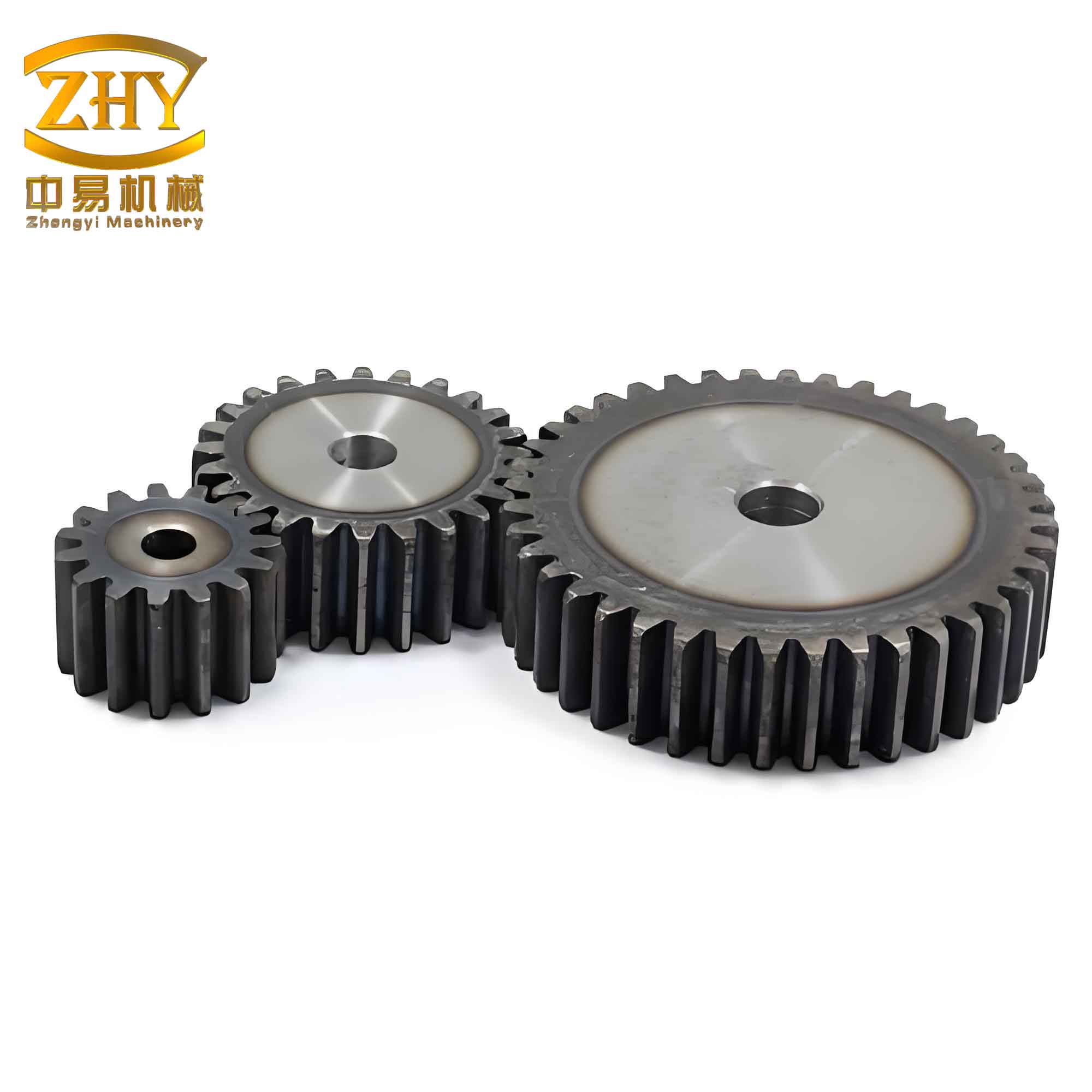
To lay the foundation for wear detection, we first establish a dynamical model for spur cylindrical gears. This model considers the gear system as a spring-rotor dynamical structure, accounting for factors such as friction torque and meshing forces. The dynamics of cylindrical gears are complex due to interactions between multiple teeth and varying operational conditions. By developing a comprehensive model, we can simulate the behavior of cylindrical gears under wear, which informs the subsequent image analysis. The dynamical equations for a pair of cylindrical gears are derived as follows:
Let \( T_p \) and \( T_g \) represent the input and output torque of the cylindrical gears, respectively. The masses of the driving and driven gears are denoted as \( m_p \) and \( m_g \), with moments of inertia \( I_p \) and \( I_g \). The angular displacements are \( \theta_p \) and \( \theta_g \), and the base radii are \( R_p \) and \( R_g \). The rotational speeds are \( n_p \) and \( n_g \). The dynamic transmission error is given by \( e(t) \), accounting for tooth profile deviations in cylindrical gears. The backlash function is \( f(\delta) \), with \( b’ \) as the side clearance. The time-varying meshing stiffness and damping are \( k(t) \) and \( c(t) \). Considering friction effects, the dynamical equations for cylindrical gears are:
$$ I_p \ddot{\theta}_p = T_p – R_p \sum_{i=1}^{n_z} F_i – \sum_{i=1}^{n_z} \Lambda_i \rho_{pi} \mu_i F_i $$
$$ I_g \ddot{\theta}_g = R_g \sum_{i=1}^{n_z} F_i + \sum_{i=1}^{n_z} \Lambda_i \rho_{gi} \mu_i F_i – T_g $$
Here, \( n_z \) is the maximum number of teeth in contact for cylindrical gears, \( \rho_{pi} \) and \( \rho_{gi} \) are the friction arms for the driving and driven gears, \( \mu_i \) is the friction coefficient, and \( \Lambda_i \) is the direction function defined as:
$$ \Lambda_i = \text{sign}(v_1 – v_2) = \begin{cases} 1 & v_1 > v_2 \\ 0 & v_1 = v_2 \\ -1 & v_1 < v_2 \end{cases} $$
where \( v_1 \) and \( v_2 \) are the tangential velocities at the meshing points of the cylindrical gears. The meshing force \( F_i \) for each tooth pair in cylindrical gears is expressed as:
$$ F_i = k_i(t) \cdot f(\delta) + c_i(t) \cdot f(\dot{\delta}) $$
The friction arms for cylindrical gears are derived from geometric relations:
$$ \rho_{pi} = \beta’ \sin \alpha’ – R_{ag} – R_g^2 + R_p \theta_p(t) $$
$$ \rho_{gi} = R_{ag}^2 – R_g^2 – R_p \theta_p(t) $$
where \( \beta’ \) is the center distance, \( \alpha’ \) is the pressure angle, and \( R_{ag} \) is the radius of the addendum circle for the driven gear in cylindrical gears. This dynamical model provides a basis for understanding wear-induced changes in cylindrical gears, which manifest as alterations in meshing forces and vibrations.
To summarize the parameters involved in the dynamical model of cylindrical gears, Table 1 presents key variables and their descriptions.
| Parameter | Description | Unit |
|---|---|---|
| \( T_p, T_g \) | Input and output torque | Nm |
| \( I_p, I_g \) | Moments of inertia | kg·m² |
| \( R_p, R_g \) | Base radii | m |
| \( n_z \) | Maximum teeth in contact | Dimensionless |
| \( \mu_i \) | Friction coefficient | Dimensionless |
| \( k_i(t) \) | Meshing stiffness | N/m |
| \( c_i(t) \) | Damping coefficient | Ns/m |
With the dynamical model established, we proceed to image processing for wear detection in cylindrical gears. The surface wear of cylindrical gears can be captured through imaging techniques, and processing these images is critical for accurate state assessment. Our method employs improved spectral residuals for edge detection in wear images of cylindrical gears. The process involves preprocessing to reduce noise and highlight wear regions, followed by edge detection to identify wear patterns.
Preprocessing begins with converting gear images to grayscale and applying adaptive binarization to separate wear regions from the background in cylindrical gears. This step enhances contrast and facilitates subsequent analysis. For edge detection, we use improved spectral residuals, which involve computing the gradient of the image to locate maximum changes indicative of wear edges in cylindrical gears. The steps are as follows:
- Smoothing: Apply a 2D Gaussian filter to the wear image of cylindrical gears to reduce noise:
$$ G(x, y) = \frac{1}{2\pi \delta^2} \exp\left(-\frac{x^2 + y^2}{2\delta^2}\right) $$
where \( \delta \) controls the smoothing intensity for cylindrical gear images.
- Gradient Computation: Calculate the gradient magnitude \( M(i, j) \) and direction \( \theta(i, j) \) at each pixel \( (i, j) \) using finite differences:
$$ M(i, j) = \sqrt{P_x(i, j)^2 + P_y(i, j)^2} $$
$$ \theta(i, j) = \arctan\left(\frac{P_y(i, j)}{P_x(i, j)}\right) $$
where \( P_x \) and \( P_y \) are the partial derivatives in the x and y directions for images of cylindrical gears.
- Non-Maximum Suppression: Thin the edges by suppressing non-maximum gradient magnitudes in the direction of the gradient for cylindrical gear images:
$$ N(i, j) = \text{NMS}[M(i, j), \xi(i, j)] $$
where NMS denotes the non-maximum suppression operation.
- Edge Detection and Linking: Use dual thresholds \( T_h \) and \( T_l \) (with \( T_l = 0.4T_h \)) to detect and link edges in cylindrical gear wear images. Pixels with gradient magnitude above \( T_h \) are considered strong edges, while those between \( T_h \) and \( T_l \) are weak edges that are linked based on connectivity.
The improved spectral residual method enhances edge detection by focusing on salient features in cylindrical gear images, which correspond to wear areas. This approach is particularly effective for cylindrical gears due to their regular tooth geometry, where wear often appears as deviations from ideal edges.
To illustrate the image processing steps for cylindrical gears, Table 2 outlines the key operations and their purposes.
| Step | Operation | Purpose for Cylindrical Gears |
|---|---|---|
| 1 | Gaussian Smoothing | Reduce noise in wear images of cylindrical gears |
| 2 | Gradient Computation | Detect intensity changes indicative of wear in cylindrical gears |
| 3 | Non-Maximum Suppression | Thin edges to precise wear locations in cylindrical gears |
| 4 | Thresholding and Linking | Segment and connect wear edges in cylindrical gears |
Following image processing, we design a comprehensive detection workflow for cylindrical gear wear state assessment. This workflow integrates the dynamical model and image analysis to predict wear states under various operating conditions. The process involves collecting wear images of cylindrical gears at different time intervals and under different parameters, such as load, speed, and material properties. Feature extraction is performed on these images, including wear depth, surface roughness, and tooth spacing deviations for cylindrical gears.
The extracted features from cylindrical gears are used to train an artificial neural network (ANN) for wear state classification. The ANN learns patterns associated with different wear levels in cylindrical gears, enabling predictive capabilities. The workflow steps are:
- Data Acquisition: Capture images of cylindrical gears before and after operation under controlled conditions.
- Feature Extraction: Compute wear-related features from processed images of cylindrical gears.
- Model Training: Train the ANN using feature vectors from cylindrical gears to recognize wear states.
- State Prediction: Use the trained model to assess wear states in new cylindrical gear images and estimate remaining lifespan.
This workflow is automated to ensure efficient detection for cylindrical gears in industrial settings. By combining dynamical insights with image-based analysis, our method provides a holistic approach to monitoring cylindrical gears.
To validate the proposed method for cylindrical gears, we conducted experiments using spur cylindrical gears with artificial defects such as scratches and pits. The performance was compared against existing methods, including a coordinate measurement technique and a wavelet-based approach. The evaluation metrics included detection accuracy and processing time, with results summarized below.
The detection accuracy was measured over 500 iterations for cylindrical gears. Our method achieved an average accuracy of 91%, significantly higher than the compared methods, which had averages of 71% and 77%. This improvement is attributed to the precise edge detection enabled by improved spectral residuals for cylindrical gears. Additionally, the processing time for our method was lower, with 20 seconds per iteration at 500 iterations, compared to 32 seconds and 42 seconds for the other methods. This demonstrates the efficiency of our approach for cylindrical gears.
Table 3 presents a comparative analysis of the methods for cylindrical gear wear detection.
| Method | Average Accuracy (%) | Processing Time at 500 Iterations (s) | Remarks for Cylindrical Gears |
|---|---|---|---|
| Proposed Method | 91 | 20 | Uses improved spectral residuals for cylindrical gears |
| Coordinate Measurement | 71 | 32 | Based on 3D scanning of cylindrical gears |
| Wavelet-Based Method | 77 | 42 | Employs wavelet thresholding for cylindrical gears |
The experimental results confirm that our method enhances both accuracy and speed for cylindrical gear wear detection. The improved spectral residual technique effectively identifies wear edges in images of cylindrical gears, while the dynamical model provides context for wear progression. This dual approach ensures robust performance across various scenarios involving cylindrical gears.
In conclusion, we have developed a novel method for detecting the meshing wear state of spur cylindrical gears based on improved spectral residuals. By establishing a detailed dynamical model for cylindrical gears, processing wear images with advanced edge detection, and implementing an efficient detection workflow, our method addresses the limitations of existing techniques. The experiments demonstrate high detection accuracy and reduced processing time for cylindrical gears, making it suitable for practical applications. Future work could explore real-time monitoring systems for cylindrical gears and integration with IoT platforms for predictive maintenance. Overall, this contribution advances the field of gear health monitoring, particularly for cylindrical gears, which are fundamental components in machinery.
The methodology presented here underscores the importance of combining theoretical modeling with practical image analysis for cylindrical gears. As industrial demands for reliability grow, such innovative approaches will play a key role in maintaining the performance of cylindrical gears in diverse mechanical systems. We encourage further research to adapt this method to other gear types and operational environments, expanding its utility beyond cylindrical gears.